

Most cleaning businesses lose somewhere around $800–1,200 a month on rework. Not from disasters or total cleaning failures, but from small, repeated mistakes that pile up across teams. A missed baseboard here, streaky mirrors there, forgotten trash bins in bathrooms. Each callback runs you roughly $45–65 once you factor in travel, labor, and the hit to client trust.
The problem usually isn't that cleaners don't care. It's that traditional training dumps everything on them at once, then expects perfect execution weeks later when muscle memory has faded and bad habits have crept in.
Why standard training creates knowledge gaps
Typical cleaning training runs 2–4 hours of initial onboarding, covers 40+ tasks back to back, then sends new hires out with a supervisor for a few shifts. By week three, they're working solo. By week six, quality complaints start rolling in.
This happens because cleaning involves hundreds of small judgment calls that experienced cleaners make automatically. Which direction to wipe glass to avoid streaks? How much product on different surface types? What order prevents cross-contamination between bathroom and kitchen?
Experienced cleaners built those instincts through months of trial and error. New staff are trying to recall everything from a training marathon while also managing time pressure, client preferences, and their own developing routines.
The memory research doesn't help either. People retain around 20% of what they hear, 30% of what they see demonstrated, but closer to 70% of what they immediately practice. Standard training front-loads information with barely enough practice time, and the knowledge just decays.
Building a library of micro-modules that target specific failures
Instead of long training sessions, break things into 5–10 minute modules that each target one specific skill or failure point. The format stays simple: quick concept explanation, demonstration or checklist, practice opportunity, supervisor verification.
Stop losing bookings in operational chaos.
Wipyly helps you manage, confirm, and optimize every cleaning appointment efficiently.
- Centralized booking management
- Automated client notifications
- Staff scheduling & route optimization
No credit card required
A module on streak-free mirror cleaning takes seven minutes. Two minutes on why circular motions create streaks. One minute demonstrating proper S-pattern technique. Three minutes of supervised practice on actual mirrors. One minute for sign-off.
Your module library grows from real quality issues you encounter. Client complains about dusty ceiling fans? Build a five-minute module on proper fan blade cleaning sequence. Soap scum getting repeatedly missed in shower corners? Create a module specifically on bathroom corner inspection.
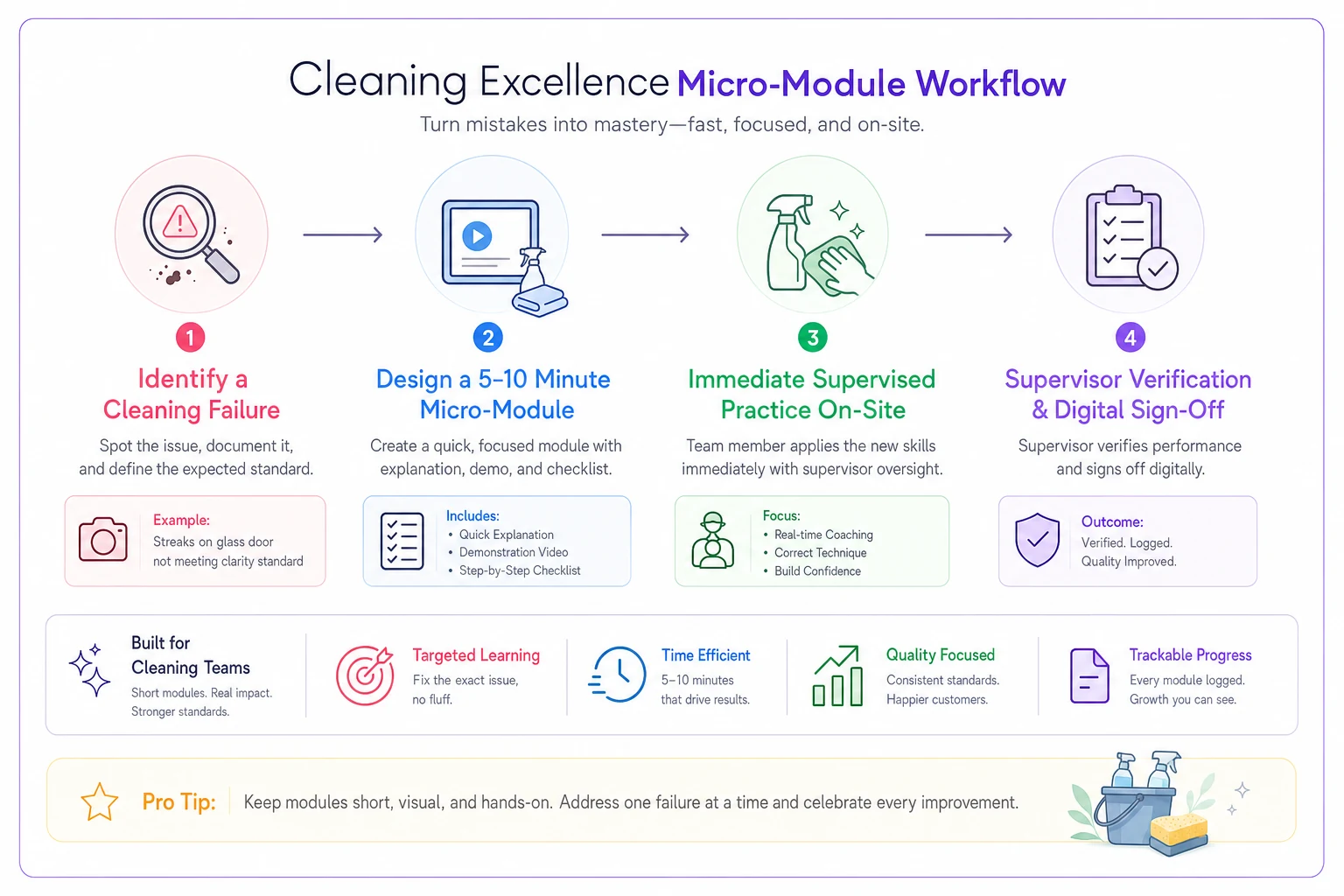
This shows the micro-module cycle from identification to verification.
This works because it creates immediate relevance. When a cleaner makes a mistake, you assign the specific module that addresses it, complete it on-site, then verify improvement at the next cleaning.
Module structure that ensures retention
Each micro-module needs five components to actually change behavior:
The Why Behind the What: Start with why the technique matters. Not "this is how we clean mirrors" but "streaky mirrors are the number one visual cue clients use to judge overall cleaning quality, and bad technique wastes 3–4 minutes of recleaning per bathroom."
The Specific Technique: Break down the exact physical movements, product amounts, and sequence. For mirror cleaning: spray from 8 inches away, start from top left corner, maintain consistent S-pattern overlap, finish with vertical edge passes.
The Common Mistakes: Show what typically goes wrong. Spraying too close creates drips. Starting from the middle leaves edge streaks. Paper towels instead of microfiber leave lint.
The Quick Practice: Immediate hands-on application with supervisor observation. The trainee performs the technique while explaining their actions out loud—not passive watching.
The Verification Checkpoint: A simple pass/fail the supervisor completes in under 30 seconds. Can the cleaner identify and correct three deliberately created mirror streaks? Yes, module done. No, quick re-demonstration and retry.
Common failure points worth targeting first
Certain issues show up repeatedly across cleaning services. These become your first modules:
Bathroom deep corners (8 minutes): The space where tub meets wall, behind toilets, and shower door tracks get missed because they require specific body positioning and tools.
Kitchen appliance surfaces (6 minutes): Stainless steel streaking, microwave interior splatters, and refrigerator seal cleaning require different products and techniques than general surface work.
Entryway detail work (7 minutes): Light switches, door frames, and baseboards near entries show dirt immediately but often get skipped in the main cleaning flow.
High-dust zones (10 minutes): Ceiling fans, tops of refrigerators, upper cabinet edges—these need specific safety protocols and extension tools that general training tends to gloss over.
Product dilution ratios (5 minutes): Over-concentrated products leave residue and waste money. Under-concentrated ones require multiple passes. A simple module on reading dilution charts and using portion control caps solves this fast.
Each of these targets mistakes that typically trigger callbacks or negative reviews. Focusing on specific failure points beats general cleaning philosophy every time.
Implementing supervisor sign-offs without creating bottlenecks
The sign-off process determines whether modules actually improve quality or just become checkbox exercises. Simple digital tracking beats complex systems.
Supervisors need a basic checklist they can complete from their phone in under a minute. Module name, date, cleaner name, pass/fail, one note field for specific feedback. That's it. No lengthy evaluations, no multiple scoring criteria.
Schedule module completions during natural workflow gaps—driving between locations, during supply pickup, or in the last 10 minutes of a shift. Not during actual cleaning time.
For remote teams, video verification works well. Cleaners record themselves demonstrating the technique while explaining their process. Supervisors review the 2–3 minute clips during administrative time and send back feedback through voice notes.
Keep sign-offs binary and specific. Either the cleaner can identify and fix three types of mirror streaks, or they can't. Either they demonstrate proper dilution ratio calculation, or they need more practice. Subjective scoring creates confusion and inconsistent standards.
Tracking improvement through rework metrics
Module effectiveness shows up in your rework data within a few weeks. Track three things:
Callback rate by issue type: If mirror complaints dropped significantly after implementing the mirror module, it's working. If bathroom corner issues persist, the module needs adjustment.
Time to competency: New hires who complete micro-modules typically reach acceptable quality standards in 3–4 weeks versus 6–8 weeks with traditional training.
Rework cost per cleaner: Calculate monthly callbacks multiplied by average resolution time. Cleaners who complete targeted modules based on their specific weak points tend to show a 40–60% reduction in personal rework costs.
A cleaning service with around 12 employees can realistically see monthly rework costs drop from $1,100–1,400 down to $400–600 after implementing targeted micro-training. That improvement comes from addressing specific, repeated failures—not hoping general training covered everything.
Creating modules from real cleaning situations
Your best modules come directly from actual problems your teams run into. When a cleaner struggles with something or a client complains about a specific issue, that's module material.
Document the problem with photos or video. Figure out why it happened—lack of knowledge, wrong technique, or skipped steps. Design a 5–10 minute intervention for that specific gap.
A client once complained about sticky residue on granite countertops. Turned out the cleaner was using all-purpose cleaner at full strength instead of granite-specific product at proper dilution. That became a 6-minute module: granite care chemistry (2 minutes), product selection (1 minute), dilution and application demonstration (2 minutes), practice and sign-off (1 minute).
The library grows organically from real issues, so every piece of training stays directly relevant to actual work.
Quick wins from the first five modules
You don't need a complete library to start. Five targeted modules can reduce rework meaningfully:
-
1. Mirror and glass perfection (7 minutes)
Covers product amount, wipe patterns, and edge finishing
-
2. Bathroom corner mastery (8 minutes)
Addresses tub-wall joints, behind toilet, and door tracks
-
3. Kitchen sink deep clean (6 minutes)
Includes faucet detail, disposal freshening, and under-edge cleaning
-
4. Vacuum pattern efficiency (5 minutes)
Shows overlap requirements and furniture moving sequence
-
5. Client note interpretation (5 minutes)
Teaches how to read and prioritize special requests
These five modules cover roughly 65% of typical cleaning callbacks. Each can be put together in an afternoon using your current supplies and a smartphone camera.
Module scheduling that doesn't disrupt operations
How you integrate modules into daily operations determines whether micro-training actually sticks.
Assign modules based on actual performance gaps, not arbitrary schedules. When a cleaner gets a quality complaint, they complete the relevant module before their next shift at that client's location.
New hires do 2–3 modules daily during their first week, focused on the most common failure points. Experienced staff might do one module monthly as a refresher or when new techniques come up.
Build module time into your labor calculations. Five minutes of targeted training that prevents a 45-minute callback pays for itself immediately. Factor that into pricing and scheduling so supervisors actually have time for proper sign-offs.
Some teams run "Module Mondays" where the first 10 minutes of the week cover one technique together. Others prefer individual assignment based on quality scores. Both work when consistently executed.
Technology and tools for module delivery
Paper checklists work, but simple digital tools make this significantly more effective. A basic system needs three things: module library access, completion tracking, and performance correlation.
Your module library can live in a shared Google Drive with videos and checklists accessible from any phone. Cleaners watch the demonstration video, complete the checklist, submit a photo of their work.
Tracking happens through any simple form tool—Google Forms, Microsoft Forms, or even a WhatsApp business account where cleaners send completion confirmations. Submission should take under 30 seconds.
Performance correlation means connecting module completions to quality scores. A basic spreadsheet tracking which cleaners completed which modules and their subsequent callback rates is enough to see what's working.
For growing operations, purpose-built software can centralize module delivery, track completions automatically, and flag which cleaners need which modules based on their quality patterns. That kind of automation starts paying off once you're managing 15–20 cleaners and manual tracking gets messy.
ROI calculation for micro-training investment
The financials are pretty straightforward. Calculate your current monthly rework cost: callbacks × average resolution time × hourly rate. For most services that lands somewhere between $800–1,500 monthly.
| Cost Factor | Estimate |
|---|---|
| Module creation (per module) | $50–75 |
| 10-module library total | $600–750 |
| Total deployment time (team) | 8–10 hours |
| Payback period | 4–6 weeks |
| Monthly rework reduction | 50–70% |
A 10-module library costs somewhere around $600–750 to create and 8–10 hours of total training time to deploy across a team. That one-time investment typically reduces monthly rework by 50–70%, paying for itself within a month or two.
The less obvious ROI is client retention. Customers who never experience quality issues don't start shopping around. Cutting callbacks in half can improve retention by 15–20%, which is worth a lot more than the training costs when you're talking about preserved monthly recurring revenue.
Beyond basic cleaning: specialized module opportunities
Once basic quality modules are working, specialized training opens new service opportunities. Modules on post-construction cleaning, move-out deep cleans, or eco-friendly techniques let you expand offerings without starting from scratch.
Each specialized service becomes a set of specific modules. Post-construction cleaning might cover: paint overspray removal (8 minutes), construction dust protocols (7 minutes), adhesive residue techniques (6 minutes), new fixture protection (5 minutes).
Cleaners qualify for specialized work by completing the relevant module sets. This creates clear advancement paths and lets you charge premium rates for certified specialists.
Medical facility cleaning, short-term rental turnovers, and commercial sanitization all become accessible through targeted modules that build on existing skills.
Making micro-training stick long-term
The difference between a successful micro-training program and another forgotten initiative is consistent execution and visible results. When callbacks drop significantly, make sure everyone knows which modules drove that improvement. People stay engaged when they can see it actually working.
Build refresher requirements around time elapsed, not just performance problems. Even strong cleaners benefit from quarterly technique refreshers. It prevents skill decay and keeps standards from slowly drifting.
Keep modules updated when products and techniques change. The mirror-cleaning module might need adjusting when you switch microfiber types or move to eco-friendly glass cleaners. Regular reviews keep training relevant.
Involve your cleaners in module creation when you can. When someone identifies a better technique or spots a recurring problem, let them help design the solution. Ownership drives adoption better than top-down mandates every time.
The cleaning services that consistently maintain high quality scores aren't just hiring naturally talented people or accepting high turnover as part of the business. They build systematic training that targets specific failure points, verifies skill acquisition, and improves continuously based on real operational data.
Your next callback is a chance to build a module that prevents that exact issue from happening again. Start there, build gradually, and the rework costs will come down.
Ready to simplify your cleaning operations?
Join 1,000+ cleaning businesses using Wipyly to save time, reduce scheduling conflicts, and enhance client satisfaction.