

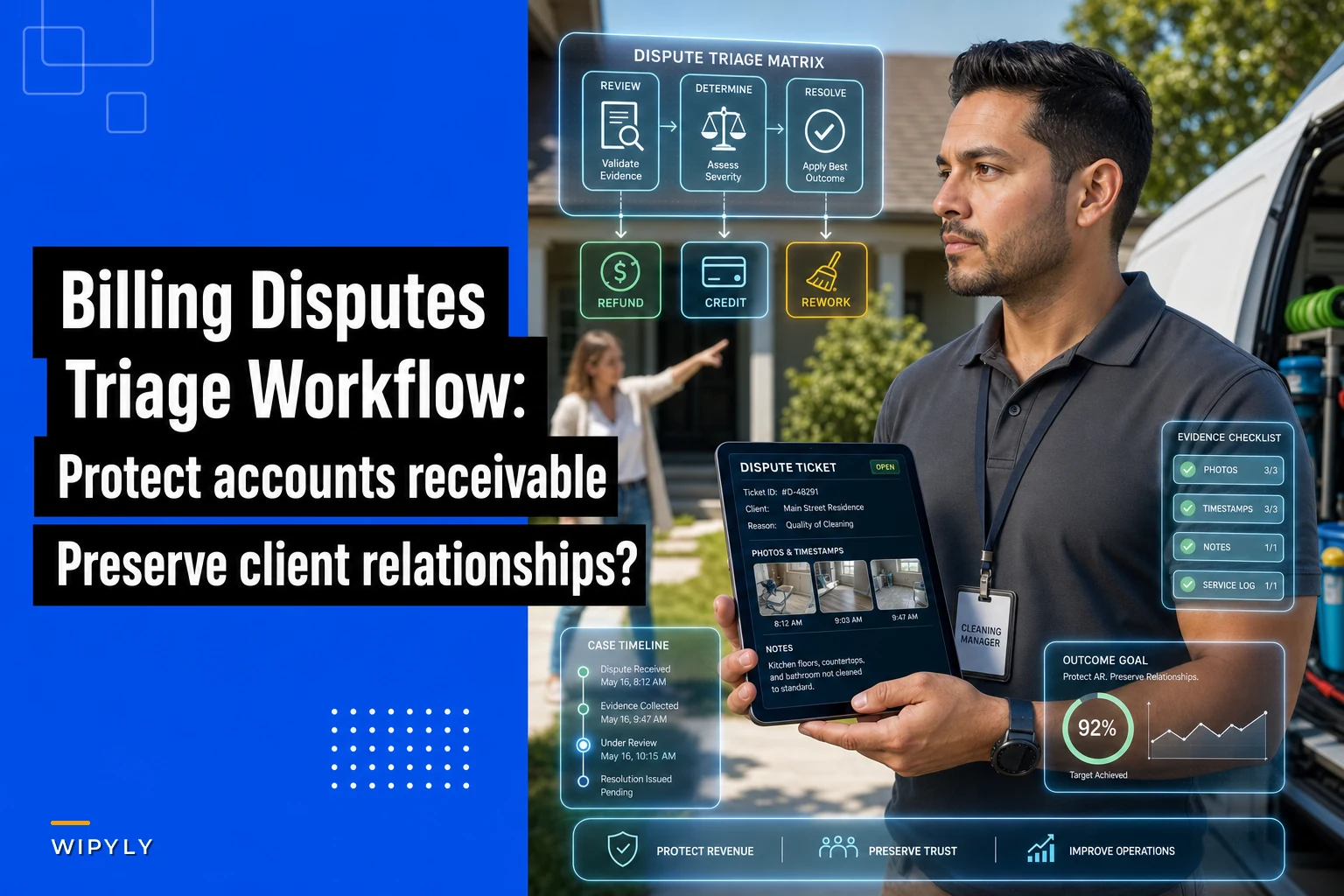

Billing disputes in cleaning services aren't just awkward conversations anymore. They're operational bleeding points that compound fast—each unresolved dispute adds another $400–600 in uncollected revenue while pushing clients toward negative reviews at the same time. The challenge isn't handling individual complaints. It's building a systematic approach that protects both cashflow and client relationships when disputes inevitably show up.
The compound damage of poor dispute handling
Most cleaning companies handle billing disputes reactively, and that creates cascading problems. A client questions a charge for a deep clean they say wasn't done properly. Without clear documentation or any real process, the dispute drags for days while the invoice ages. The client gets frustrated with slow responses, payment gets delayed another 30 days, and cash gets squeezed.
What makes this particularly damaging for cleaning businesses is the trust erosion that happens during poorly managed disputes. Clients already feel vulnerable letting cleaners into their homes. When billing confusion layers on top of that, they don't just withhold payment—they cancel entirely. A $180 disputed invoice can easily lead to losing $2,000+ in annual recurring revenue from that one client.
The real operational killer? Disputes tend to spike during your busiest periods. Holiday season brings more deep cleans, more temporary staff, more service variations—and proportionally more billing questions. Right when cashflow needs to be strongest, your dispute resolution capacity is usually weakest.
Building your triage matrix for dispute classification
The core of effective dispute management is immediate classification. Not every dispute deserves the same response intensity or resolution path.
Stop losing bookings in operational chaos.
Wipyly helps you manage, confirm, and optimize every cleaning appointment efficiently.
- Centralized booking management
- Automated client notifications
- Staff scheduling & route optimization
No credit card required
Here's the framework that consistently works:
Category A disputes (Immediate full resolution):
-
Claims of damage to property
-
Missing items accusations
-
Safety concerns raised
-
Disputes over $300
These require same-day response, direct owner involvement, and a full documentation review. Resolution typically means a full refund, immediate re-service, or initiating an insurance claim.
Category B disputes (Partial resolution path):
-
Quality complaints without damage
-
Billing confusion on standard services
-
Disputes between $100–300
-
Communication breakdown issues
These get 24-hour response windows, team lead involvement, and standardized resolution options like partial credits or complimentary add-on services.
Category C disputes (Clarification only):
-
Questions about charges under $100
-
Confusion about service scope
-
Scheduling misunderstandings
-
First-time client concerns
These need 48-hour response times, standard templated explanations, and minimal financial concessions.
| Category | Triggers | Response/Action |
|---|---|---|
| Category A | Claims of damage to property; Missing items accusations; Safety concerns raised; Disputes over $300 | Same-day response; Owner involvement; Full documentation review; Refund, re-service, or insurance |
| Category B | Quality complaints without damage; Billing confusion on standard services; Disputes between $100–300; Communication breakdown issues | 24-hour response; Team lead involvement; Partial credits or complimentary add-ons |
| Category C | Questions about charges under $100; Confusion about service scope; Scheduling misunderstandings; First-time client concerns | 48-hour response; Templated explanations; Minimal concessions |
Quick visual of the triage workflow.
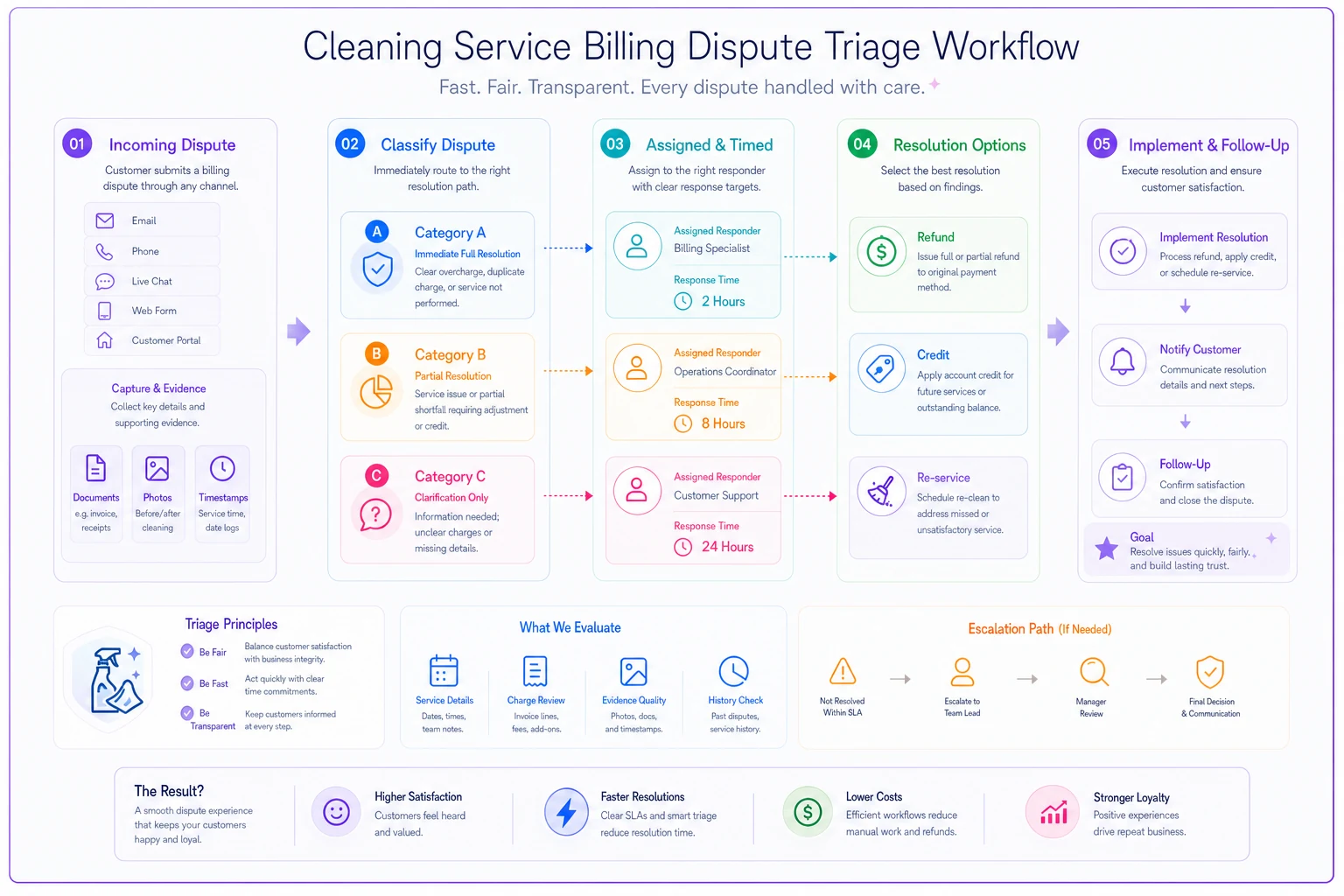
The classification happens immediately when a dispute comes in. It determines not just how fast you respond, but who handles it, what authority they have, and which resolution options are on the table.
Evidence collection that actually protects you
Documentation feels like overhead until you actually need it. Then suddenly those before-and-after photos are the difference between eating a $450 refund or holding your position.
Pre-service documentation:
-
Timestamped arrival photos showing property condition
-
Client-signed or digitally confirmed service agreement
-
Special instructions acknowledgment
-
Access method confirmation
During service tracking:
-
Photo documentation of problem areas discovered
-
Time logs showing actual service duration
-
Supply usage records for deep cleans
-
Team member assignments and rotations
Post-service confirmation:
-
Completion photos of key areas
-
Quality checklist sign-offs
-
Client walk-through notes (when applicable)
-
Departure timestamp verification
The goal isn't to document everything—that's not realistic operationally. It's to document the high-risk points where disputes typically emerge: problem areas discovered during service, special requests that deviate from standard scope, and any job where the client isn't present at completion.
Timeline management to prevent escalation
Dispute resolution runs on client time, not business time. Something that feels minor to you feels urgent to a client who thinks they've been charged incorrectly. The timeline breakdown that prevents escalation:
Hour 0–4: Acknowledgment
A simple confirmation that you've received their concern and are reviewing it. This alone prevents a large portion of disputes from escalating to negative reviews. The acknowledgment doesn't promise anything—just attention.
Pro-tip: send an acknowledgment within the first hour to defuse most disputes.
Hour 4–24: Initial assessment
Review the evidence, classify the dispute category, and determine preliminary resolution options. This is where your documentation either saves or sinks you.
Hour 24–48: Resolution offer
Present your resolution based on the triage category. Be specific about what you're offering and why. Vague promises of "making it right" just extend the dispute.
Hour 48–72: Implementation
Execute whatever resolution was agreed upon. If it's a credit, apply it immediately. If it's a re-clean, schedule it within the week. Speed of implementation often matters more than the size of the concession.
Missing these windows doesn't just frustrate clients—it shifts how they perceive the situation from "a mistake that happens" to "a company that doesn't care."
Templated responses that feel personal
Templates save operational time but can destroy relationships if they feel generic. The key is building them to provide structure while leaving room for personalization.
For quality disputes:
"Hi [Name], I understand you're concerned about the service quality from [date]. That's definitely not the standard we aim for. I've pulled up your service records and photos from that visit. [Insert specific observation about their concern] Based on what you've described, here's what I can offer: [specific resolution]. Would this work for you, or would you prefer [alternative option]? Let me know by [specific time] so I can get this handled immediately."
For billing confusion:
"Hi [Name], I see where the confusion happened with your invoice. Looking at your service from [date], here's the breakdown: [Specific line items with explanations] The additional charge you're seeing is for [specific reason with context]. This should have been communicated more clearly upfront. To resolve this, I can either [option A] or [option B]. What would you prefer?"
For damage claims:
"Hi [Name], I take any damage concern seriously. I need to review this thoroughly with my team and insurance before saying anything definitive. Can you send photos of [specific damage] and let me know when you first noticed it? I've already pulled our service documentation from [date] to start the review. I'll have a complete response with resolution options by [specific time tomorrow]. If this is urgent beyond that timeline, please call me directly at [number]."
The templates provide consistency. The bracketed sections make sure each response actually addresses the specific concern. That balance keeps things efficient without making clients feel like ticket numbers.
Protecting cashflow while preserving relationships
The tension between protecting revenue and maintaining client relationships is where most dispute resolution falls apart. Companies either give away too much trying to save relationships or hold too firm and lose clients entirely.
Set clear refund thresholds based on client lifetime value. A client who's been with you for two years and generates $3,600 annually deserves more flexibility than a one-time deep clean. Build this into your triage matrix—not favoritism, just operational reality.
Offer credits before refunds whenever you can. A $200 credit costs less operationally than a $200 refund because it keeps future service revenue intact. Clients often prefer credits too, since it signals commitment rather than just cutting a check to end the conversation.
Track dispute patterns across the business. If three clients dispute the same charge type in a single month, that's not a client problem—it's a communication or delivery problem that needs to get fixed operationally.
Never argue fault when safety or property damage is involved. Even if you're confident your team didn't cause the issue, the reputational risk of fighting these disputes publicly outweighs any individual invoice. Handle through insurance or full refund, then close the operational gap that allowed the situation to happen in the first place.
The technology layer that scales dispute management
Manual dispute tracking starts breaking down around 25–30 active clients. Beyond that, you're juggling too many conversations, timelines, and resolution paths to stay consistent.
This is where AI-powered operational software becomes useful—not to replace human judgment, but to make sure nothing falls through the cracks. The right platform can monitor incoming disputes, flag them according to your triage categories, trigger appropriate response timelines, and track resolution progress without you having to manage it manually. Evidence gathering from service records, templated response suggestions based on dispute type, and cashflow impact tracking across all active disputes can all run in the background while your team focuses on actual resolution.
The key isn't full automation. Clients can tell when they're talking to a bot about a billing concern. It's using AI-assisted tools to handle the administrative load while keeping human judgment on the actual resolution decisions. The software tracks and reminds. People still resolve.
Realistic implementation in your operation
Building this workflow doesn't happen in a week, and trying to implement everything at once usually means implementing nothing effectively.
Start with the triage matrix. Spend a couple weeks classifying every dispute that comes in, even if you're still handling them the old way. This gives you baseline data on dispute patterns and helps you refine categories for your specific operation.
Next, implement the evidence checklist for high-risk services only. Deep cleans, move-out cleans, and first-time clients get full documentation. Regular maintenance cleans for established clients can wait. Build the habit before expanding scope.
Add templated responses once you actually understand your common dispute patterns. Don't try to template everything—just the disputes that come up weekly. Quality concerns, billing questions, and scheduling issues probably cover the majority of your volume.
Finally, layer in technology once your manual process is solid. Software can't fix a broken process; it only scales what you've already built. Whether you use a specialized dispute management tool or a broader operational platform with dispute tracking built in, make sure it fits your established workflow rather than forcing you to adapt around its structure.
The compound benefits of systematic dispute resolution
Strong dispute management creates positive cycles beyond just protecting revenue. Clients who see disputes resolved quickly tend to become more forgiving of minor issues down the road. They're also more likely to refer others, because they've seen firsthand how problems get handled.
Your team benefits too. Clear protocols remove the anxiety of dealing with an angry client. Team members know how to escalate, what they can offer, and when to pull in management. That alone reduces turnover in customer-facing roles and generally improves service quality.
And honestly, systematic dispute resolution reveals operational weaknesses before they compound. Patterns in disputes highlight training gaps, communication failures, and service inconsistencies that would otherwise stay hidden until a major client walks.
The cleaning companies that last aren't the ones that never have disputes—that's impossible in any service business. They're the ones that handle disputes well enough that clients trust them more afterward. Building that capability takes systematic processes, solid documentation, and the discipline to follow through even when things get busy. In an industry where margins are thin and trust is everything, that's a real competitive advantage.
Ready to simplify your cleaning operations?
Join 1,000+ cleaning businesses using Wipyly to save time, reduce scheduling conflicts, and enhance client satisfaction.