


The Fed's split decision yesterday caught a lot of people off guard. Nine committee members voted to hold rates at 3.50%-3.75%, but three regional Fed officials pushed for a quarter-point hike. That visible dissent matters more than the hold itself — according to CNBC's coverage, markets now expect rates to stay elevated through at least Q1 2027.
For cleaning businesses, this hits directly on equipment financing costs. That $42,000 cargo van you were planning to finance? Monthly payment goes from around $780 to $825 at current commercial lending rates. Multiply that across three vans and you're looking at an extra $1,620 per month — roughly $19,440 annually that has to come from somewhere.
What most cleaning operators miss is that the financing squeeze just exposes a deeper problem. Your pricing model was probably built when rates were lower, equipment was cheaper, and commercial clients weren't scrutinizing every line item. Now you're stuck between rising capital costs and contracts that locked in yesterday's margins.
The hidden math behind cleaning business pricing interest rates
Equipment financing drives more of your cost structure than most owners realize. Take a typical mid-size commercial cleaning operation — eight employees, four vehicles. Financing costs might look something like this:
-
Vehicle loans or leases (4 vans at roughly $800/month each)
-
Floor equipment financing ($1,200/month for scrubbers and buffers)
-
Pressure washer and specialty equipment ($400/month)
-
Supply financing through vendor credit lines (another $600/month in carrying costs)
That's $5,200 monthly in financing-related costs alone. When rates jump half a percent, you're absorbing an extra $260-$320 per month. Sounds manageable until you factor in that most cleaning contract margins sit somewhere between 18-22%.
The real problem is how these costs cascade. Higher financing costs push you to delay equipment replacement. Older equipment breaks more often. More breakdowns mean overtime labor and missed appointments. Missed appointments trigger contract penalties. It compounds fast.
Why traditional pricing adjustments won't save you
Most cleaning businesses respond to rate pressure the wrong way. Either they panic and raise prices across the board, losing competitive bids, or they absorb the costs quietly and watch margins erode. Both approaches fail because they ignore how cleaning contracts actually work.
Stop losing bookings in operational chaos.
Wipyly helps you manage, confirm, and optimize every cleaning appointment efficiently.
- Centralized booking management
- Automated client notifications
- Staff scheduling & route optimization
No credit card required
Commercial contracts typically lock in pricing for 12-24 months. Your medical office client signed in January when rates were lower. The corporate campus runs through December. You can't send a rate increase letter and expect goodwill — and even if you tried, competitors are already circling with "introductory" pricing to match your current rates.
The smarter move is recognizing this is a cashflow timing problem, not just a pricing levels problem. When you finance a new van today but can't touch contract pricing for six months, you're carrying that gap on your own. That gap compounds across every piece of financed equipment in the fleet.
What actually works is restructuring how equipment costs fit into your pricing model. Instead of treating equipment as a fixed monthly line item, operators who are managing this well build dynamic equipment cost factors into their modular pricing engines. That way new contract pricing adjusts monthly while existing contracts stay protected through operational efficiency gains.
Building a rate-resistant financing strategy
The cleaning companies holding up in this environment share three things: they finance strategically, they negotiate before signing anything, and they actually track equipment ROI.
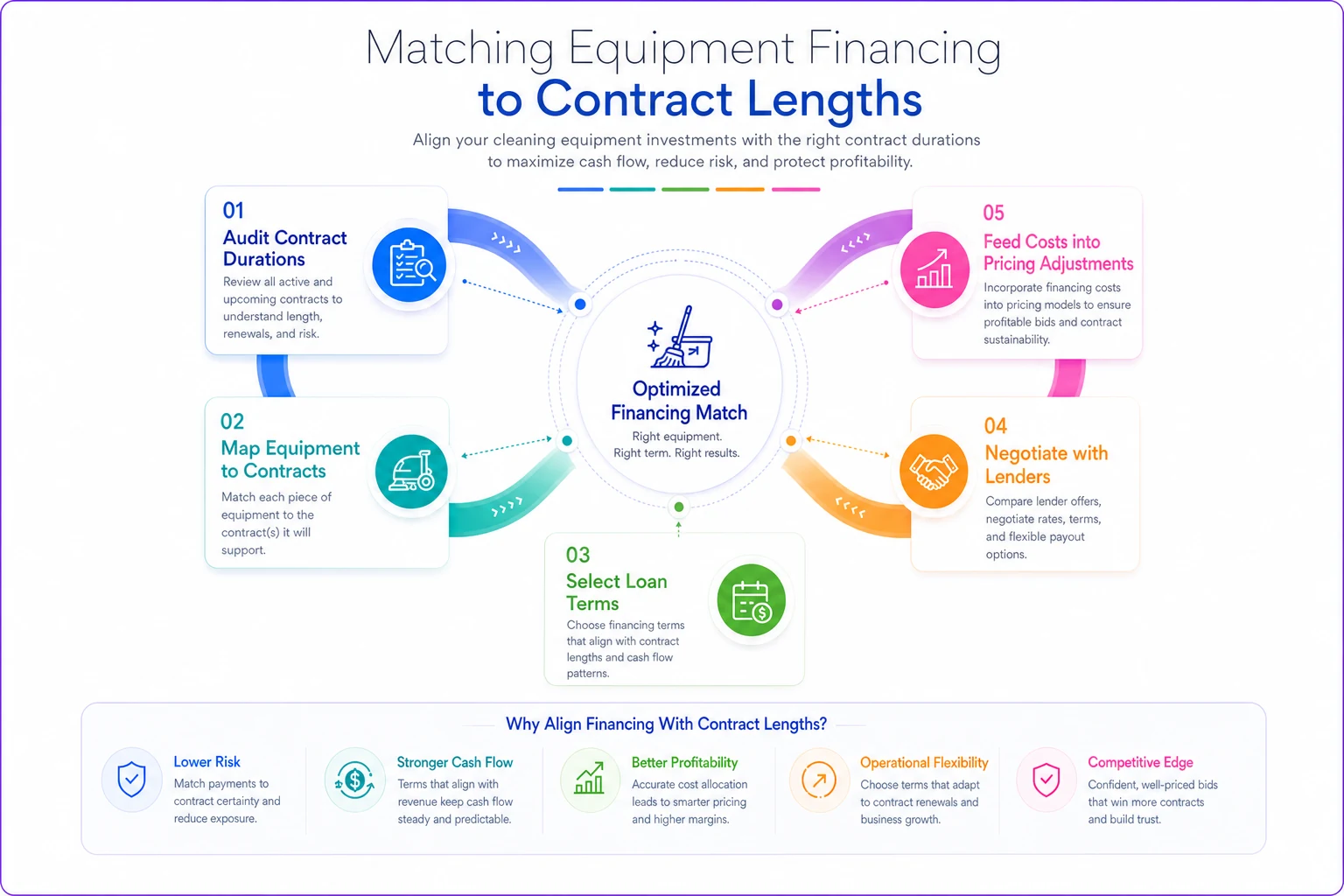
Strategic financing means matching loan terms to contract lengths. If most of your contracts run 18 months, financing equipment over 60 months is just unnecessary interest expense. One operator switched from five-year to three-year terms on van leases — monthly payment jumped from $750 to $1,050, but total interest savings came out to $8,400. More importantly, they can now adjust pricing at contract renewals before the financing burden becomes a problem.
On negotiation — regional banks want commercial lending relationships right now. They'll beat manufacturer financing rates by 0.75-1.25% if you bring them your operating accounts. Credit unions often do better. One cleaning business owner recently saved $14,000 over three years just by moving van financing from the dealer to a local credit union. The dealer never mentioned that was an option.
Tracking actual equipment ROI by contract type is where most operators have a real blind spot. Here's a framework that works:
| Equipment Type | Monthly Finance Cost | Revenue Generated | Contracts Served | ROI Multiple |
|---|---|---|---|---|
| Ride-on scrubber | $420 | $3,800 | 4 large commercial | 9.0x |
| Backpack vacuums (set of 6) | $85 | $1,900 | 12 office buildings | 22.4x |
| Pressure washer system | $280 | $750 | 2 monthly exterior | 2.7x |
| Carpet extractor | $140 | $380 | 3 quarterly deep cleans | 2.7x |
That pressure washer barely pays for itself. The backpack vacuums are generating massive returns by comparison. Yet most operators finance everything equally and treat it all as necessary overhead. That's the kind of thinking that quietly kills margins.
Prioritize shorter financing terms for assets tied to short contracts to avoid unnecessary interest drag.
The workflow below shows the practical steps to match financing to contract exposures.
That's the kind of thinking that quietly kills margins.
Rethinking contract structure when money costs more
Higher interest rates change which contracts actually make sense to take. That $4,000 monthly office cleaning contract looks fine on paper until you trace the true cost of capital required to service it. Equipment, vehicle time, working capital — you might net $400 after financing costs. That's a 10% return when your money costs 8%. Not exactly compelling.
Smart operators are restructuring around capital efficiency. Instead of five-day-per-week service at a lower rate, push clients toward three-day service at a higher per-visit price. Less equipment wear, lower financing needs, better margin per dollar deployed.
Contract length matters more than it used to. Annual contracts with quarterly billing used to be the standard. Six-month contracts with monthly payments make more sense now — you can adjust pricing faster, reduce accounts receivable financing costs, and stay flexible as rates shift. Yes, clients prefer longer terms. But many will accept shorter contracts for a small discount on autopay or ACH versus check.
Payment terms directly affect how much you need to borrow. Net 30 means you're lending money to clients at 0% while borrowing at 8-9% to cover operations. Moving to Net 15 or collecting deposits can cut working capital needs by thousands per month. It's one of the fastest levers you have.
Build equipment costs into contract pricing explicitly, as a visible line item rather than buried in your margin. This makes financing cost adjustments at renewal a natural conversation instead of a renegotiation battle.
Operational adjustments that actually offset rate pressure
You can't control Fed policy, but you can control how efficiently capital moves through your operation. The businesses holding margins right now have made specific changes that directly offset financing pressure.
Equipment idle time is a real cost most people ignore. That floor scrubber sitting in the warehouse three days a week is costing $14 per idle day in financing alone. Successful operators schedule specialty equipment like a shared resource — not assigned to specific teams, but deployed based on where it generates the most revenue that week.
Route density becomes critical when capital costs more. Every mile driven between jobs is financed fuel, financed vehicle depreciation, and financed labor. Clustering contracts geographically can reduce equipment needs by 20-30%, which isn't nothing when you're paying 8-9% to borrow.
Labor efficiency improvements deliver the fastest ROI in a high-rate environment. One cleaning business implemented photo-based quality checks and cut rework by roughly 40% — about four fewer overtime hours per week, or somewhere around $6,800 annually in labor savings. They also didn't need to finance a backup crew van, which matters more than most people would expect.
Equipment standardization is underrated too. Instead of financing three different scrubber models, buying six units of the same model improves loan terms, reduces parts inventory, and simplifies crew training. One company saved $180 per month just in financing costs by consolidating to a single vacuum model. Small, but permanent.
When to delay, accelerate, or abandon equipment purchases
Not all equipment purchases are affected equally by higher rates. Knowing which to time differently can save real money.
Delay purchases for equipment that's working but aging. A four-year-old van with 80,000 miles might cost $2,000 in repairs this year — but that's still cheaper than $9,900 in annual financing on a replacement. Run the actual numbers. Maintenance cost plus downtime cost versus financing cost plus opportunity cost. The answer isn't always obvious.
Accelerate purchases when equipment directly unlocks new revenue. A $15,000 ride-on scrubber that lets you bid two warehouse contracts worth $8,000 monthly? The 9% financing rate is basically irrelevant. You're generating a 53% monthly return on borrowed capital. These opportunities actually become more attractive when rates are high because hesitant competitors leave them on the table.
Abandon the nice-to-have upgrades. A fleet management system that saves 30 minutes daily in routing sounds great, but at $400 monthly in financing, it needs to move the needle significantly more. Same with office renovations, premium supplies that don't affect contract retention, or new uniforms that clients don't care about.
Buy now if:
-
Equipment failure would lose contracts
-
Financing enables 3x+ revenue within six months
-
Repair costs exceed 50% of replacement cost
-
Tax advantages offset rate increases
Wait if:
-
Current equipment works with minor repairs
-
Revenue opportunity is uncertain
-
Rates might drop in 6-12 months
-
Cash reserves are below three months' expenses
Lease instead if:
-
Equipment technology changes rapidly
-
Contract requiring equipment is short-term
-
Cashflow is tight but revenue is stable
-
Buyout options exist at reasonable terms
A simple decision framework:
Protecting cashflow when credit tightens
Banks aren't just charging more — they're also tightening lending standards. The Federal Reserve's recent decision signals continued uncertainty, and banks are reacting accordingly. Even profitable cleaning businesses are running into friction accessing working capital.
The answer isn't finding cheaper money. It's needing less of it.
Invoice immediately after service completion, not weekly or monthly. Every day of delay has a real cost at current rates. One operator cut average collection time from 31 days to 19 days by switching to daily invoicing through their operational software. That freed up around $28,000 in working capital — without borrowing anything.
Require credit card authorization for smaller accounts. Yes, processing fees run 2.5-3%, but that's still cheaper than factoring receivables at 12-15% annually, and you get paid within two days instead of 30-45.
Structure contracts with upfront payments where you can. Bill monthly in advance instead of in arrears. Offer a 2% discount for annual prepayment — the benefit of having the cash now outweighs what you give up on the discount.
Build equipment costs into contract pricing explicitly, as a visible line item rather than buried in your margin. This makes financing cost adjustments at renewal a natural conversation instead of a renegotiation battle.
The three-month action plan
Month 1: Audit and assess
Review every equipment loan and lease. Calculate the true APR including fees. List equipment by ROI using the framework above. Map financing costs to specific contracts. Identify which contracts can't support their equipment costs at current rates. Get a clear picture of your blended cost of capital across all financing sources.
Month 2: Renegotiate and restructure
Get competitive quotes from at least three lenders. Go back to existing lenders with those quotes. Restructure underperforming contracts — shorten terms, adjust scope, or exit where margins are genuinely unsustainable. Test pricing changes on new contracts only. Build the equipment cost factor explicitly into your pricing model.
Month 3: Systematize and monitor
Build monthly equipment ROI tracking into your regular reviews. Create financing cost triggers in your pricing model — when rates hit certain thresholds, new contract pricing adjusts automatically. Set cashflow benchmarks that signal when operational changes are needed. Document which improvements actually moved the needle so you stop guessing.
The businesses that come out of this environment stronger won't be the ones who predicted Fed policy correctly. They'll be the ones that stopped tolerating operational inefficiencies they'd been putting off for years.
Turning rate pressure into competitive advantage
Higher rates don't hurt everyone equally. Undercapitalized competitors fail first. Overleveraged operators pull back on growth. Businesses without financial discipline watch margins evaporate and start losing people.
That creates real opportunity for prepared operators. When competitors can't finance new equipment, you can pursue their best contracts. When others delay expansion, you can hire their best crew members. When rate pressure forces pricing discipline across the market, efficient operations capture more margin, not less.
The key is maintaining financial flexibility while others lose it:
-
Keep debt service below 15% of revenue
-
Establish credit lines before you actually need them
-
Build cash reserves during strong months
-
Create operational buffers that absorb cost volatility
One cleaning business owner put it this way recently: "Everyone's worried about rates going up another point. I'm focused on finding 3% operational efficiency. That's permanent. Rate changes aren't."
That's the right mindset. Rate cycles create winners and losers, and the winners are almost always the operators who use external pressure as a forcing function for internal improvement — fixing problems they'd been tolerating, implementing systems they'd been postponing, making hard calls on unprofitable contracts.
The current environment is pushing cleaning businesses to professionalize operations in ways they should have years ago. Those who lean into it will come out the other side in better shape. Those who wait for rates to drop will find themselves permanently behind operators who didn't.
Your financing costs are sending you a clear signal: operational efficiency isn't optional anymore. The question is just whether you'll move fast enough to protect margins while your competitors are still scrambling to understand what happened.
Ready to simplify your cleaning operations?
Join 1,000+ cleaning businesses using Wipyly to save time, reduce scheduling conflicts, and enhance client satisfaction.