



Most cleaning businesses quote jobs based on square footage and prayer. You walk through a 2,000 square foot home, multiply by your standard rate, add a bit for "that looks messy," and hope you didn't just promise three hours of work for two hours of pay.
The problem isn't your experience or judgment. It's that cleaning times vary wildly depending on condition, frequency, and what the job actually involves. A bathroom that takes 15 minutes during a weekly maintenance clean might need 45 minutes on a first-time deep clean. Multiply that difference across every room and surface, and your two-hour quote quietly turns into a four-hour nightmare.
The maintenance vs deep clean timing gap
A new client calls for a "regular cleaning." You quote based on maintenance rates because that's what they asked for. You show up to soap scum that hasn't been touched in months, baseboards caked with dust, and kitchen grease that needs actual degreasing and real scrubbing.
Now you're stuck. Do you eat the extra time and kill your margin? Tell the client it'll cost double? Rush through and deliver mediocre results?
The core problem is that most cleaning businesses use one timing formula for everything. But maintenance cleans and deep cleans are completely different operations. It's like using the same estimate for an oil change and an engine rebuild.
A cleaning time estimation calculator that accounts for condition-specific timing is what separates profitable operations from ones where you're constantly working for free.
Breaking down actual task timing by condition level
These timing tables come from real cleaners timing real jobs across a lot of different operations. Not theoretical — averaged from what actually happens.
Stop losing bookings in operational chaos.
Wipyly helps you manage, confirm, and optimize every cleaning appointment efficiently.
- Centralized booking management
- Automated client notifications
- Staff scheduling & route optimization
No credit card required
Kitchen Timing Table (Per 100 sq ft)
| Task | Maintenance (Weekly) | Light Deep (Monthly) | Heavy Deep (Quarterly+) |
|---|---|---|---|
| Counters & Surfaces | 8-10 min | 12-15 min | 18-22 min |
| Appliance Exteriors | 5-7 min | 8-10 min | 12-15 min |
| Stovetop & Range | 8-10 min | 15-18 min | 25-30 min |
| Inside Microwave | 3-4 min | 5-7 min | 10-12 min |
| Sink & Fixtures | 5-6 min | 8-10 min | 12-15 min |
| Floors (sweep/mop) | 8-10 min | 10-12 min | 15-18 min |
| Cabinets (exterior) | Skip | 8-10 min | 15-20 min |
Look at the stovetop alone — 8 minutes maintenance, up to 30 minutes on a heavy deep clean. That's almost 4x. Miss that in your quote and you've just given away 22 minutes of labor on a single task.
Bathroom Timing Table (Per bathroom)
| Task | Maintenance (Weekly) | Light Deep (Monthly) | Heavy Deep (Quarterly+) |
|---|---|---|---|
| Toilet (complete) | 5-7 min | 8-10 min | 12-15 min |
| Shower/Tub | 8-10 min | 15-20 min | 25-35 min |
| Sink & Counter | 4-5 min | 6-8 min | 10-12 min |
| Mirror & Fixtures | 2-3 min | 4-5 min | 6-8 min |
| Floor (sweep/mop) | 5-6 min | 7-8 min | 10-12 min |
| Walls/Tiles | Skip | 10-12 min | 20-25 min |
A single bathroom goes from roughly 25 minutes maintenance to 60+ minutes for a heavy deep clean. Quote four bathrooms wrong and you've lost two hours before you even touch the kitchen.
The adjustment multipliers everyone ignores
Raw timing tables are only half the picture. Real-world conditions create variance that most cleaners learn about the hard way.
Pet households: Add 15-20% to all floor-related tasks. Pet hair doesn't just sit on surfaces — it weaves into carpet fibers, clings to baseboards, and creates a film on hard floors that needs extra passes. That's an extra 3-4 minutes per room just for proper hair removal.
Cluttered spaces: Moderate clutter adds 20-25% to surface cleaning time. Not because the actual cleaning takes longer, but because you're constantly moving items, cleaning under them, and putting them back. A cluttered kitchen counter that should take 10 minutes becomes 13 minutes of shuffle-clean-replace. It adds up fast.
High ceilings and two-story homes: Add 10-15% to total time. You're hauling equipment up stairs, reaching higher surfaces, dealing with ceiling fans, covering more vertical space. Those cathedral ceilings look great but they're adding 5 minutes to that room alone.
Hard water areas: Bathrooms take 20-30% longer. That white scale on fixtures doesn't come off with a quick wipe. You need specialized products, more scrubbing time, and often multiple passes.
Building buffer time that actually works
Even when cleaners nail the task timing, they still underquote because they calculate exactly how long the cleaning takes — and then quote that number.
Then reality happens.
Buffer formula that actually works:
-
First-time cleans
Add 25-30%
-
Weekly maintenance
Add 10-15%
-
Bi-weekly service
Add 15-20%
-
Monthly or less frequent
Add 20-25%
Schedule first-time cleans with extra buffer to avoid rescheduling when unexpected issues arise.
The less familiar you are with a space, the more buffer you need. That first visit isn't just about extra cleaning — it's about learning the layout, finding the problem areas, and figuring out what tools you actually need where.
Real calculation examples that prevent underquoting
Scenario 1: First-time deep clean
-
2,200 sq ft home
-
3 bedrooms, 2.5 bathrooms
-
Moderate clutter, one cat
-
Hard water area
Kitchen (300 sq ft):
-
Base time (heavy deep)
95 minutes
-
Pet adjustment (+15%)
14 minutes
-
Clutter adjustment (+20%)
19 minutes
-
Subtotal
128 minutes
Bathrooms (2 full, 1 half):
-
Full bath base time (heavy deep)
60 minutes × 2 = 120 minutes
-
Half bath base time
30 minutes
-
Hard water adjustment (+25%)
38 minutes
-
Subtotal
188 minutes
Living spaces (1,900 sq ft):
-
Base time (heavy deep)
95 minutes
-
Pet adjustment (+15%)
14 minutes
-
Clutter adjustment (+20%)
19 minutes
-
Subtotal
128 minutes
Total cleaning time: 444 minutes
Buffer (25% first-time): 111 minutes
Total quote time: 555 minutes (9.25 hours)
Compare that to the typical "2,200 sq ft × 2 minutes per square foot" calculation that spits out 73 minutes. That's a 7.5 hour difference on a single job.
Scenario 2: Weekly maintenance clean
Same house after three months of weekly service:
Kitchen: 35 minutes
Bathrooms: 55 minutes
Living spaces: 45 minutes
Total cleaning: 135 minutes
Buffer (10%): 14 minutes
Total quote time: 149 minutes (2.5 hours)
Same house. 9.25 hours for the initial deep clean, 2.5 hours for maintenance. Quote them the same and you're either losing money or overcharging — there's no good version of getting that wrong.
The expensive mistakes this prevents
Underquoting doesn't just cost you money on that one job. It creates a chain of problems.
You underquote by two hours. Now you either rush the job and deliver mediocre work, or you eat the time and make below minimum wage. If you rush, the client notices and doesn't rebook. If you eat the time, your cleaner earns less per hour or you're paying overtime.
And if this becomes a recurring client, you're locked into that bad rate. Every single week you're losing money. Try to raise the price and the client feels blindsided. Don't raise it and you're essentially subsidizing their cleaning indefinitely.
The part people don't talk about enough is employee turnover. Cleaners know when they're being pushed through impossible schedules. They feel the pressure, absorb the complaints, and burn out. The good ones leave for companies that quote properly. Then you're paying to recruit and train replacements, which costs more than just quoting right the first time.
Setting up your own estimation system
You don't need complex software to start. A simple spreadsheet or printed checklist works fine initially.
Track these for every quote:
-
Room type and square footage
-
Condition level (maintenance / light deep / heavy deep)
-
Applicable adjustments (pets, clutter, specific home features)
-
Calculated base time
-
Buffer percentage and time
-
Final quoted time
Here's a simple workflow for the estimation process.
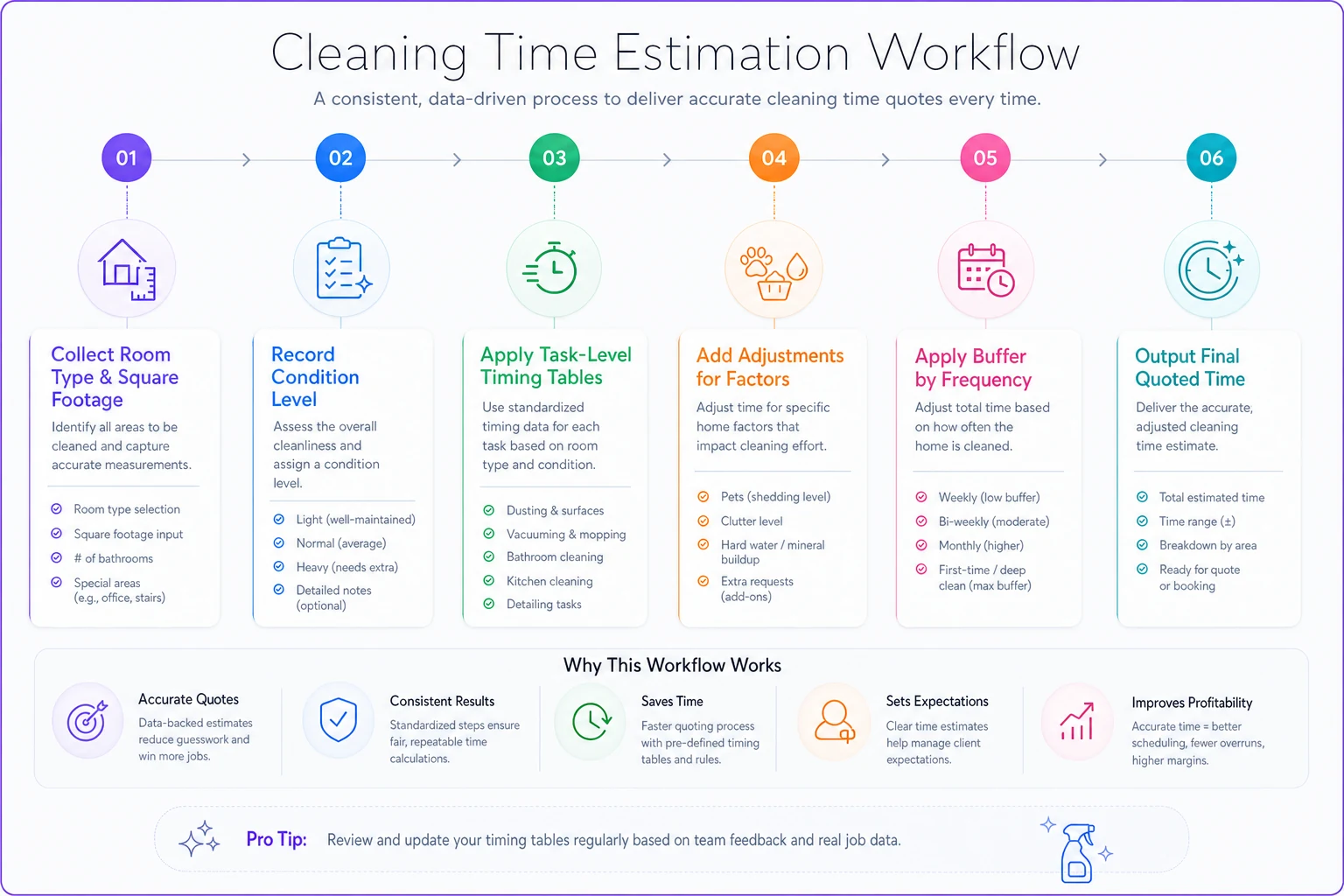
After 20-30 jobs, you'll have real data on your actual times versus your estimates. Adjust the tables based on your team's reality. Maybe your cleaners are faster on bathrooms but slower on kitchens. Maybe pet hair takes 25% more time for you, not 15%. The framework stays the same — the numbers just become yours.
The bigger win is consistency. Every person quoting uses the same tables, same adjustments, same buffer logic. Someone new can quote as accurately as someone with five years of experience because they're working from the same system, not intuition.
When detailed estimation becomes mandatory
If you only service similar suburban homes with consistent layouts and conditions, rough estimates can work well enough. But detailed estimation becomes non-negotiable when:
-
You're servicing diverse property types (condos to large homes)
-
Your margins are tight and can't absorb timing errors
-
Multiple people are doing quotes
-
You're scaling beyond owner-operated
-
You offer both deep and maintenance cleaning
-
Your market has significant condition variation between clients
This is where operational software starts making a real difference. When you're managing dozens of recurring clients with different service levels and conditions, manual calculations get messy fast. AI-powered cleaning management platforms can handle this automatically — input the property details once, and the system builds accurate quotes based on your timing data. As you complete jobs and log actuals, the estimates get sharper over time without extra effort on your part.
The compound effect of accurate quoting
Getting quotes right does more than protect margins on individual jobs. It changes how the whole business runs.
Accurate quotes mean predictable schedules. Your cleaners have realistic time to do quality work. Quality work means fewer complaints and more rebooking. Your reputation builds on consistency rather than occasionally getting lucky with an easy job that offsets an underquoted disaster somewhere else.
Hiring gets easier too. When cleaners can reliably hit their target hourly rate because jobs are quoted properly, word spreads. Cash flow stabilizes. You can forecast monthly revenue and costs with confidence. The business starts to feel like a real operation instead of a constant scramble.
Final thoughts
Most cleaning businesses fail because they can't quote accurately — not because they can't clean well. They work harder and harder for less money until the owner burns out or the business folds.
Task-level timing tables aren't about making cleaning complicated. They're about acknowledging a reality that already exists: different conditions require genuinely different time investments. A cleaning time estimation calculator that accounts for these variations is what separates businesses that hope they're making money from ones that actually know.
Maintenance cleans take roughly 25-30% of the time that initial deep cleans require. Pet homes consistently need 15-20% more time. Hard water areas add around 25% to bathroom cleaning. Ignore those realities and you're not running a business — you're running a subsidy program for homeowners getting premium service at bargain prices.
Build your timing tables. Track your actuals. Adjust for your market. Build in appropriate buffers. Quote with confidence.
Your cleaners will thank you. Your clients will respect you. Your bank account will finally make sense.
Stop guessing. Start measuring. Price accordingly.
Ready to simplify your cleaning operations?
Join 1,000+ cleaning businesses using Wipyly to save time, reduce scheduling conflicts, and enhance client satisfaction.