


Most cleaning companies don't fail because they can't clean. They fail because the way they run the cleaning doesn't survive growth. At 3 crews, everything lives in the owner's head. At 12 crews, that same "system" produces missed sites, double-booked staff, angry commercial clients, and a supervisor texting you at 6 a.m. asking who's supposed to cover the medical office on Route 4.
A cleaning operations playbook isn't a binder nobody reads. Done right, it's a set of connected rules—staffing logic, handoffs, KPIs, and escalation paths—that let the business make decisions without you. The keyword there is connected. A playbook that treats staffing, quality, and communication as separate documents breaks the same way a car breaks when the transmission and engine were designed by two teams that never spoke.
This is the systems view. Not "here are 20 tips," but how the operating pieces feed each other, and what specifically snaps when volume doubles.
Why owner-brain operations hit a wall
In the early stage, coordination is cheap. You know every account, every cleaner's strengths, which client is picky about baseboards. Decisions happen fast because there's one decision-maker.
The problem is that this model scales linearly with you, and the business scales faster than you do. What tends to happen across small operators is a pretty predictable breaking sequence:
-
Around 4–6 crews, scheduling starts leaking. Someone calls out and there's no rule for who covers—just whoever the owner reaches first.
-
Around 8–10 crews, quality gets inconsistent because standards were never written, they were demonstrated. New hires learn from whoever trained them, and that person learned from someone two versions removed from what you actually want.
-
Somewhere past 10, communication collapses. The owner becomes a human message router: client → owner → supervisor → cleaner → back up the chain. Every message adds delay and distortion.
None of these are cleaning problems. They're information and decision problems. The playbook exists to move decisions out of your head and into rules that anyone can follow.
The four systems that actually run a cleaning company
Think of the playbook as four interlocking systems. Each one has a failure mode, and each one feeds the next.
Stop losing bookings in operational chaos.
Wipyly helps you manage, confirm, and optimize every cleaning appointment efficiently.
- Centralized booking management
- Automated client notifications
- Staff scheduling & route optimization
No credit card required
| System | What it decides | What breaks without it | Feeds into |
|---|---|---|---|
| Staffing rules | Who works where, coverage, callouts | Random scrambling, overtime creep, burnout | Handoffs, KPIs |
| Handoff workflows | Info transfer between shifts/roles | Repeated mistakes, "nobody told me" | KPIs, escalation |
| KPI cascade | What each role is measured on | Everyone busy, nothing improving | Escalation, staffing |
| Escalation ladder | Who decides when something goes wrong | Owner becomes the bottleneck | Staffing, handoffs |
The mistake most owners make is building one of these well and ignoring the other three. You can have beautiful checklists and still lose accounts because your escalation path is "text the owner and hope." These systems only work as a set.
Staffing rules: the layer everyone underbuilds
Staffing isn't a schedule. A schedule is the output. The rules are the logic that generates the schedule and, more importantly, handles the schedule breaking—which it will, constantly.
A usable staffing rule set answers questions before they happen:
-
Coverage tiers. Which accounts are "never miss" (a hospital, a food-prep facility) versus "flexible" (a small office that won't notice a one-hour shift)? When someone calls out, you pull from flexible to protect never-miss. Without this tier written down, you protect whichever client complains loudest—which is not the same as whichever client matters most.
-
Callout protocol. A cleaner texts "can't make it" at 5:40 a.m. The rule should already say: who gets notified, who's on standby, and what the client-facing message is. If that decision happens fresh every time, you're paying for it in overtime and stress.
-
Skill mapping. Not every cleaner can run a medical site or a floor machine. Tag people by capability so coverage decisions don't accidentally send an untrained person into a compliance-heavy account.
Companies that track skill and account tiers together tend to reduce callout chaos far more than companies that just hire extra float staff. The float model treats symptoms. The rules treat the actual decision. This connects directly to scheduling patterns that reduce turnover—rules that respect people's real availability keep them longer, which shrinks the callout problem at the source.
Start writing rules when you notice yourself making the same coverage decision over and over.
When rigid staffing rules are a bad idea
If you're running 2–3 crews with stable, long-tenured staff, heavy rule structure is overhead you don't need. The judgment lives in your head and works fine. Start writing rules when you notice yourself making the same coverage decision over and over—that repetition is the signal it's ready to become a rule.
Handoff workflows: where quality actually leaks
Handoffs are the least glamorous part of operations and the biggest silent cost. A handoff is any point where responsibility or information passes between people: shift-to-shift, sales-to-operations, supervisor-to-crew, crew-to-client.
Here's a pattern that kills companies: the sale closes with promises ("they want the break room detailed every Friday, and they're sensitive about the CEO's office"), and maybe 30% of that context never reaches the person holding the mop. The client experiences it as the cleaner "not caring." It's actually a broken handoff.
A working handoff workflow, in plain terms:
-
Sales captures scope in a structured format—not a paragraph in an email, but actual fields: frequency, special requests, access instructions, client sensitivities.
-
Operations reviews and confirms the scope is deliverable with current staffing before anything is promised as recurring.
-
Site sheet generated for the crew—the working document they actually see, containing only what they need to execute.
-
First-clean debrief within the first two visits, where the supervisor confirms reality matches the scope sheet and flags gaps.
-
Recurring feedback loop so client requests update the site sheet instead of living in someone's memory.
Information degrades every time it's re-typed or re-explained verbally. Every hop is a chance for loss. The fewer hops, and the more structured each one, the less quality drift you get over time. This is the same reason SOP versioning matters at scale—handoffs and standards are two sides of the same "does the crew know the current truth?" problem.
KPI cascade: measuring the right thing at each level
Most cleaning companies measure one number—complaints—and only at the top. That's like flying a plane with a single warning light that only triggers after you've already hit the mountain.
A KPI cascade means each role has a metric that rolls up into the level above it, so problems surface at the lowest possible level before they become client-facing.
-
Cleaner level first-time-quality rate (did the site pass without rework), on-time arrival.
-
Supervisor/route level callout coverage rate, rework rate across their crews, photo-verification completion.
-
Ops manager level account health (trending complaints, SLA compliance), staff retention on their book.
-
Owner level margin by account, contract renewal rate, revenue per crew.
The reason the cascade matters more than any single KPI: a metric only drives behavior if the person being measured can actually influence it. Measuring a cleaner on "renewal rate" is pointless—they don't control it. Measure them on first-time quality, and that rolls up into renewal rate. The metrics that predict contract performance only work when they're distributed down to the level that can actually move them.
A common trap: adding more KPIs to fix a problem. If nothing improves after you add a dashboard, the issue is usually that no metric is tied to a decision. A number nobody acts on is decoration.
Escalation ladders: getting yourself out of the middle
The escalation ladder is what finally removes you as the human router. Its job is to answer: when X happens, who handles it, and at what point does it move up?
Without a ladder, every problem defaults to the owner. With one, most problems die at the level they were born.
-
Client reports a missed area. Supervisor owns it → resolves within 24 hours with a re-clean and photo proof → only escalates to ops manager if the same complaint repeats twice.
-
Equipment down mid-route. Crew lead owns the immediate workaround → escalates to ops for a replacement decision if it stops a never-miss account.
-
Billing dispute. Handled by admin using a defined script → escalates to owner only above a dollar threshold.
Most owners miss this: escalation ladders fail not because they're missing, but because the time limits are missing. "Escalate if it's serious" isn't a rule—it's a vibe. "Escalate if unresolved in 24 hours" is a rule. Attach a clock to every step or the ladder collapses back into "ask the owner."
A real scenario: what changes when the systems connect
A janitorial company running about 9 crews and roughly $95k–$110k in monthly recurring revenue was drowning in owner-dependency. The owner was personally handling callouts, most client complaints, and every scope question. Rework was running high—crews redoing work because the scope sheet either didn't exist or was wrong.
They didn't add software first. They wrote the four systems: coverage tiers, a structured handoff sheet, a two-level KPI rollup, and an escalation ladder with actual time limits.
-
Callout scrambles dropped noticeably because supervisors now pulled from flexible accounts by rule instead of calling the owner.
-
Repeat complaints fell—not to zero, but the "same problem again" category shrank considerably once handoffs were structured.
-
The owner's daily involvement in operational fires went from constant to a couple of genuine escalations a week.
The revenue didn't triple. What changed was that the business could take on the next three accounts without the owner's day getting worse. That's the real return on a playbook—capacity to grow without proportional chaos.
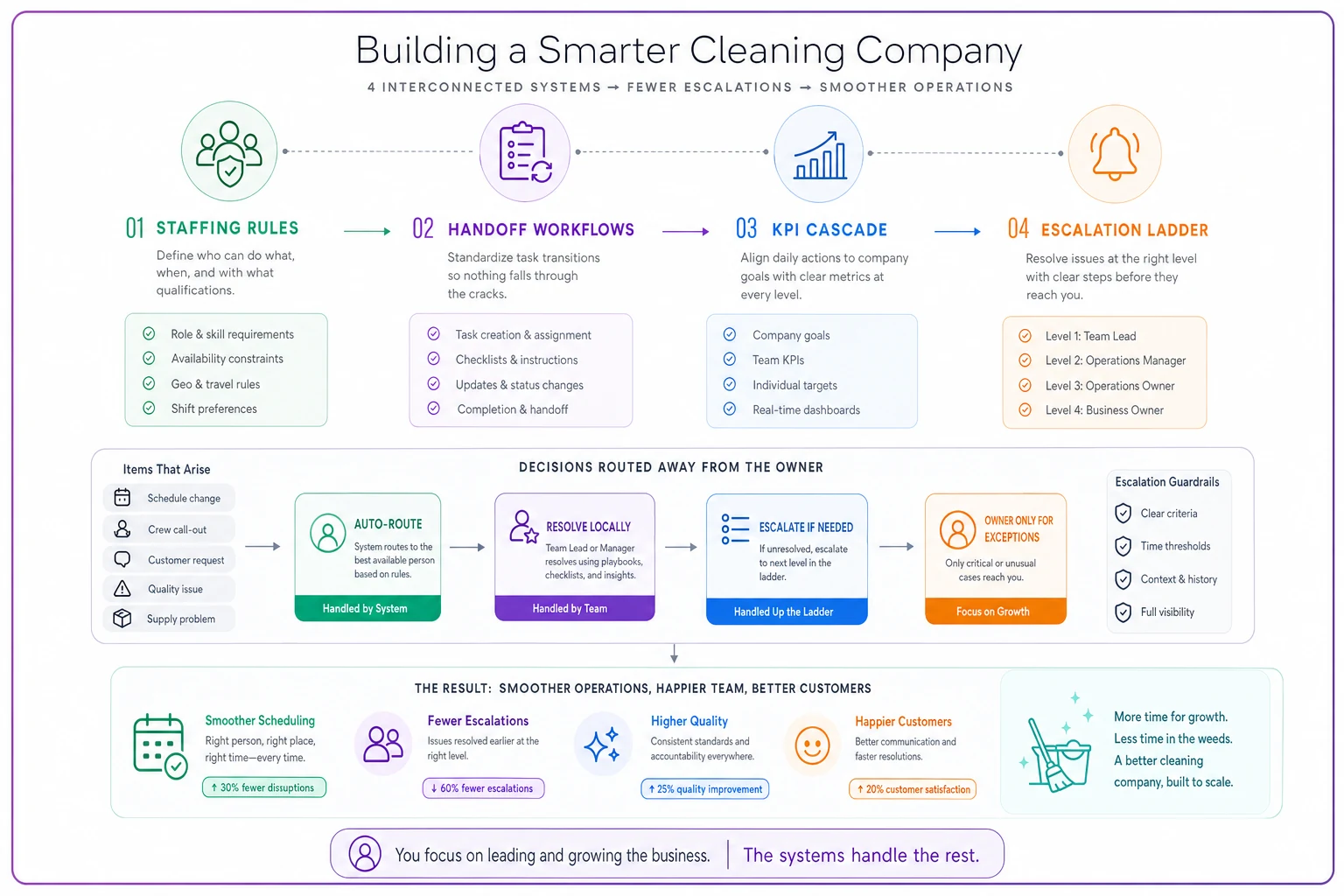
This sketch shows how the four systems route decisions away from the owner and into rules and handoffs.
Where the manual version breaks (and where tools earn their place)
You can run all four systems on spreadsheets and group chats up to a point. What tends to happen is that the systems themselves stay valid, but keeping them synced becomes the new bottleneck. The scope sheet lives in one place, the schedule in another, the KPIs in a third, and now someone spends hours reconciling them—which is just a new manual job you've created.
This is the honest place for AI-assisted operational software: not to replace the rules, but to keep the four systems talking to each other. When a callout happens, the platform already knows which accounts are flexible and which staff are skill-matched, and surfaces the coverage option instead of making a human dig. When a complaint comes in, it starts the escalation clock automatically and routes it to the right owner. Photo-verification and first-time-quality data feed the KPI rollup without anyone building a report by hand.
The value isn't magic—it's reducing the hops and the reconciliation. The rules are still yours. Automation just removes the manual glue that eats supervisor time as you scale. If your systems are well-designed on paper, software makes them faster. If they're broken on paper, software just breaks faster.
Implementation checklist
Build in this order. Each layer depends on the one before it.
-
[ ] Tier your accounts into never-miss, standard, and flexible.
-
[ ] Map staff by skill and site capability, not just availability.
-
[ ] Write the callout protocol—who's notified, who covers, what the client hears.
-
[ ] Create a structured scope-capture format for sales to fill (fields, not paragraphs).
-
[ ] Build the crew-facing site sheet that pulls only execution-relevant info.
-
[ ] Add a first-clean debrief step in the first two visits of any new account.
-
[ ] Define KPIs per role, making sure each is something that role can control.
-
[ ] Set the rollup—which lower metrics feed which higher ones.
-
[ ] Write the escalation ladder with owner + time limit + next-level action for each issue type.
-
[ ] Attach a clock to every escalation step.
-
[ ] Pick one metric to act on this month—don't launch ten dashboards nobody uses.
Build in this order. Each layer depends on the one before it.
Who should hold off
If you're running two crews and everything works, don't over-engineer this. Writing a heavy playbook before you feel the pain just creates documents you won't maintain. The right moment is when you catch yourself making the same decision repeatedly, or when a supervisor can't answer a question without texting you. That's the signal a decision is ready to become a rule.
And if your quality is genuinely inconsistent at the crew level right now, fix that before building KPI cascades—measuring a broken process just gives you a precise picture of the mess.
The point of the whole thing
A cleaning operations playbook isn't paperwork. It's the mechanism that lets the business make good decisions when you're not in the room. Staffing rules decide who, handoffs decide what gets known, KPIs decide what gets watched, and escalation ladders decide who acts. Build them as one connected system, and you stop being the bottleneck. Build them in isolation, and you've just documented four separate ways to grow into chaos.
Start with the layer that's hurting most right now. Get it working on paper. Then let the systems—and eventually the tools that keep them synced—carry the load you've been carrying alone.
A cleaning operations playbook isn't paperwork. It's the mechanism that lets the business make good decisions when you're not in the room. Staffing rules decide who, handoffs decide what gets known, KPIs decide what gets watched, and escalation ladders decide who acts. Build them as one connected system, and you stop being the bottleneck. Build them in isolation, and you've just documented four separate ways to grow into chaos.
Start with the layer that's hurting most right now. Get it working on paper. Then let the systems—and eventually the tools that keep them synced—carry the load you've been carrying alone.
Ready to simplify your cleaning operations?
Join 1,000+ cleaning businesses using Wipyly to save time, reduce scheduling conflicts, and enhance client satisfaction.