



Most cleaning owners I've talked to don't have a financial model. They have a bank balance and a gut feeling. That works fine when you're running three crews out of your own driveway. It stops working the moment you're deciding whether to buy a second cargo van, hire an area manager, or take on a 12-site regional contract that needs staff before the first invoice clears.
The problem isn't that owners are bad with money. It's that the numbers that actually predict whether you survive the next six months — routes, crew-hours, capex timing — live in completely different places than the numbers your accountant looks at. Your P&L tells you what already happened. It says nothing about whether adding four cleaners next month drains your cash before those cleaners generate any revenue.
A company financial operating model for cleaning businesses fixes that gap. Not a fancy one. A working one — the kind you can run in a spreadsheet, update in twenty minutes on a Sunday, and actually use to answer the questions that keep you up at night. This article walks through how to build one that's mapped to your stage of growth, because the model that keeps a 4-van operation alive is not the same model that governs a 40-van one.
Why the same model breaks at every stage
Before you build anything, it's worth understanding one pattern: the thing that constrains your business changes as you grow, and if your model keeps optimizing the old constraint, you get blindsided.
-
Startup (1–8 crews) Your constraint is cash timing. You win or lose based on how fast you collect versus how fast you pay wages and buy supplies. Utilization matters less than not running dry between invoices.
-
Scale (8–25 crews) Your constraint shifts to crew-hour efficiency and route density. You now have enough volume that a few points of wasted drive time or idle labor compounds into real money. Cash is still tight, but the leaks are operational.
-
Expansion (25+ crews / multi-region) Your constraint becomes capex cadence and management overhead. You're buying vans and equipment in waves, funding new-region ramp-ups that lose money for months, and paying supervisors who don't touch a mop.
A model built for the startup stage — basically "will I make payroll Friday?" — is useless for expansion decisions. And an expansion-grade model full of allocation logic is overkill that a 5-crew owner will never keep updated. So you build in layers, and activate the layer that matches where you actually are.
The three inputs that drive everything
Almost every meaningful decision in a cleaning business traces back to three operational numbers. Get these tracked and your model practically writes itself.
Stop losing bookings in operational chaos.
Wipyly helps you manage, confirm, and optimize every cleaning appointment efficiently.
- Centralized booking management
- Automated client notifications
- Staff scheduling & route optimization
No credit card required
1. Routes (and their density). A route isn't just a list of stops. It's revenue-per-drive-minute. Two crews billing the same hours can have wildly different margins if one spends 90 minutes a day driving between jobs and the other spends 30. Your model needs route revenue net of drive time, not gross.
2. Crew-hours. This is your real capacity unit — not headcount, not vans. A part-timer at 22 hours and a full-timer at 40 are different amounts of capacity, and your ability to take on new contracts is capped by billable crew-hours available, minus the slack you need for callbacks and rework.
3. Capex cadence. Vans, floor machines, backpack vacuums, pressure washers. These come in lumpy chunks and they wreck cash forecasts precisely because they're irregular. The mistake owners make is treating capex as a surprise instead of a scheduled rhythm tied to fleet age and contract wins.
Once these three feed your model, you can connect them to the thing that actually matters: runway.
Building the runway view
Runway is how many months you can operate before cash hits zero, given your current burn and collection timing. Every cleaning owner should be able to answer "what's my runway?" in under thirty seconds. Most can't.
The simplest version that works: in a Google Sheet, build a rolling 13-week cash view with these rows:
-
Opening cash (this week's starting bank balance)
-
Collections in (invoices you realistically expect to clear — not what you billed, what you'll collect, offset by your average days-to-pay)
-
Payroll out (crew-hours × loaded wage rate, including payroll taxes)
-
Supplies & fuel out (variable, roughly scales with crew-hours)
-
Fixed out (rent, insurance, software, admin salaries)
-
Capex out (scheduled purchases — this is where the lumpiness shows)
-
Closing cash (opening + in − everything out)
That closing-cash number, carried forward week to week, is your runway line. When it trends toward zero, you have a warning that a P&L would never give you until it was too late.
A quick visual of the runway workflow.
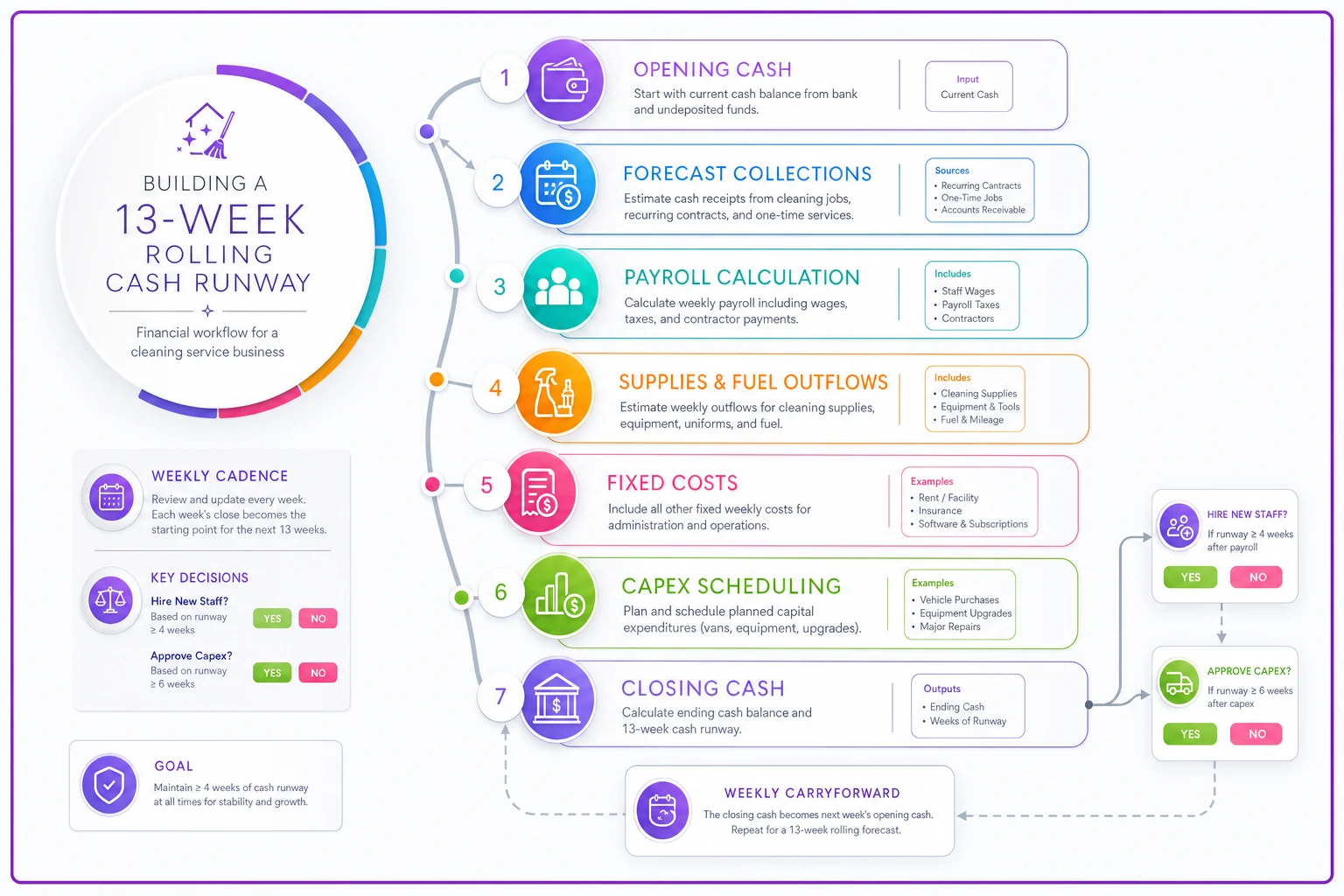
Update the 13-week sheet weekly so the carryforward closing cash stays accurate.
The 13-week horizon is deliberate. It's long enough to see a van purchase or a slow-paying national account coming, short enough that your estimates aren't fiction. Beyond 13 weeks you move to a monthly scenario model, which is the next piece.
Scenario forecasts you can actually build
The single highest-leverage thing in your model is running three versions of the future side by side. Not because you'll predict correctly — you won't — but because it shows you which decisions are reversible and which aren't.
Build three columns: Conservative, Base, Stretch. The only differences between them are a handful of assumption cells at the top:
| Assumption | Conservative | Base | Stretch |
|---|---|---|---|
| New contracts won / quarter | 1 | 3 | 5 |
| Avg monthly value per contract | $2,400 | $2,900 | $3,300 |
| Crew utilization (billable %) | 68% | 74% | 80% |
| Collection days | 52 | 41 | 33 |
| Churn (accounts/quarter) | 2 | 1 | 1 |
| Capex this quarter | $0 | $18k (1 van) | $34k (2 vans) |
Everything downstream — crew-hours needed, payroll, closing cash — recalculates off those cells. You're not looking for the "right" answer. You're looking at the Conservative column's runway. If Conservative still keeps you above your cash floor, the decision is safe. If only Stretch survives, you're gambling.
One pattern that comes up constantly: owners fall in love with the Base case because it feels realistic. What actually happens lands between Conservative and Base far more often than between Base and Stretch. Plan off Conservative, get pleasantly surprised by Base.
Hiring gates: stop hiring on vibes
The most expensive mistake at the scale stage isn't hiring too slow. It's hiring on optimism — bringing on crew because a contract "looks likely" and then carrying idle labor for six weeks while the deal drags.
A hiring gate is a simple rule that says you don't add crew-hours until specific conditions are met. Here's a version that works well for operations moving through the 8-to-25-crew range:
-
Signed contracts (not verbal, not "very likely") require more than 90% of current billable crew-hour capacity
-
The 13-week cash view shows you can cover the new hire's wages for 6 weeks before the associated revenue collects
-
Your trailing 8-week rework/callback rate is under your threshold (hiring while quality is slipping just multiplies the mess)
-
Conservative-case runway stays above your cash floor after the hire
That third bullet trips people up. Adding staff while quality is already drifting almost never works out — you're stretching supervision thinner right when it needs to be tighter. The gate forces you to fix the operation before you scale it.
Capex allocation: turning lumpy into rhythmic
At expansion stage, capex stops being "we needed a van so we bought a van" and becomes a portfolio you manage on a schedule. The goal is to smooth the lumpiness so it doesn't ambush your cash.
Fleet replacement math. Track each van's age and rough maintenance spend. Once annual maintenance on a vehicle crosses around 40–50% of a replacement lease payment, it's a candidate for replacement. Staggering purchases so you're never replacing more than one or two vehicles in the same quarter keeps capex from spiking unexpectedly.
Contract-triggered capex. Tie equipment buys to signed revenue, not anticipated revenue. A new floor-care contract that needs an auto-scrubber only justifies the scrubber once it's signed and the account P&L clears your margin band. This is where understanding your true per-account economics matters — if you haven't segmented clients and run the numbers, read through the approach in account-level profitability for cleaning companies before you commit capital to serve them.
The broader point here is that capex decisions are almost always more manageable when they're planned months in advance rather than reacted to. Your model should surface these windows early enough that you have options — negotiate a lease, time a purchase to a slower collection month, or simply delay until a signed contract justifies it.
When this level of modeling makes sense — and when it doesn't
When it makes sense:
-
You're carrying more than a few crews and cash timing has surprised you at least once
-
You're weighing a decision that can't easily be reversed (fleet purchase, region expansion, a big anchor contract)
-
You've had a month where you were profitable on paper but scrambling for cash
When it's overkill:
-
You're a solo operator or running one or two crews. Just track the 13-week cash view. The full scenario apparatus is more maintenance than it's worth at that size.
-
Your revenue is highly stable and recurring with no expansion plans. A simple model updated monthly is plenty.
One thing worth being direct about: if you won't actually update it, don't bother building the full version. A perfect model touched once a quarter is worse than a rough one you update every Sunday, because a stale model gives you false confidence. Build the smallest version you'll actually maintain.
A real scenario
A commercial cleaning operator running 11 crews across a mid-size metro kept hitting the same wall: profitable quarters, but twice a year they'd nearly miss payroll and end up drawing on a line of credit at a rate that ate into their margin.
The issue wasn't profitability — it was timing. Two of their largest accounts paid on 50-plus day terms, and both happened to renew equipment-heavy scopes in the same season, so a van purchase and slow collections collided every time.
They built the 13-week cash view and the three-scenario model. Nothing fancy — a shared Sheet, updated weekly. The first thing it surfaced: their Conservative case dipped below the cash floor every Q1, every year, predictably. That single insight let them do two things — stagger the van replacement into Q3 instead of Q1, and renegotiate one anchor account's payment terms during renewal.
Over the following year, they stopped touching the credit line entirely and freed up somewhere around $4k–$6k in interest and fees that had just been quietly leaking out. Not a revenue miracle. Just seeing the collision before it happened instead of after.
Where pricing ties back in
A financial model is only as honest as the margins feeding it. If your contracts are priced inconsistently — some fat, some barely breakeven — your scenario forecasts inherit that noise and every projection wobbles.
Tightening pricing into defined margin bands makes the whole model more predictable, which is exactly why it's worth pairing this with a structured approach like a modular pricing engine for mixed contracts. Clean inputs produce trustworthy forecasts.
Keeping it alive as you grow
The model isn't a document you finish. It's a habit.
Startup stage: check the 13-week cash view weekly, that's it. Scale stage: add the crew-hour utilization tracking and turn on the hiring gates. Expansion stage: layer in capex cadence and per-region scenario columns.
The owners who navigate growth without the near-death cash scares aren't smarter or better capitalized. They just refused to make irreversible decisions in the dark. They knew their Conservative runway, they knew their hiring gate conditions, and they knew when a van purchase was going to collide with slow collections — because their model told them weeks ahead, while there was still time to move things around.
You don't need a finance background to run this. You need three inputs tracked honestly, a rolling cash view, and the discipline to plan off your conservative numbers instead of your hopeful ones.
Build the smallest version today, and add layers only when your stage actually demands them.
Ready to simplify your cleaning operations?
Join 1,000+ cleaning businesses using Wipyly to save time, reduce scheduling conflicts, and enhance client satisfaction.