



The late-October numbers landed with a strange mix of signals. U.S. third-quarter GDP came in hotter than expected, powered largely by consumer spending, while September inflation readings ran warmer than forecasters wanted to see. For most industries that's a headline. For cleaning operators it's a two-sided operational event happening in real time: more phones ringing, and every input line creeping up at the same moment.
The trap isn't demand. Demand is good. The trap is accepting new work at last quarter's prices while your wages, consumables, and fuel quietly reset to this quarter's reality. That gap is where margin goes to die — and it dies silently because revenue is growing the whole time. You feel busy and profitable right up until you run the P&L and realize you added volume at a worse margin than you had in the spring.
This is a playbook for moving fast without wrecking your numbers.
The specific way a demand surge eats your margin
Rising demand doesn't hurt margin directly. The damage comes from the operational decisions you make because of the demand. There's a predictable sequence:
You get more inbound. You quote fast to not lose the deal. You staff up in a hurry, which means paying over-market or accepting weaker candidates. You stretch your existing crews on overtime to cover the gap. You reorder consumables mid-cycle at whatever the current price is, not the price you budgeted. And because everyone's slammed, nobody reprices the renewing contracts still sitting on terms you set when wages were lower.
Six weeks later you've got 15% more revenue and roughly the same dollar profit. The business grew. The margin didn't.
What makes this period different from a normal busy season is that the cost side is moving with the demand, not lagging behind it. In a typical spring rush you had old-price supplies on the shelf and stable wages. Right now the inflation reading means your next supply order and your next hire both cost more than your current baseline assumes. You don't get the usual lag that cushions a volume spike.
Reprice before you re-staff, not after
Most operators do this backwards. They hire and schedule to meet demand first, then "get around to" pricing once things calm down. By the time they revisit pricing, they've locked in a quarter of underpriced work.
Stop losing bookings in operational chaos.
Wipyly helps you manage, confirm, and optimize every cleaning appointment efficiently.
- Centralized booking management
- Automated client notifications
- Staff scheduling & route optimization
No credit card required
Flip the order. The fastest, highest-leverage move you can make this month is adjusting your quote prices and your renewal terms before you add a single headcount. Price is instant margin. A new hire is a two-to-three week ramp, a training cost, and a productivity drag before they contribute anything.
-
Recalculate your loaded labor rate using current wages, not last quarter's. Include payroll taxes, the realistic overtime you're actually running, and a drive-time allocation. Most operators under-load by 8–12% because they anchor to base wage.
-
Update your consumables cost per job. Pull your last two supply invoices, not your annual average. If microfiber, liners, and chemicals moved, your per-job cost moved.
-
Set a new-quote floor price that bakes in the updated labor and supply numbers plus your target margin band. Anything below the floor requires sign-off, not a reflex discount.
-
Flag every contract renewing in the next 90 days and build a reprice case for each one before the renewal conversation, not during it.
-
Only then open the staffing req — because now you know what each new job is actually worth and whether the volume is even worth servicing.
The point of this order is simple: you want to be adding people to profitable work, not chasing volume you mispriced.
Here’s a quick visual of the recommended sequence so your team can follow it consistently.
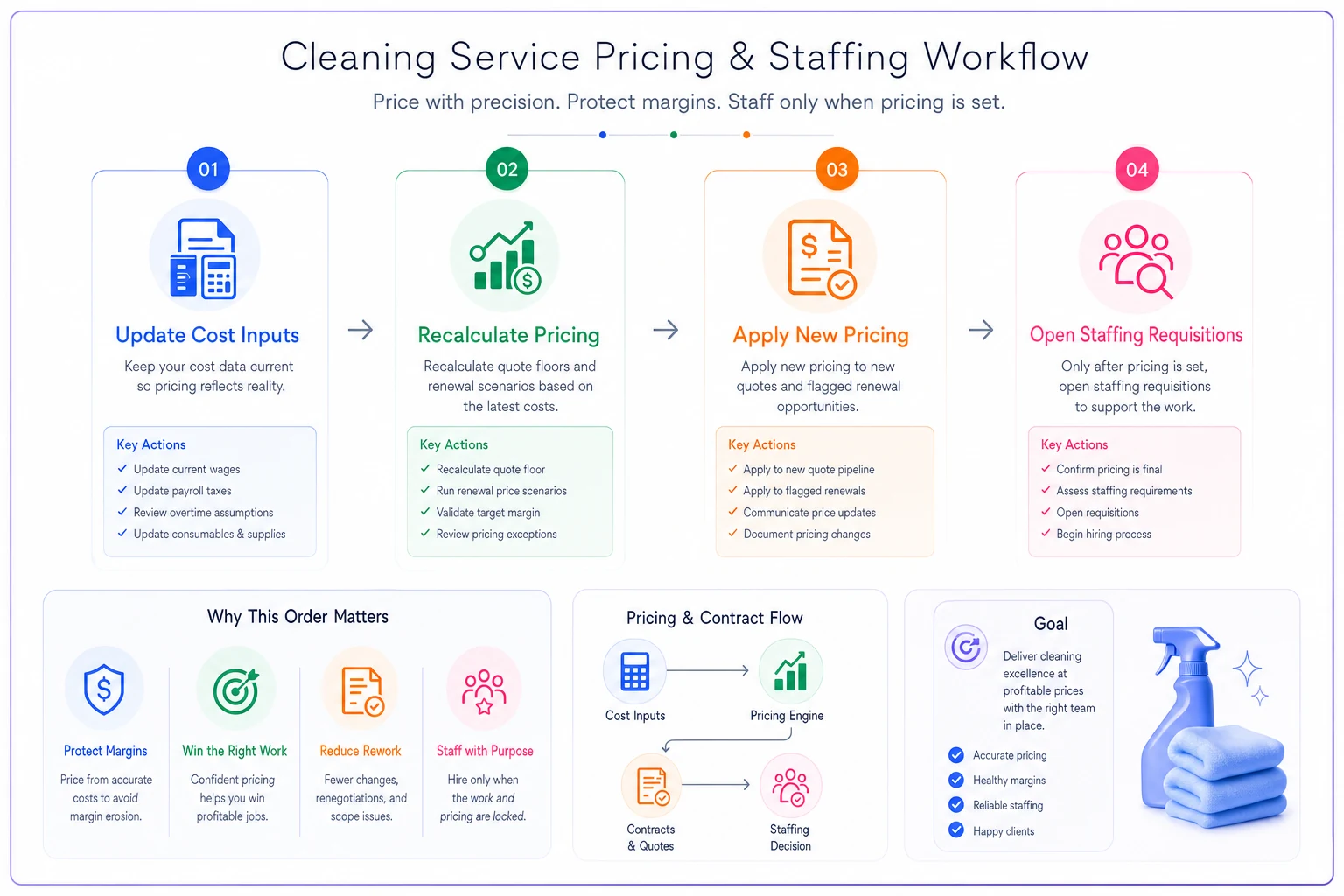
A simple, repeatable sequence like this is what turns a reactive scramble into a controlled scale-up.
A quick comparison: three ways operators respond to a surge
Compare the high-level response patterns and their margin outcomes.
| Response pattern | What it looks like | Margin outcome |
|---|---|---|
| Grab everything | Accept all inbound at current prices, staff on overtime, reprice "later" | Revenue up, margin flat or down. Burns crews. |
| Hold and protect | Keep prices static, cap intake to existing capacity, refuse overtime | Margin protected, but you leave growth and market share on the table |
| Reprice-then-scale | Raise quote floor and renewal terms first, add staff against the new pricing | Revenue and margin grow together. Slower on week one, far better by week eight |
The middle option feels safe but it's often the worst long-term play — you train your market to go to the competitor who answered the phone.
The reprice-then-scale path takes a bit more discipline up front and wins on every real metric by the end of the quarter.
The renewal conversation nobody wants to have
Repricing a new quote is easy — the client has no anchor. Repricing an existing account is where operators lose their nerve, and it's exactly where the surge-period money is.
The mistake is treating it as a single awkward ask: "we need to raise your rate." That invites a yes/no fight. Better to frame it around what's actually happening in the economy, which your client is living through in their own business anyway.
"With wage and supply costs rising across the board this year, we're adjusting rates on renewal to keep the same crew and service level on your site. We'd rather do a modest adjustment now than cut corners on the work. Here's the new rate and here's what stays exactly the same."
That last line matters more than people realize. Clients tolerate price increases far better when you explicitly protect continuity — same crew, same schedule, same quality. The thing they actually fear about a price hike is service degradation. Remove that fear and the number itself becomes a much smaller objection.
One thing worth noting: never reprice everyone the same percentage. Run it by account. Some accounts are already at a strong margin and don't need the bump. Some are underwater and need more than a token increase. Blanket percentage raises are lazy and they annoy your best-margin clients while under-correcting your worst ones.
Why your pricing logic can't live in someone's head
Most cleaning businesses don't have a pricing system. They have a pricing person — usually the owner, sometimes a sales lead, who "knows" roughly what to charge based on square footage and gut feel.
That works fine when costs are stable and volume is predictable. It falls apart the moment costs shift weekly and quote volume doubles. The owner becomes the bottleneck, quotes get inconsistent, and the margin assumptions baked into each number are invisible — nobody can audit whether a job was priced right until the P&L comes in a month later.
What you actually need is pricing logic that's written down, tied to current cost inputs, and structured in margin bands with clear decision gates for when to approve something below floor. When your labor rate updates, every quote should reflect it automatically instead of relying on someone remembering to adjust. That's the entire idea behind building a modular pricing engine for mixed cleaning contracts — formulas, margin bands, and gates that keep your numbers honest even when you're quoting at triple the normal pace.
This is also where AI-assisted operational tools earn their keep without any hype attached. The practical value is unglamorous: a platform that holds your updated cost inputs in one place, applies them consistently to every new quote, flags renewals coming due, and surfaces which accounts are drifting below your margin band before you notice manually. It's not magic. It just removes the three-week lag between "costs changed" and "pricing reflects it." During a surge, that lag is the entire problem.
Staffing fast without overpaying for it
Once pricing is handled, the hiring question gets a lot more manageable. The surge-period staffing mistake is panic-hiring at a premium because you're desperate to cover work you already committed to.
-
Protect your core crews first. Overtime is cheaper than a bad hire for short bursts, but past roughly 8–10 overtime hours per person per week you start trading quality and retention for coverage. Use OT as a bridge, not a strategy.
-
Separate "surge" demand from "permanent" demand. Some of this quarter's volume is durable and some is seasonal noise. Hire full-time against the durable baseline; cover the uncertain top layer with overtime or vetted subcontractors so you're not stuck carrying headcount when volume normalizes.
-
Don't skip the vetting to go faster. A rushed hire who causes a re-clean or a client complaint costs more than the two days you saved. The surge is the worst time to loosen hiring standards because your supervisors are already stretched thin and can't babysit a weak new hire.
-
Front-load the onboarding that prevents rework. Even a compressed version of your training beats throwing someone on a site cold. First-time quality is cheaper than fixing it twice.
When aggressive hiring actually makes sense
Add permanent headcount when the new demand is anchored in signed recurring contracts (not one-off deep cleans), the work is priced at your target margin band, and the geography clusters with routes you already run. If all three are true, hire.
When it doesn't
Hold off when the volume is one-off project work, the new accounts are scattered across zones that wreck your routing efficiency, or you had to quote below floor to win them. Cover with overtime and subcontractors and don't take on fixed cost against unstable, thin-margin work.
Use vetted subcontractors or overtime as a bridge to avoid taking on fixed headcount against scattered or one-off accounts.
A clear hiring gate tied to contract type, margin, and routing keeps you from converting temporary noise into permanent cost.
A real scenario
A mid-size commercial cleaning operator running around 40 recurring accounts saw inbound jump noticeably through October — enough to potentially add six or seven new sites. Their instinct was to say yes to everything and hire three cleaners immediately.
Instead they ran the reprice-first sequence. They recalculated loaded labor against current wages and found they'd been under-loading by about 9%. They set a new quote floor, which bumped new-site pricing up meaningfully, and they lost one of the seven prospects on price. Fine — that one was going to be a low-margin headache anyway.
On the renewal side, they flagged roughly a dozen accounts coming due before year-end and ran account-by-account repricing instead of a blanket raise. Most accepted a modest increase. Two of their best-margin accounts got no increase at all, which those clients noticed and appreciated.
Net result after about eight weeks: five of the six viable new sites added, effective pricing raised across the renewing book, and blended margin actually came up a couple of points while revenue grew. Compare that to the "grab everything" version — all seven sites at old pricing, crews run ragged on overtime, margin flat. Same demand environment, very different outcome. The only difference was sequencing.
The one-page checklist for this quarter
Use this checklist to ensure you reprice before you scale and protect margin during the surge.
-
- [ ] Recalculate loaded labor rate using current wages and real overtime
-
- [ ] Update consumables cost-per-job from your last two invoices, not the annual average
-
- [ ] Set a new quote floor with your target margin band built in
-
- [ ] Require sign-off on any quote below floor — no reflex discounting
-
- [ ] List every contract renewing in the next 90 days
-
- [ ] Build an account-by-account reprice case (no blanket percentages)
-
- [ ] Script renewal conversations around continuity ("same crew, same service")
-
- [ ] Separate durable demand from seasonal noise before hiring permanent staff
-
- [ ] Cap overtime around 8–10 hours/person/week as a bridge, not a plan
-
- [ ] Keep onboarding tight enough to prevent first-week rework
-
- [ ] Review margin by account monthly, not just total revenue
Review margin by account monthly, not just total revenue
Who should ignore most of this
If you're a solo operator or a two-crew residential shop with stable, hand-picked clients and no real intake pressure, you don't need to overhaul anything. Raise your rates modestly on renewal to keep pace with costs and move on.
The full reprice-then-scale machinery is for operators who are actually feeling the demand surge and the cost squeeze simultaneously — the ones deciding right now whether to add headcount and chase growth.
The core lesson isn't complicated. A strong economy with rising prices is a good environment for a cleaning business — but only if your pricing moves at the same speed your costs do. The operators who struggle this quarter won't be the ones who were too cautious. They'll be the ones who grew fast on numbers they set before the costs changed, and found out too late that busy and profitable aren't the same thing.
The core lesson isn't complicated. A strong economy with rising prices is a good environment for a cleaning business — but only if your pricing moves at the same speed your costs do. The operators who struggle this quarter won't be the ones who were too cautious. They'll be the ones who grew fast on numbers they set before the costs changed, and found out too late that busy and profitable aren't the same thing.
Ready to simplify your cleaning operations?
Join 1,000+ cleaning businesses using Wipyly to save time, reduce scheduling conflicts, and enhance client satisfaction.