



The notifications started rolling in around 6:30am on July 2nd. Three facility management clients forwarding the same basic message: "Did you see the new rates? We need to talk about our contract pricing." Another owner in our network texted a screenshot of their payroll preview showing a $4,800 monthly increase. July's minimum wage increases had officially landed.
Alaska jumped to $11.91. DC hit $17.50. Chicago pushed to $16.20. Several California cities crossed $18. According to Money.com's recent roundup, over 15 jurisdictions raised their wage floors on July 1st, affecting millions of workers — and thousands of cleaning operations that employ them.
For cleaning and facility service businesses, these aren't abstract policy changes. When 60–70% of your operating costs sit in labor, a dollar-per-hour increase across 20 full-time employees translates to roughly $41,600 in added annual costs. That's before factoring in overtime calculations, supervisor wage compression, payroll tax bumps, and the quiet pressure to raise experienced staff who were already earning slightly above the old minimum.
The three-week scramble that defines your next six months
Most cleaning businesses find out about wage increases one of three ways: a payroll software alert, a client raising it during contract talks, or — worst case — seeing it in their first post-increase payroll run. By then, you're already behind.
The real damage happens in those first few weeks. Contracts signed in May or June are suddenly operating at negative margins. Your scheduler doesn't realize overtime just got more expensive, so they're still approving last-minute coverage at time-and-a-half of the new rate. Sales keeps quoting off old labor numbers. Meanwhile, faster-moving competitors are already pitching your accounts with "updated, compliant pricing that reflects current market conditions" — which is just a polished way of saying they're hunting your clients.
July increases are particularly rough on timing. Commercial contracts often renew in January or September, which means you're stuck operating at a loss through summer unless you can negotiate mid-term adjustments. Residential customers who just adjusted to your spring pricing now hear about another increase. And your field supervisors, who were making $2–3 above the old minimum, suddenly find themselves earning the same as new hires.
The Department of Labor's state wage database now shows a patchwork of rates that vary not just by state, but by city and county. A cleaning company working across the Seattle metro area might deal with four different minimums depending on which side of a city boundary a crew is operating. One wrong assumption and you're looking at wage violations on top of margin compression.
Why standard pricing models break when wages shift asymmetrically
The traditional cleaning pricing formula — labor hours × hourly cost × markup — assumes stable inputs. Minimum wage increases don't work that way. Your entry-level crew jumps from $14 to $16 per hour, but your $18/hour team leads expect proportional bumps to maintain their wage gap. Suddenly labor costs aren't climbing 14% across the board — they're up 14% at the bottom, 8% in the middle, and creating compression that quietly drives turnover at the top.
Stop losing bookings in operational chaos.
Wipyly helps you manage, confirm, and optimize every cleaning appointment efficiently.
- Centralized booking management
- Automated client notifications
- Staff scheduling & route optimization
No credit card required
A 40-person commercial cleaning operation handled this wrong last January. They applied a flat 10% price increase across all contracts to cover a $1.50 minimum wage bump. Seemed logical on paper, except their high-margin deep cleaning services used mostly experienced staff who didn't get raises, while their daily office cleaning relied almost entirely on minimum wage workers. They ended up overcharging profitable clients while still losing money on routine maintenance contracts.
The scheduling dimension makes it worse. When labor costs spike, the obvious move is to cut hours. But cleaning has minimum viable time requirements — you can't clean a 10,000-square-foot office faster just because wages went up. So operators start playing dangerous games: pushing crews to move faster (quality drops), cutting "non-essential" tasks (clients eventually notice), or holding prices flat and hoping volume bails them out while margins quietly evaporate.
Building wage flexibility into your operating model
Operations that hold up through repeated wage increases tend to share a few structural traits. They've already separated service tiers by labor intensity, not just scope. Their premium offerings use the same crew hours but layer in higher-margin consumables, specialized equipment, or certification requirements that justify price premiums beyond pure labor cost.
A facility services company in Portland restructured their service menu around this about two years ago. Basic cleaning uses standard minimum-wage labor. Enhanced cleaning adds HEPA filtration and antimicrobial treatments — same labor hours, but roughly $30 in additional product costs that support $150 in extra charges. Their "medical-grade" tier requires specialized training and certification, letting them bill $45/hour for work done by someone earning $22/hour.
When Oregon's minimum wage increased again this July, the basic tier needed adjustment, but the enhanced and specialized tiers held their margins. More importantly, they'd spent two years gradually moving clients upward — only about 30% of revenue still came from minimum-wage-dependent basic cleaning by the time the increase hit.
Crew scheduling needs the same kind of strategic thinking. Not all hours carry the same wage pressure. Early morning shifts already pay a premium in many markets, so minimum wage increases hit them less proportionally. Weekend work already carries overtime risk. But that Tuesday afternoon office cleaning route? That's where new minimum wage rates land hardest.
Converting wage pressure into scope conversations
Asking clients for more money only works when you have leverage. There's a different conversation available: scope adjustment. Almost every cleaning contract includes tasks that clients think they need but don't value proportionally when pushed.
Take quarterly baseboard cleaning in office environments. It might run 2 hours per visit, 8 hours annually. At $14/hour, that's $112 in direct labor — probably billed at $200–250. At $16/hour, it's $128. But the real question is whether the client actually values those clean baseboards at $250, or whether they'd rather skip them and keep their overall contract price flat.
-
Option A Maintain current scope and frequency, accept X% price increase
-
Option B Maintain current pricing, reduce frequency by one service per month
-
Option C Maintain pricing and frequency, remove specific lower-priority tasks (listed per account)
Nearly 70% of clients chose Option B or C. The company maintained revenue while actually reducing labor hours, improving per-hour margins despite the wage increase. More importantly, clients felt like they had agency over the decision rather than being handed an increase.
For residential customers, the conversation shifts toward efficiency. Can a two-person crew be replaced by one person with better equipment? Would clients trade weekly full service for monthly deep cleans plus bi-weekly maintenance? These aren't necessarily downgrades — they're scope realignments that reflect real economic conditions.
The automation dividend in high-wage environments
When minimum wage hits $17–18 per hour, the math on operational software changes meaningfully. A scheduling platform that saves 30 minutes of coordinator time per day is now saving around $8–9 daily — which compounds to $170+ monthly and close to $2,000 annually just in direct wages. Factor in payroll taxes, workers comp, and overhead, and the real number is probably closer to $2,800.
But the bigger value isn't replacing admin time. It's preventing the expensive mistakes that happen when teams are scrambling. Automated scheduling rules catch accidental overtime assignments that now cost $25–27 per hour. Digital quality checklists catch issues before they turn into re-cleaning visits at full wage rates. Route optimization keeps crews from burning expensive hours sitting in traffic.
Start by automating overtime prevention rules — they typically deliver the fastest ROI when labor costs spike.
The modular pricing engine approach becomes genuinely important when wage inputs vary by location and change frequently. Instead of manually recalculating every contract, you build rules that automatically adjust pricing based on local wage rates, service tier, and client type. A 10-person operation might be managing 100+ active contracts — manually repricing each one takes days and invites errors. AI-assisted platforms can surface which contracts are now underwater within hours of a wage change, so decisions get made before more damage is done.
Software also enables the scope flexibility described earlier. When you can show a client in real time how removing two monthly tasks saves them $180/month while only reducing your margin by $20, those conversations get a lot easier. When crews can see clearly which tasks are priority versus optional on each visit, quality stays consistent even as scope shifts.
Protecting margins through the transition period
The next six months will sort cleaning businesses into three groups: those that adapted fast, those that absorbed losses while slowly adjusting, and those that didn't make it. The gap usually comes down to how quickly decisions get made in the first 30 days after wage changes hit.
A few immediate moves that actually matter:
First, freeze all new contract quotes until pricing models are updated. Nothing hurts worse than signing a year-long contract on July 3rd using June economics. Your sales team might push back, but it beats running at a loss for twelve months.
Second, audit existing contracts for repricing triggers. A lot of commercial agreements include language around "regulatory changes" or "mandated cost increases" that allow mid-term adjustments. Find those clauses and use them now.
Third, segment your workforce by wage pressure. Who's at minimum? Who's just above and expecting a bump to maintain the gap? Who's far enough above to be unaffected? This tells you where compression risk lives and where you have some flexibility.
Fourth, build your client communication before you need it. Whether that's a formal letter about wage-driven price adjustments or a more casual scope conversation, having talking points ready prevents scrambling and keeps messaging consistent across your team.
For the medium term, the goal is building wage elasticity into the operation — service tiers that aren't purely labor-dependent, contracts with escalation clauses, and enough operational efficiency to absorb 5–10% wage increases without blowing up margins.
Below is a rough timeline for how the first 90 days should be structured:
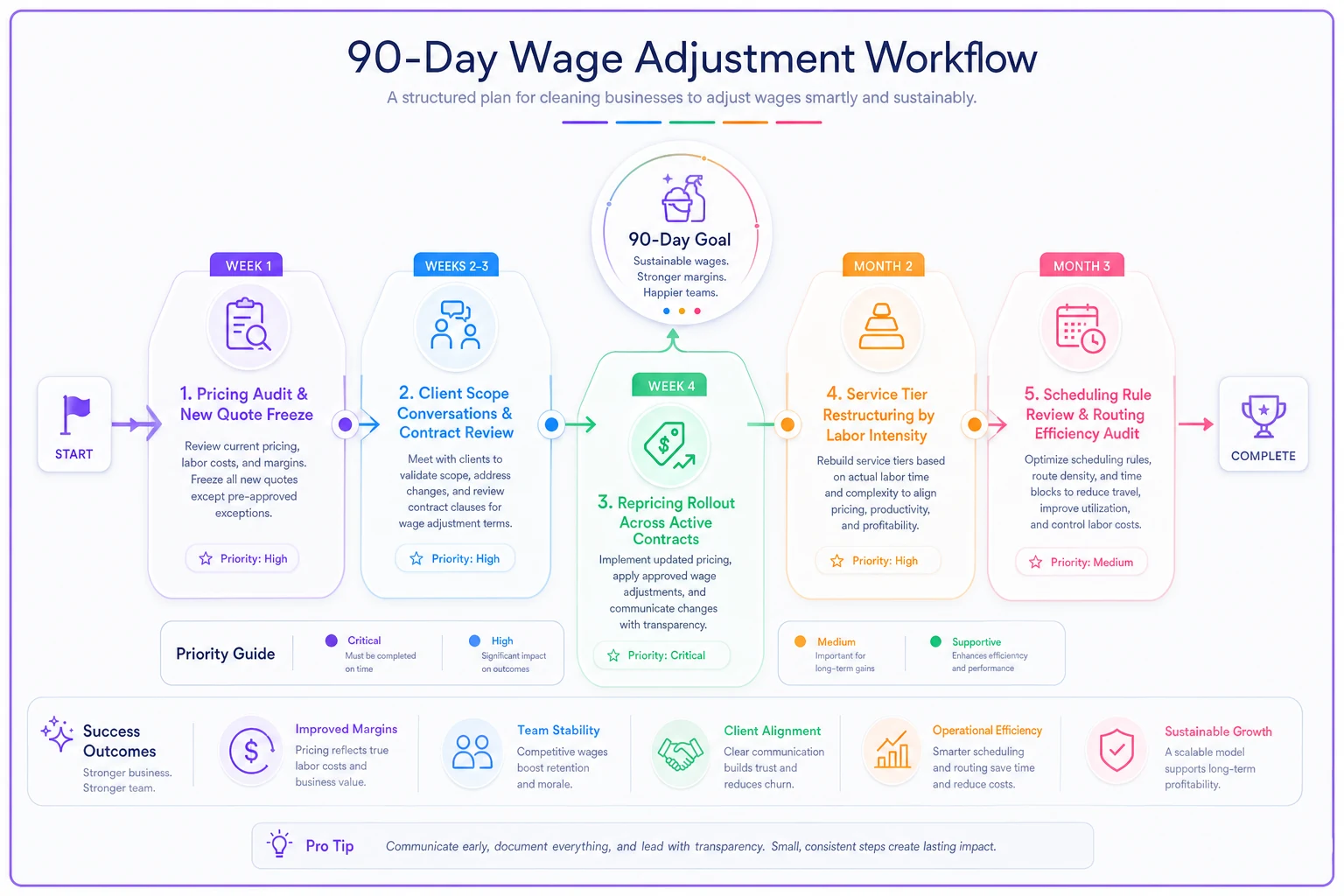
| Action | Timeline | Priority |
|---|---|---|
| Freeze new quotes, update labor cost inputs | Week 1 | Critical |
| Audit contracts for mid-term repricing clauses | Week 1–2 | Critical |
| Segment workforce by wage impact level | Week 1–2 | High |
| Prepare client communication and scope menus | Week 2–3 | High |
| Roll out updated pricing across active contracts | Week 3–4 | High |
| Restructure service tiers by labor intensity | Month 2 | Medium |
| Review scheduling rules and overtime triggers | Month 2–3 | Medium |
| Evaluate routing efficiency and crew productivity | Month 3 | Medium |
The businesses that come out of this in decent shape are the ones that run the math in week one — not after the August payroll run.
Moving forward with sustainable economics
Minimum wage increases aren't stopping. Whether driven by state legislation, city ordinances, or just market pressure, the direction is clear. Cleaning businesses built on the assumption of stable, low-wage labor need to restructure — not just patch.
That starts with honest math about which services can actually be delivered profitably at different wage levels. Some contracts that made sense at $12/hour minimum simply don't work at $17/hour. It's better to cut them than to keep bleeding margin waiting for relief that isn't coming.
It continues with operational choices that reduce dependence on minimum-wage labor — investing in equipment that improves individual productivity, specializing in higher-margin services, building systems that cut down on re-work and windshield time.
The July 2026 increases created immediate pressure, but they also exposed which cleaning businesses have built something sustainable versus those running on thin margins and outdated pricing assumptions. That distinction becomes harder to ignore as more jurisdictions push wages higher.
The cleaning businesses still operating profitably six months from now won't be the ones that quietly absorbed the increases or fought clients over every dollar. They'll be the ones that restructured around the new economics fast enough to matter. That work starts now.
That work starts now.
Ready to simplify your cleaning operations?
Join 1,000+ cleaning businesses using Wipyly to save time, reduce scheduling conflicts, and enhance client satisfaction.