


Most commercial cleaning audit checklists are useless. They check if trash was emptied and floors look clean, but completely miss what actually matters for contract renewals and avoiding penalties.
The real problem is that standard audits don't connect to your SLA commitments. You end up with a clipboard full of checkmarks that mean nothing when the property manager calls about missed KPIs or threatens to invoke penalty clauses. Meanwhile, your team thinks they're doing great because they're hitting 90% on your internal checklist.
This disconnect played out painfully when running operations for a regional cleaning company with 47 commercial contracts. Beautiful audit forms. Color-coded spreadsheets. Monthly reports that looked professional. Then a $180,000/year medical office contract walked out the door because the audits weren't catching the specific infection control standards written into their SLA. The checklist said "sanitize high-touch surfaces." Their SLA specified "ATP testing below 30 RLU on designated surfaces within 2 hours of opening."
After that, the entire audit system got rebuilt from scratch — scorecards mirrored actual SLA language, scoring tied directly to penalty thresholds, and automatic triggers for renewal conversations. Contract retention went from 72% to 94% over roughly eighteen months.
Why generic audits fail at protecting commercial contracts
The disconnect happens because most cleaning companies build their audit checklist before they win contracts, not after. They create a one-size-fits-all form based on general cleaning standards, then try to force every client into that same framework.
Every commercial contract has a different SLA structure. A Class A office building might have 15-minute spill response requirements during business hours. A medical facility needs specific pathogen reduction metrics. Manufacturing facilities often include equipment cleaning protocols with precise chemical concentrations. When your audit checklist doesn't match these specifics, your team could be doing genuinely solid work by internal standards while completely missing contractual obligations.
The financial impact compounds fast. Most commercial cleaning contracts include penalty structures that escalate:
-
First violation
Warning
-
Second violation within 30 days
2–5% monthly invoice reduction
-
Third violation
10% reduction plus potential termination clause activation
A mid-sized contract worth $8,000 monthly can trigger around $800 in penalties from just three audit failures. Across 20 contracts, that's real exposure — potentially $16,000 per month — if your audit system isn't catching SLA violations before the client does.
Building audit scorecards that actually match SLA requirements
The fix starts with contract-specific audit templates, not universal ones. Each commercial client needs their own scorecard built directly from their SLA document.
Stop losing bookings in operational chaos.
Wipyly helps you manage, confirm, and optimize every cleaning appointment efficiently.
- Centralized booking management
- Automated client notifications
- Staff scheduling & route optimization
No credit card required
Take the contract language and convert it into measurable checkpoint items. If the SLA says "restrooms fully stocked by 7 AM," your audit item becomes "Paper products verification at 7:05 AM — towels/tissue/soap at 80% capacity minimum." Not "check restroom supplies" like most generic forms say.
Here's a framework that actually works:
Tier 1 Items (Immediate penalty risk): These are SLA elements with specific penalties attached — response times, critical area cleaning frequencies, mandatory documentation requirements. Weight these at 40% of total score.
Tier 2 Items (Client satisfaction drivers): Elements specifically mentioned in the contract but without direct penalties attached. Usually appearance standards, minor scheduling requirements, communication protocols. Weight at 35%.
Tier 3 Items (Operational quality): Internal standards that aren't in the SLA but affect service delivery — training compliance, equipment maintenance, supply management. Weight at 25%.
-
0
Complete failure/not performed
-
1
Partial completion/below standard
-
2
Meets requirement
-
3
Exceeds standard
This creates scores ranging from 0–300, making it straightforward to set trigger thresholds. Anything below 210 (70%) triggers immediate remediation. Below 180 (60%) triggers client notification and an action plan. Below 150 (50%) enters penalty territory.
Visual workflow of converting contract SLAs into audit scorecards and triggers.
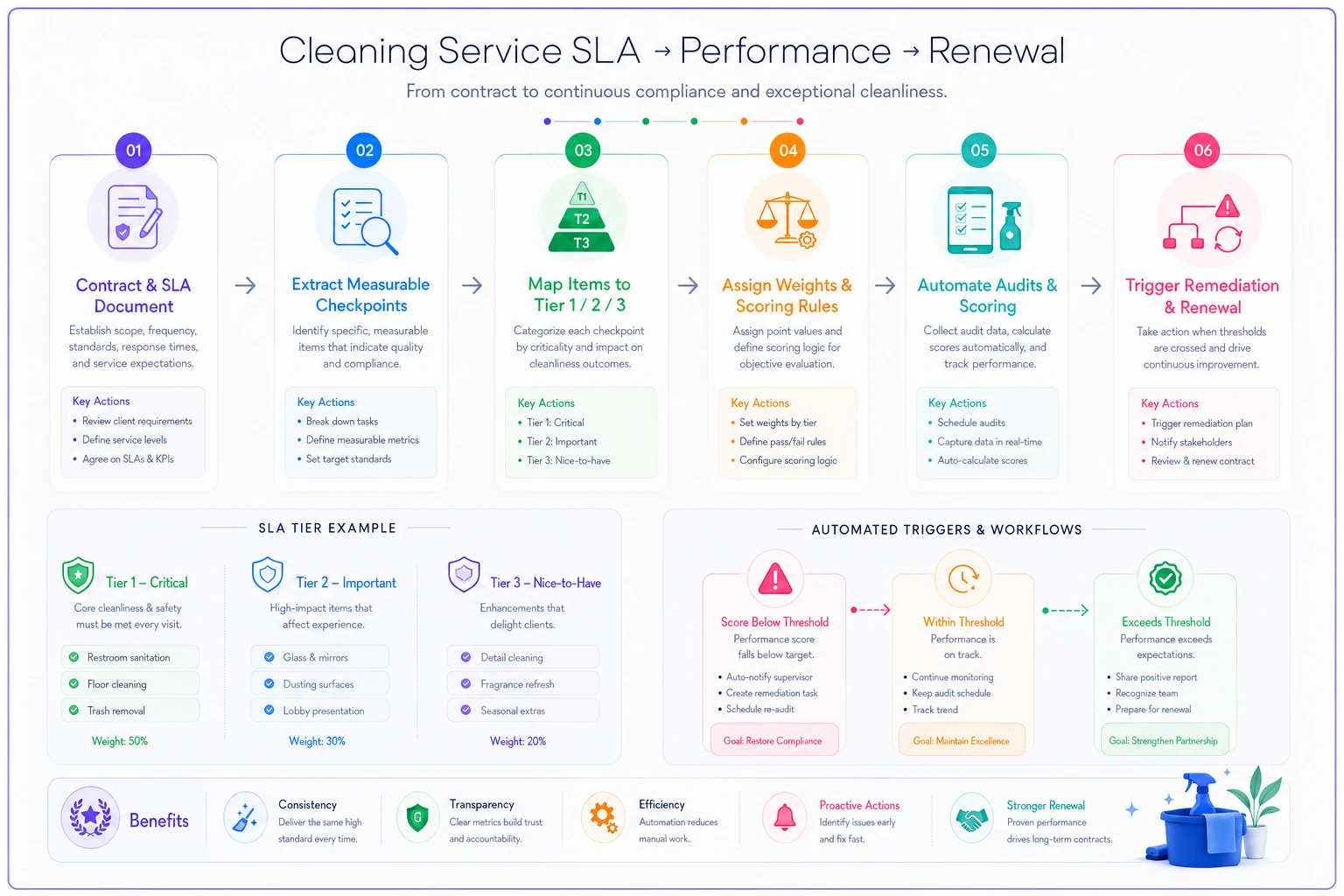
Score everything on a 0–3 scale and set clear thresholds so operations and sales know when to act.
Audit frequency patterns that prevent surprises
Standard monthly audits don't work for commercial cleaning. By the time you catch a problem, it's been happening for weeks and the client already noticed.
Cadence needs to match contract value and risk level:
High-value contracts (over $15,000/month): Weekly abbreviated audits hitting Tier 1 items only — roughly 20 minutes per location. Full comprehensive audit monthly covering all tiers. This catches issues within days, not weeks.
Standard contracts ($5,000–$15,000/month): Bi-weekly spot checks on rotating sections. Full audit monthly. Rotate through different days and times to capture various shifts and conditions.
Small contracts (under $5,000/month): Monthly comprehensive audit plus triggered audits based on complaints. Not economical to audit more frequently, but these typically have simpler SLAs anyway.
One thing people consistently miss on timing: audit the day before the client's typical inspection pattern. If property management walks the building every Wednesday morning, audit Tuesday afternoon. You want to see exactly what they'll see.
Audit the day before the client's typical inspection pattern.
For multi-shift operations, rotate audit times. Don't always check the day crew at 2 PM. Hit the night shift at 11 PM occasionally. Morning crew at 6 AM. Different shifts often have different performance patterns, and SLAs usually don't distinguish between them.
Creating audit reports that drive contract conversations
Raw scores mean nothing to clients. They want to know if you're meeting their specific requirements, not that you scored 247 out of 300.
Structure reports to mirror their priorities. Lead with SLA compliance percentage, not overall quality scores. Show specific line items they care about, not your internal operational metrics.
Executive Summary Box:
-
SLA Compliance
94% (target: 90%)
-
Critical Items Passed
12 of 12
-
Response Time Achievement
100%
-
Penalty Risk Status
None
Detailed Findings by Priority: Start with what they specified as most important in the contract. If infection control was their top concern during negotiations, lead with those metrics. If appearance standards drove the RFP, showcase those first.
Trending Analysis: Show three-month rolling averages for key metrics. Clients want to see consistency, not just point-in-time performance. A simple line graph showing score trends goes a long way toward building confidence.
Photo Evidence: Include 3–5 photos of exceptional work, not just problem areas. One client mentioned these photos alone stopped them from going to bid when renewal came up.
Action Items with Dates: Any score below standard needs a specific remediation plan with a completion date. Not "will address" — "retraining scheduled for Tuesday, follow-up audit on Friday."
Send reports within 24 hours of the audit. Delayed reports lose impact and suggest disorganization. Set up templates where you just fill in scores and comments — shouldn't take more than 15 minutes to complete once the structure is in place.
The penalty conversation playbook
When audit scores dip into penalty territory, the conversation approach determines whether you pay fines or get a grace period.
Never wait for the client to discover issues. The moment an audit shows SLA violation risk, initiate contact within 2 hours. Not next day. Not after you've figured out exactly what to say. Immediately.
The conversation framework:
Open with accountability: "During our audit at 2 PM today, we identified a service gap in the second-floor conference areas that doesn't meet our agreed standards."
Provide specific data: "Our ATP testing showed 47 RLU on conference table surfaces, above the 30 RLU threshold in Section 3.2 of our agreement."
Present the fix already in motion: "We've dispatched a remediation team arriving at 4 PM today. The area will be re-cleaned and retested by 6 PM. I'll send confirmation photos and test results by 7 PM."
Address systemic prevention: "To prevent recurrence, we're adjusting our daily sequence to hit conference areas 30 minutes earlier, before morning meetings increase bioload."
Request grace period if needed: "While we understand this technically triggers a Level 1 violation, we're asking for consideration given our immediate response and correction plan."
This works because you're not making excuses — you're showing operational control and proactive management. Property managers usually care more about responsiveness than perfection.
Document these conversations immediately. Email a summary within an hour stating what was discussed, what was agreed, and next steps. This prevents "misunderstandings" during invoice review.
Building renewal triggers from audit data
Smart operators use audit scores to time renewal conversations perfectly. Don't wait for the 90-day renewal window — build momentum when scores are high.
Set automatic triggers in your audit tracking:
When scores exceed 95% for three consecutive months: Schedule a renewal conversation for the following week. You're negotiating from maximum strength — this is when to push for rate increases or expanded scope.
When scores stay between 85–95% consistently: Begin renewal discussions 120 days out instead of 90. You need more runway to reinforce value since you're not clearly exceeding expectations.
When scores dip below 85% twice in six months: Start rehabilitation immediately. Document every improvement, every extra effort, every positive client interaction. You need ammunition for a defensive renewal negotiation.
-
Pull SLA document for the contract up for renewal
-
Cross-reference last six months of audit scores against Tier 1 penalty items
-
Identify any patterns — same area, same shift, same day of week
-
Address those patterns before the renewal conversation starts
-
Build your renewal presentation around the trajectory, not just current scores
In the 60 days before renewal discussions, increase audit frequency by roughly 50%. If you normally audit monthly, go bi-weekly. If bi-weekly, go weekly. This catches any lingering issues before negotiations start and generates fresh positive data.
The renewal presentation should lead with audit performance: "Over the past year, we've maintained 94% SLA compliance with zero penalty events. Our monthly audit scores averaged 267, with steady improvement from 251 in Q1 to 279 in Q4."
Then tie improvements to specific client benefits: "Your facility received more consistent attention to high-traffic areas, and complaint calls to your office dropped by roughly 60%."
Numbers like that justify rate increases and hold off competitive bids.
Sample audit scoring rubric for a medical office facility
Here's an actual scoring rubric adapted from a 15,000 square foot medical office contract worth $11,000 monthly:
| Category | Item | SLA Requirement | Weight | Score (0-3) |
|---|---|---|---|---|
| Infection Control | Exam room ATP levels | <30 RLU within 30 min of last patient | 15% | ___ |
| Waiting area high-touch | Disinfected every 2 hours | 10% | ___ | |
| Bathroom sanitization | Complete clean every 4 hours | 10% | ___ | |
| Response Times | Spill response | <10 minutes during office hours | 15% | ___ |
| Supply requests | Fulfilled within 2 hours | 5% | ___ | |
| Appearance | Entry glass/doors | Spot-free by 7:30 AM | 8% | ___ |
| Carpet appearance | No visible spots/stains | 7% | ___ | |
| Waiting room presentation | Magazines organized, furniture aligned | 5% | ___ | |
| Documentation | Daily logs | Submitted by 9 PM | 10% | ___ |
| Incident reports | Within 1 hour of occurrence | 10% | ___ | |
| Operational | Supply stock | Never below 20% capacity | 5% | ___ |
Scoring interpretation:
-
270–300
Exceeding all SLA requirements
-
240–269
Meeting SLA requirements
-
210–239
At risk, remediation needed
-
180–209
Violation territory, client notification required
-
Below 180
Penalty assessment likely
This rubric maps directly to Section 3 (Service Standards) and Section 7 (Performance Metrics) of the actual contract. Every item has a specific contract reference, which makes disputes a lot harder to sustain.
Technology's role in scaling audit systems
Managing contract-specific audits across multiple sites gets overwhelming fast once you're past 10 contracts. The administrative burden starts eating into margins in ways that are genuinely hard to track until it's already a problem.
AI-powered operational software changes this significantly. Instead of juggling different forms for each client, these platforms store custom rubrics and automatically generate the right audit checklist based on location and contract terms. The right audit form just appears in the field manager's app when they arrive on site — no version control headaches, no outdated paper forms.
The real efficiency gain is in automated scheduling and tracking. The platform assigns audits based on contract value and risk scores, sends reminders to field managers, and tracks completion rates. Photo requirements get enforced through the mobile app — you simply can't submit an audit without the required evidence attached.
Scoring calculations happen instantly. No more Excel formulas or manual math. The system weights scores according to your rubric, flags violations immediately, and pushes notifications to operations managers when scores drop below thresholds.
Report generation that used to take 30–45 minutes per site becomes a 2-minute export. The platform pulls scores, photos, and trending data into professional PDFs that go directly to clients. For multi-site contracts, AI automation aggregates scores across locations to show portfolio-level performance — which matters a lot for regional clients who want visibility across all their facilities, not just individual site reports.
The compliance tracking alone is worth the investment. Every audit creates a timestamped record. Every photo gets stored with metadata. If a client claims you missed service requirements six months ago, you have documentary evidence one way or the other.
Moving forward with confidence
The difference between a decent commercial cleaning audit checklist and one that actually protects your contracts isn't complexity — it's alignment. When every checkpoint traces back to specific SLA language, scoring reflects actual penalty risk, and reports speak the client's language, audits stop being an administrative burden and start functioning as a real business tool.
Start with your highest-value contract. Pull out the SLA document and build a custom rubric using the framework above. Run a pilot audit this week, score it properly, and generate a client-ready report. See how different it feels compared to a generic quality check.
The goal isn't perfect scores. It's catching issues before they become penalties, building trust through transparency, and creating data that makes renewals feel inevitable rather than uncertain. Your audit system should protect margins, not just measure mop water.
Most cleaning companies lose contracts because of accumulated small failures, not dramatic incidents. A proper SLA-aligned audit system catches those small failures while they're still fixable. That's the difference between defending your renewal and celebrating it.
Ready to simplify your cleaning operations?
Join 1,000+ cleaning businesses using Wipyly to save time, reduce scheduling conflicts, and enhance client satisfaction.