



Most cleaning service owners hit the same wall around 8-12 regular crews. Everything runs smoothly when you're directly managing everyone, but then your best crew lead quits, three new hires ghost after training, and your scheduling falls apart trying to cover 40+ weekly clients with a constantly shifting roster.
The problem isn't finding people—cleaning positions always attract applicants. The real breakdown happens in that gap between hiring someone and having them productively clean houses six months later. That gap contains dozens of small decisions that determine whether you're building a stable workforce or running an expensive revolving door.
Cleaning work follows predictable patterns, which should make staffing easier. A three-bedroom house takes roughly the same time whether it's Tuesday or Thursday, whether it's Maria's crew or Jennifer's crew. Yet cleaning services lose roughly 300% of their workforce annually. For every person still working after a year, three others have quit.
Some businesses accept this as normal, constantly recruiting to replace departures. Others build systems that cut turnover in half while improving service quality.
Why traditional hiring breaks down for cleaning crews
The standard hiring process most businesses copy from corporate handbooks misses fundamental realities about cleaning work. You're not filling desk positions where people show up at 9am to the same location. You're building mobile teams that work independently in clients' homes, starting at different locations each day, handling both physical work and customer interaction.
Consider what typically happens during a cleaning service hire. Someone applies online, fills out a basic application. You call them, ask about experience, schedule an interview. They show up (or don't), you chat for 20 minutes about their background, maybe check references. If they seem reliable, you offer them the job, pair them with an experienced cleaner for a day or two, then add them to the schedule.
This process screens for almost nothing that predicts cleaning crew success. The person who interviews well might hate the physical reality of cleaning six houses in a day. The one with great references from hotel housekeeping might struggle with the independence of residential cleaning. Meanwhile, someone who'd become your best team lead never applies because your job posting asks for "5 years experience" when they've only cleaned their own home.
Cleaning work clusters in specific time windows—most residential clients want morning service, most commercial wants evening. This creates scheduling conflicts that standard hiring ignores. You hire someone full-time, then realize you can only offer them 25 productive hours because travel time eats the rest. Or you hire part-time, but they quit when another job offers more hours.
Geography matters too. A cleaner living on the north side of town might spend an hour driving to their first house on the south side, unpaid, burning their own gas. After a few weeks, they calculate they're effectively making $11 an hour after expenses when you're paying $16. They don't complain—they just stop showing up.
Building a hiring funnel that actually predicts retention
Cleaning services with 50% turnover instead of 300% hire for situation fit before skill fit. Someone's life circumstances matter more than their cleaning experience.
Stop losing bookings in operational chaos.
Wipyly helps you manage, confirm, and optimize every cleaning appointment efficiently.
- Centralized booking management
- Automated client notifications
- Staff scheduling & route optimization
No credit card required
Start with your application process. Instead of asking about years of experience, ask about transportation reliability, schedule flexibility, and physical stamina. Include questions like "Can you reliably get to different locations across the city?" and "Are you comfortable being on your feet and active for 8 hours?" These filter for reality, not resume keywords.
Initial Application Questions:
-
Do you have reliable transportation that you control? (not depending on others for rides)
-
Can you work Monday through Friday, starting between 7-8am?
-
Are you comfortable with physical work including lifting, bending, and standing for extended periods?
-
Can you pass a background check?
-
Are you looking for
Full-time (30+ hours) / Part-time steady (15-25 hours) / Flexible fill-in work
Second Stage Questions (for those who pass initial):
-
Where do you live? (zip code to assess commute patterns)
-
What's your availability for the next two weeks to start training?
-
Have you worked independently without direct supervision before?
-
Tell us about a time you had to solve a problem on your own at work
Notice what's missing—no questions about cleaning experience, no requests for resumes, no emphasis on prior employers. These questions identify people whose life situation aligns with the job reality.
The phone screen gets specific fast. Use about 10 minutes with reality checks:
"The position involves driving your own vehicle to 4-6 homes per day. We reimburse mileage at 58 cents per mile, typically $30-40 per day. You'd get paid every two weeks. The work is physical—lots of movement, lifting, bending. Starting pay is $15-17 per hour depending on experience, with increases at 90 days and 6 months. Does this still sound like something that works for you?"
About half drop out here when confronted with specifics. Better they self-select out now than quit after training.
The probation workflow that saves you from bad fits
Even solid screening can't predict everything. Someone might interview perfectly then discover they're allergic to cleaning chemicals, or realize they can't handle client interaction. Most cleaning services waste resources by investing in full training before discovering these fundamental mismatches.
Day 1-2: Shadow Only New hire rides along with an experienced crew, observes, asks questions. They don't clean—they watch. Pay them their hourly rate for this. You're investing about $250 to learn if they show up on time, interact well with the team, and maintain interest after seeing the actual work.
Day 3-5: Supervised Assistance They help with basic tasks under direct supervision. Dusting, vacuuming, simple bathroom cleaning. Still with an experienced crew, but now participating. Watch for physical stamina, attention to detail, and how they handle correction.
Week 2-3: Junior Team Member Paired with a crew as the third person (normally two-person crews). They handle defined portions of houses independently while crew lead checks their work. This reveals whether they can work without constant supervision.
Week 4: Route Testing They complete a full route with shifting supervision—crew lead is there but deliberately steps back. Can they maintain pace? Handle unexpected situations? Communicate with clients professionally?
Only after passing all four stages do they become full team members. Yes, this means a month of reduced productivity from that employee. But compare that to the cost of having them quit after two months, leaving you scrambling to cover their routes while restarting the hiring process.
Track specific checkpoints during probation:
| Checkpoint | Target | Days |
|---|---|---|
| Arrives on time | 10/10 days | 1-10 |
| Appropriate hygiene/presentation | 10/10 days | 1-10 |
| Positive team interaction | 10/10 days | 1-10 |
| Maintains work pace | Pass/Fail | Day 10 |
| Quality meets standards | Pass/Fail | Day 15 |
| Handles client interaction | Pass/Fail | Day 20 |
Anyone failing checkpoints gets redirected early, saving both parties wasted time.
Here's a quick visual of the probation workflow.
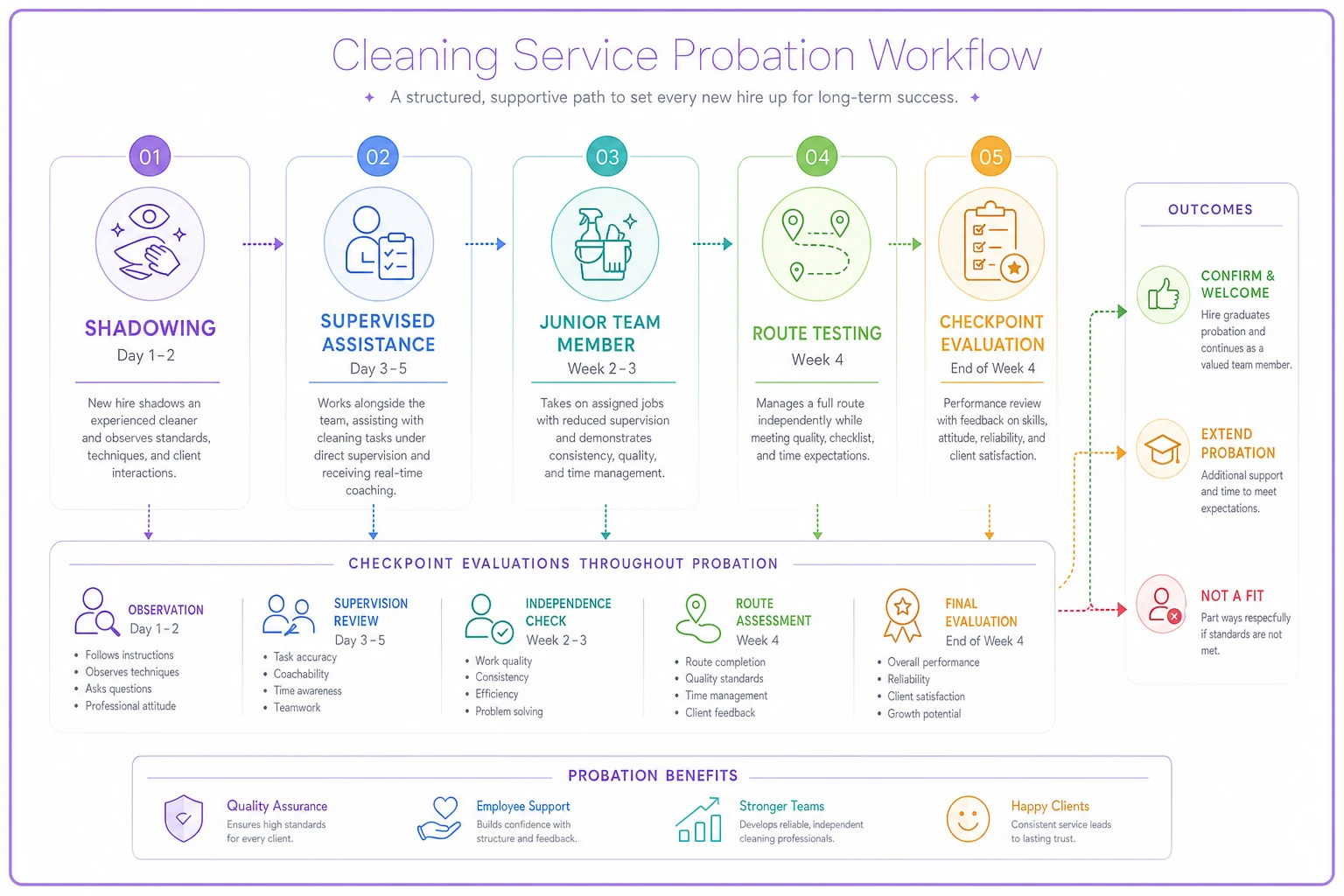
Use this visual when onboarding new hires.
Shift patterns that match cleaner reality with client needs
The standard Monday-Friday, 8am-5pm schedule that most businesses default to creates unnecessary turnover. It assumes all cleaners have the same availability and all clients want the same service windows. Neither assumption holds.
Map your actual demand patterns first. Pull three months of scheduling data and identify when clients actually want service. You'll likely find patterns like:
-
70% of residential wants morning service (8am-noon)
-
20% are flexible about time
-
10% specifically want afternoon
-
Commercial properties want evening or weekend
-
Certain zip codes cluster on specific days
Now map your cleaner availability reality. You'll discover categories like:
The School-Hours Cleaner Usually parents who need to drop kids at 8:30am and pick up at 3pm. Perfect for 9am-2pm shifts, about 20-25 hours weekly. They're incredibly reliable during school months but need coverage during breaks.
The Full-Timer Plus Wants 40+ hours, willing to work early/late/weekends. Often supporting a family on this income alone. They'll take every hour you can give them and cover emergency calls.
The Steady Part-Timer Has another job or commitment, wants consistent 2-3 days per week. Same days, same houses if possible. Won't take extra shifts but rarely misses scheduled ones.
The Flex Filler College students, gig workers, people between careers. Availability changes weekly, can't commit to regular schedule. Great for covering gaps but won't anchor a crew.
Instead of forcing everyone into the same mold, build distinct shift patterns:
School Hours Crew (9am-2pm) handles Monday/Wednesday/Friday or Tuesday/Thursday, covering 3-4 houses per day. They're home by school pickup and earn around $300-400 weekly.
Early Full Route (7am-3pm) works Monday through Friday, handles 5-6 houses per day, gets first pick of overtime and weekend work. These people earn $600-700 weekly and anchor your operation.
Split Coverage (10am-6pm) handles late morning and afternoon flexibility, mixing residential and small commercial. They can work Tuesday through Saturday and earn $500-600 weekly.
Weekend Specialist (Saturday/Sunday) gets premium pay (extra $2/hour), covers move-out cleanings and special requests, with optional Friday addition. This brings in $250-450 weekly income.
This variety expands your hiring pool and improves coverage when someone calls out. Most importantly, it reduces turnover by matching job structure to life structure.
Building schedules that reduce chaos
Most cleaning services schedule reactively. A client calls wanting service, you check who's available, assign it, hope it works. This creates constant small disruptions that exhaust crews and create quality problems.
Build route stability instead. Assign each crew a base route that repeats weekly or bi-weekly:
Maria's Crew - Monday Route:
-
8
00am - Johnson house (North Oak area)
-
9
30am - Peterson house (North Oak area)
-
11
00am - Williams house (Downtown)
-
1
00pm - Lunch
-
1
30pm - Anderson office (Downtown)
-
3
00pm - Chen house (Riverside)
The geographic clustering in the morning isn't random. Neither is the lunch break after the physically hardest houses, or the mix of residential and commercial. It's designed for sustainability.
Build these routes with specific rules:
-
Geographic Clustering
No more than 15 minutes drive between houses in the same area
-
Difficulty Balance
Alternate hard cleanings (large houses, heavy soil) with easier ones
-
Client Personality Balance
Don't stack all the demanding clients on one day
-
Break Planning
Build in a real lunch break, not just "eat while driving"
-
End Time Padding
Last appointment should finish 30 minutes before promised end time
The critical part: protect these base routes. When new clients call, fit them into existing routes rather than disrupting everything. Can't fit them? They join a waitlist for that area/time, or you offer them a different slot.
This might seem rigid, but it creates predictability that keeps cleaners happy. They know their Monday will always be North Oak morning, Downtown afternoon. They can plan their life around it. Clients get consistent crews who know their homes. Quality improves because crews aren't constantly adjusting to new patterns.
The retention levers nobody talks about
Pay matters, but not as much as owners think. The cleaner making $17/hour with a predictable schedule, reliable hours, and respect stays longer than the one making $19/hour with chaos, uncertainty, and poor treatment.
Small operational decisions have outsized retention impact.
Supply Management Requiring cleaners to buy their own supplies seems minor—maybe $30 monthly. But it's a constant irritation, especially when they run out mid-route. Companies that provide all supplies, including the good vacuums and mops cleaners actually want to use, see noticeable retention improvement. The cost is maybe $50 per cleaner monthly, far less than replacing someone.
Payment Timing Weekly pay costs more in processing than bi-weekly, but for workers living paycheck-to-paycheck, that seven-day difference matters enormously. One company switched from bi-weekly to weekly pay and cut turnover by 30% with no other changes.
Communication Respect Companies with lowest turnover have one surprising common practice: they close their cleaner WhatsApp/text threads on evenings and weekends. Cleaners aren't getting barraged with "emergency" schedule changes at 9pm. Changes wait until morning unless genuinely urgent. This simple boundary makes cleaners feel like professionals, not on-call servants.
Advancement Pathways Create real progression beyond "cleaner" and "crew lead." Options like Quality Inspector ($2/hour more, reviews completed cleanings), Training Specialist ($2/hour more, onboards new hires), Route Coordinator ($3/hour more, helps plan schedules), or Client Relations Specialist ($3/hour more, handles complaints/special requests).
Mistake Handling How you handle the inevitable broken vase or scratched floor sends powerful signals. Companies that immediately blame cleaners, dock pay, or threaten firing create fear-based cultures where people quit at the first opportunity. Those that treat mistakes as system failures to investigate together keep people longer.
Switch to weekly pay if many cleaners live paycheck-to-paycheck — the retention gains often offset the processing cost.
These aren't fake titles—they're real responsibilities that let good cleaners grow without leaving.
Scripts that work in real conversations
When interviewing, try this reality check: "I want to be really transparent about what this job involves. You'll be cleaning 4-6 houses per day, spending about 90 minutes in each. The work is physical—lots of bending, lifting, moving furniture. You'll be using professional cleaning chemicals with proper ventilation but some people find the smells challenging. You'll drive your own vehicle between houses, we reimburse at 58 cents per mile which usually comes to $30-40 per day paid out weekly. The starting pay is $15 per hour for the first 30 days, then $16 per hour, with another review at 90 days. After seeing the reality of the job, does this still interest you?"
For first day orientation: "Welcome to the team. Over the next month, you'll gradually learn our system. This week is just observation and basic helping—no pressure to be fast or perfect. Week two, you'll start doing more independently but always with support. By week four, you should be comfortable working as part of a crew. We'd rather take time getting you properly trained than rush you into situations you're not ready for. My phone is always on during work hours if you have questions or problems. What questions do you have for me?"
When introducing new cleaners to clients: "Dear [Client Name], I wanted to introduce you to [Cleaner Name] who will be joining your regular cleaning crew starting [Date]. [Cleaner Name] has completed our full training program and will be working alongside [Experienced Cleaner Name] who you already know. This helps us maintain consistent quality while building a stronger team to serve you. If you have any special instructions or preferences, please let me know and I'll make sure [Cleaner Name] is aware. Thank you for your patience as we grow our team to better serve you."
For performance concerns: "Hey [Name], I wanted to check in about something I've noticed. The last few days, [specific issue like arriving late/missing areas/seeming tired]. This isn't like you—you're normally [positive trait]. Is everything okay? Is there something about the job or schedule that isn't working for you that we could adjust?"
When staff scheduling becomes your competitive advantage
Cleaning services that scale successfully past 20, 30, even 50 employees don't do it through recruitment genius. They build operational systems that make people want to stay. Their scheduling respects cleaner reality. Their progression paths give people futures. Their daily operations treat cleaners as professionals, not replaceable labor.
Every cleaner who quits costs you around $3,200 to replace when you factor in recruitment time, training hours, lost productivity, and quality issues during transition. A company with 20 cleaners turning over 300% annually spends nearly $200,000 per year just treading water. Cut that turnover and you save enough to hire additional full-time cleaners or invest in growth.
Modern cleaning services increasingly rely on AI-powered operational software to handle the complexity of matching cleaner availability with client needs, tracking performance checkpoints during probation, and maintaining consistent communication without overwhelming anyone. These platforms can automatically build routes that respect your clustering rules, flag when someone's showing early turnover warning signs, and ensure new hires get the right information at the right time.
But software just amplifies good systems—it doesn't create them. The fundamentals remain human: hire for situation fit, respect the reality of the work, build predictable patterns, and treat cleaners as professionals building careers, not just filling slots.
Most cleaning service owners want to focus on growth and customer service, not constantly recruiting and training. Building these systems takes upfront work—maybe a month of restructuring how you hire, schedule, and manage. But once in place, they run themselves and give you the stable workforce needed to actually scale.
Most cleaning service owners want to focus on growth and customer service, not constantly recruiting and training. Building these systems takes upfront work—maybe a month of restructuring how you hire, schedule, and manage. But once in place, they run themselves and give you the stable workforce needed to actually scale.
Ready to simplify your cleaning operations?
Join 1,000+ cleaning businesses using Wipyly to save time, reduce scheduling conflicts, and enhance client satisfaction.