

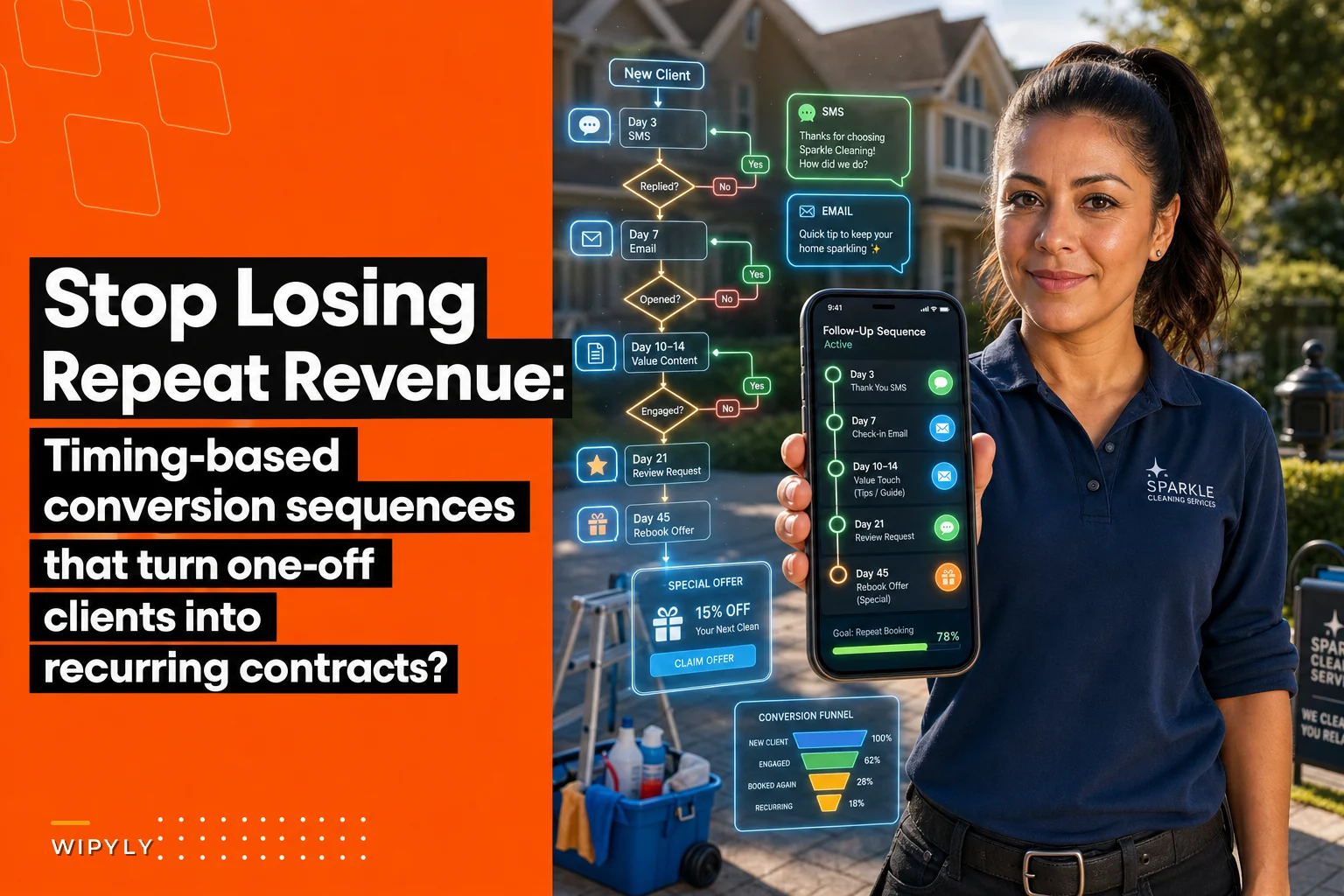

Most cleaning businesses watch the same pattern play out month after month: a new client books a deep clean, loves the results, says they'll call again... and disappears. You're left wondering if it was the price, the service, or just bad timing.
These aren't unhappy customers. They genuinely appreciated your work. They just never made the mental shift from "I need a cleaner for this specific mess" to "I need regular cleaning service." Without a real follow-up system, you'll keep losing potential recurring revenue to competitors who figured out timing-based follow-up a long time ago.
The conversion window nobody talks about
There's roughly a 14-day window after the first service where clients are most likely to convert to recurring contracts. Miss it, and your conversion rate drops by around 70%.
Why 14 days? It's long enough for the "clean house high" to fade but short enough that they still remember how good it felt. By day 21, they've adjusted to handling cleaning themselves again. By day 30, booking a recurring service feels like a brand new decision rather than a natural next step.
Most cleaning businesses either follow up too aggressively—next-day calls that feel pushy—or not at all, just waiting for the client to reach out whenever. Neither approach respects the actual psychological journey from one-time need to ongoing commitment.
Three conversion offers that actually work
Not every one-time client should get the same offer. The deep clean client who just moved has completely different needs than the party aftermath client or the spring cleaning customer. Your conversion approach needs to match why they booked in the first place.
Stop losing bookings in operational chaos.
Wipyly helps you manage, confirm, and optimize every cleaning appointment efficiently.
- Centralized booking management
- Automated client notifications
- Staff scheduling & route optimization
No credit card required
For move-in deep cleans: Wait 10 days, then offer a "maintenance package" at 30% less than their deep clean price. Frame it as protecting their fresh start. These clients convert at the highest rate—around 35%—because they're already establishing new routines.
For event or emergency cleans: Follow up after 7 days with a "preventive cleaning" angle. Show them how regular service costs less than crisis cleaning. Include photos from their service showing the before/after difference. Conversion rate hovers somewhere between 18-22%.
For seasonal deep cleans: These are your toughest conversions, typically below 15%. Wait the full 14 days, then offer a trial month at a discount. The key message: "We know you handle daily cleaning well—let us handle the deep stuff monthly."
The mistake that shows up constantly is the generic "10% off recurring service" email that completely ignores why they booked initially. That's like a dentist sending the same follow-up to someone who came for a routine cleaning and someone who just had emergency root canal work.
Message templates tied to satisfaction signals
Your follow-up message should change based on how the first service actually went. A five-star review client gets different messaging than someone who had minor complaints. This isn't manipulative—it's just addressing their real experience.
For highly satisfied clients (5-star reviews, tips, or explicit compliments): "Hi [Name], noticed you loved having [specific area they complimented] finally tackled! Most clients tell us the hardest part is keeping it that way. Would you like to lock in that fresh feeling with regular service? Here's a no-commitment trial month at [X]% off..."
For satisfied but quiet clients (no complaints, standard tip): "Hi [Name], it's been about two weeks since we cleaned your home. Right about now is when dust starts building up again and bathrooms need attention. Before you spend another Saturday cleaning, wanted to share our recurring service options..."
For clients with minor issues resolved: "Hi [Name], wanted to check that everything still looks good after we addressed [specific issue]. If you're happy with how we handled that, I'd love to show you our recurring service options that include our satisfaction guarantee..."
None of these messages pretend the first service didn't happen. They build on the actual experience rather than starting fresh.
The tripwire sequence that maximizes conversions
Here's the exact sequence that consistently outperforms random follow-up:
-
Day 3
Satisfaction check — Brief text asking if everything still looks good. No selling. Just care. About 60% respond, giving you real engagement data.
-
Day 7
Soft value-add — Send a cleaning tip related to what you noticed during service. "Noticed your shower glass—here's a trick to keep it spotless between cleanings..." Still no hard sell.
-
Day 10-14
Conversion offer — (Timing depends on service type.) Present your specific offer based on their situation. Include three options: weekly, bi-weekly, monthly. Always include an easy-out clause for the first month.
-
Day 21
Final attempt — If no response, send a "before we close your file" message with a standing offer they can use anytime in the next 30 days.
-
Day 45
Reactivation — One last touch with a different angle—usually seasonal. "Spring allergies starting? Remember how fresh your air felt after our deep clean..."
This sequence respects their decision timeline while keeping you present during the conversion window. Assertive without being aggressive.
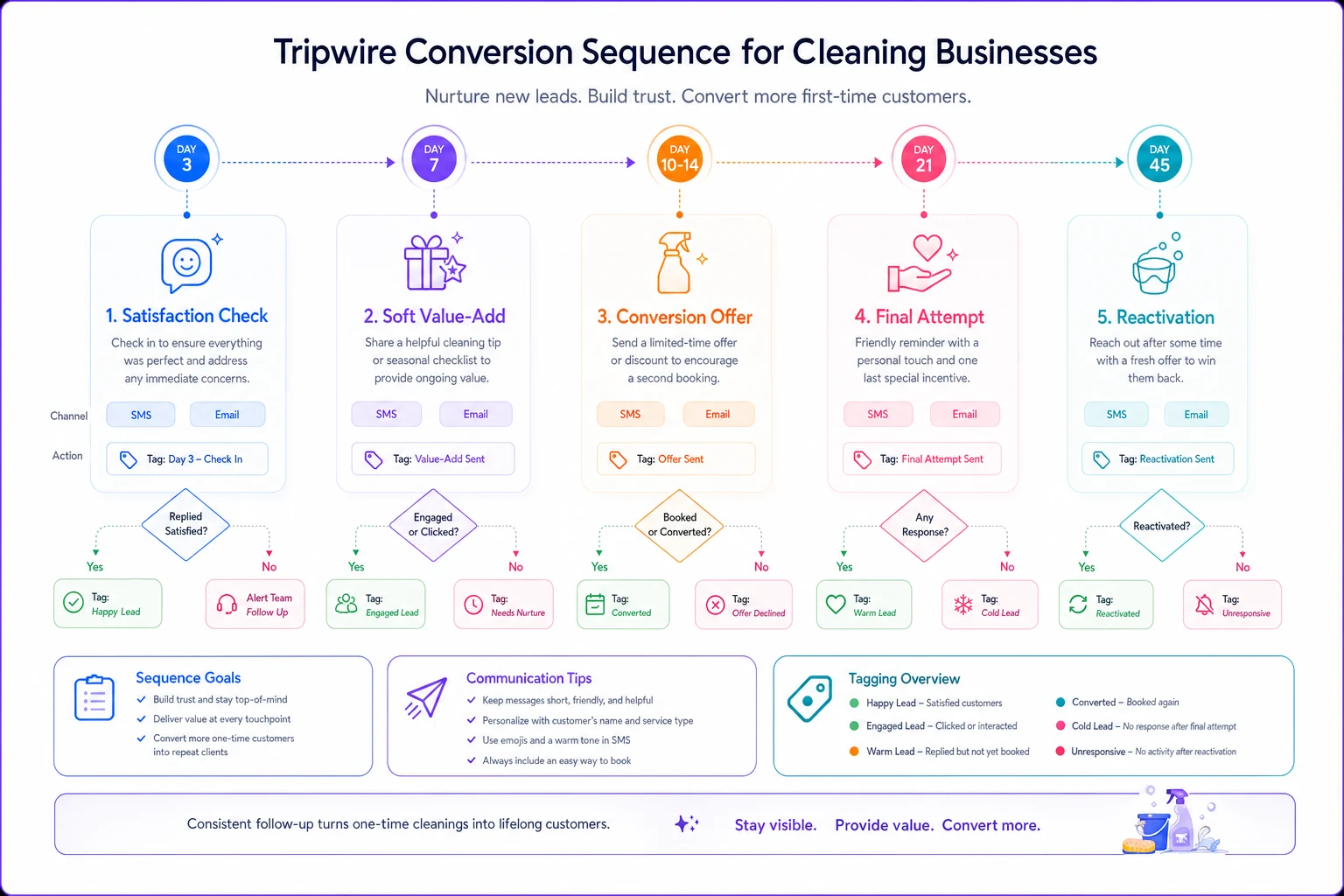
A simple visual of the sequence helps teams understand the timing and handoffs between outreach channels and CRM tagging.
A useful way to think about how each touchpoint connects to the next: the early steps are purely relational, and the conversion offer only lands at the moment trust is already warm. Skipping Day 3 and Day 7 and jumping straight to the offer is the most common reason this kind of sequence underperforms.
Why job type matters more than demographics
A 35-year-old professional who booked emergency cleaning after their nanny quit needs completely different messaging than another 35-year-old professional who booked pre-holiday deep cleaning.
Job types tell you about life patterns:
-
Move-in cleans → Major life transition, establishing new routines
-
Emergency cleans → Overwhelmed, needs reliable support
-
Event cleans → Image-conscious, values presentation
-
Seasonal cleans → Organized but occasionally needs help
-
Construction cleans → Project-focused, likely a temporary need
Your operational software should tag each booking by type, not just track customer demographics. That tag drives your entire conversion sequence. When you message based on situation rather than statistics, relevance jumps dramatically.
Reading satisfaction signals beyond reviews
Star ratings tell you something, but behavior tells you more. Here's what actually predicts conversion likelihood:
High conversion probability:
-
Tips above 20%
-
Requests your specific team again
-
Asks about additional services during the visit
-
Provides gate codes or keys unprompted
-
Texts a thank you after service
Medium conversion probability:
-
Standard tip
-
No complaints but no enthusiasm
-
Was home during service
-
Asked detailed questions about products or methods
Low conversion probability:
-
No tip or minimal tip
-
Multiple rescheduling attempts
-
Excessive pre-service instructions
-
Price negotiations on the initial booking
-
Explicitly compared your quote to others
Track these signals. A client who tipped 25% and asked for the same team back gets a different follow-up intensity than someone who haggled on price and provided three pages of instructions before you even showed up.
The recurring contract structure that sticks
When someone does convert, the first 90 days determine whether they'll stay long-term. A lot of cleaning businesses lose close to 40% of new recurring clients within three months because the contract structure doesn't match what the client actually expected.
Start with a "trial month" that's technically month-to-month but positioned as a test period. Include:
-
One free re-clean if they're unsatisfied
-
Flexible scheduling for the first month
-
Ability to adjust service level after two visits
-
Clear communication preferences checkbox
After the trial month, present three commitment levels:
| Commitment Level | Pricing | Cancellation Notice | Extra Perks |
|---|---|---|---|
| Month-to-month | Full price | 72-hour notice | Flexible |
| 3-month commitment | 5% discount | 1-week notice | — |
| 6-month commitment | 10% discount | Locked-in pricing | Priority scheduling |
Around 65% choose the 3-month option. It feels committed without feeling trapped.
Common conversion killers to avoid
Calling too soon: Next-day follow-up feels desperate. Give them time to actually live in their clean space.
Overexplaining recurring service: They know what regular cleaning is. Three paragraphs on the benefits of consistency is too much.
Ignoring their booking channel: Someone who found you on Thumbtack expects different communication than someone who called after a neighbor referred you.
Generic discounts: "New customer special" for someone who's already been your customer feels tone-deaf.
Pressure tactics: "Limited spots available" might work for new prospects but feels off to someone who just experienced your service firsthand.
Building the tech stack for conversion tracking
Your conversion system needs three technical components working together:
CRM tagging system:
-
Service type (deep, emergency, seasonal, etc.)
-
Satisfaction indicators
-
Response tracking for each touchpoint
-
Conversion outcome
Automated messaging platform:
-
Dynamic templates based on tags
-
Multi-channel capability (SMS, email)
-
Response detection
-
Sequence triggers
Performance dashboard:
-
Conversion rate by service type
-
Message performance
-
Time-to-conversion tracking
-
Revenue impact calculations
The actual tech matters less than how well the systems connect. A basic CRM with solid tagging beats expensive software with poor implementation. Businesses have tripled their conversion rates just by properly categorizing initial bookings and automating appropriate follow-up sequences—nothing fancy required. AI-powered operational software makes this kind of tagging and sequencing significantly easier to manage at scale, but even a well-organized spreadsheet beats doing nothing systematically.
Start by tagging service type and key satisfaction signals before you build automated templates—your messaging will perform much better.
The actual tech matters less than how well the systems connect. A basic CRM with solid tagging beats expensive software with poor implementation.
When not to push for conversion
Some one-time clients should stay one-time clients. Pushing everyone toward recurring service wastes resources and can actually hurt your reputation.
Don't pursue conversion for:
-
Clients who explicitly stated a temporary need (selling a house, construction project)
-
Anyone who complained extensively despite resolution attempts
-
Price-shoppers who brought up multiple competitor quotes
-
Clients requiring excessive customization you can't sustainably deliver
These clients drain margin and team morale when forced into recurring relationships. Let them go gracefully with a "we're here when you need us" message and move on.
The math behind conversion timing
Running the numbers on a typical cleaning business with 30 new one-time clients monthly:
| Scenario | Conversion Rate | Monthly Converts | Annual Recurring Revenue |
|---|---|---|---|
| No systematic follow-up | ~12% | 3-4 clients | ~$35,000 |
| Timing-based conversion system | ~28% | 8-9 clients | ~$85,000 |
The difference compounds. Those extra monthly conversions become dozens of additional recurring clients annually. At an average lifetime value of around $2,800, the revenue impact from a system that costs almost nothing to implement is significant.
Measuring what matters
Track these metrics weekly:
-
Conversion rate by service type
-
Days to conversion (average and median)
-
Message response rates
-
Trial month retention
-
90-day retention
If conversion rates drop below 20% for move-in cleans or below 10% for seasonal cleans, your messaging needs adjustment. If trial month retention falls below 70%, service delivery and client expectations aren't aligned.
Track trends, not just snapshots. A steady 18% conversion rate beats one that spikes to 30% one month and crashes to 8% the next. Consistency is what lets you actually forecast revenue and capacity.
Starting your conversion sequence tomorrow
Pick your five most recent one-time clients who seemed satisfied. Check how many days it's been since their service. If any of them fall within the 7-14 day window, send a personalized message today based on their service type.
Don't wait for the perfect system. Start with manual follow-up to test your messaging, then gradually automate what works. Even following up exclusively with move-in deep clean clients—your highest probability conversions—will generate noticeable recurring revenue within 30 days.
The businesses doing this well aren't doing anything revolutionary. They're just being systematic about follow-up instead of hoping clients spontaneously decide they want recurring service. They understand that converting one-time cleaning clients isn't about pushy sales tactics—it's about reaching out at the right moment with the right message based on real signals.
Your one-time clients don't need convincing that you do good work. They've already seen it. They just need a nudge at the right moment to make recurring service feel like the obvious next step rather than a new commitment. Build that system, and your recurring revenue will grow in a way you can actually predict.
Ready to simplify your cleaning operations?
Join 1,000+ cleaning businesses using Wipyly to save time, reduce scheduling conflicts, and enhance client satisfaction.