

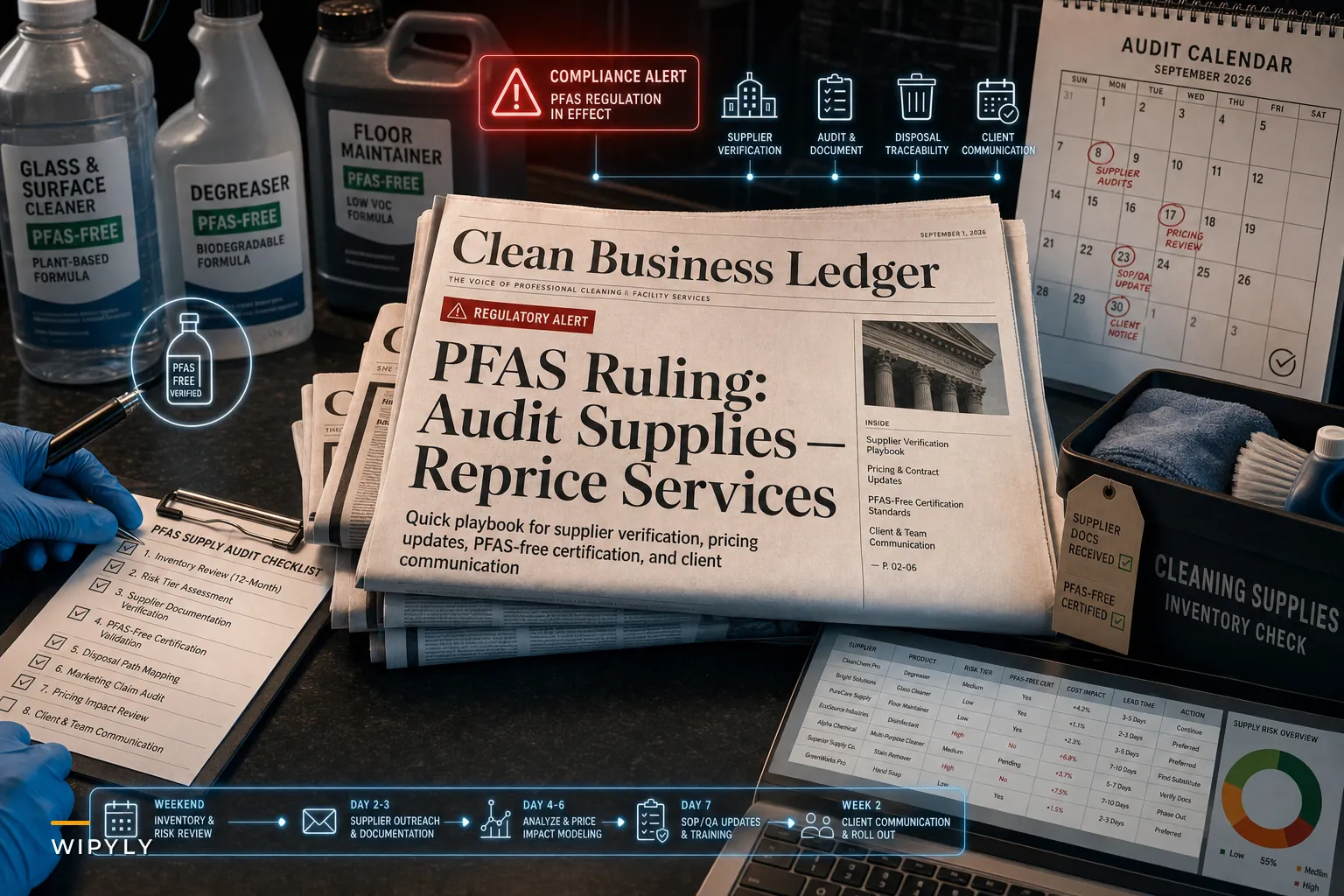

The August 18, 2026 appeals court decision that upheld the EPA's designation of PFOA and PFOS as CERCLA hazardous substances didn't invent a new problem for cleaning companies. It closed the door on the hope that the problem might quietly go away. For owners who were half-watching this litigation, that door closing is the cue to actually do something.
What most coverage skips is this: the ruling itself doesn't ban a single product you're currently using. It's a liability and cleanup framework, not a product recall. But the downstream effects — supplier reformulations, price movement on certain chemical lines, clients suddenly asking whether your workflow is "PFAS-free" — are where cleaning businesses actually feel it. And those effects arrive on a much faster clock than any enforcement action.
So this isn't a legal explainer. It's an operational one. What to check, in what order, and how to keep the whole thing from turning into a margin leak.
First, understand what actually changed for you (and what didn't)
The designation matters because of liability chains. Under CERCLA, hazardous-substance classification pulls parties who "arranged for disposal" or handled contaminated materials into potential cleanup responsibility. For a cleaning company, the realistic exposure isn't that you'll be named in some Superfund case tomorrow. It's narrower:
-
You dispose of used product, rags, mop water, or filters that may contain trace PFAS
-
You service facilities where PFAS handling is part of the client's operation
-
You make a marketing claim ("PFAS-free," "green," "non-toxic") that you can't actually back up
That last one is the sleeper risk. The EPA's own background on the PFOA/PFOS designation makes clear how broadly these compounds show up in industrial and consumer supply chains — which means a confident "PFAS-free" claim on your website is a claim about products you didn't manufacture and can't personally test. That gap gets small operators in trouble long before any cleanup letter arrives.
What didn't change: your day-to-day cleaning is still legal, your existing products are still on the shelf, and nobody is coming to inspect your van. The pressure is coming from two directions — suppliers repricing and reformulating, and clients starting to ask questions. Both are manageable if you get ahead of them.
Where PFAS actually hides in cleaning supplies
Most owners assume PFAS is a "coatings and firefighting foam" problem, not a mop-and-bucket problem. That's partly true, but the overlap with PFAS cleaning supplies is bigger than people expect. The compounds show up as surface-treatment agents, water and stain repellents, and processing aids. In a typical cleaning inventory, the suspects cluster in a few categories.
Stop losing bookings in operational chaos.
Wipyly helps you manage, confirm, and optimize every cleaning appointment efficiently.
- Centralized booking management
- Automated client notifications
- Staff scheduling & route optimization
No credit card required
| Product category | Why PFAS may be present | Likelihood | What to do |
|---|---|---|---|
| Floor finishes & sealers | Used as leveling/wetting agents | Medium–High | Request reformulation status from maker |
| Stain & water repellents (carpet, upholstery) | Core function historically PFAS-based | High | Prioritize substitution |
| Waxes and buffing products | Surface-slip additives | Medium | Verify with SDS + supplier letter |
| Non-stick / anti-graffiti coatings | Fluoropolymer chemistry | High | Substitute or document client-owned |
| General detergents & degreasers | Rarely intentional; possible trace | Low | Get supplier confirmation, don't panic |
| Microfiber cloths / treated wipes | Some durable-water-repellent treatments | Low–Medium | Check treated vs untreated stock |
The pattern worth noting: the highest-risk items are usually the specialty products — the stuff used on maybe 10% of jobs but charged at a premium. Bread-and-butter neutral cleaners are mostly fine. That's operationally good news, because it means your audit can be focused rather than a full inventory teardown.
One mistake worth calling out: owners reading a Safety Data Sheet, seeing no PFAS listed, and calling it done. SDS documents don't reliably disclose trace PFAS or proprietary processing aids. "Not on the SDS" is not the same as "not in the product." You need a supplier statement, not just a datasheet scan.
The supply audit, done in a weekend
You don't need a lab. You need a structured pass through what you buy, what you claim, and what you throw away. A small operator can realistically get through this in a couple of days.
-
Pull your full purchase list. Everything from the last 12 months, not just what's in the closet right now. Seasonal and specialty products are exactly where the risk concentrates.
-
Sort into the risk tiers above. High, medium, low. Ignore low for now — focus energy where it matters.
-
Send one standard letter to each supplier of high/medium items. Ask three things: Does this product contain intentionally added PFAS? Have you reformulated or do you plan to? Can you provide written confirmation? Keep the responses in one place.
-
Flag every product with no clear answer. No response within a reasonable window is itself an answer — treat it as "assume risk until proven otherwise."
-
Map your disposal. Where does used product, wash water, and spent material go? For most maintenance cleaning this is routine, but anti-graffiti removal, industrial degreasing, or coating work deserves a closer look at how waste leaves your hands.
-
Audit your own marketing. Every place you say "green," "eco," "non-toxic," or "PFAS-free." If you can't back it with supplier documentation, soften the language now.
That sixth step protects you more cheaply than almost anything else. Rewording a webpage costs an afternoon. Defending an unsupported claim costs considerably more.
Below is a simple workflow you can follow for the weekend audit.
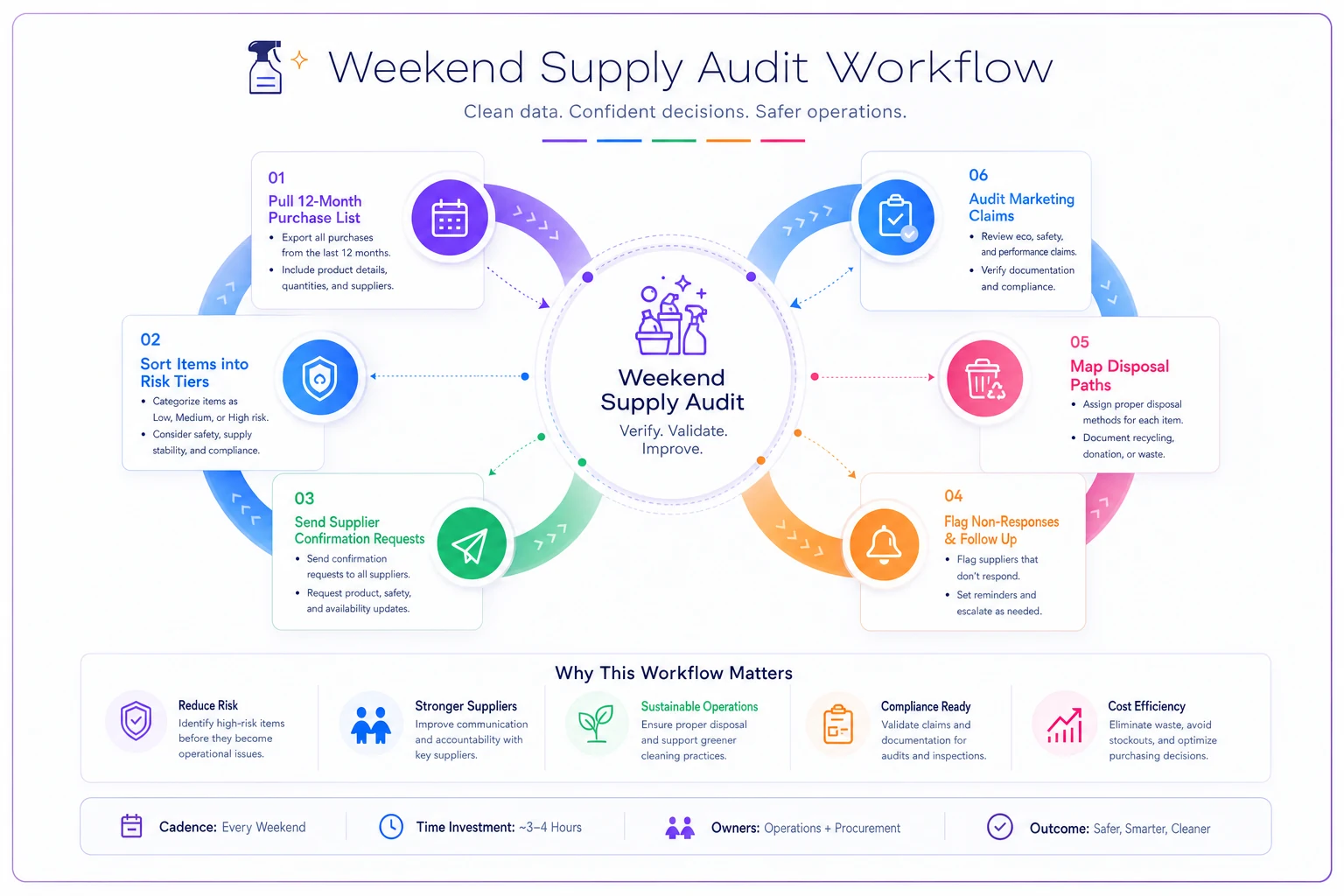
Use this as a one-page reference during your audit.
Rewording an unsupported marketing claim on your website costs an afternoon and can dramatically reduce exposure while you complete supplier checks.
A quick checklist you can hand to a manager
-
[ ] 12-month purchase list exported and sorted by risk tier
-
[ ] Supplier confirmation letters sent for all high/medium items
-
[ ] Responses filed in one accessible location (not someone's inbox)
-
[ ] "No response" suppliers flagged and substitution alternatives identified
-
[ ] Disposal path documented for any specialty/industrial work
-
[ ] All public claims reviewed and matched to documentation
-
[ ] SOPs updated to note which products are cleared vs. under review
The repricing problem nobody wants to talk about
Reformulated products almost never come back at the same price. When a supplier removes a PFAS-based additive, they replace it with a different chemistry that's often more expensive, sometimes less durable, and occasionally needs more product per job to match the same result. Your input cost can rise two ways at once — higher unit price and higher consumption.
A realistic example: if floor finish is a meaningful line item for a small commercial operator running strip-and-wax cycles, and a reformulated version runs 15–20% more per gallon and needs an extra coat to hit the same shine, the effective material cost on that service could climb by roughly a third. On a job priced two years ago and never adjusted, that's the difference between a healthy margin and a break-even one.
The mistake is repricing everything in a panic. You don't need to. Most contract value sits in low-risk, stable-cost work. The right move is surgical:
-
Identify the specific services that depend on affected products
-
Recalculate material cost per job for just those services
-
Adjust those line items, ideally at renewal, with a short factual explanation
-
Leave stable services alone so you're not handing clients a reason to shop the whole contract
Clients accept "our floor-finish costs went up due to reformulation" far more easily than a vague across-the-board increase. Specificity reads as honesty, and that honesty is what holds contracts together.
Turning compliance pressure into a service you can sell
The same clients getting nervous about PFAS liability — property managers, healthcare facilities, schools, food-adjacent sites — are the ones willing to pay for documented assurance. A cleaning company that can hand a facility manager a clean, organized packet showing exactly what products are in use and exactly where the proof is has done something most competitors haven't.
This is where the audit work pays for itself twice. You already gathered supplier confirmations, sorted products, and cleaned up your claims. Package that. A verified, PFAS-conscious cleaning program with real documentation behind it is a premium offering, not a checkbox.
If you've built out chemical tracking and certification already, this slots right in — and if you haven't, the guide on how to build a profitable green-cleaning program that measures chemical use, certifies services, and prices green options covers the pricing and certification mechanics that make this defensible rather than just a marketing sticker. The PFAS ruling gives you a concrete, current reason to have that conversation with clients now.
One thing worth sitting with: certification only sells when it's documented and current. A "PFAS-free" badge with nothing behind it is a liability. The same badge backed by dated supplier letters, a product register, and an SOP is an asset. The difference is entirely in the recordkeeping — which is exactly the part small operators tend to skip.
When to move fast, and when to wait
Move quickly if you: do specialty work (floor finishing, carpet and upholstery treatment, coating removal), serve regulated facilities that will ask, or actively market "green" or "PFAS-free" services. Your exposure is real on both liability and reputation, and clients will start asking within the year.
You can move more deliberately if you: run mostly standard janitorial and maintenance work with common neutral cleaners, don't make chemistry-based marketing claims, and serve clients who haven't raised the topic. Do the audit, but you don't need to reprice or re-certify overnight.
Don't overreact if: a single low-risk product gets no response from a supplier and you're tempted to rip out your entire product line. Substitute where it matters, document where you can, and don't burn budget chasing trace risks on products that represent a rounding error of your total usage.
A real scenario: mid-size commercial operator
A commercial cleaning company running around 40 accounts — mostly office and light-industrial — ran this audit after the ruling. Their inventory sorted out quickly. The vast majority of products landed in the low-risk tier. Real exposure was concentrated in two specialty lines: a floor finish and a carpet-protection treatment used across maybe a dozen accounts.
Supplier letters came back mixed. The floor finish was already reformulated (at a higher price), and the carpet treatment supplier went quiet, which was treated as a red flag and substituted. They repriced just those two services at renewal — a targeted adjustment on roughly a quarter of their accounts — and left everything else alone. No clients pushed back on the increase once they saw the one-line explanation attached.
The unexpected win was on the sales side. They built a two-page "product transparency" sheet from the supplier documentation and started including it in proposals for healthcare and education prospects. It became a genuine differentiator in bids where a competitor couldn't produce the same paperwork. The compliance chore turned into a closing tool.
Keeping the documentation from rotting
The quiet failure mode here isn't the initial audit — it's month nine, when supplier confirmations are scattered across three inboxes, two products have been reformulated again, and nobody can tell a client which version is actually in the van. Point-in-time compliance is easy. Maintained compliance is where it falls apart.
Whatever operational system you already use to track products, SOPs, and client requirements is where this belongs — a living product register tied to your job workflows, so the answer to "is this account PFAS-conscious?" is a quick lookup rather than a small archaeology project. The businesses that handle this well aren't the ones with the biggest compliance budgets. They're the ones who put supplier letters, product tiers, and marketing claims in one place and update them on a schedule instead of scrambling when a client forces the issue.
The PFAS ruling didn't create work you can avoid. It created work you can do calmly now, on your own terms, or scramble through later when a client or supplier forces the timing. The audit is a weekend. The repricing is surgical. And the documentation, if you keep it current, quietly becomes something you can sell.
The PFAS ruling didn't create work you can avoid. It created work you can do calmly now, on your own terms, or scramble through later when a client or supplier forces the timing. The audit is a weekend. The repricing is surgical. And the documentation, if you keep it current, quietly becomes something you can sell.
Ready to simplify your cleaning operations?
Join 1,000+ cleaning businesses using Wipyly to save time, reduce scheduling conflicts, and enhance client satisfaction.