

Most green claims fall apart the moment a client asks for documentation
There's a specific moment that trips up cleaning businesses trying to sell green services. A facilities manager or sustainability lead at a corporate account asks a simple question: "Can you show me the numbers?"
And suddenly the whole pitch falls apart. You've been telling clients you use "eco-friendly products" and "green methods," but when someone wants chemical dilution data, per-square-foot energy figures, or a certification they can drop into their own ESG report, you've got nothing but a supplier's marketing sheet and a vague promise.
That gap — between claiming green and proving green — is where most of the profit leaks out. The clients willing to pay a premium for sustainable cleaning are exactly the ones who demand documentation. If you can't measure it, you can't charge for it, and you definitely can't defend the price when procurement pushes back.
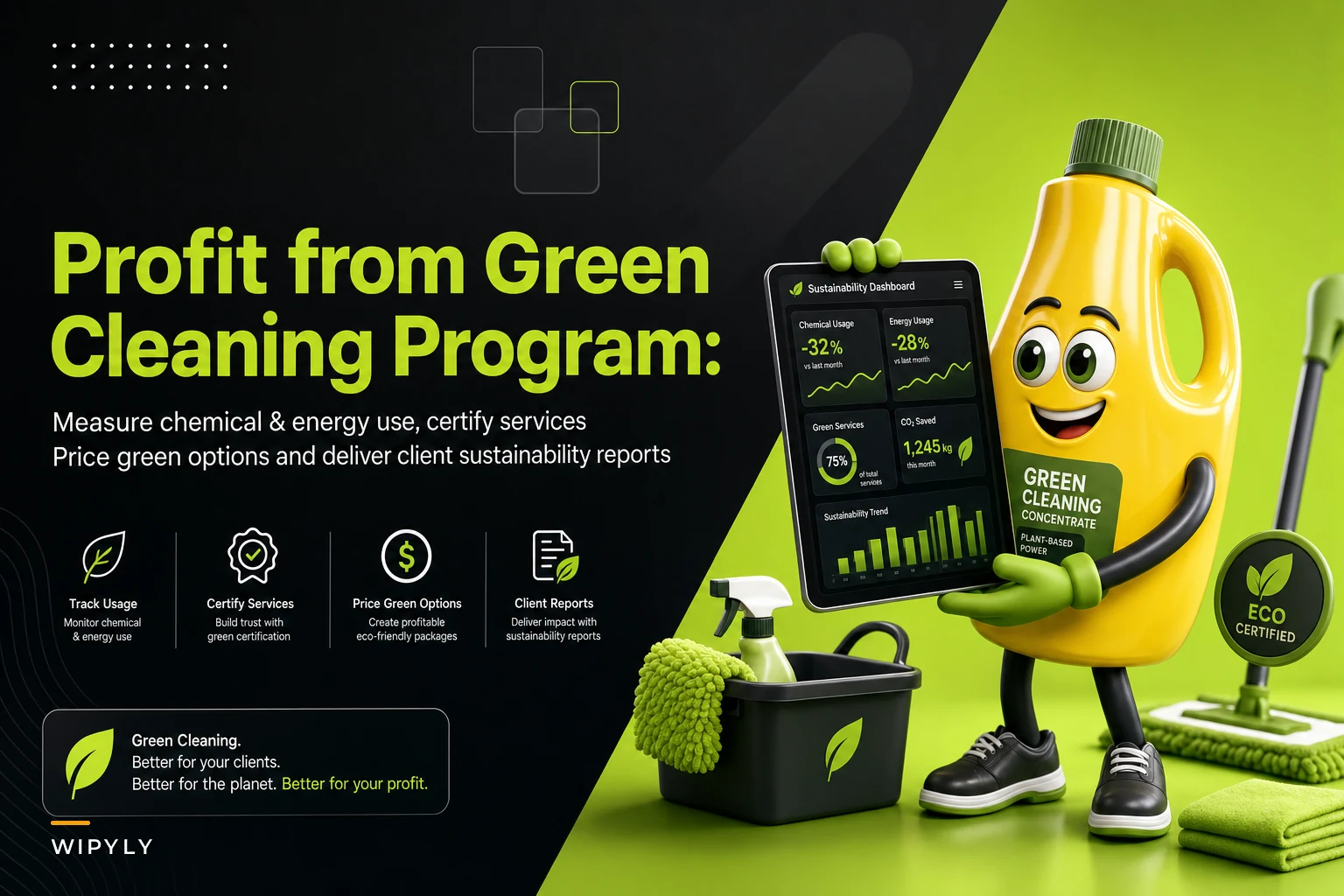
This is a build guide for a green cleaning program that treats sustainability as a measurable, sellable service line — not a marketing adjective. We'll cover how to measure chemical and energy use, which certifications actually move contracts, how to report in a way clients can reuse, and how to price the whole thing so it's actually profitable rather than a feel-good loss leader.
Start with measurement, because everything else depends on it
The reason most green programs stay vague is that nobody set up a baseline. You can't report reductions if you never recorded what normal looked like. And you can't price a green option if you don't know what it actually costs you versus your standard service.
So before certifications, before client reporting, before pricing — you measure two things: chemical use and energy use per job or per square foot.
Chemical measurement that actually works in the field
Forget lab precision. What you need is a repeatable field method your crews can follow without a chemistry degree.
-
Concentrate volume used (liters or ounces of concentrate, not diluted product)
-
Dilution ratio actually used on site (crews love to over-pour — this is where waste hides)
-
Square footage cleaned with that volume
-
Product type (neutral cleaner, disinfectant, degreaser, glass, floor)
The number you care about is concentrate per 1,000 sq ft. That's your chemical intensity, and it's what you show clients when you claim a reduction.
A typical example: a mid-size office account, roughly 22,000 sq ft, cleaned five nights a week. Before any structured tracking, the crew was burning through concentrate at a rate nobody questioned. Once someone actually measured, it turned out they were diluting at about half the recommended ratio "to be safe." Fixing that one habit cut concentrate use by close to 30% with zero change in cleaning outcomes.
That's the pattern almost everywhere. The first green win isn't a fancy product swap — it's stopping the over-pour. Measurement exposes it.
Energy measurement without an engineering degree
Energy in cleaning mostly comes from three places: hot water heating, powered equipment (auto-scrubbers, vacuums, burnishers), and — often the biggest and most ignored — how long lights and HVAC run because of when you clean.
-
Equipment runtime (hours of scrubber/vac use per job)
-
Hot water usage for methods that require it
-
Daytime vs. after-hours cleaning split (daytime cleaning can cut a building's after-hours energy load meaningfully)
The daytime cleaning angle surprises people. When you clean during occupied hours instead of forcing a building to keep lights and air running for a night crew, the client's energy bill drops. That's a green claim you can hand them that costs you nothing but scheduling changes — and it's directly tied to your equipment reliability. If your machines aren't dependable enough to run day shifts without breaking down, that whole argument collapses, which is why an equipment uptime plan sits underneath any serious energy claim.
Measurement gives you the baseline you need to price and report accurately.
The certification decision: which paths are worth the paperwork
Certifications are where a lot of owners either waste money or avoid the whole thing out of confusion. Not every certification is worth chasing, and the right one depends entirely on who your clients are.
Stop losing bookings in operational chaos.
Wipyly helps you manage, confirm, and optimize every cleaning appointment efficiently.
- Centralized booking management
- Automated client notifications
- Staff scheduling & route optimization
No credit card required
Here's a practical breakdown of the main paths cleaning businesses actually encounter:
| Certification path | Best for | Effort to obtain | What clients actually do with it |
|---|---|---|---|
| Green Seal / EcoLogo product certs | Any account wanting verified products | Low — you buy certified products | Proof the chemicals themselves are certified |
| CIMS-GB (Green Building) | Commercial, LEED-adjacent buildings | High — full org audit | Feeds their LEED points, big contract differentiator |
| ISSA / GBAC training credentials | Health-sensitive facilities | Medium — crew training | Shows trained staff, not just products |
| Client's own ESG reporting support | Corporate & enterprise accounts | Medium — data reporting | Lets them count your service in their sustainability report |
The mistake owners make is chasing the most prestigious certification instead of the relevant one. A three-van operation cleaning small professional offices does not need a full CIMS-GB audit. They need certified products and clean measurement data. Meanwhile, a company gunning for corporate campuses and hospitals will lose bids without the deeper credentials.
When full certification actually makes sense: you're regularly bidding on contracts where the RFP explicitly asks for it, or where the client has public sustainability commitments. If certification requirements keep showing up in your losing bids, that's your signal.
When it's a bad idea: you're pursuing it for marketing prestige with no accounts actually demanding it. The audit costs and annual renewal fees will quietly eat the premium you were hoping to earn.
Reporting: turn your data into something the client can reuse
This is the part almost everyone skips, and it's the part that justifies the premium.
A green client doesn't just want to be told they're getting sustainable service. They want a document they can forward to their boss, their board, or drop into their own sustainability report. When your reporting becomes an input to their reporting, you stop being a vendor and start being part of their compliance story. That's a kind of stickiness that's genuinely hard to price out.
A useful quarterly client sustainability report includes:
-
Chemical intensity trend (concentrate per 1,000 sq ft, this quarter vs. baseline)
-
Percentage of certified products used
-
Energy-related notes (daytime cleaning hours, equipment efficiency)
-
Waste diversion if you track it (recycling, reduced single-use)
-
A plain-language summary line they can copy-paste
Keep it to one page. The trap is over-engineering the report into something so detailed nobody reads it. What the client wants is a clean number showing improvement over time and a sentence they can lift directly.
The reporting cadence also gives you a natural reason to stay in front of the account, which quietly supports retention. Clients who receive regular, tangible proof of value renew more consistently — the same dynamic behind timing-based conversion sequences that turn one-off clients into recurring contracts. A sustainability report is just another well-timed touchpoint that reminds them why they pay you.
Pricing the green option so it's actually profitable
The core problem: green methods sometimes cost more (certified products, more labor for microfiber laundering, training) and sometimes cost less (reduced chemical waste, less water). If you price on gut feel, you'll either scare clients off or quietly lose margin.
The clean approach is to price green as a defined tier, not a vague upgrade. Three tiers work well:
-
Standard — your existing service, no green claims.
-
Green — certified products, chemical-reduction protocol, quarterly reporting.
-
Green+ / Certified — full certified process, energy-optimized scheduling, ESG-ready reporting, third-party certification backing.
Then build the price from real cost deltas, not a random percentage bump.
A simple process to set the green premium
-
Calculate your standard cost per account (labor + product + overhead).
-
Add the incremental green costs
certified product price difference, extra training amortized per job, reporting time (usually 20–40 minutes per account per quarter).
-
Subtract the green savings
reduced concentrate waste, lower water use, sometimes fewer callbacks because processes are tighter.
-
The net delta is your true cost increase — often smaller than owners assume.
-
Set the premium at a level that covers the delta and prices in the value of the documentation and certification you're providing.
A realistic picture: for that 22,000 sq ft office, the certified products cost a bit more, but the chemical-reduction protocol offset most of it. The genuine added cost landed somewhere around 6–9% over standard. The green tier was priced at roughly a 15–20% premium — because clients aren't only paying for greener cleaning, they're paying for the proof and the reporting they can reuse.
The gap between your real cost increase and your price is the profit that makes the program worth running. Underprice it and green becomes a charity project. Price it on cost delta plus documentation value, and it becomes one of your higher-margin service lines.
Real scenario: a five-van commercial cleaner adds a green tier
A commercial cleaning company running five vans, mostly small-to-mid office accounts, kept losing a few bids a year to competitors advertising eco-friendly service. They had no measurement, no certification, no reporting — just the same claim everyone else was making.
They spent about a quarter building the basics: field tracking for concentrate use, switched their core products to certified equivalents, and built a one-page quarterly report template. No expensive org-wide audit — just certified products and honest measurement.
Within the first full year:
-
They cut concentrate use across tracked accounts by roughly a quarter, mostly from fixing over-pouring.
-
They rolled out a Green tier priced around 17% above standard.
-
About a third of existing accounts upgraded to the green tier, and it became the default pitch for new commercial bids.
-
Win rate on sustainability-conscious RFPs improved noticeably — they stopped losing the "prove it" conversation.
The added margin from upgraded accounts landed somewhere in the low-to-mid thousands per month, and the reduced chemical spend partly funded the certified products. The bigger win was harder to quantify: they became the vendor whose data fed the client's own reporting, and those accounts got noticeably harder for competitors to poach.
Where owners get this wrong
A few patterns show up repeatedly when green programs stall:
-
Claiming without measuring. The fastest way to lose credibility with a serious client is to make green claims you can't back with a number.
-
Buying certifications nobody asked for. Prestige credentials with no matching demand just add cost.
-
Reporting that's too complex to read. If the client's sustainability lead can't copy a line into their own report, your reporting failed.
-
Pricing on vibes. A random green surcharge either loses bids or loses margin. Price the actual cost delta plus documentation value.
-
Treating it as a one-time setup. The measurement and reporting have to be ongoing, or the whole proof structure decays within a couple of quarters.
Who should not build this yet
If your standard operations are still shaky — inconsistent quality, unreliable equipment, no basic job-costing — a green program isn't your priority. Green is a layer on top of an operation that already works. Adding measurement and certification requirements to a business that can't reliably clean a building on schedule just adds paperwork to chaos. Fix the foundation first.
Keeping the data honest without drowning in spreadsheets
The measurement side is where good intentions die. Crews forget to log concentrate. Runtime data lives in someone's head. By the third month, your baseline has holes in it and your reporting loses credibility.
The practical fix is to make logging part of the existing job flow, not a separate task. If your crews already check in and out of jobs and capture photos, adding a quick concentrate-and-runtime entry to that same routine keeps data flowing without creating a second system.
Here's a simple workflow that shows how on-site logging feeds reports and flags issues automatically.
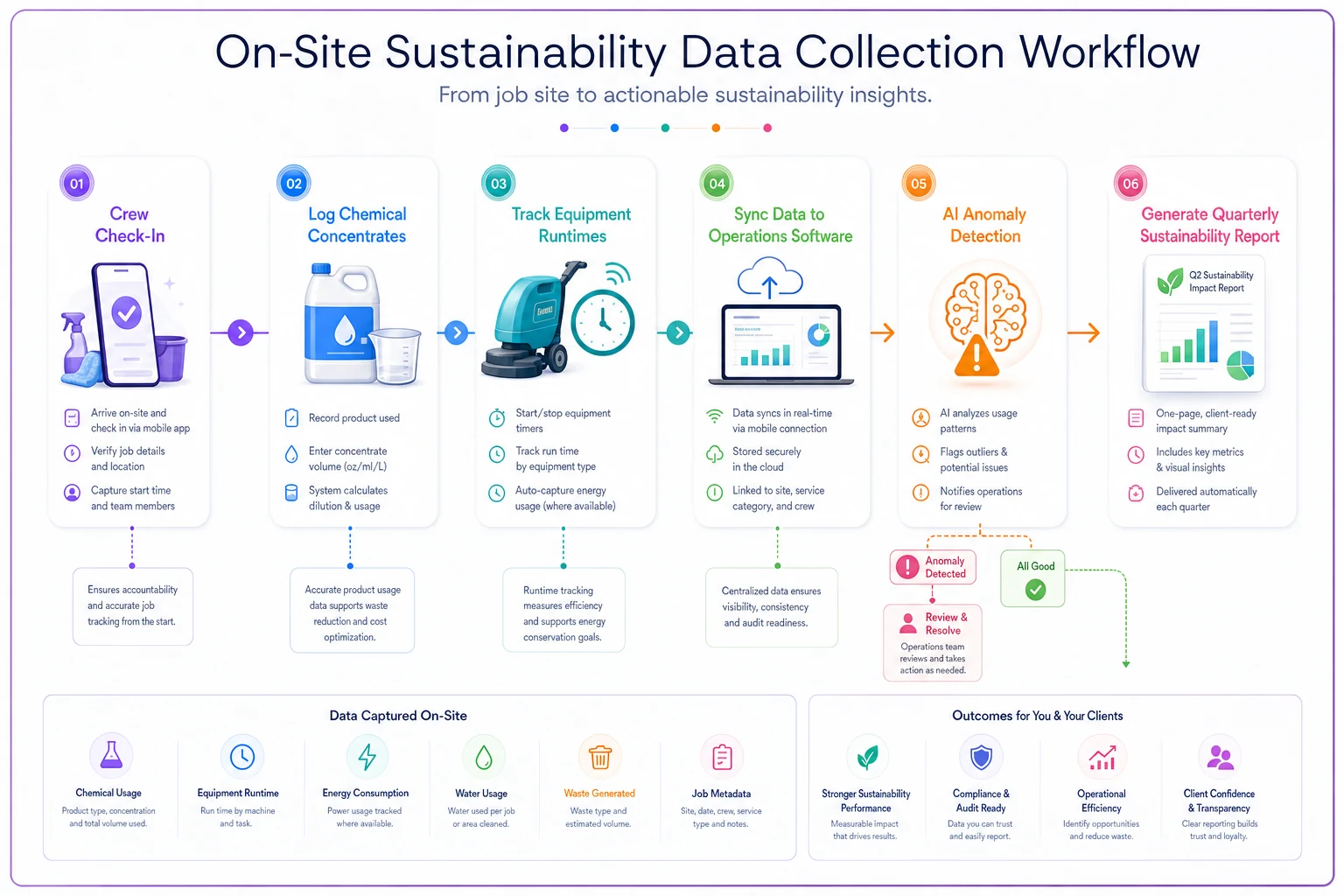
Add the concentrate and runtime entry to the crew check-in routine so missing logs are obvious immediately.
This is where operational software that already tracks jobs, schedules, and QA earns its keep — the sustainability numbers become a byproduct of work crews are already logging, rather than a whole new administrative burden. AI-assisted tracking can flag when an account's chemical intensity drifts out of range, so you catch over-pouring or missed logs before they corrupt a full quarter of data.
The point isn't the software. The point is that green programs live or die on consistent data, and consistency comes from folding measurement into work that's already happening — not from asking tired crews to fill out one more form at the end of a shift.
The takeaway
A green cleaning program only makes money when it's provable. Measurement gives you the baseline and exposes the easy chemical-waste wins. The right certification — matched to your actual clients, not chased for prestige — gets you past procurement filters. Clean, reusable reporting turns you into part of the client's own sustainability story. And pricing built on real cost deltas plus the value of documentation is what separates a profitable green tier from an expensive marketing gesture.
Measure, certify appropriately, report simply, price deliberately. Do those four things in order and green stops being a claim you hope nobody questions. It becomes a service line you can defend, renew, and grow.
Ready to simplify your cleaning operations?
Join 1,000+ cleaning businesses using Wipyly to save time, reduce scheduling conflicts, and enhance client satisfaction.