

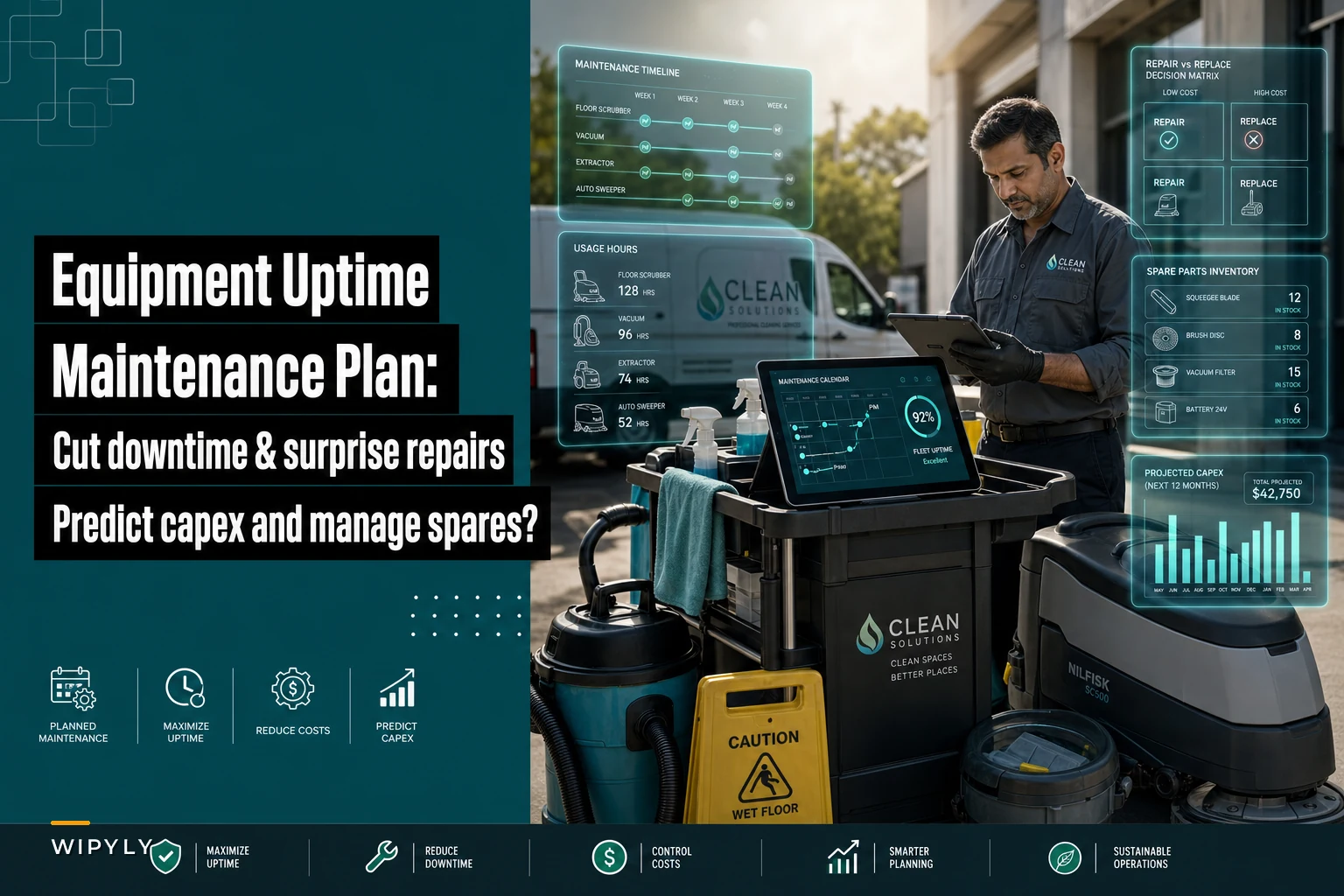

Your commercial carpet extractor dies at 2 PM on a Tuesday. You've got four office buildings scheduled that afternoon, plus a medical clinic deep clean starting at 6 PM. The rental place wants $185 for the day, but they're 40 minutes away. Your tech sits idle while you scramble.
This scenario costs cleaning businesses somewhere between $8,000 and $15,000 a year in lost productivity, rental fees, and rushed equipment purchases. Not because equipment breaks — that's going to happen regardless — but because there's no real plan for when it does.
The hidden math of cleaning equipment downtime
Most cleaning business owners track equipment purchases but completely miss the operational impact when something goes down. A broken floor buffer isn't just a $60 rental fee. It's the time someone spends driving to get it, the overtime when crews fall behind, and the reputation hit when you have to reschedule a client.
When equipment fails in a typical commercial cleaning operation with 8-10 crew members, you're losing roughly 160 productive hours annually to equipment-related delays. That's not repair time — that's the scrambling, waiting, driving, and schedule reshuffling that happens around each failure.
The real damage is the cascade. Your morning crew's broken vacuum means they're still on-site when the afternoon crew needs the van. Now both teams are behind. The afternoon crew rushes through a medical office trying to catch up. Quality drops. Client complains. You send someone back tomorrow to re-clean, eating into tomorrow's margins.
Building a cleaning equipment maintenance plan that prevents chaos
A maintenance system that actually works needs three things: a calendar tied to real usage hours, replacement math based on repair frequency, and spare equipment rules that make operational sense.
Stop losing bookings in operational chaos.
Wipyly helps you manage, confirm, and optimize every cleaning appointment efficiently.
- Centralized booking management
- Automated client notifications
- Staff scheduling & route optimization
No credit card required
Creating usage-based maintenance intervals
Pull the maintenance manuals for your top five pieces of equipment. Ignore anything that just says "every 3 months." Convert everything to usage hours.
-
For a commercial vacuum used 20 hours weekly
-
Filter cleaning
every 40 hours (2 weeks)
-
Belt inspection
every 80 hours (4 weeks)
-
Brush roll replacement
every 320 hours (16 weeks)
-
Motor bearing service
every 960 hours (48 weeks)
Build a simple tracking sheet. Have crews mark daily usage in 15-minute increments. Takes seconds, saves thousands.
Have crews mark daily usage in 15-minute increments.
Most cleaning operations find their equipment gets used 3x more than they assumed. That "annual" service interval? You're hitting it every four months.
The repair-or-replace calculation
Track every repair with three data points: repair cost, equipment age, and downtime hours. When repair costs hit 40% of replacement cost twice in six months, replace it.
The thing most people miss is the soft costs. A $200 repair that takes your equipment offline for three days has completely different math than a $200 repair you handle in-house in two hours.
Commercial vacuum breakdown:
-
Repair quote
$180
-
Replacement cost
$450
-
Looks like a clear "repair" decision
Add in operational costs:
-
Repair turnaround
4 days
-
Rental cost
$40/day = $160
-
Productivity loss
2 hours of crew scrambling = $60
-
Total real cost
$400
Suddenly replacement makes more sense, especially if this is the second breakdown in three months.
A simple visual of the maintenance workflow can help get buy-in from crews and managers.
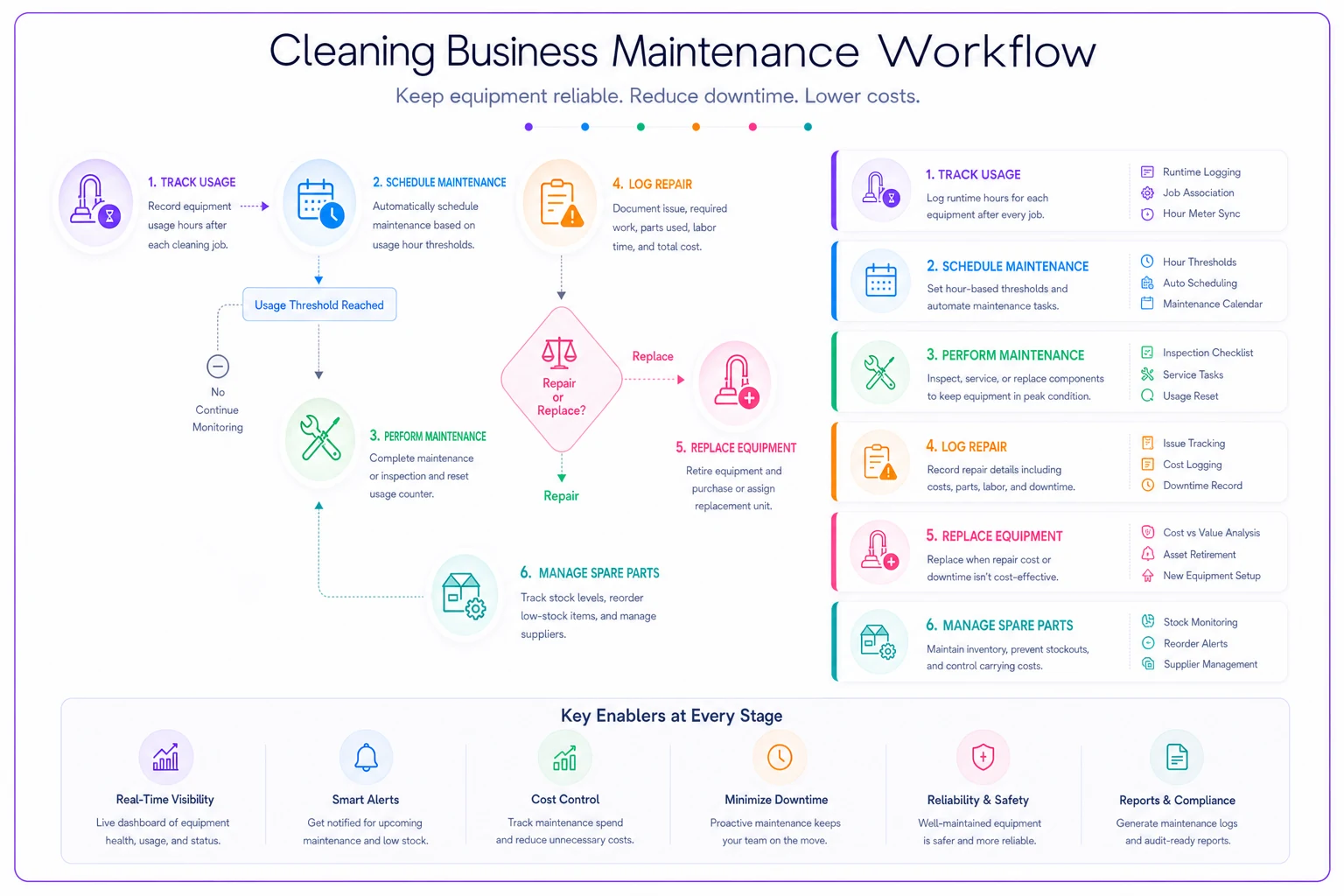
The workflow above links usage tracking, scheduled service, spare parts stocking, and replacement decision thresholds into one operational loop.
Parts inventory and spare equipment rules
The standard advice says keep 10% of your equipment value in spare parts. That's not very useful for cleaning businesses. You need specific parts for specific failure points.
Track what actually breaks. Over six months, patterns emerge:
-
Vacuum belts (monthly)
-
Mop bucket wheels (quarterly)
-
Spray bottle triggers (weekly)
-
Extractor hose connections (every 4-6 months)
Stock two weeks of high-frequency parts, one month of medium-frequency parts. Skip anything that fails less than annually — not worth the inventory cost.
The spare equipment formula
Daily-use equipment (vacuums, mops, buckets):
-
1 spare per 3 in service
-
Never less than 1 spare total
Weekly-use equipment (extractors, floor machines):
-
1 spare per 5 in service
-
Consider rental agreements instead if you're running fewer than 5 units
Specialty equipment (pressure washers, window cleaning rigs):
-
Rental relationships unless used 3+ times weekly
-
Pre-negotiated rates beat emergency rentals by 30-40%
Daily-use equipment needs different redundancy than something you pull out once a week.
Budget allocation across maintenance, replacement, and contingency
Most cleaning businesses allocate equipment budgets randomly, then scramble when three vacuums die at once.
| Equipment Category | Annual Budget (% of equipment value) | Breakdown |
|---|---|---|
| Maintenance/Parts | 15-20% | Filters, belts, routine service |
| Replacement Reserve | 25-30% | Planned replacements |
| Emergency Buffer | 10-15% | Unplanned failures, rentals |
| Upgrades | 5-10% | Efficiency improvements |
For a cleaning business with $20,000 in equipment assets:
-
Maintenance
$3,000-4,000 annually
-
Replacement
$5,000-6,000 annually
-
Emergency
$2,000-3,000 annually
-
Upgrades
$1,000-2,000 annually
This seems like a lot until you calculate the alternative. Emergency purchases cost 20-30% more. Rush rentals cost 40% more. Lost productivity from scrambling costs even more than that.
Creating equipment lifecycle replacement schedules
Stop replacing equipment when it breaks. Start replacing it before it becomes operationally expensive.
Heavy daily use (6+ hours/day):
-
Commercial vacuums
12-14 months
-
Mop buckets
18-24 months
-
Spray bottles
3-4 months
-
Microfiber mops
6-8 months
Moderate use (2-6 hours/day):
-
Carpet extractors
2-3 years
-
Floor buffers
3-4 years
-
Pressure washers
2-3 years
-
Window cleaning tools
18-24 months
Light use (under 2 hours/day):
Add 50% to moderate use timelines
Build replacement into your annual budget. Stagger purchases across quarters to avoid cash flow hits.
A 10-person cleaning crew typically replaces:
-
2-3 vacuums quarterly
-
1 major equipment piece semi-annually
-
Small tools monthly
That's roughly $1,200-1,800 monthly in planned equipment turnover. Not budgeting for it doesn't make it go away — it just makes it hurt more when it happens.
Rental relationships and contingency planning
Every cleaning business needs three pre-established rental relationships:
-
Same-day general equipment (vacuums, mops)
-
Specialty equipment (extractors, lifts)
-
Emergency after-hours access
Negotiate rates before you need them. A panicked Friday afternoon rental costs double what a pre-negotiated rate does.
Set rental trigger rules:
-
Equipment down less than 4 hours
wait for repair
-
Equipment down 4-24 hours
rent if 3+ jobs affected
-
Equipment down 24+ hours
automatic rental
-
Critical path equipment
immediate rental
Document rental contacts, rates, and pickup procedures somewhere accessible. During an equipment crisis, you don't have time to comparison shop.
The underutilized lease option
For expensive equipment used consistently, leasing often beats buying outright. A $3,000 floor scrubber leased at $125 monthly can include maintenance and replacement guarantees.
The math works when:
-
Equipment costs exceed $2,000
-
You use it 3+ times weekly
-
Manufacturer offers maintenance inclusion
-
You don't have repair expertise in-house
Just watch out for lease-to-own arrangements where you end up paying 2x the purchase price over the term.
When manual tracking becomes a bottleneck
Spreadsheet maintenance logs work fine until you're tracking around 15 pieces of equipment. After that, things start slipping. A crew forgets to log hours. Someone misses a maintenance interval. The spreadsheet drifts from reality.
This is where operational software built for service businesses starts making sense. Instead of crews manually logging equipment hours, the system can track usage through job completion data. When your team checks off "carpet extraction completed," the platform logs the usage time automatically against that equipment's maintenance schedule.
The bigger value is what happens with that data over time — automated alerts when equipment approaches service thresholds, repair cost tracking that tells you when something is approaching replacement territory, and replacement planning that isn't just a gut call. It turns reactive scrambling into proactive schedule management.
Good platforms also handle rental vendor tracking — preferred contacts, negotiated rates, availability windows. When something breaks, you're three clicks from a solution instead of making six phone calls.
Practical implementation steps
Start small. Don't try to build a complete equipment management system in a week.
-
Week 1-2
Create a simple equipment inventory with purchase dates and current hours (estimate if you have to).
-
Week 3-4
Set up usage tracking. Basic paper logs are fine to start.
-
Week 5-6
Identify your top five equipment failure points from the last six months.
-
Week 7-8
Stock parts for those five failure points.
Month 3: Establish one rental relationship with preset pricing.
Month 4: Build a replacement budget based on actual lifecycle data.
Month 6: Decide whether manual tracking still holds up or if you need software support for routing and operations.
The compound effect of equipment planning
A cleaning business with 12 employees and solid equipment planning saves somewhere around $18,000-24,000 annually compared to reactive management. That's not from buying better equipment — it's from avoiding emergency rentals, preventing cascade delays, and cutting out rushed purchases that always cost more than they should.
Beyond the money, reliable equipment reduces crew stress and improves retention. Nobody wants to start their shift wondering if their tools will work. Nobody wants to be the one calling a client to reschedule because a vacuum died.
The gap between professional cleaning operations and struggling ones often isn't the quality of the cleaning. It's the reliability of how everything runs. Equipment planning doesn't feel urgent today, but it's what determines whether you're scrambling through crises or actually growing.
Your next equipment failure is coming. The only question is whether you'll have a spare, a rental contact, and a replacement budget ready — or whether you'll be the person racing across town at 2 PM on a Tuesday, hoping the rental place still has what you need.
Ready to simplify your cleaning operations?
Join 1,000+ cleaning businesses using Wipyly to save time, reduce scheduling conflicts, and enhance client satisfaction.