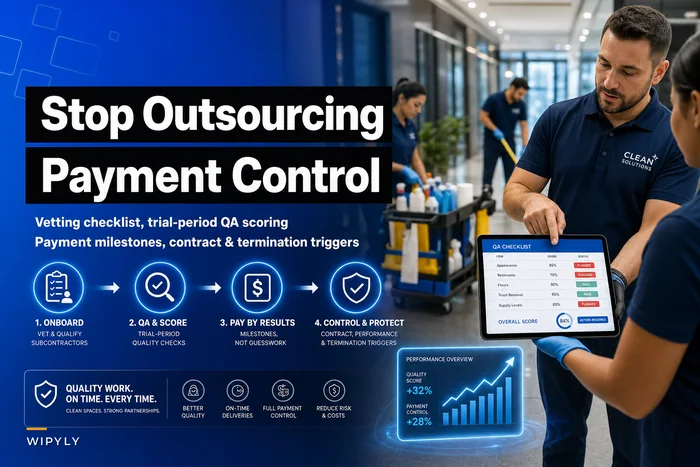



The moment a cleaning company crosses from "a few trusted subs on speed dial" to "a network of outsourced crews covering 40+ sites," something shifts. The informal handshake system that worked at five accounts starts leaking money, SLA credits, and sleep. Not because the subs got worse — but because there was never a system holding the network together. Just you, a group chat, and hoping everyone shows up.
Subcontractor governance cleaning programs are what separate operators who scale their outsourced network profitably from the ones who quietly lose margin to rework, disputes, and surprise terminations. This isn't about distrusting subs. It's about building the scaffolding so good subs stay good, mediocre ones improve or exit fast, and you never find out about a problem from the client first.
This post covers how the whole thing connects — onboarding standards, pilot windows, pay mechanics that reward real performance, payment-hold triggers, and termination ladders that don't blow up into legal fights — and where it tends to break at each stage of growth.
Why informal subcontractor networks fall apart predictably
The failure isn't random. It follows a pattern tied almost perfectly to headcount and site count.
At 3–8 subcontracted sites, everything runs on relationship. You personally vetted every sub, you know their work, and when something goes sideways you call them directly. Governance feels like overhead you don't need.
At 15–25 sites, the cracks show. You're no longer doing the vetting personally — a dispatcher or ops lead is. The subs you onboarded last quarter you've never actually watched clean. QA is inconsistent because nobody wrote down what "passing" means. Payment is a monthly scramble where someone reconciles invoices against... vibes.
By 40+ sites, you're running a network you can't personally see. This is where the expensive stuff happens:
-
A sub underperforms for six weeks before anyone catches it, because there's no scoring threshold that flags them
-
You keep paying a sub in full while the client is withholding payment from you over the same site
-
A termination turns into a dispute because there was no documented performance trail
-
Your best subs leave because pay is flat and a competitor offered performance bonuses
The core issue: informal networks have no feedback loop between quality, payment, and tenure. A sub who's failing and a sub who's excelling get treated identically until something breaks badly enough to notice. Governance closes that loop.
The four systems that have to connect
Most operators try to fix subcontractor problems one at a time — tighten onboarding here, add a QA checklist there. It doesn't hold, because these pieces are a single system. When they're disconnected, subs learn exactly which gaps to exploit.
Stop losing bookings in operational chaos.
Wipyly helps you manage, confirm, and optimize every cleaning appointment efficiently.
- Centralized booking management
- Automated client notifications
- Staff scheduling & route optimization
No credit card required
Here's how the four pillars should feed each other:
| System | What it controls | What it feeds into |
|---|---|---|
| Onboarding standards | Who gets in, what they commit to | Pilot period baseline |
| Pilot period | Proving ground before full volume | QA scoring + pay tier assignment |
| Performance-linked pay | Rewards real output, not promises | Payment-hold triggers |
| Termination ladder | Structured exit, not emotional firing | Portfolio re-planning |
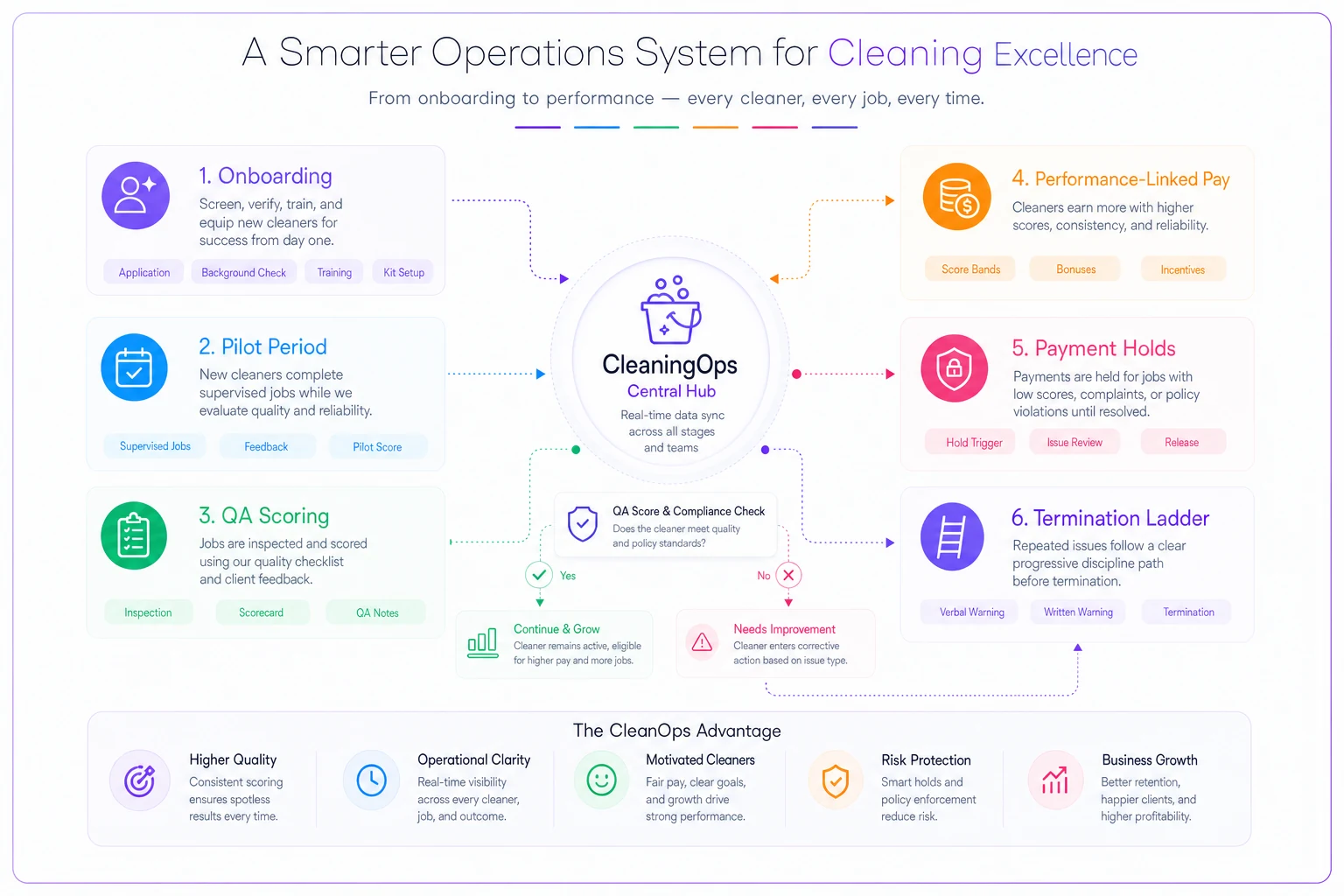
The magic is in the handoffs. A QA score shouldn't just sit in a spreadsheet — it should determine whether a payment gets held, whether a sub advances a pay tier, and where they sit on the termination ladder. When these are wired together, a declining sub automatically surfaces before the client complains.
Here's a quick visual of how those handoffs work in practice.
If you're still deciding which parts of your portfolio should even be subcontracted versus kept in-house, that decision sits upstream of all of this — worth working through the trade-offs in cost, quality and coverage before you build the governance layer on top.
Onboarding standards: the gate, not the welcome mat
Weak onboarding is where the majority of later problems originate. Operators treat it as paperwork — W-9, insurance cert, a handshake — when it should be a hard gate with documented standards the sub signs off on.
A real onboarding standard covers:
-
Insurance and licensing minimums, verified not just collected (expired certs are the silent killer — set calendar triggers for renewal dates)
-
Scope-of-work acknowledgment per site type, because a sub cleaning a medical office needs different commitments than one doing a warehouse
-
Evidence standards — what photos, timestamps, and sign-offs they owe you per visit
-
Communication SLAs — how fast they respond to a callback, who they escalate to
-
Pay structure and hold rules, explained upfront so nothing feels like a surprise later
That last point matters more than people think. The number one reason payment disputes get ugly is that the sub didn't understand the hold rules until their money got held. Walk them through it during onboarding. Have them sign it.
Tier onboarding by site risk so higher-risk sites get more verification and lower-risk retail sites onboard faster.
One pattern worth building in: a tiered onboarding by site risk. A low-risk retail site can onboard a sub in a few days. A healthcare or regulated site should require additional verification, a documented walkthrough, and a shorter leash during the pilot. Don't use one onboarding standard for wildly different site types.
The pilot period: prove it before you scale volume
This is the single highest-leverage piece most operators skip. They onboard a sub and immediately hand them four sites. If the sub underperforms, you now have four problems and four unhappy clients.
A pilot period caps initial exposure. You give a new sub one or two sites for a defined window — usually 30 to 45 days — at full pay but under intensified QA. It's the proving ground where the sub earns the right to more volume.
Sample pilot contract terms
A workable pilot agreement includes:
-
Defined scope
1–2 specific sites, named explicitly
-
Duration
30–45 days, with a clear review date
-
QA frequency
audited at roughly 2–3x your standard rate during the pilot
-
Advancement threshold
e.g., "average QA score ≥ 90 across the period, zero critical failures, ≤ 1 missed visit"
-
Pay terms during pilot
full standard rate (don't underpay during pilot — it attracts the wrong subs and sours the relationship before it starts)
-
Outcomes
pass → expanded volume + standard QA cadence; borderline → pilot extended 15 days; fail → no further volume, pilot ends cleanly
The benefit of a documented pilot is that a non-renewal at the end isn't a "firing" — it's just the pilot not advancing. No drama, no dispute, because the terms said so from day one.
Pilots are for subs you intend to bring into the recurring portfolio. If you're covering emergency overflow or a short-term one-off contract, don't bother with the full structure — the overhead isn't worth it.
Performance-linked pay mechanics
Flat pay creates flat performance. If a sub earns the same whether they score 78 or 96 on QA, you've removed every incentive to care about the difference.
The cleanest model ties a portion of pay to a rolling QA score:
-
Base rate
85–90% of total, paid regardless (subs need predictable income — don't make their rent dependent on a bonus)
-
Performance band
the remaining 10–15%, released based on rolling QA average over the pay period
-
Advancement tiers
subs who sustain high scores over several months move to a higher base rate entirely
A simplified version of the mechanic:
| Rolling QA score | Performance band released | Standing |
|---|---|---|
| 95–100 | 100% of band | Preferred — priority for new volume |
| 88–94 | 100% of band | Good standing |
| 80–87 | 50% of band | Watch — coaching triggered |
| Below 80 | 0% of band | At-risk — payment-hold review |
Two things make this work in practice. First, the score has to come from a QA process the sub trusts — consistent, not one manager's mood on a bad day. Second, the sub needs visibility into their own score mid-period so there are no surprises at payout. A sub who can see they're at 86 and slipping will fix it before payday. A sub who finds out after is just angry.
Auto-hold payment rules
Payment holds are the enforcement teeth, and they're also where operators get sued if done sloppily. Holds must be automatic, documented, and tied to objective triggers — never discretionary.
Common auto-hold triggers that are defensible:
-
Client is withholding payment from you over that specific site (you shouldn't be fronting money on a site you're not getting paid for)
-
Critical QA failure — a health/safety miss, a missed visit at a compliance-sensitive site
-
Missing required evidence — no photos, no sign-off, no proof the work happened
-
Unresolved client complaint past a defined cure window
The structure matters: a hold is not a non-payment. It's a pause with a defined resolution path. Spell it out:
-
Trigger fires → portion of payment held (not the whole invoice — hold the disputed scope, not everything)
-
Sub notified immediately with the specific reason and evidence
-
Cure window opens (e.g., 5–10 business days to remediate or dispute)
-
Resolution → payment released, or escalates to the termination ladder
The connection to protecting your own accounts receivable and account-level margin is direct here — you can't have subs draining cash on sites that are themselves unprofitable or in client dispute. The hold rules and your account P&L have to be looking at the same data.
One thing worth flagging from real operations: holds work only if they're rare and justified. If you're holding payment on half your subs every month, the problem isn't the subs — it's your onboarding or QA thresholds, and your best subs will leave.
The termination ladder: structured exits, not explosions
Firing a sub emotionally — one bad visit and they're gone — destroys your coverage and your reputation in the local sub network (word travels fast). But keeping a failing sub too long costs you clients. The answer is a ladder: documented, progressive, and predictable.
A typical four-rung ladder:
-
Rung 1 — Coaching flag
QA dips into the watch band. Documented feedback, specific fixes, defined re-check date. No pay impact yet beyond the performance band.
-
Rung 2 — Formal warning + hold risk
second consecutive watch-band period or a critical failure. Written warning, performance band withheld, 30-day improvement window with weekly QA.
-
Rung 3 — Probation + volume reduction
no improvement. Volume cut back to minimum, intensified QA, final written notice. Sub knows exactly where they stand.
-
Rung 4 — Termination
documented failure to improve across the prior rungs. Clean exit with a full performance trail, so there's no credible dispute.
Each rung feeds portfolio re-planning. A sub hitting rung 3 means you need coverage lined up before rung 4, not scrambling after. The ladder gives you lead time to reassign sites without leaving a client uncovered — which is the whole point of governing a network instead of reacting to it.
A real scenario
A mid-sized commercial cleaning operator running around 55 sites had roughly 12 subcontracted crews, all on flat pay, no pilot process, QA done "when someone remembered." They were eating somewhere between $2k and $3k a month in SLA credits from two chronically underperforming sites and didn't know which subs were the problem because nothing was scored.
They rolled out a basic version of this system over a quarter: documented onboarding, a 30-day pilot for any new sub, a rolling QA score with a 12% performance band, and auto-hold tied to client disputes.
Within about four months, the SLA credits dropped to near zero on those sites — two subs improved once their pay was actually linked to the score, and one exited cleanly through the ladder with no dispute, because the trail was documented. Payment disputes with subs, which had been a near-monthly headache, basically stopped because the hold rules were explained upfront. The owner's own description was that the network "finally felt manageable instead of like a daily fire." Not a dramatic revenue explosion — just a network that stopped leaking.
The deeper mechanics of wiring onboarding, QA and payment control into one workflow are worth going further on in this breakdown of the subcontractor onboarding-to-payment workflow if you want the step-level detail.
When this full system actually makes sense
Build the full governance stack when:
-
You run 20+ subcontracted sites, or you're clearly heading there
-
You can't personally observe the work anymore
-
SLA credits or client disputes are showing up and you can't trace them to a specific sub
-
You're bringing on new subs regularly
Keep it lightweight when:
-
You have a handful of long-tenured subs you trust and no plans to expand
-
Subcontracting is occasional overflow, not core delivery
If you only have two or three subs who've worked flawlessly for years, imposing pilot periods and termination ladders on them will feel insulting and buy you nothing. Governance scales with the network. Build the pieces as the problems they solve actually appear.
Where tooling quietly earns its keep
None of this requires fancy software to start — a shared sheet and some discipline can run a 15-site network. But the handoffs between QA, pay, and holds are exactly the kind of repetitive, error-prone reconciliation that eats a dispatcher's week once you're past 30–40 sites.
Matching QA scores to payment bands, firing hold triggers when a client dispute hits a specific site, flagging subs crossing into watch bands — these are the places where an operational platform with some automation stops you from missing the signal buried in the noise. The point isn't to replace judgment. It's to make sure the declining sub surfaces automatically, before the client is the one who tells you.
Bringing it together
A subcontractor network isn't a cost problem or a quality problem in isolation — it's a coordination problem. The operators who scale outsourced crews cleanly aren't the ones with the strictest rules or the cheapest subs. They're the ones whose onboarding, pilot, pay, hold, and termination systems actually talk to each other, so a sub's performance automatically shapes their volume, their pay, and their tenure without manually connecting the dots every month.
Start with onboarding as a real gate. Add pilots before you hand over volume. Link pay to a QA score your subs trust. Keep holds rare, objective, and explained upfront. And when a sub has to go, let the ladder — not your frustration — walk them out with a documented trail. Do that, and the chaos that defines most outsourced networks stops being your daily problem.
Start with onboarding as a real gate. Add pilots before you hand over volume. Link pay to a QA score your subs trust. Keep holds rare, objective, and explained upfront. And when a sub has to go, let the ladder — not your frustration — walk them out with a documented trail. Do that, and the chaos that defines most outsourced networks stops being your daily problem.
Ready to simplify your cleaning operations?
Join 1,000+ cleaning businesses using Wipyly to save time, reduce scheduling conflicts, and enhance client satisfaction.