

Your best subcontractor just ghosted three houses on their route. The replacement you scrambled to find left a client's door unlocked. Another sub invoiced you for 4 hours on a 2-hour job. And that "experienced" crew you brought on last month? They've been using Windex on marble countertops for three weeks.
This is what happens when subcontractor onboarding for cleaning businesses runs on hope and handshakes instead of actual process.
Most cleaning companies treat subcontractor vetting like speed dating. Quick phone screen, maybe check insurance docs, throw them on a route. Then wonder why quality tanks, clients complain, and margins disappear into rework and damage claims.
The difference between companies that scale with subs and those that get burned? A solid onboarding workflow that catches problems during trials—not after the contracts are signed.
Why traditional subcontractor screening fails cleaning operations
Standard subcontractor onboarding usually means checking insurance, maybe calling a reference, then hoping for the best. That's not screening—that's gambling with your reputation.
Real operational problems with subs don't show up on paperwork. They surface in the field: missing basic cleaning sequences that create callbacks, using the wrong products on the wrong surfaces, cutting corners when they think nobody's watching, invoice games that quietly erode your margins, and communication gaps that leave clients hanging with no answers.
A sub can have perfect insurance docs and glowing references and still wreck your operations if they don't match your standards, speed requirements, and client communication expectations.
The screening process most companies use catches maybe a third of actual operational risks. The rest only shows up after they've already damaged client relationships.
Build a 4-gate vetting system that protects your business
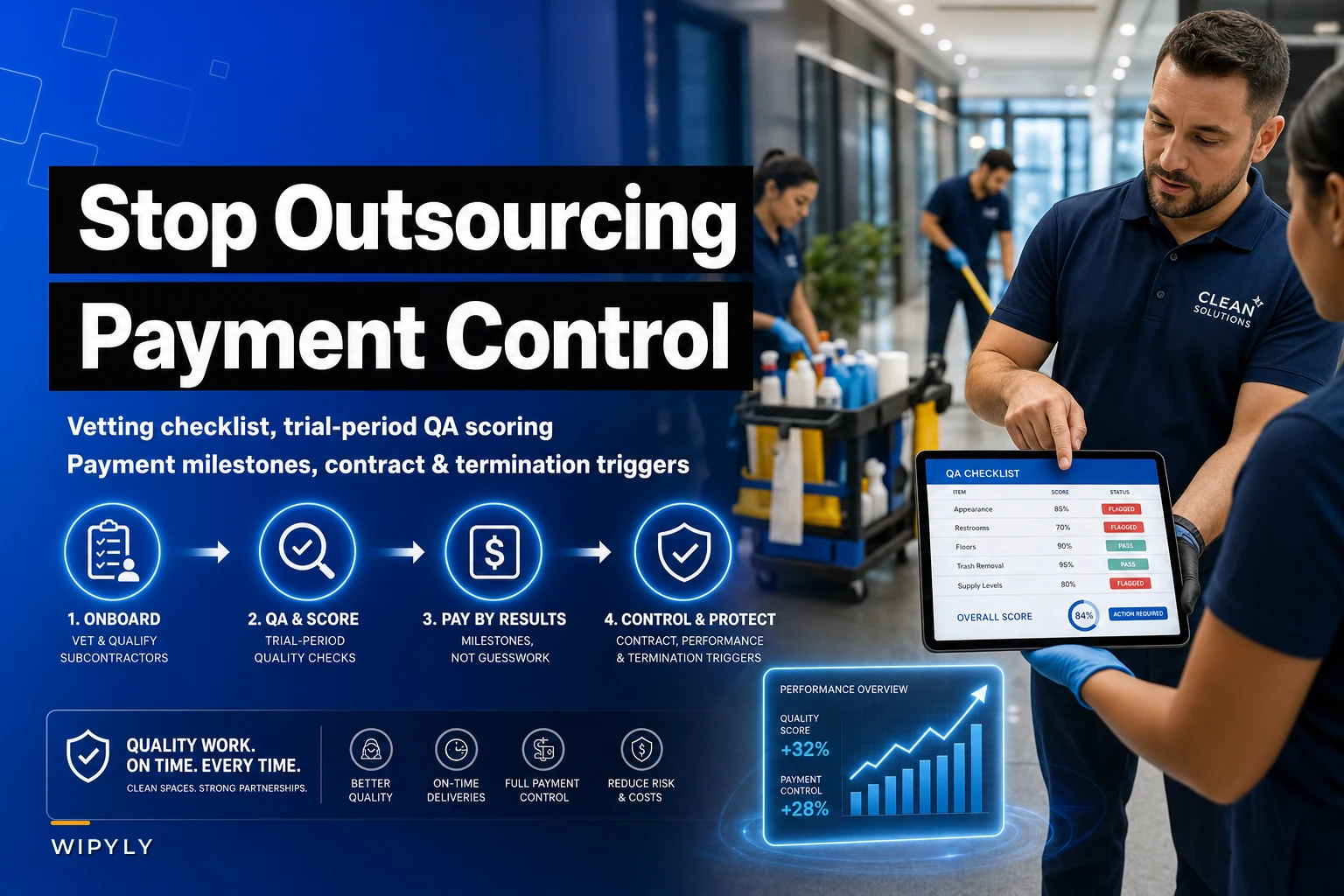
Effective subcontractor onboarding requires four distinct evaluation gates, each designed to catch specific risks before they hit your clients.
Stop losing bookings in operational chaos.
Wipyly helps you manage, confirm, and optimize every cleaning appointment efficiently.
- Centralized booking management
- Automated client notifications
- Staff scheduling & route optimization
No credit card required
Gate 1: Paper Screening (Day 1) Beyond basic insurance and licensing, your paper screen needs to evaluate operational compatibility.
-
Actual cleaning checklists they currently use
-
Photos from their last 5 completed jobs
-
Equipment list with product brands
-
Current client communication templates
-
Rate sheets showing their typical pricing
Red flags at this stage: generic checklists copied from Google, no photo documentation system, suspiciously low rates that suggest corner-cutting.
Gate 2: Skills Verification (Day 2-3) Skip the reference calls. Set up a paid trial clean at your office or a friendly client's space. Watch them work for 30 minutes, then leave them alone. Come back and inspect.
-
Do they follow a systematic room pattern or bounce around randomly?
-
How do they handle unexpected issues—a stain, broken item, locked room?
-
What's their actual working speed versus what they claimed?
-
Do they bring proper equipment or try to use yours?
Document everything on a standard scorecard. No memory-based decisions.
Gate 3: Communication Testing (Day 4-7) Before they touch a real client's property, test their communication under pressure.
-
"Client says you missed the baseboards"
-
"Can you add a fridge clean for today's 2pm appointment?"
-
"Client's not home and the door code isn't working"
Grade response time, professionalism, and how they problem-solve. Subs who go radio silent or get defensive during a test scenario will crater when real issues hit.
Gate 4: Trial Period Scoring (Days 8-30) The first month isn't employment—it's extended evaluation. Every job gets scored on five metrics:
-
Quality consistency (photos before/after)
-
Time accuracy (estimated vs. actual)
-
Client feedback (immediate post-service)
-
Invoice accuracy (claimed vs. verified hours)
-
Communication reliability (response times logged)
Fall below an 80% average across all five? Automatic termination trigger.
The trial period QA scorecard that reveals true performance
Opinions don't scale. Scorecards do. Below is the tracking system that separates keepers from problems during trial periods.
Daily Performance Matrix
| Metric | Weight | Measurement | Threshold |
|---|---|---|---|
| Arrival Accuracy | 15% | Minutes early/late | ±10 min |
| Task Completion | 30% | Checklist items done/total | 95% |
| Quality Standard | 25% | Photo review pass rate | 90% |
| Client Interaction | 20% | Feedback score if applicable | 4.5/5 |
| Invoice Accuracy | 10% | Claimed vs verified time | ±15 min |
Track this for every single service during the trial. No exceptions, no "they seem fine" overrides.
Weekly Rollup Calculation
Each week, calculate their rolling average. Weight recent performance higher—this week counts 50%, last week 30%, prior weeks 20%. This catches both declining performance and slow improvement.
Below 80% overall triggers a documented warning. Second week below 80% triggers termination. No negotiations, no excuses. The numbers decide.
Hidden Quality Checks
Beyond the standard scorecard, run a few stealth checks:
-
Have a friend book a cleaning to see how they handle a "new" client
-
Spot-check supply usage to see if products are being over-diluted
-
Review vehicle GPS tracks against reported times
-
Call clients a couple days later for honest feedback
These shadow metrics often reveal problems the standard scorecard misses. One company discovered their highest-rated sub was consistently leaving 30 minutes early because clients never cross-referenced timestamps against invoices.
Contract clauses that prevent the expensive surprises
Your subcontractor agreement isn't just legal protection—it's operational armor. Standard template contracts miss critical protections specific to cleaning operations.
Termination Triggers (Non-Negotiable)
-
Any single quality score below 70%
-
Two weekly scores below 80%
-
Three client complaints within 30 days
-
Single instance of using unapproved chemicals
-
Ghost/no-show without 2-hour notice
-
Invoice padding exceeding 15% of verified time
Make these automatic, not discretionary. It removes the emotional difficulty of firing underperformers.
Payment Protection Clauses
-
Hold the first two weeks' payment as a performance bond
-
Pay weekly but withhold 20% until the month-end quality review
-
Automatic deduction for any rework required
-
Invoice disputes freeze payment until resolved with documentation
Example clause: "Payment for services is contingent upon client satisfaction verification. Any service requiring rework will result in automatic 50% payment reduction for that service, with an additional 25% reduction for each subsequent rework requirement."
Damage and Liability Allocation
-
Sub handles all damage claims under $500 directly
-
Company deductible responsibility caps at $1,000 per incident
-
Immediate photo documentation required for any incident
-
Failure to report damage within 2 hours = full liability
Include this specific language: "Subcontractor assumes full liability for any damage discovered more than 2 hours after service completion if no incident report was filed."
Non-Compete With Teeth
-
No direct service to your clients for 24 months
-
Liquidated damages of 18 months' average revenue per client taken
-
Immediate termination if marketing to your client base
Don't try to prevent them from cleaning in your area entirely—courts rarely uphold that. Focus on protecting your specific client relationships with clear financial consequences.
Payment milestones that maintain control and quality
How you structure payment determines whether subs prioritize quality or speed. Most companies get this backwards—paying fully for time regardless of outcome.
The 70-20-10 Payment Structure
-
70% on service completion (basic job done)
-
20% on quality verification (passes photo review)
-
10% on client satisfaction (no complaints within 48 hours)
For a $100 house cleaning, the sub gets $70 immediately upon completion, an additional $20 after the office reviews submitted photos, and the final $10 if no client issues surface within 2 days.
Bonus Triggers That Drive Right Behavior
-
$5 per perfect quality score (100% on checklist)
-
$10 for handling a difficult client situation well
-
$25 monthly bonus for zero complaints
-
5% rate increase after 90 days at 90%+ scores
Keep bonuses small but frequent. A daily $5 bonus motivates more than a monthly $150 payout most subs forget is even coming.
Penalty Structure Without Drama
-
Late arrival
$10 per 15 minutes
-
Missing supplies requiring company backup
$25
-
Client complaint requiring revisit
50% service fee reduction
-
No-show
$100 + removal from next week's schedule
Build these into your operational software so deductions calculate automatically. No awkward conversations, just system-generated adjustments.
Sample documents: from vetting checklist to trial scorecards
Templates are what make any of this actually usable. Here are the exact documents that make subcontractor onboarding work in practice.
SUBCONTRACTOR SCREENING CHECKLIST Company: Date: __
PHASE 1: DOCUMENTATION (Must have all)
-
□ General liability insurance ($1M minimum)
-
□ Workers comp certificate (if applicable)
-
□ Business license for operating area
-
□ Signed W-9 form
-
□ Two client references with contact info
PHASE 2: OPERATIONAL REVIEW (Score each 1-5)
-
□ Sample cleaning checklist provided ____
-
□ Photo documentation examples (5 minimum) ____
-
□ Equipment list specificity ____
-
□ Chemical knowledge test score ____
-
□ Professionalism of communication ____
PHASE 3: FIELD TRIAL (Pass/Fail)
-
□ Arrived within 10-minute window
-
□ Brought all necessary supplies
-
□ Followed systematic cleaning pattern
-
□ Completed in estimated time (±15%)
-
□ Passed quality inspection (90%+)
DECISION: □ Advance to trial period □ Reject Notes: _
30-Day Trial Period Tracker Create a simple spreadsheet tracking daily performance:
| Date | Client | Arrival | Quality | Time | Invoice | Issues | Score |
|---|---|---|---|---|---|---|---|
| 3/1 | Smith | -5 min | 95% | 2.0/2.0hr | Match | None | 96% |
| 3/2 | Jones | +12 min | 88% | 2.5/2.0hr | +0.5hr | Bathroom missed spot | 71% |
| 3/3 | Clark | On time | 100% | 1.5/1.5hr | Match | None | 100% |
-
Week 1
89%
-
Week 2
92%
-
Week 3
87%
-
Week 4
94%
Overall trial score: 90.5% ✓ PASS
Quality Photo Review Template Don't just collect photos—score them systematically:
-
□ Kitchen
Counters clear, sink shining
-
□ Bathroom 1
Toilet, tub, mirror visible
-
□ Bathroom 2
(if applicable)
-
□ Living areas
Floors, surfaces clear
-
□ Entryway
Floor clean, organized
-
□ Problem areas
Before/after if found
-
□ Supplies photo
Showing products used
-
□ Completion note
Visible to client
-
□ Overall wide shots
Each main room
-
□ Detail shots
Corners, edges, fixtures
DEDUCTIONS:
-
□ Blurry/unclear (-5 each)
-
□ Missing rooms (-10 each)
-
□ Visible dirt/issues (-10 each)
Score: ___/100
The operational impact: what actually changes
Companies using structured subcontractor onboarding see improvements that go well beyond quality scores.
Administrative Time Reduction
Without proper onboarding, you're spending roughly 3–4 hours per week per subcontractor on quality complaints, invoice disputes, client credits, and scrambling for emergency coverage. With a system in place, that drops to around 45 minutes per sub per week. For 10 subcontractors, that's 25+ hours of admin time back every week.
Margin Protection
Poor subcontractor performance kills margins through rework costs (typically $40–60 per callback), credits and refunds ($30–50 per incident), lost clients (lifetime value often in the $2,000–4,000 range), and invoice padding that averages around 10–15%. A functioning vetting and trial system reduces these costs significantly—a company doing $30k monthly through subs can realistically save $2,000+ per month just on reduced rework and credits.
Client Retention Impact
| Scenario | 90-Day Retention |
|---|---|
| Without structured onboarding | ~68% |
| With full system implemented | ~84% |
That 16-point gap translates directly to revenue. Every retained client is worth far more than the time you invested in screening properly upfront.
Setting up your evaluation workflow in operational software
Manual tracking works until it doesn't. Once you're managing 5+ subs across dozens of daily services, spreadsheets become the bottleneck—not the solution.
AI-powered operational software changes the dynamic here. Instead of catching problems after client complaints, you're identifying patterns before they damage relationships. Modern platforms can automatically track arrival times, require photo uploads before job completion, and calculate quality scores without someone manually reviewing everything each day.
The workflow looks like this:
-
Sub completes service and uploads photos through the mobile app
-
System auto-scores based on checklist completion and photo analysis
-
Anomalies trigger immediate supervisor review
-
Weekly performance reports generate automatically
-
Payment adjustments calculate based on actual scores
What typically requires 2–3 hours of daily management drops to a 15-minute morning review. You're not eliminating oversight—you're focusing it where it actually matters.
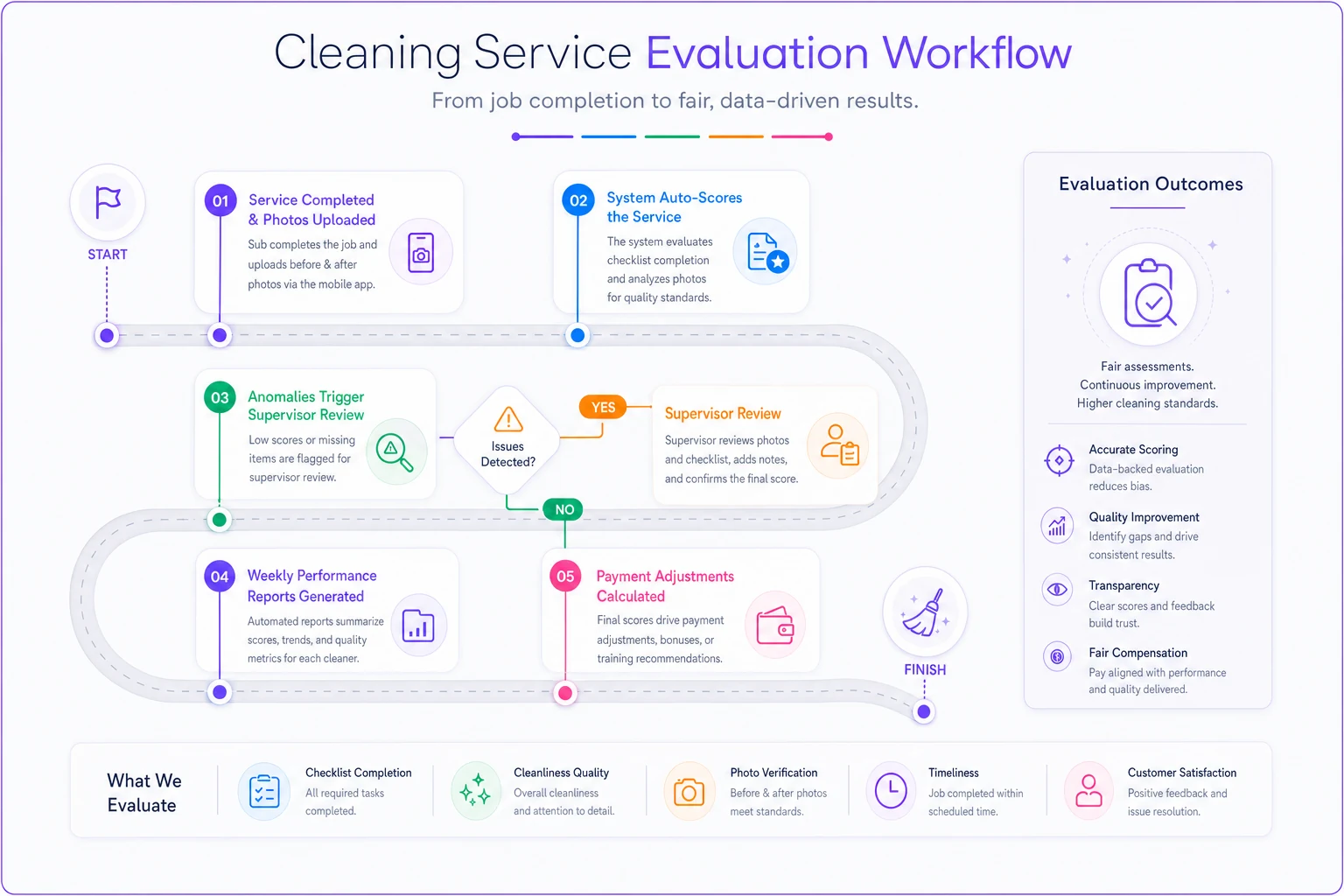
A quick visual of that process helps teams understand where automation fits.
Manual tracking is fine for 2–3 subs. Beyond that, things slip through cracks, standards drift, and you're back to playing quality roulette. The AI components in these platforms flag missing documentation and identify when a sub is consistently underperforming on specific property types—patterns you'd never catch manually until a client complained.
When to build internally vs outsource these systems
Not every cleaning company needs the same level of subcontractor oversight. Your operational complexity determines the right approach.
Build Internal Systems When:
-
You're running fewer than 5 subcontractors and have someone who genuinely enjoys spreadsheets and process documentation. The templates above will work fine tracked manually. Budget about 10 hours to set everything up, then 1–2 hours weekly to maintain it.
The challenge with internal systems is they rely entirely on discipline. Miss a week of scoring and behavior starts sliding. Whoever owns this process needs to be committed to daily tracking—not just in the first month.
Leverage Operational Software When:
-
You're managing 5+ subcontractors, expanding into new markets, or your current system already has gaps. The setup time for manual systems multiplies fast with each new sub. By the time you hit 10 subcontractors across 50+ daily services, manual tracking is a full-time job.
The real consideration isn't just where you are now—it's where you're heading. If you plan to grow beyond 10 subs in the next year, implement software while your operation is still manageable. Retrofitting systems into a complex operation takes significantly longer than building right from the start.
The difference between companies that scale with subs and those that get burned
Subcontractor onboarding for cleaning businesses isn't about paperwork and legal protection—it's about building predictable quality at scale. Every successful cleaning company eventually faces the same choice: stay small with employees only, or figure out how to make subcontractors actually work.
The companies that scale successfully with subs don't have better contractors. They have better systems for finding, evaluating, managing, and improving contractor performance. They treat onboarding as an operational function, not an HR checkbox.
-
Implement the 4-gate vetting system for every new sub
-
Set up trial period scoring (manually or through software)
-
Update contracts with operational protection clauses
-
Create payment structures that incentivize quality
-
Track everything for 30 days before making permanent decisions
If you're also thinking about how to staff and structure your cleaning teams more broadly, this breakdown on staffing and schedule patterns covers how to scale without adding unnecessary overhead. And if rework keeps eating into your margins regardless of who's doing the cleaning, these micro-training modules are worth implementing alongside your onboarding process.
The gap between cleaning companies that thrive with subcontractors and those that struggle isn't luck—it's process. The templates, scorecards, and workflows above remove the guesswork from subcontractor performance.
Stop hoping your next subcontractor works out. Build the system that ensures they do—or reveals they won't—before they touch a single client property. Because the real cost of bad subcontractors isn't the rework or refunds. It's the clients who quietly switch to your competitor and never tell you why.
Ready to simplify your cleaning operations?
Join 1,000+ cleaning businesses using Wipyly to save time, reduce scheduling conflicts, and enhance client satisfaction.