



Gas prices have been dropping for six straight weeks. Reuters reported that U.S. gasoline prices finally dipped below $4 per gallon for the first time since April, with the trend continuing through late June. For cleaning businesses running multiple vans, this is actually a meaningful operational moment — not just a temporary margin boost.
Most cleaning companies won't do anything with it. They'll pocket the savings for a few months, breathe a little easier, then watch prices climb back up without having made any real adjustments. The smarter operators understand that fuel price drops are the right time to restructure routing and pricing — not wait and see.
Why Fuel Costs Hit Cleaning Businesses Harder Than Most
A typical cleaning route burns 15-25 gallons per van per week. Five vans means roughly 375-625 gallons monthly. A dollar drop per gallon is $375-625 straight back into your operating budget. That's real money — but what makes it complicated is how fuel cost compares to revenue per stop in this industry specifically.
HVAC or plumbing techs might hit 4-6 stops per day, each billing hundreds to thousands of dollars. Cleaning vans typically run 8-14 stops, each earning $65-150 for residential or $200-400 for small commercial. The fuel cost per dollar of revenue is higher in cleaning than in almost any other field service business. When gas was pushing $5.50 last year, some routes were barely breaking even after techs and vehicle costs.
The routes that made sense at $5.50 look completely different at $3.80. That medical office 12 miles out isn't eating your margin anymore. The cluster of homes on the far side of town becomes profitable again. But most operators are still running the same tight routes they built when fuel was expensive, and missing the window to expand while costs are down.
The Hidden Pricing Problem
Something weird happens when fuel prices drop. Competitors start getting aggressive, but not in an obvious way. They don't announce surcharge removals or advertise lower rates. They quietly start accepting jobs they would've turned down three months ago.
Stop losing bookings in operational chaos.
Wipyly helps you manage, confirm, and optimize every cleaning appointment efficiently.
- Centralized booking management
- Automated client notifications
- Staff scheduling & route optimization
No credit card required
That house 18 miles from their hub? They'll take it now without the usual travel fee. The one-off deep clean way out in the suburbs? Suddenly worth doing. You can't see this pressure directly — you just notice getting undercut more often, especially on the edges of your territory.
Meanwhile, your existing customers haven't forgotten the surcharges you added when gas hit $5. Even if you formally removed them, they remember. When prices drop noticeably, some customers expect their regular service cost to drop too, even though labor, supplies, and insurance haven't changed at all.
Racing to the bottom on pricing isn't the answer. Using the margin breathing room to lock in longer-term contracts at current rates is. Offer 12-month price locks in exchange for commitment. Customers get price certainty, you get revenue stability when fuel climbs again.
Restructuring Routes While You Have the Cushion
Lower fuel costs change your break-even distance. A job that wasn't worth a 15-mile drive at $5 per gallon might work fine at today's prices. But you can't just start accepting every far-flung job and hope the math works.
What actually makes sense is using these windows to test new territory in a controlled way. Pick one day per week for an expansion route into areas you normally skip. Build it tight — 8-10 confirmed stops minimum. Track everything: drive time, fuel usage, cleaning time, customer quality.
Pro-tip: Pick one day per week for an expansion route into areas you normally skip.
| Territory Factor | Weight | Score (1-5) |
|---|---|---|
| Current job density | 30% | Based on stops per mile |
| Growth potential | 25% | New construction, business growth |
| Customer quality | 20% | Payment history, tips, reviews |
| Competition level | 15% | Other cleaners serving area |
| Route efficiency | 10% | Natural connection to existing routes |
Anything scoring above 3.5 becomes a permanent expansion target. Below 2.5, you only service during low-fuel periods. The ones in the middle get reevaluated monthly.
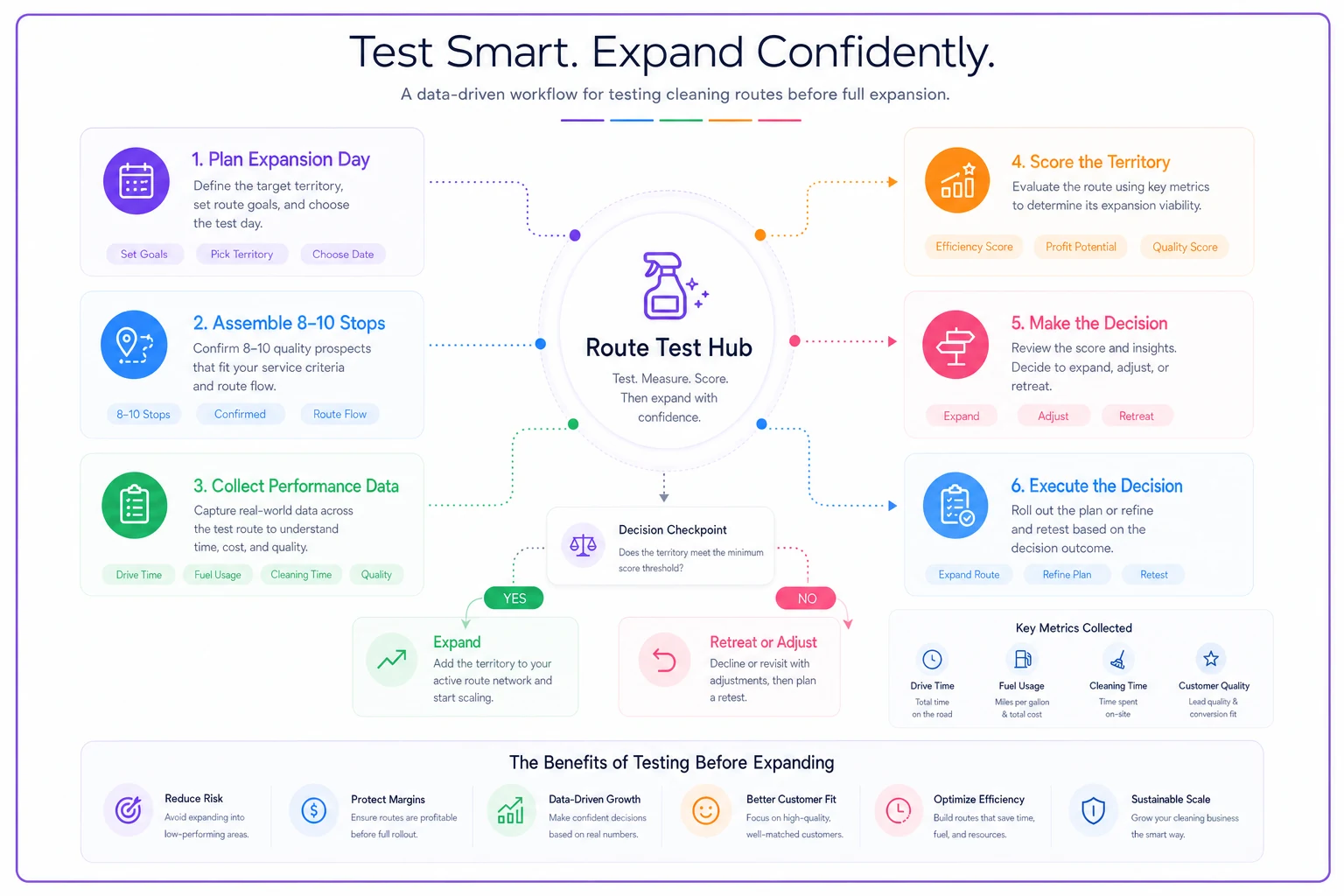
A simple visual of the expansion-route testing workflow.
Schedule Optimization Nobody Talks About
Lower fuel costs don't just affect where you can profitably service — they change when certain types of jobs make sense to run.
Think about your typical week. Monday and Tuesday fill up fast because commercial clients want cleaning after the weekend. Thursday and Friday pack out with residential customers prepping for theirs. Wednesday sits partially empty, especially in the afternoon.
When fuel is expensive, sending a van out for 3-4 stops on a slow Wednesday doesn't make sense. You compress those jobs into busier days, even if it means longer individual routes. At current prices, a half-day route becomes viable again.
At $5 per gallon, a typical route day runs $40-50 in fuel. You need $400-500 in revenue to justify it. At $3.80, that same route costs $30-38. A $300-350 half-day route starts making sense.
Smart operators are using this to spread their schedules out — 8-10 stops across more days instead of cramming 12-14 into monster Tuesday and Thursday routes. Techs actually prefer it. Less rushing, better quality work, fewer complaints about jobs getting skipped or shortened.
The Competitive Landscape Shift
Regional companies with 30+ vans approach fuel differently. They lock in prices through fleet cards and bulk purchase agreements, so when retail prices drop, they don't see the full benefit right away. That creates a 2-3 month window where smaller operators actually have a cost advantage.
Use it to go after accounts you normally wouldn't win. That medical building. The corporate campus needing daily service. These usually go to bigger players who can absorb fuel volatility — but right now, your actual per-mile costs might be lower than theirs.
The pitch that works isn't price. It's flexibility and response time. "We can start next week" beats "we're 5% cheaper" almost every time. Once you're in and proving quality, switching costs keep you there even after fuel prices normalize.
Building a Fuel-Flexible Pricing Model
Most cleaning businesses still quote using flat hourly rates plus some vague travel fee for distant locations. That worked when fuel prices were stable for years at a time. With prices swinging 30-40% in a matter of months, it's not a sustainable approach.
-
Base service rate (labor + supplies + overhead)
-
Distance-based fuel component (miles from hub × current fuel cost per mile)
-
Time-based traffic component (for urban routes where time matters more than distance)
-
Minimum stop threshold (the revenue needed to justify the stop)
When fuel prices move more than 15% and hold for 30 days, you adjust only the fuel component. Customers can follow that logic. What they can't follow is seemingly random price changes or surprise fees on invoices.
A cleaning company in Phoenix started using this transparent breakdown about a year ago — showing customers the components on every invoice. Revenue per customer went up around 8% because clients finally understood what they were actually paying for. More importantly, they stopped losing money on edge-of-territory jobs.
What to Do This Week
The current window won't stay open forever — it never does. Prices have been dropping steadily through June, but oil markets move fast on global news. There's probably 60-90 days to make real moves before conditions shift.
Start by auditing your current routes. Pull your actual routing data from the last month and find which stops eat the most drive time. Those become your redistribution candidates when building out new Wednesday or Saturday routes.
Then identify 2-3 expansion territories you've been curious about. Keep it grounded — areas within 20 miles with natural customer density. Strip malls with multiple business clients. Residential developments with 100+ homes. Medical corridors with clustered practices and facilities.
Run the numbers on switching your furthest 20% of customers to the fuel-flexible pricing model. Frame it as a long-term transparency thing, not a reaction to current gas prices. "We want to be upfront about how we price so we can maintain quality regardless of what markets are doing."
And talk to your team. Cleaners know which routes are inefficient. They know which customers are always asking whether you service their friend's neighborhood across town. When fuel costs allow more flexibility, the people doing the actual work often have the best read on where to expand.
The Automation Angle
What separates operators who actually capture value during fuel price swings from those who just survive it is systematic decision-making. You can't manually re-optimize routes every time gas prices move 50 cents. You can't recalculate every quote when your service area shifts.
The cleaning businesses that get the most out of these periods have operational systems that flag opportunities automatically. When fuel drops below certain thresholds, the software identifies previously unprofitable territories that now make sense. When prices spike, it surfaces which customers need a fuel surcharge conversation.
This doesn't require expensive enterprise software. Even basic AI-powered operational platforms can track fuel costs against route profitability, flag outlier jobs, and suggest schedule optimizations. The difference is having actual data flowing through a system rather than keeping it in your head or scattered across spreadsheets.
One operator in Dallas built a simple alert setup that monitors local fuel prices and generates a weekly opportunity report. When fuel drops significantly, it shows him exactly which previously declined quotes to revisit, which territories become profitable, and which routes could be split for better efficiency. Last quarter, that added around $18k in revenue he would have otherwise missed.
Making Long-Term Moves During Short-Term Windows
Fuel prices will go back up. They always do. The question is whether you'll have used this period to build something sturdier, or just enjoyed a few months of better margins.
The businesses that come out ahead use fuel price drops to invest in competitive position. They lock in efficient routes that stay profitable even when prices rise. They establish presence in new territories before competitors notice the opportunity. They build customer relationships that aren't purely price-driven.
But mostly, they get operationally tighter. Inefficiencies that hide when margins are comfortable become very visible when fuel costs squeeze profits. Routes that barely work at $3.80 definitely won't work at $5. Customers who push back on fuel surcharges now will leave when prices spike again.
Operators worth studying document everything during these periods. Which routes consistently underperform? Which customer segments are most price-sensitive? Which territories generate the most referrals? That intelligence is genuinely valuable during the next fuel cycle.
The cleaning businesses still running strong after a decade have lived through multiple fuel swings. They've figured out that fuel costs aren't just an expense line — they're a variable that touches every part of how you operate. Treating a drop in prices as a temporary reprieve is exactly how you miss the chance to build something more resilient.
Right now, with fuel down 25-30% from recent peaks, there's room to experiment, expand, and optimize in ways that weren't realistic six months ago. The question isn't whether you'll save money on fuel this quarter. It's whether you'll use the opportunity to build a business that holds up regardless of what happens at the pump next year.
Ready to simplify your cleaning operations?
Join 1,000+ cleaning businesses using Wipyly to save time, reduce scheduling conflicts, and enhance client satisfaction.