

Most cleaning operators don't have a pricing problem. They have a product problem. Every quote is custom, every job has slightly different scope, and every client thinks they're paying for something a little different from the client across the street. That's fine when you're running two vans. It quietly becomes the thing capping your growth around the time you hit six or seven crews.
The fix isn't a fancier price sheet. It's treating your services the way a software company treats plans: a small number of clearly defined tiers, each with its own SOP, staffing model, and known marginal cost. When you do this well, your cleaning service design portfolio strategy stops being a collection of one-off bids and becomes a catalog — something a new salesperson can quote, a new supervisor can deliver, and a bookkeeper can actually reconcile.
This article walks through how the whole system connects: how tier definitions drive SOPs, how SOPs drive staffing, how staffing drives marginal cost, and how you pilot the whole thing before you roll it out across the book.
Why ad-hoc service menus quietly break
The reason most cleaning companies never productize isn't laziness. It's that custom quoting feels like a competitive advantage early on. You win jobs because you flex. The client wants the breakroom done daily but the conference rooms twice a week? Sure. You eyeball it, you price it, you win it.
-
Two sites with "the same" service have 20% different labor hours, and nobody can explain why.
-
A supervisor covering a shift doesn't know what's actually promised, so they either over-deliver (margin leak) or under-deliver (complaint).
-
Billing disputes multiply because "what we agreed to" was never written as a repeatable spec.
In real operations, this usually shows up as a gross margin that looks fine in aggregate but is wildly inconsistent account-to-account. You're subsidizing your sloppy contracts with your good ones and you can't see it.
Productizing is really just the act of pulling that knowledge out of people's heads and into definitions. Tiers are where you start.
Step one: define tiers around outcomes, not task lists
The mistake almost everyone makes on their first attempt is building tiers as task bundles — "Tier 1 includes vacuuming and trash, Tier 2 adds dusting." That falls apart fast because clients don't buy tasks, they buy a condition. A medical office and a law firm might get the identical task list but have completely different expectations about appearance and documentation.
Stop losing bookings in operational chaos.
Wipyly helps you manage, confirm, and optimize every cleaning appointment efficiently.
- Centralized booking management
- Automated client notifications
- Staff scheduling & route optimization
No credit card required
A simple tier definition worksheet
| Field | Essential | Professional | Critical/Compliance |
|---|---|---|---|
| Target client type | Small office, low foot traffic | Mid-size commercial, client-facing | Healthcare, food, regulated |
| Outcome standard | Visibly clean, no complaints | Inspection-ready at all times | Passes documented audit |
| Visit frequency | 1–2x / week | 3–5x / week | Daily + spot checks |
| Quality assurance | Spot check monthly | Scored inspection weekly | Photo log + chain of custody per visit |
| Response to issues | Next scheduled visit | 24 hours | 2–4 hours |
| Reporting | None / on request | Monthly summary | Per-visit documentation |
| Who can deliver it | Any trained cleaner | Experienced cleaner | Certified + supervised crew |
The last row matters more than people expect. If a tier requires a certified crew member and a supervisor sign-off, that constraint flows straight into your staffing model and your cost. A tier you can't staff reliably isn't a product — it's a liability you've priced.
Step two: map each tier to an SOP
Once a tier is defined by outcome, the SOP is just the repeatable recipe that produces that outcome at the lowest reliable cost. The key word is reliable. An SOP that only works when your best person runs it isn't an SOP — it's a dependency.
-
Sequence — the order of tasks, which done right cuts walk time and rework.
-
Time standard — target minutes per task and per zone, not a vague "about an hour."
-
Consumable spec — exactly which products and quantities, so cost per visit is predictable.
-
Evidence requirement — what proof of completion is captured, matching the tier's assurance level.
-
Exception rule — what the cleaner does when something's outside scope. This is where scope creep lives or dies.
The connection people miss: your SOPs and your tiers have to be versioned together. If you upgrade the inspection standard on your Professional tier, the SOP has to change the same day, or you've just promised something your delivery can't produce. This is where a lot of companies silently drift — the sales promise and the floor reality separate over a few months and nobody notices until a renewal goes sideways.
Step three: build a staffing model per tier
Because each tier has a time standard and a skill requirement, you can finally staff from the catalog instead of guessing.
-
Convert each tier's SOP time standards into labor hours per visit.
-
Multiply by frequency to get labor hours per month, per account.
-
Tag each tier with a skill level (trainee, standard, certified) because loaded cost differs.
-
Roll it up into a crew composition — a Professional route might be two standard cleaners; a Critical site needs one certified lead plus a standard cleaner and periodic supervisor time.
Track certified crew availability monthly so you can forecast hiring or certification needs before they become urgent.
What changes at scale is coordination. With five accounts, one supervisor holds it together informally. Past 15–20, you need the staffing model to tell you in advance when adding a Critical-tier contract forces you to hire or certify someone, versus when a new Essential account can just be absorbed into existing slack. Without that visibility, you win a contract on Friday and spend the next two weeks robbing crews from other routes.
Step four: marginal-cost templates
This is the part that separates a real portfolio from a pretty brochure. For every tier, you need a marginal-cost template — what it actually costs you to deliver one more unit of that tier.
-
Direct labor — hours × loaded wage (wage + payroll taxes + comp).
-
Consumables — from the SOP's consumable spec.
-
Equipment allocation — wear and depreciation per visit, not ignored.
-
Travel/drive — a prorated share based on route density.
-
QA/supervision — the slice of inspection and sign-off time the tier requires.
Marginal cost per month, per account, is just per-visit × frequency, plus any fixed account overhead like reporting and account management.
A typical example: say a Professional-tier visit runs:
-
Labor
2.5 hours × ~$24 loaded = ~$60
-
Consumables
~$6
-
Equipment
~$3
-
Drive (dense route)
~$5
-
QA allocation
~$4
That's roughly $78 per visit. At 4 visits a week, you're near $1,350/month in true marginal cost. Now you can price with intent — and more importantly, you can see that if your drive share jumps because the account is isolated, your margin on that "standard" contract is quietly 8–10 points lower than the identical account across town. Those are the contracts that look fine on the quote and bleed quietly all year.
If you want to go deeper on turning these cost templates into a flexible quoting system, the logic pairs well with a modular pricing engine for mixed cleaning contracts — the tiers give you the products, the engine gives you the margin bands and decision gates around them.
The workflow, start to finish
Once productized, here's how the pieces move together:
A salesperson scopes a prospect and picks the closest tier from the catalog. The tier's marginal-cost template generates a floor price; the pricing logic adds margin and any site adjustments — drive time, after-hours, specialty surfaces. The signed tier triggers the matching SOP version to the delivery team, and the staffing model checks whether current capacity absorbs the account or flags a hire or certification need. Delivery runs the SOP, captures tier-appropriate evidence, and QA scores against the tier's assurance standard. Any out-of-scope request hits the SOP's exception rule and becomes a change order instead of silent free work. At renewal, actuals — real hours, real consumables, real QA scores — feed back into the tier's templates so the next version is sharper.
Below is a simple visual of that workflow.
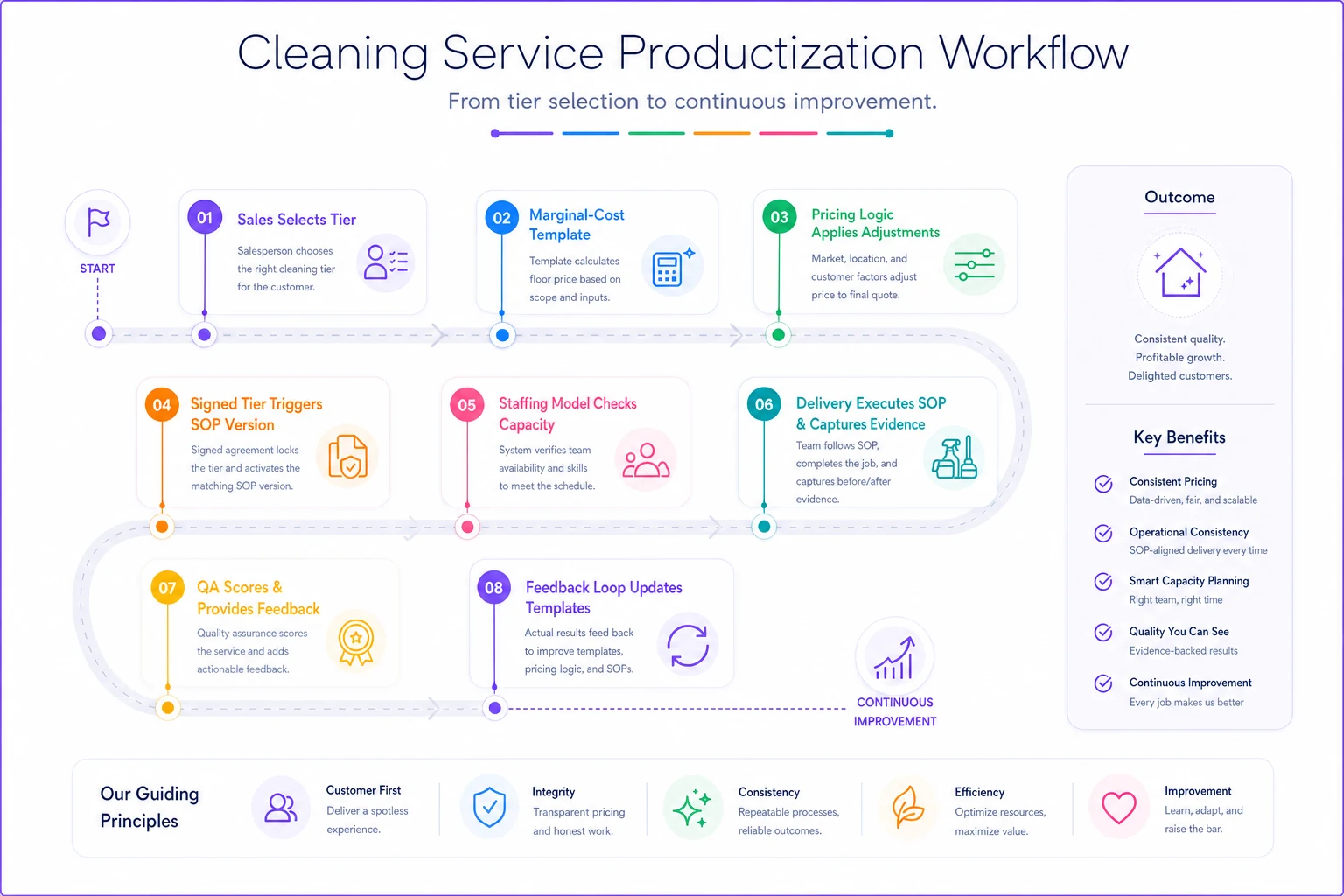
That feedback loop is the whole point. A productized portfolio isn't static. It's a set of specs that improve every renewal cycle because you're finally measuring against a defined standard instead of someone's memory.
The pilot → rollout GTM checklist
Don't re-tier your whole book at once. The single biggest rollout failure is converting everything to new packages overnight and confusing your crews and clients in the same month. Pilot it first.
Pilot phase (3–5 accounts, ~4–6 weeks):
-
[ ] Pick 1 account per tier you plan to offer, plus one messy edge case.
-
[ ] Write the tier definition worksheet and SOP for each before touching the account.
-
[ ] Baseline current actuals
real hours, consumables, complaint rate.
-
[ ] Run the SOP and capture evidence at the tier's assurance level.
-
[ ] Track variance between the marginal-cost template and reality, per visit.
-
[ ] Log every exception and scope request, and how the exception rule handled it.
-
[ ] Debrief crews weekly — the floor will tell you where the SOP is wrong.
Rollout gate (decide before scaling):
-
[ ] Template variance under ~10% on at least two tiers.
-
[ ] Crews can run SOPs without the owner present.
-
[ ] QA scores are consistent across different cleaners on the same tier.
-
[ ] Pricing floor produces target margin at real costs, not projected ones.
Rollout phase:
-
[ ] Map every existing account to the nearest tier (some will need custom add-ons — that's fine, add-ons are a feature).
-
[ ] Reprice at renewal, not mid-contract, unless the account is already underwater.
-
[ ] Retrain supervisors on tier-based QA before sales starts selling tiers.
-
[ ] Set a quarterly review to re-version SOPs and cost templates from actuals.
When you're ready to grow accounts into higher tiers, the same tier structure makes upselling clean without blowing up delivery — there's a useful approach to that in this breakdown of a stage-gated upsell system for cleaning portfolios.
A real scenario
A mid-sized commercial operator — around 11 crews, mostly offices and a couple of clinics — was quoting everything bespoke. Gross margin on paper looked healthy, call it mid-30s, but it swung from near 20% to over 45% account to account, and nobody could predict which new contracts would actually be profitable.
They built three tiers, wrote SOPs for each, and ran a six-week pilot on four accounts including one clinic. The first thing the pilot exposed: their standard office SOP had no sequence, so two cleaners on identical sites were logging roughly 30–40 minutes of difference per visit. Tightening the sequence and time standard pulled that variance way down. After rolling tiers out across renewals over about two quarters, the headline number barely moved — margin went from the mid-30s to maybe high-30s. The real win was the spread. Underwater accounts surfaced and got repriced or exited, quoting got faster because sales picked a tier instead of building from scratch every time, and new supervisors could run inspections against a written standard instead of guessing at what the owner would accept. Scope creep dropped noticeably once the exception rule turned free extras into change orders.
When this makes sense — and when it doesn't
Productizing is worth the effort once you're past the point where one person can hold every account's scope in their head. For most operators that's somewhere around five to eight recurring commercial accounts, or the moment you hire your first supervisor who isn't you.
When it's a bad idea: if your book is almost entirely true one-off deep cleans and move-outs with no repeat structure, rigid tiers will fight your reality. Strong task-level timing tables will serve you better than SLA packages. Who should not do this yet: a brand-new operator still figuring out what their costs actually are. You can't productize costs you haven't measured. Run ten or fifteen jobs, capture real hours and consumables, then build tiers on data instead of hope.
Where tooling fits
None of this requires software to start — a worksheet and a spreadsheet get you through a pilot. But the system gets heavy fast once you're maintaining SOP versions per tier, matching staffing to incoming contracts, and feeding actuals back into cost templates across dozens of accounts. That's where an AI-powered operational platform earns its keep: keeping each tier's SOP version tied to the accounts on it, surfacing when a new contract forces a hiring or certification decision, and flagging accounts whose real costs have drifted past their template.
The job isn't to replace your judgment — it's to keep the catalog, the delivery, and the numbers from quietly separating as you scale.
Stop selling your time and start selling defined products. Define the tier, write the recipe, staff from the recipe, know the marginal cost, and prove it in a pilot before you bet the book on it. Do that, and your portfolio becomes something you can price, deliver, and grow with actual confidence — instead of a pile of custom promises you're just hoping you can keep.
Ready to simplify your cleaning operations?
Join 1,000+ cleaning businesses using Wipyly to save time, reduce scheduling conflicts, and enhance client satisfaction.