

A winter storm warning hits your metro on a Thursday afternoon. By Friday morning, three commercial accounts are calling for emergency ice-melt applications, two office parks want their entrances cleared, and your main janitorial supplier just told you ice melt is on backorder until Tuesday. Crews are scrambling, you're paying $11 a bag for something that normally runs $6, and none of this was priced into the contracts you signed back in June.
This is where cleaning companies quietly lose money they won't notice until the quarter closes. The jobs still get done. Clients are mostly happy. But the margin on that surge week? Gone. Sometimes negative.
The fix isn't "stock more supplies" or "charge more during storms." It's building pre-defined rules that connect specific surge triggers to specific buffer levels, backup contracts, and pricing schedules — so nobody has to improvise at 6 a.m. during a flu-season spike or a flooding event. That's what supply contingency cleaning planning actually looks like in practice, and most operators don't build it until they've been burned at least twice.
Where the margin actually leaks during a spike
Surge losses rarely come from one big expense. They come from four small leaks happening simultaneously, and because each one looks minor on its own, nobody flags it.
-
Panic-buying at retail prices. Your standing supplier runs dry, so a supervisor grabs supplies from a hardware store at a 60–90% markup. Nobody logs it against the account that caused it.
-
Overtime with no surcharge. Crews work weekend or night hours at 1.5x pay, but the contract bills the client at the normal flat rate.
-
Scope creep disguised as emergencies. A client asks for "just a quick extra pass" and because it's a crisis, nobody writes a change order.
-
Expedite and delivery fees. Rush shipping, after-hours supplier pickups, fuel for off-route runs — all absorbed silently.
Consider a mid-size janitorial company serving around 18 commercial accounts that gets hit with a norovirus outbreak across three school clients in the same week. They spend roughly $2,800 extra on disinfectant and electrostatic sprayer rentals, pay around $1,900 in unplanned overtime, and bill none of it as a surcharge because the master service agreement didn't allow for it. Close to $4,700 of margin erosion from a single week — and it repeats every flu season because nothing structural changed.
The core problem: demand spikes are predictable in type even when they're unpredictable in timing. Weather, illness outbreaks, post-event cleanups, seasonal move-outs. You can't know the date, but you absolutely know the scenario. And anything you can name in advance, you can write rules for.
Start by mapping your surge scenarios
Before you touch buffer stock or supplier contracts, list the specific surge types your business realistically faces. Keep it concrete. "Bad weather" is useless. "Freezing rain requiring entrance de-icing at retail and office accounts" is a scenario you can actually plan against.
Stop losing bookings in operational chaos.
Wipyly helps you manage, confirm, and optimize every cleaning appointment efficiently.
- Centralized booking management
- Automated client notifications
- Staff scheduling & route optimization
No credit card required
-
Severe weather — snow, ice, flooding, post-storm debris and water extraction
-
Illness outbreaks — flu season, norovirus, anything requiring disinfection beyond baseline scope
-
Seasonal demand — end-of-lease move-out cleans, holiday retail deep cleans, spring surges
-
Supply disruption — a key product on backorder independent of demand (the PFAS reformulations caused a wave of this)
-
Event-driven spikes — conferences, large facility events, emergency biohazard calls
For each scenario, answer three questions: How fast does it hit? (hours vs. days), Which supplies spike?, and Which clients are affected? A freezing-rain event hits in hours and burns through ice melt and mats. A flu outbreak builds over days and burns through disinfectant and labor. Those need completely different buffer rules — stocking ice melt won't help you during norovirus.
This mapping exercise is the foundation. Everything downstream — buffer levels, backup suppliers, pricing triggers — attaches to a specific named scenario.
Buffer rules: how much to hold, and when to hold it
Carrying inventory costs money, so the goal isn't to stockpile everything. It's to hold the right buffer for scenarios that are fast-hitting and supply-constrained, and lean on rapid resupply for everything else.
A practical way to split this:
| Scenario type | Lead time to impact | Buffer strategy | Example buffer level |
|---|---|---|---|
| Freezing rain / ice | Hours | Hold physical buffer stock | 2 full events' worth of ice melt + mats |
| Snow events | 1–2 days | Partial buffer + supplier on standby | 1 event's worth, pre-positioned |
| Flu / outbreak | 3–7 days (builds) | Light buffer, fast reorder trigger | 1 week of disinfectant at surge rate |
| Seasonal move-outs | Weeks (known calendar) | No buffer, pre-order on schedule | Order 2 weeks ahead per lease calendar |
| Supply backorder | Variable | Dual-source critical SKUs | 30-day safety stock on at-risk items |
The piece most operators miss: your buffer level should be tied to how fast you can resupply, not to how often the scenario happens. A once-a-year ice event still justifies holding stock because when it hits, you have hours — not days — to react, and every other cleaning company in your market is draining the same shelves at the same moment.
Set a hard reorder trigger for each buffered item. Something like: "When ice melt drops below two events' worth during November–March, reorder immediately." The trigger should be a number, not a gut feeling. Supervisors shouldn't be eyeballing a supply closet and guessing.
Tie reorder triggers to supplier lead times so you don't understock items that take days to replace.
One more thing worth noting — buffer stock interacts with your equipment. If a flu-season surge means you're running sprayers and extractors harder than usual, your maintenance cadence matters just as much as your supply closet. It's worth keeping surge demand in mind when you build out your equipment uptime plan, because a sprayer that dies mid-outbreak is effectively a supply problem too.
Emergency supplier contracts: negotiate before you need them
The worst time to find a backup supplier is during the shortage. Prices are already up, everyone's calling the same distributors, and you have zero leverage because you need product today.
-
A named secondary supplier for every critical SKU. Disinfectant, ice melt, can liners, paper — whatever runs out first in your scenarios. One backup minimum.
-
Pre-agreed surge pricing. Get a written ceiling. "During a declared supply event, you won't charge me more than X% over standard." Suppliers will often agree to this in exchange for being your standing backup.
-
Standby or priority terms. Some suppliers offer priority allocation to accounts who commit to a minimum annual spend. For fast-hitting scenarios, this is worth more than a slightly lower unit price.
-
Clear activation language. Define exactly what triggers the emergency terms so there's no argument about whether a situation qualifies.
How it works in practice:
[Surge trigger fires] ↓ [Ops lead checks primary supplier availability] ↓ ┌─────┴─────┐ Can fulfill? Cannot fulfill within window ↓ ↓ Proceed Activate backup contract normally at pre-agreed rate ↓ [No retail panic buy needed]
Turn that decision flow into a simple workflow you can execute without a phone-tree scramble.
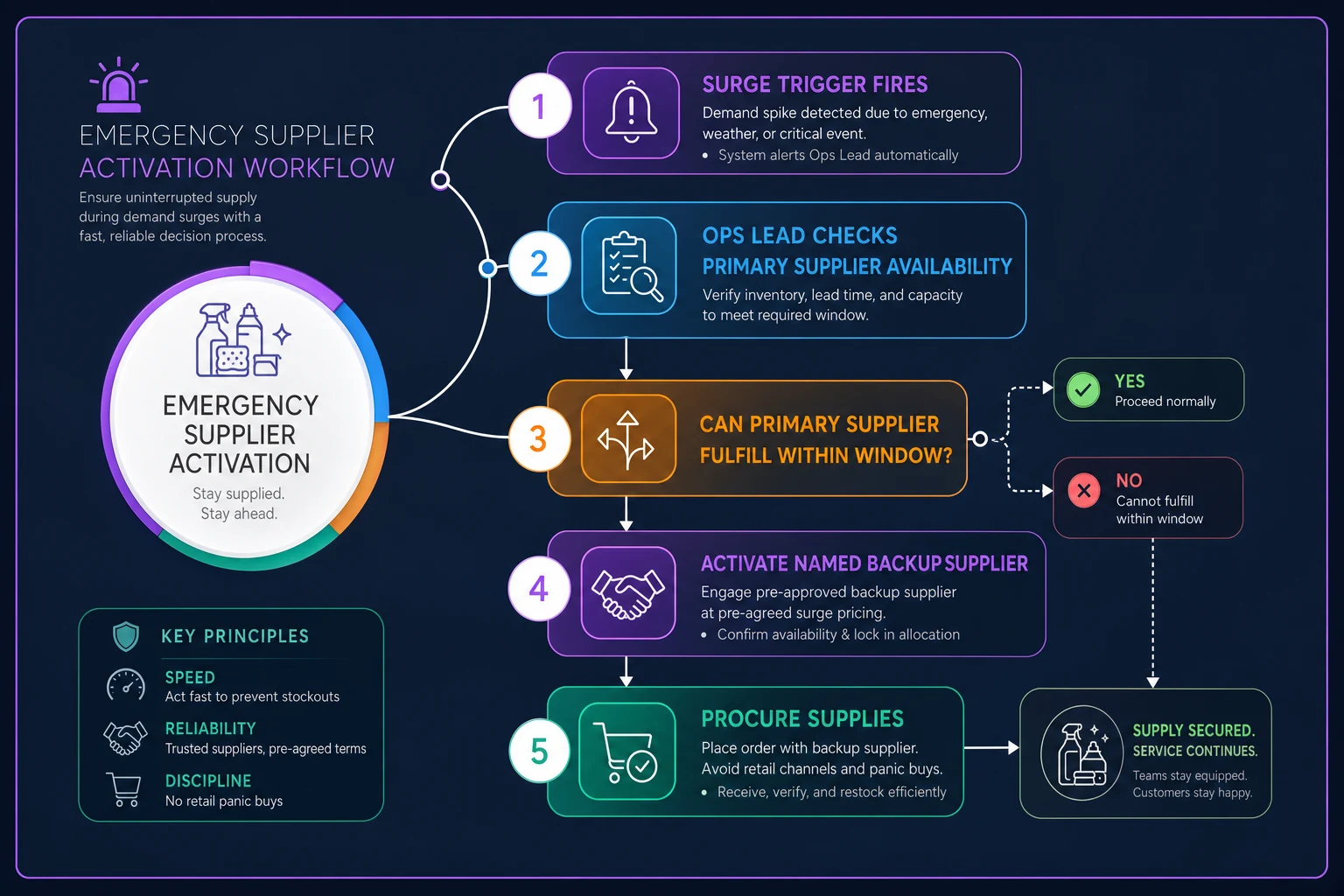
No phone-tree scramble, no retail panic buys. The decision was made months ago — the storm just executes it.
Operators who do this well treat backup suppliers like insurance. You pay a small premium — sometimes just relationship maintenance and a committed minimum — to guarantee you're not buying ice melt at Home Depot prices during the one week you need forty bags of it.
Exception-pricing schedules: the part everyone skips
This is where most of the margin actually gets saved, and it's the piece operators most often leave out. Holding buffer stock and lining up backup suppliers controls your costs. But if you can't pass surge costs through to the client, you're just absorbing them more efficiently.
An exception-pricing schedule is a pre-built table that says, for each surge scenario, what the client gets charged above baseline. You build it once, reference it during the spike, and apply it without a negotiation every time.
| Surge trigger | Client charge adjustment | Billing mechanism |
|---|---|---|
| Emergency de-icing (unscheduled) | Per-application flat fee | Logged change order |
| After-hours disinfection | Base rate + weekend/night differential | Pre-authorized in MSA |
| Outbreak response (extra frequency) | Per-visit surge rate | Triggered by written request |
| Supply-cost pass-through | Documented cost + agreed markup | Attached receipts |
| Expedite / rush response | Fixed emergency call-out fee | Flat, per activation |
The critical move is tying each exception price to a documented trigger. The surge rate doesn't apply because you felt like charging more — it applies because freezing rain was forecast, the client requested emergency service, and your contract authorizes it. That paper trail is what protects the relationship when the invoice comes in higher than usual.
If you've already built a flexible pricing structure for your mixed contracts, this plugs right in — the exception schedule is really just a surge layer on top of your existing modular pricing engine, with margin bands that account for the higher cost of emergency labor and supplies.
The client clauses that make all of this enforceable
None of your pricing schedules matter if your contract doesn't allow them. This is where surge losses become permanent — you're structurally unable to recover costs because the master agreement locked you into flat pricing with no exceptions.
-
Force majeure with service continuity terms. Defines what happens during weather events, including who pays for emergency response and at what rate.
-
Surge-pricing authorization. Explicitly permits exception rates during defined scenarios, referencing your schedule.
-
Supply-cost pass-through. Allows documented cost increases to flow to the client, within an agreed cap so it stays fair.
-
Emergency service request procedure. Requires written (even text or email) authorization for out-of-scope emergency work, which prevents "quick extra pass" scope creep.
-
Minimum response commitments and the price attached to them. If the client expects two-hour de-icing response, the contract states that service level and its surge cost.
The goal of these clauses isn't to gouge clients. It's to make the economics transparent before the crisis, so there's no awkward conversation during it. Good clients generally accept surge terms when they're reasonable, capped, and explained upfront — because they'd rather have a cleaning company that shows up prepared during a storm than one quietly going broke trying to serve them.
A short real scenario
A regional janitorial operator running about 14 commercial and retail accounts kept losing somewhere between $3k and $5k every winter to ice events. Every storm, supervisors bought ice melt at retail, crews ran weekend hours that didn't get billed as emergency service, and nothing got invoiced at a surge rate.
Before the next season, they did three things: mapped their ice/snow scenario with a hard buffer rule (two events of ice melt held November through March), signed a backup supplier with a capped surge price, and added a de-icing exception line to their contracts at a flat per-application fee with client sign-off by text.
The following winter brought a comparable number of events. Supplies came from the primary supplier or the capped backup — no retail panic buys. Emergency applications got billed at the agreed rate. The surge week that used to run negative came out roughly break-even to modestly profitable. Nothing dramatic — just a leak that stopped leaking.
When this level of planning is worth it — and when it isn't
If you run two or three residential recurring clients, a full contingency framework is overkill. Your exposure is small, your supply needs are simple, and a basic buffer plus common sense covers it.
This becomes worth building when:
-
You have multiple commercial or institutional accounts with response-time expectations
-
Your region sees predictable weather or seasonal spikes
-
You've already eaten a bad surge week and felt it in the quarter
-
You're bidding contracts that include emergency or weather-response scope
Over-engineering this for mostly flat residential work with no emergency component is a waste of time — you'll build schedules you never trigger. Match the depth of the plan to your actual exposure.
Pulling it together
Surge losses feel like bad luck in the moment — the storm hit, the supplier ran dry, crews had to scramble. But almost none of it is actually unpredictable. You know which scenarios you face. You know which supplies spike and which clients call. The only thing you don't know is the date.
That's exactly why rules work here. Map your surge scenarios, attach buffer levels to how fast each one hits, line up backup suppliers before you're desperate, build an exception-pricing schedule, and make sure your client contracts authorize all of it. Do that once, maintain it seasonally, and the next spike becomes a logistics exercise instead of a margin event.
The crews will still scramble a little — that part never fully goes away. But your P&L stops absorbing the damage.
Ready to simplify your cleaning operations?
Join 1,000+ cleaning businesses using Wipyly to save time, reduce scheduling conflicts, and enhance client satisfaction.