


Most cleaning businesses lose clients in the gaps between departments. Not because the cleaning is bad, but because nobody owns the transition from sales promise to operational reality to ongoing account management. This pattern destroys otherwise solid cleaning operations — a sales rep closes a $4,800/month office contract, operations gets a half-complete intake form, the first clean goes sideways, and by month three everyone's pointing fingers while the client walks.
The real killer isn't bad cleaning. It's bad handoffs.
Why cleaning businesses break at the seams
Sales closes a deal on Friday afternoon. They email operations a contract PDF and maybe some notes about "special requirements." Operations shows up Monday morning and realizes they need door codes, parking instructions, supply preferences, and about twelve other details nobody captured. The crew arrives Tuesday, can't access half the areas, uses the wrong products on specialty surfaces, and suddenly that promising new account starts with an apology call.
This isn't a training problem. It's a lifecycle problem.
The cleaning client lifecycle has distinct stages, each requiring specific artifacts, clear ownership, and measurable handoff criteria. Without these, you're basically hoping information magically transfers between people who rarely talk to each other.
Here's what a proper cleaning client lifecycle looks like when you actually build it out.
Stage 1: Sales to operations handoff (Days 0-3)
The moment a contract gets signed, a countdown starts. You have roughly 72 hours to transfer everything operations needs to deliver on whatever sales promised. Miss this window and the first service becomes a scramble.
Stop losing bookings in operational chaos.
Wipyly helps you manage, confirm, and optimize every cleaning appointment efficiently.
- Centralized booking management
- Automated client notifications
- Staff scheduling & route optimization
No credit card required
Required artifacts at this stage:
-
Access requirements (codes, keys, contact for entry)
-
Service specifications by area (what gets cleaned, what doesn't)
-
Supply restrictions or preferences
-
Scheduling constraints (quiet hours, restricted areas by time)
-
Billing setup confirmation
-
Special surfaces or equipment requiring specific care
-
Photo documentation requirements from the client
The SLA that matters here: Sales must deliver a complete intake package to operations within 4 hours of contract signing. Not "by end of day." Not "when they get around to it." Four hours.
Operations then has 24 hours to review and flag any gaps. This creates a feedback loop that catches missing information before the first service.
Require sales to attach the completed intake form before marking a deal as 'won' in your CRM.
Handoff trigger: The intake package gets marked complete only when operations confirms they have everything needed for service delivery. No confirmation, no commission. That usually gets sales moving pretty quick.
Stage 2: Operations to field crew (Days 3-7)
Operations translating sales promises into actual work instructions — this is where most cleaning businesses completely fail their crews. A typical crew lead gets handed an address, a key, and maybe "it's a standard office clean." Then everyone wonders why quality issues pop up on week one.
The onboarding checklist that actually works:
-
Room-by-room task lists with time allocations
-
Product requirements by surface type
-
Client-specific preferences documented with photos
-
Quality checkpoints the client specifically mentioned
-
Areas to avoid or handle carefully
-
Preferred communication style with on-site contacts
This isn't documentation for documentation's sake. One cleaning company cut first-visit complaints by around 70% just by giving crews actual site playbooks instead of verbal instructions. The playbooks took maybe 40 minutes to build per client but saved hours of rework and saved more than a few client relationships.
Critical handoff: The crew lead must acknowledge receiving AND understanding the playbook — not just "got it," but actually walking through unclear points with operations before the first visit.
Stage 3: First service to steady-state (Days 7-30)
The first 30 days determine whether a client stays for years or churns in months. Yet most cleaning companies treat day one and day thirty exactly the same.
The QA cadence that prevents surprises:
-
Week 1
Daily check-ins with the client contact. Just a text or quick call — "How did yesterday's service go?" You're not looking for praise. You're looking for small adjustments before they turn into complaints.
-
Week 2-3
Shift to every-other-day check-ins. By now you should have a rhythm, but you're still in the window where client expectations might not match what's actually being delivered.
-
Week 4
Weekly check-in, plus a formal 30-day review.
The 30-day review template that actually drives retention:
-
What's working well (get specific examples)
-
What needs adjustment (capture everything, even minor items)
-
Any changes to original scope or schedule
Operations owns weeks 1-3, but account management joins for the week 4 review. This creates a natural transition point where the client relationship shifts from new implementation to ongoing management.
Stage 4: Steady operations with quarterly touchpoints (Months 2-11)
Once past the first month, most cleaning companies go completely hands-off until something breaks. They only hear from clients when there's a billing dispute or major complaint. This is exactly backwards.
Quarterly Business Review structure for cleaning accounts:
-
Service quality trends (any recurring issues)
-
Scope changes or additions since last review
-
Upcoming facility changes that might affect service
-
Rate adjustment discussions if applicable
-
Introduction of new service offerings
These aren't sales calls. They're operational alignment checks. One commercial cleaning company started doing quarterly reviews and discovered roughly 40% of their clients had upcoming office moves or renovations they'd never mentioned. Knowing three months early versus three days early completely changes how you handle the transition.
The early warning system:
-
Two quality complaints within 30 days
-
Payment delays beyond normal pattern
-
Sudden communication changes (new point of contact, delayed responses)
-
Service cancellations or reductions
-
Requests for copies of insurance or contracts (often means they're shopping)
When any trigger hits, account management schedules an immediate check-in. Not to sell — to understand what's changing.
Stage 5: Annual renewal and expansion (Month 11-12)
Renewal shouldn't be a surprise scramble in month twelve. It should be a natural conclusion to eleven months of consistent communication and service delivery.
The 60-day renewal sequence:
-
Day -60
Account management sends renewal notice with current terms and any rate adjustments. Include a summary of service delivery over the past year — number of services completed, special requests accommodated, quality scores if you track them.
-
Day -45
Follow-up call to discuss questions or concerns. This is where you catch brewing dissatisfaction before it becomes non-renewal.
-
Day -30
Final renewal package with any negotiated adjustments. Include options for service expansion if appropriate.
-
Day -15
Confirmation required or the account goes into transition planning.
The expansion conversation that doesn't feel salesy:
One question works well during renewal: "What's changing in your facility over the next year?"
Office expanding? They'll need more service. Cutting costs? Maybe you adjust frequency but add periodic deep cleans. Installing new flooring? You can recommend appropriate maintenance schedules.
| Day | Action |
|---|---|
| Day -60 | Account management sends renewal notice with current terms and any rate adjustments. Include a summary of service delivery over the past year — number of services completed, special requests accommodated, quality scores if you track them. |
| Day -45 | Follow-up call to discuss questions or concerns. This is where you catch brewing dissatisfaction before it becomes non-renewal. |
| Day -30 | Final renewal package with any negotiated adjustments. Include options for service expansion if appropriate. |
| Day -15 | Confirmation required or the account goes into transition planning. |
The point is aligning your service with their operational reality, not pushing unnecessary add-ons.
Building the operational infrastructure
All these handoffs and templates mean nothing without clear ownership and systems to track them.
Role clarity:
-
Sales owns
Initial intake and complete information capture
-
Operations owns
Service setup, crew training, first 30 days quality
-
Account management owns
Ongoing relationship, renewals, expansion
-
Field crews own
Service delivery and immediate issue flagging
Information flow:
Every client needs a single source of truth — one place where all information lives. Not scattered across emails, text messages, and sticky notes. When the crew lead needs to know about a client's surface preferences at 7am, they shouldn't have to dig through six months of email chains to find it.
Accountability metrics:
Track handoff completion rates. How often does operations actually get complete intake packages from sales? How often do quarterly reviews happen on schedule? How many renewals get addressed 60 days out versus as last-minute scrambles?
One cleaning company tracking these metrics found their sales team completed intake forms properly only about 60% of the time. The other 40% led to rocky starts and early churn. Once they started enforcing the handoff SLA, their 90-day retention improved by around 25%.
Here's a simple visual of how the lifecycle and handoffs connect.
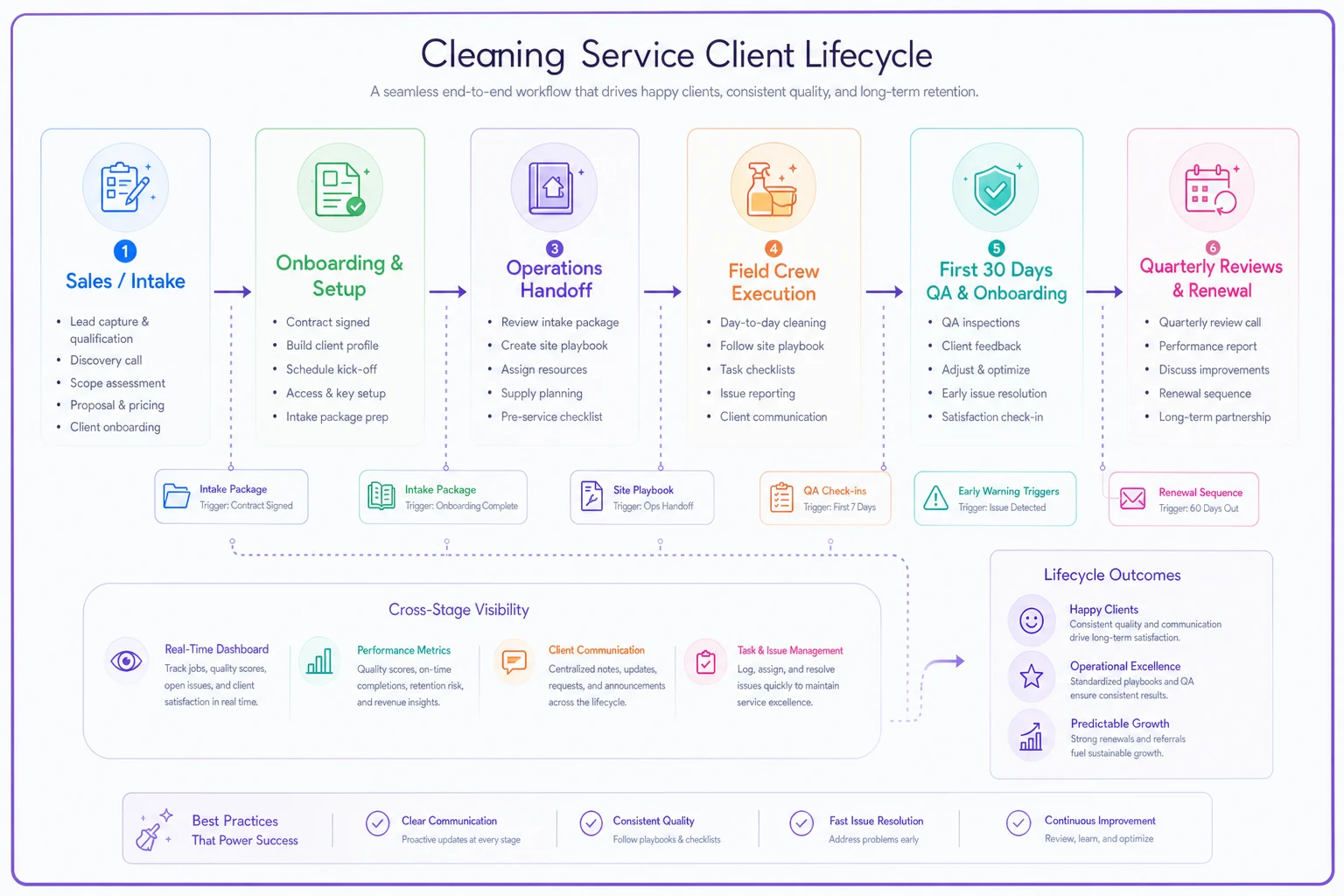
Place this diagram where your team onboards new hires so everyone sees the handoffs and ownership at a glance.
Where automation actually helps
The cleaning client lifecycle generates a lot of repetitive coordination work. Following up on handoffs, scheduling reviews, tracking triggers — it's all necessary and all painfully manual at scale.
AI-powered operational software makes a real difference here. Not by replacing people, but by making sure nothing falls through the cracks. Automated reminders for quarterly reviews, alerts when handoff SLAs get missed, centralized client information accessible to anyone who needs it — these aren't flashy features, but they're what separates a well-run operation from one that's constantly putting out fires.
The best systems don't try to automate actual client interactions. They handle the tracking, reminding, and information sharing that makes good client interactions possible. When your account manager doesn't have to remember to schedule quarterly reviews because the system prompts them automatically, they can focus on actually running a valuable conversation instead of just remembering to have one.
Making the lifecycle work in reality
The process outlined here probably feels overwhelming if you're currently managing everything through group texts and memory. Start with one transition point — usually sales to operations — and fix that first. Build the intake form, set the SLA, track completion for a month. Once that's working, add the next stage.
Most cleaning businesses can get a functional lifecycle management system running in around 90 days. Not perfect, but solid enough to see real impact. Confusion drops, fire drills get rarer, and clients stick around longer because they actually feel managed rather than forgotten until something breaks.
The cleaning client lifecycle isn't about bureaucracy. It's about making sure every client gets consistent, professional service from contract signing through year-five renewal. Map the stages, build the artifacts, enforce the handoffs — and you stop being a company that does cleaning and start being an operation that delivers predictable outcomes.
The difference shows up in retention rates, your team's stress levels, and ultimately the bottom line. Keeping a client for three years instead of three months changes everything about how a cleaning business actually grows.
The cleaning client lifecycle isn't about bureaucracy. It's about making sure every client gets consistent, professional service from contract signing through year-five renewal. Map the stages, build the artifacts, enforce the handoffs — and you stop being a company that does cleaning and start being an operation that delivers predictable outcomes.
The difference shows up in retention rates, your team's stress levels, and ultimately the bottom line. Keeping a client for three years instead of three months changes everything about how a cleaning business actually grows.
Ready to simplify your cleaning operations?
Join 1,000+ cleaning businesses using Wipyly to save time, reduce scheduling conflicts, and enhance client satisfaction.