

Event cleaning breaks most of the systems that work fine for your recurring commercial accounts. A 400-person conference teardown isn't a bigger version of your nightly office route — it's a different animal that compresses two weeks of operational decisions into about six hours, half of which happen after midnight when nobody you trust is answering their phone.
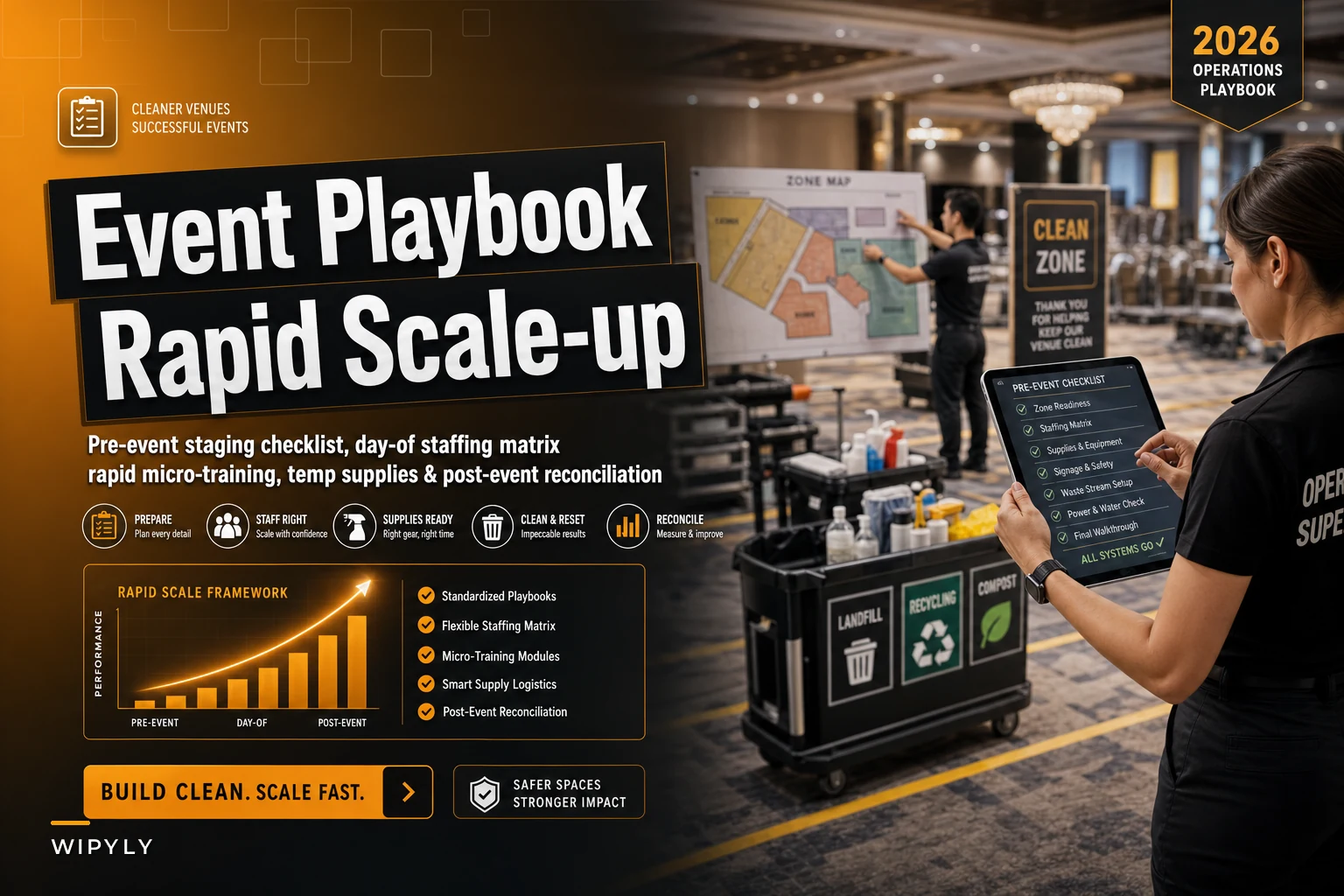
The margin is good when it works. It evaporates fast when it doesn't. And the difference almost always comes down to four boring documents nobody wants to build until the second time they get burned: a pre-event staging checklist, a day-of staffing matrix, a rapid micro-training format for temps you've never met, and a post-event reconciliation template. This is the operational core of an event cleaning playbook — not the sales pitch, the actual runbook you hand a supervisor at 11pm.
Here's where these contracts fall apart and what actually holds them together.
Where event contracts quietly bleed money
The standard failure isn't dramatic. You don't lose the account in a blowup. You finish the job, invoice it, and then realize three weeks later that your "profitable" $9,200 event netted you closer to $1,400 once you counted the no-show temps you still paid a four-hour minimum, the supplies that walked off the truck, the overtime your two reliable leads racked up covering gaps, and the $600 damage charge the venue billed back because nobody documented the scuffed ballroom floor was already scuffed when you arrived.
| Line item | Quoted assumption | What actually happened |
|---|---|---|
| Labor (12 temps × 5 hrs) | $3,600 | 3 no-shows, 2 left early; paid minimums to 9, overtime to 2 leads → ~$4,450 |
| Supplies & consumables | $480 | Over-ordered liners, lost a backpack vac → ~$720 |
| Venue damage/clawback | $0 | Pre-existing floor damage charged back → $600 |
| Supervisor hours | $300 | Chaos extended the night by 3 hrs → $540 |
None of those overages are exotic. Each one traces back to a missing document or a missing photo. That's the frustrating part — these losses are almost entirely preventable with paper, not talent.
The pre-event staging checklist (where 70% of the night is won)
Event cleaning is unusual because the quality of your setup determines the ceiling of your execution. On a recurring account you can fix a weak day tomorrow. On an event, the doors open once, the teardown window is fixed, and whatever you didn't stage in advance you're now improvising at 1am with temps who don't know where the loading dock is.
Stop losing bookings in operational chaos.
Wipyly helps you manage, confirm, and optimize every cleaning appointment efficiently.
- Centralized booking management
- Automated client notifications
- Staff scheduling & route optimization
No credit card required
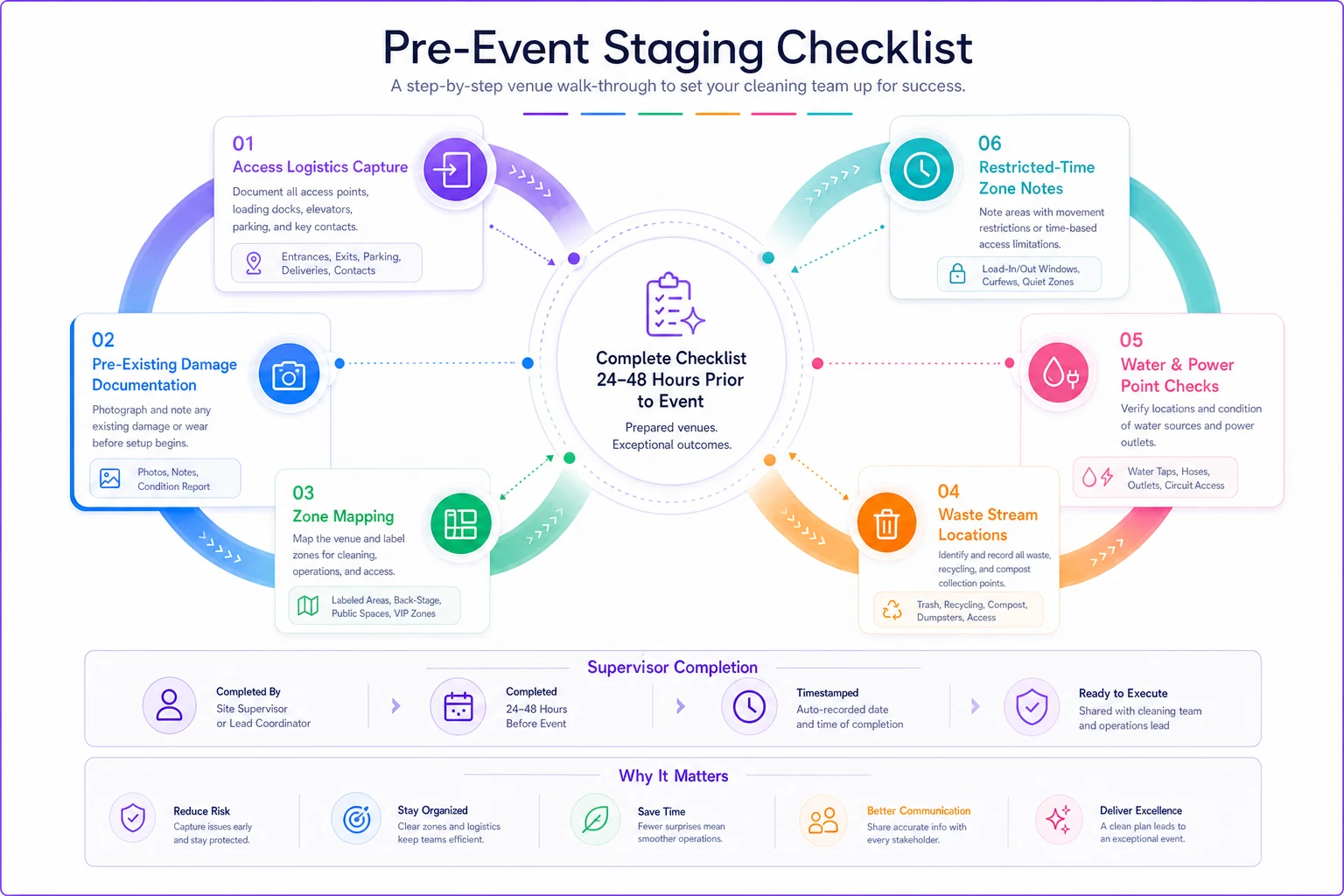
The staging checklist exists to make the chaotic part boring. Build it as a walk-the-venue document completed 24–48 hours out, not a generic template.
What it has to capture, specifically:
-
Access logistics — dock door numbers, badge/escort requirements, freight elevator dimensions and reservation times, and the single phone number of the venue person who's actually on-site that night (not the salesperson who signed the contract)
-
Pre-existing damage photos — timestamped, geotagged, covering floors, walls, glass, fixtures, and anything the venue could plausibly bill back. This one line prevents most clawbacks.
-
Zone map with square footage — the floor broken into labeled zones so your staffing matrix maps to physical reality, not a vague "the whole hall"
-
Waste stream rules — where recycling, compost, and landfill actually go, container locations, and whether the venue fines you for contamination (convention centers often do)
-
Water and power points — for auto-scrubbers and extractors; more than one event has stalled because the only working outlet was behind a locked panel
-
Restricted-time zones — areas you can't touch until a VIP leaves or a vendor finishes load-out
Here's a quick visual of the staging workflow.
Have the person who will run the night perform the staging walkthrough.
The mistake people make is treating staging as a sales walkthrough. It's not. It's an operational recon mission, and the person who does it should be the person running the night — or should hand off a document detailed enough that a stranger could run it.
The day-of staffing matrix
Recurring routes let you assume a known crew. Events don't. You're often blending two or three reliable leads with eight to fifteen temps from a staffing agency, half of whom you've never worked with, some of whom won't show.
A staffing matrix is not a schedule. A schedule says "12 people, 10pm." A matrix answers the question that actually matters at 10:15pm when only 9 of them walked in: who does what, who can be pulled from where, and what gets cut first if we're short.
-
Role, not name. Define functions — zone cleaners, floor machine operators, restroom crew, trash runners, a staging/supply runner, and a float. Assign people to roles, so a no-show is a role you backfill, not a hole you panic over.
-
Zone coverage with minimum viable staffing. For each zone, note the ideal headcount and the floor — the fewest bodies that still hits SLA. When you're short, you collapse to the floor on low-priority zones and protect the high-visibility ones (main entrance, restrooms, client greeting areas).
-
Pull-and-cut order. Pre-decide the sequence
if you lose two people, you pull the float and the supply runner into cleaning first; if you lose five, zone 7 (back-of-house storage) gets a quick pass instead of a full clean. Deciding this in advance, cold, is far better than deciding it at 1am, tired.
The matrix also needs a skill flag. Not every temp can run a propane burnisher or an auto-scrubber safely. Mark who's cleared for machines before the shift starts, because the worst time to discover someone's never touched an extractor is when they're dragging it across a $40,000 ballroom floor.
If you're scaling event work alongside a growing route operation, the same zoning discipline you'd use to split territories applies here — the logic in our zone and hub-and-spoke transition playbook translates surprisingly well to carving a convention hall into manageable coverage blocks.
Rapid micro-training for temps you just met
The constraint nobody designs around: you have maybe 10 minutes before the shift to train people who may never work for you again. A full onboarding is useless. A 40-slide SOP is worse than useless. What works is a tight, physical, repeatable briefing that covers the three things that actually cause damage, injury, or rework.
The format that holds up under time pressure:
-
The 3 non-negotiables — the handful of rules where a mistake is expensive or dangerous. Usually: don't mix these two chemicals, don't use the wrong pad on the protected floor, and don't throw anything in the wrong waste stream (contamination fines).
-
One physical demo per task — show the correct trash liner change, the correct machine start/stop, the correct wipe pattern. People remember watching far better than reading.
-
The "when in doubt" rule — one named person they radio or text with any question, so uncertain temps stop and ask instead of improvising.
-
The photo standard — what they shoot and when, so your reconciliation and damage defense hold up.
Keep each module short and task-specific. The same logic behind our five-minute micro-training modules that cut rework applies in sharper form here — except instead of reinforcing a crew over weeks, you're compressing the essentials into a single pre-shift huddle. Build these once as laminated cards or short phone videos, and you reuse them on every event.
Temps don't underperform because they're lazy. They underperform because they were dropped into an unfamiliar space with no map, no standard, and no one to ask. Fix the information gap and most of them do fine.
A short real scenario
A regional cleaning company — mostly nightly office and medical accounts — started taking convention teardowns to fill revenue gaps. Their first three events ran rough: a no-show rate around 25%, two venue damage clawbacks totaling just over $1,000, and reconciliation so messy they underbilled one event by roughly $800 because nobody tracked the extra hours.
They didn't hire better. They built the four documents. Staging walkthrough with damage photos, a role-based staffing matrix with a cut order, a laminated three-card temp briefing, and a reconciliation sheet filled out before anyone left the site.
By their fifth and sixth events, clawbacks dropped to zero — the pre-existing damage photos killed every dispute — no-shows still happened but stopped causing chaos because the matrix absorbed them, and billing finally matched reality. Net margin on comparable events moved from somewhere near breakeven to roughly 22–28%. Nothing about their crew changed. The paperwork changed.
Post-event reconciliation before anyone leaves
The single most expensive habit in event cleaning is reconciling the next morning. By then the temps are gone, the venue contact has left, your supplies are unaccounted for, and every disputed detail is now a he-said-she-said you'll lose.
-
Joint venue walkthrough — do a final pass with the venue contact, compare against your pre-event damage photos, and get a sign-off (even a photo of them nodding next to a clean zone helps). This closes the damage question while both parties are present.
-
Labor truth-up — record actual in/out times per person against the matrix, flag no-shows and early-leaves, and note overtime. This is your billing and payroll source of truth, captured before memories blur.
-
Supply and equipment count — reconcile what left the truck against what came back. Missing backpack vac, extra cases of liners used — log it now, because "we think we used about" is how supply variance hides for months.
-
Scope-change capture — anything the client asked for beyond contract (an extra hall, a spill response, an earlier start) gets documented and acknowledged on-site so it lands on the invoice instead of in your "swallowed it" column.
The reconciliation template turns a chaotic teardown into a clean invoice and a defensible position. It's the least glamorous of the four documents and probably the one that saves the most money per event.
When event work actually makes sense — and when it doesn't
Event contracts aren't automatically worth it. They fit when:
-
You have at least two or three leads who can run a night without you babysitting
-
Your market has steady event volume (convention centers, stadiums, large venues) rather than one-off weddings scattered across the calendar
-
You can source temps reliably, or you've built a repeat bench of event workers
-
Your margins can absorb the no-show and overtime volatility that comes with the territory
They're a bad fit when you're already stretched thin on your recurring book, because the one thing event work demands is your best people on an unpredictable overnight — exactly when your regular accounts might need them too. Chasing event revenue by pulling your strongest leads off stable contracts is how operators win a $9k event and quietly lose a $60k annual account.
And if you can't get your crews to shoot the photos, fill the reconciliation sheet, or follow the matrix — skip event work entirely. It will punish you harder than any other segment you run.
The through-line
Everything about event cleaning rewards decisions made in advance and documentation captured in the moment. The staging checklist front-loads the chaos. The staffing matrix makes no-shows survivable. The micro-training closes the stranger gap. The reconciliation sheet protects the margin you actually earned.
Build these four documents once, refine them after every job, and the second event is calmer than the first, the fifth starts feeling routine, and the segment that used to scare you becomes some of the most predictable high-margin work on your calendar. Not because the work got easier — because you stopped improvising the parts that were always supposed to be written down.
Ready to simplify your cleaning operations?
Join 1,000+ cleaning businesses using Wipyly to save time, reduce scheduling conflicts, and enhance client satisfaction.