



Running 10 vans feels manageable until it isn't. One morning your dispatcher spends 90 minutes plotting routes on a whiteboard. Three drivers text about overlapping territories. Your newest crew drives past two other vans to reach a client 18 miles away while a closer team sits in traffic heading the opposite direction.
The chaos compounds weekly. Routes that worked at 8 vans create pure operational mess at 15. What got you here won't get you to 50 vans, but most cleaning companies get stuck in this exact transition — too big for manual routing, not ready to drop $40k on enterprise routing software.
The breaking point hits differently for every cleaning operation
Your routing probably worked fine until recently. Maybe you added your 12th van and suddenly morning dispatch takes twice as long. Or you expanded into a new county and now half your crews spend 40% of their day driving. The symptoms vary but the core problem is consistent: your routing method can't scale with your growth.
Most cleaning companies hit this wall somewhere between 10 and 20 vans. The exact number depends on your service area density, client distribution, and how much chaos your dispatchers can absorb before they quit. Urban operations might manage 18 vans before things break. Suburban companies covering three counties might struggle at 11.
The traditional advice says buy routing software once you pass 10 vehicles. Except most routing platforms built for 50+ van operations cost thousands per month and take weeks to implement. They also assume you have clean address data, standardized service times, and crews who actually follow assigned routes — assumptions that rarely hold in cleaning operations.
Why zone models work when manual clustering fails
Zone-based routing creates structure without requiring perfection. Instead of optimizing every route from scratch each morning, you establish territories that crews own. Daily routing decisions drop from hundreds to dozens.
Stop losing bookings in operational chaos.
Wipyly helps you manage, confirm, and optimize every cleaning appointment efficiently.
- Centralized booking management
- Automated client notifications
- Staff scheduling & route optimization
No credit card required
A cleaning company running 14 vans across two counties switched from daily manual routing to zones last year. Their morning dispatch time dropped from roughly 2 hours to about 35 minutes. More importantly, crews stopped calling about confusing routes because they actually knew their territory.
The zone model works because it matches how cleaning operations already function. Experienced crews have preferred areas. Regular clients expect familiar faces. New business clusters around existing accounts through referrals. Zones just formalize what's already happening informally.
But zones alone won't solve everything. Dense urban territories handle pure zones well. Spread-out suburban and rural areas need something else.
Hub-and-spoke fills the gaps zones can't cover
Pure zone models break down when client density varies dramatically across your service area. Your downtown zone might have 80 clients within 4 square miles. Your suburban zone might have 45 clients across 30 square miles. Same crew size, completely different routing challenge.
Hub-and-spoke handles this variance. You establish central points — offices, storage facilities, major client locations — as hubs. Routes radiate out from these hubs, with crews assigned to specific spokes based on the day.
One residential cleaning company serving both urban and suburban markets uses a hybrid approach. Their city crews work pure zones. Suburban crews operate from two hubs — their main office and a large commercial client where they keep supplies. Monday/Wednesday crews take the northern spokes. Tuesday/Thursday crews handle southern territories. Friday floats between both based on actual demand.
This flexibility matters more than optimization. Perfect routes that change daily confuse crews and frustrate clients. Consistent, good-enough routes reduce mistakes and improve service quality over time.
Transition triggers that signal it's time to change
Waiting too long to restructure routing creates cascade failures. But jumping too early wastes effort on problems you don't actually have yet. Watch for these specific triggers:
Dispatch time explosion: Route planning takes over 90 minutes daily, or your dispatcher arrives two hours before crews just to sort out assignments.
Territory conflicts multiply: Three or more weekly incidents where crews argue about who owns which client, or multiple vans showing up at the same location.
Drive time exceeds 35%: Track actual windshield time for one week. If crews spend more than 35% of paid hours driving between jobs, routing inefficiency is eating your margins.
New business clustering fails: You can't efficiently assign new clients because every area already has overlapping coverage from different crews.
Crew retention drops: Drivers quit because they're fed up with confusing routes, constant changes, or driving past each other to reach jobs 20 minutes in the wrong direction.
Most companies see two or three triggers at once. One residential cleaning service ignored the warning signs until their best dispatcher quit, explicitly citing "impossible routing complexity" in her resignation letter. They lost four more employees the following month as the chaos spread.
Simple metrics to evaluate and design zones
Zone design doesn't require complex analysis, but you need basic metrics to avoid creating worse problems than the ones you started with. Start here:
Client density per square mile: Count clients within rough geographic boundaries. Aim for 15-25 clients per zone in dense areas, 8-12 in suburban spread.
Average distance between stops: Track actual driving distance, not straight lines. Zones should keep this under 3 miles in cities, under 7 miles in suburbs.
Daily capacity match: Each zone needs enough work for a full crew day but not so much that you're always sending backup.
Service time distribution: Mix quick maintenance cleans with longer deep cleans. Zones stacked with only large jobs create scheduling nightmares.
Calculate zone balance with this basic formula:
| Formula | Target |
|---|---|
| (Number of clients × Average service time) ÷ Available crew hours = Zone load | Keep zone load between 0.85 and 1.1. |
A 16-van operation mapped their zones wrong initially — divided territory by geographic size, ending up with one zone at 67 clients and another at 22. The busy zone needed constant overflow support while the light zone's crew was done by 2 PM every day. After rebalancing by client count and service time, both zones settled around 40-45 clients with matched workloads.
Measure driving distances using actual routes from GPS or phone logs rather than straight-line estimates to get realistic zone boundaries.
Keep zone load between 0.85 and 1.1. Below 0.85 wastes capacity. Above 1.1 creates permanent backlogs.
Staging rules for gradual transition
Switching routing systems overnight is asking for chaos. Your crews trained on one system. Clients expect certain arrival windows. Dispatchers know current routes from memory. Gradual transition reduces these disruption risks considerably.
Stage 1: Map current reality (Week 1-2) Document where crews actually go, not where you think they go. Track one full week of real routes. You'll find unofficial patterns — maybe your Tuesday crew always starts north because the driver lives there, or your newest van always handles overflow because they're the most flexible.
Stage 2: Define natural boundaries (Week 3-4) Look for existing geographic breaks — highways, rivers, downtown districts. These become zone borders. Don't force arbitrary lines that crews will quietly ignore.
Stage 3: Test with willing crews (Week 5-8) Pick your two most experienced teams. Assign them defined zones for a month. Let them figure out their internal routing sequence. Document what works and what breaks.
Stage 4: Expand gradually (Week 9-16) Add one new zone every two weeks. This pace lets you adjust boundaries based on actual experience without disrupting the whole operation.
Stage 5: Formalize and refine (Week 17-20) Once all crews are operating in zones, establish official policies. Create simple maps. Build coverage rules for sick days. Set up overflow protocols for busy periods.
An 18-van commercial cleaning company rushed their zone transition — implemented everything in two weeks. Three major clients complained about unfamiliar crews showing up. Five drivers threatened to quit over territory disputes. They had to revert to manual routing and restart the process from scratch, losing roughly three months and somewhere around $15k in efficiency gains.
Here's a quick visual of the staging workflow.
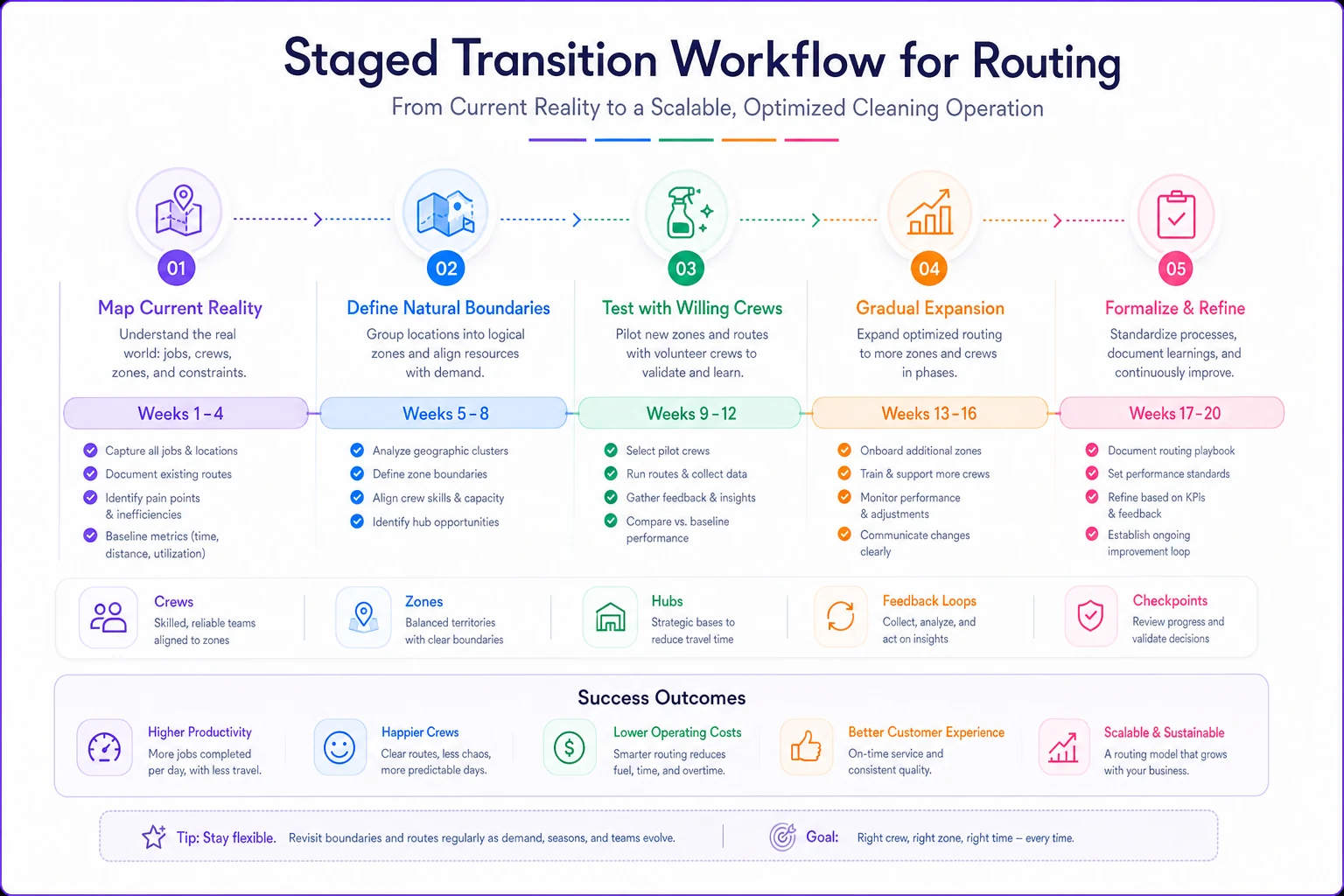
Use the stages as a loose timeline and adjust pacing based on crew feedback and client impact.
Sample zone layouts for common scenarios
Dense urban grid (Downtown commercial cleaning)
-
6-8 blocks per zone
-
Each zone gets 20-30 clients
-
Crews park centrally and work outward
-
Overlap zones at major streets for flexibility
Suburban residential spread
-
Natural neighborhood boundaries define zones
-
35-50 homes per zone
-
Morning routes start at zone edges, work inward to reduce backtracking
-
Adjacent zones share overflow on a predetermined schedule
Mixed urban/suburban
-
Urban zones stay small and dense
-
Suburban areas use hub-and-spoke from urban zones
-
Crews based in urban zones take suburban spokes on specific days
-
Keeps vehicles centrally located while covering spread
Rural/small town clusters
-
Each town becomes a hub
-
Zones radiate from town centers
-
Crews assigned to 2-3 towns based on day
-
Travel time between towns scheduled as a separate line item
Strip mall and office park
-
Each major complex becomes its own micro-zone
-
Crews own specific complexes
-
Overflow between complexes based on proximity
-
New complexes assigned to the closest existing zone
Real example: a cleaning company serving both downtown offices and suburban homes uses hybrid zoning. Their downtown crews work pure geographic zones — everything between 3rd and 8th Street belongs to Team A. Suburban crews operate from three hubs (their main office plus two supply storage locations), with each hub serving 4-5 residential neighborhoods on rotating schedules.
Manual tools that work without software investment
You don't need expensive routing platforms to implement zones effectively. Basic tools handle 10-50 van operations fine when used consistently.
Zone maps: Print large maps, laminate them, hang them where everyone sees them every day. Use different colored markers per zone. Physical maps crews can point at beat digital maps they never open.
Assignment boards: Whiteboard or corkboard with columns for each zone. Move client cards between zones as needed. Sounds primitive, but it gives instant visual load balancing.
Simple spreadsheets: Basic Excel with client addresses, zones, service types, and crew assignments. No complex formulas. Sort by zone, print daily routes.
Paper route sheets: Each crew gets a printed sheet with stops in rough geographic order. Let experienced drivers sort out the specific sequence themselves.
Group messaging: WhatsApp or similar for same-day coordination. "Zone 3 finished early, heading to help Zone 5" beats complex dispatch software for operations at this scale.
A 22-van operation runs entirely on laminated maps, a big whiteboard, and a shared Google Sheet. Dispatch averages around 45 minutes daily. They tried routing software but found it slower than their manual system for their specific setup.
Measuring success without complex analytics
You'll know zone transition worked through simple observations before any metrics confirm it.
Morning chaos disappears. Your dispatcher stops arriving at 5 AM to untangle routes. Crews leave on time because they know where they're going. The phone stops ringing with "where should we go next?" calls.
Track these basic numbers monthly:
-
Average dispatch time (should drop 40-60%)
-
Drive time percentage (should fall below 30%)
-
Client complaints about arrival times (should drop 50%+)
-
Crew overtime hours (should reduce 20-30%)
-
Miles per van per day (should decrease 15-25%)
Don't obsess over perfect measurement. A cleaning company with 19 vans tracks just two numbers: weekly fuel costs and dispatcher hours. Both dropped around 35% after zone implementation. That simplicity tells them what they need to know.
When zones aren't enough
Zones solve most routing problems for 10-50 van operations, but some situations need a different approach.
High daily variance: If Monday has 12 vans busy but Thursday only needs 6, pure zones waste capacity. Consider hybrid models where some crews float between zones based on actual demand.
Extreme geographic spread: Companies covering a 100+ mile radius can't rely on simple zones. Hub-and-spoke becomes the primary model, with mini-zones built around each hub.
Mixed service types: When the same crew does residential mornings, commercial afternoons, and emergency evening calls, zones need temporal layers — different boundaries for different parts of the day.
Rapid growth: Adding 2+ vans per month breaks zone stability. Plan for expandable zones with built-in split points, like the manual clustering approach for smaller operations.
Common zone transition mistakes
Mistake 1: Perfect boundaries obsession Companies spend weeks drawing precise zones on maps, then discover crews quietly ignore them anyway. Start rough and refine through experience.
Mistake 2: Forcing equal-size zones Geographic equality doesn't equal workload equality. A dense apartment complex zone might be one-tenth the geographic size of a suburban house zone but require the same crew hours.
Mistake 3: Ignoring crew preferences Your senior crew who's serviced the north side for three years won't happily switch to the south side because a map says so. Work with existing patterns when you can.
Mistake 4: No overflow plan Zones fall apart during flu season, vacation weeks, and truck breakdowns. Build overflow protocols before you need them.
Mistake 5: Customer communication gaps Regular clients notice when different crews show up. Explain zone transitions to key accounts. Most appreciate the consistency zones actually bring.
A 14-van operation made all five mistakes at once. Two months building "perfect" equal zones, crews reassigned randomly, no backup plan, clients never told. The fallout cost them three major contracts and four experienced employees.
Building sustainability into your zone system
Zones work long-term when built for change, not perfection. Your business will grow. Service areas will shift. Crews will turn over. Design for that reality from the start.
Growth triggers: Decide now when zones split — maybe at 60 clients or when daily routes consistently exceed 10 hours. Document these thresholds before you're in the middle of a crisis.
Seasonal flexibility: Build winter and summer zone variants if your business has seasonal patterns. Some cleaning companies run tighter zones in winter when weather slows everything down.
Training integration: New hires learn one zone thoroughly before floating to others. Builds geographic knowledge gradually while maintaining service quality.
Client assignment rules: New business goes to the zone with the most capacity, not just the closest geography. This prevents overloading growing areas while underutilizing stable ones.
Regular rebalancing: Review zone loads quarterly. Small adjustments prevent major restructuring later. Moving 2-3 clients between zones monthly is far easier than reassigning 20 in crisis mode.
The transition from manual routing to zones doesn't require massive investment or complex software. Most cleaning companies running 10-50 vans can get basic zones working in 8-12 weeks using tools they already have.
The goal isn't perfection — it's structure that scales. Your zones will have overlaps. Some days crews will drive past each other. Edge cases will need manual fixes. But structured imperfection beats chaotic optimization every time at this scale.
Start with natural boundaries. Test with willing crews. Expand gradually. Measure simply. Refine constantly.
When zone-based routing runs smoothly, your dispatcher stops firefighting and starts actually optimizing. Crews develop territory expertise that improves service quality. You can focus on growth instead of daily routing puzzles.
The companies that successfully scale from 10 to 50 vans don't have perfect routing — they have good-enough routing that doesn't break under pressure. Zones and hub-and-spoke models provide exactly that foundation.
If you're still working out how to price jobs accurately enough to make any routing system worth the effort, task-level timing tables for deep vs. maintenance cleans are worth working through before you go too deep on zone design.
That morning dispatcher panic, the overlapping routes, the confused crews — they're fixable problems. The transition triggers, metrics, and staging rules here give you a clear enough playbook. The sample layouts show what's actually worked for operations in similar situations.
Your routing will never be perfect. But it can be predictable, scalable, and sustainable. That's what zones deliver for growing cleaning operations.
Ready to simplify your cleaning operations?
Join 1,000+ cleaning businesses using Wipyly to save time, reduce scheduling conflicts, and enhance client satisfaction.