

Every cleaning business owner knows this frustration. A client calls complaining about dusty baseboards your team supposedly cleaned yesterday. Your crew lead swears they cleaned them perfectly. The client sends photos of obvious dust buildup. Nobody has proof of what actually happened, and you're stuck eating the cost of a callback.
The evidence problem nobody talks about in cleaning operations
This isn't about bad cleaners or difficult clients. It's about broken documentation systems that turn every quality issue into a blame game instead of an improvement opportunity.
Most cleaning companies try fixing rework with more training or stricter checklists. But without root cause analysis backed by actual evidence, you're just guessing at solutions. Businesses that document problems systematically tend to reduce callbacks by roughly 35–40% within three months. Those that don't stay stuck in the same rework cycles.
Why traditional quality checks fall short
The typical approach goes something like this: supervisors spot-check maybe 10% of jobs, usually the problem accounts. They fill out a checklist, maybe snap a photo of obvious issues. When rework happens on the other 90% of jobs, there's zero documentation to analyze.
Stop losing bookings in operational chaos.
Wipyly helps you manage, confirm, and optimize every cleaning appointment efficiently.
- Centralized booking management
- Automated client notifications
- Staff scheduling & route optimization
No credit card required
Even when documentation does exist, it's scattered across text messages, email threads, handwritten notes, and random photos on different phones. By the time you try piecing together why a specific type of rework keeps happening, half the evidence is gone and nobody remembers the details.
The real killer is inconsistent severity scoring. One supervisor marks a streaky mirror as critical. Another considers it minor. Without standardized criteria, your data turns into meaningless noise. You can't identify patterns when everyone's measuring differently.
This documentation chaos creates a vicious cycle. Teams stop bothering to document properly because nothing seems to change. Management can't make informed decisions without good data. Problems keep recurring. Everyone gets frustrated.
Building evidence standards that actually work
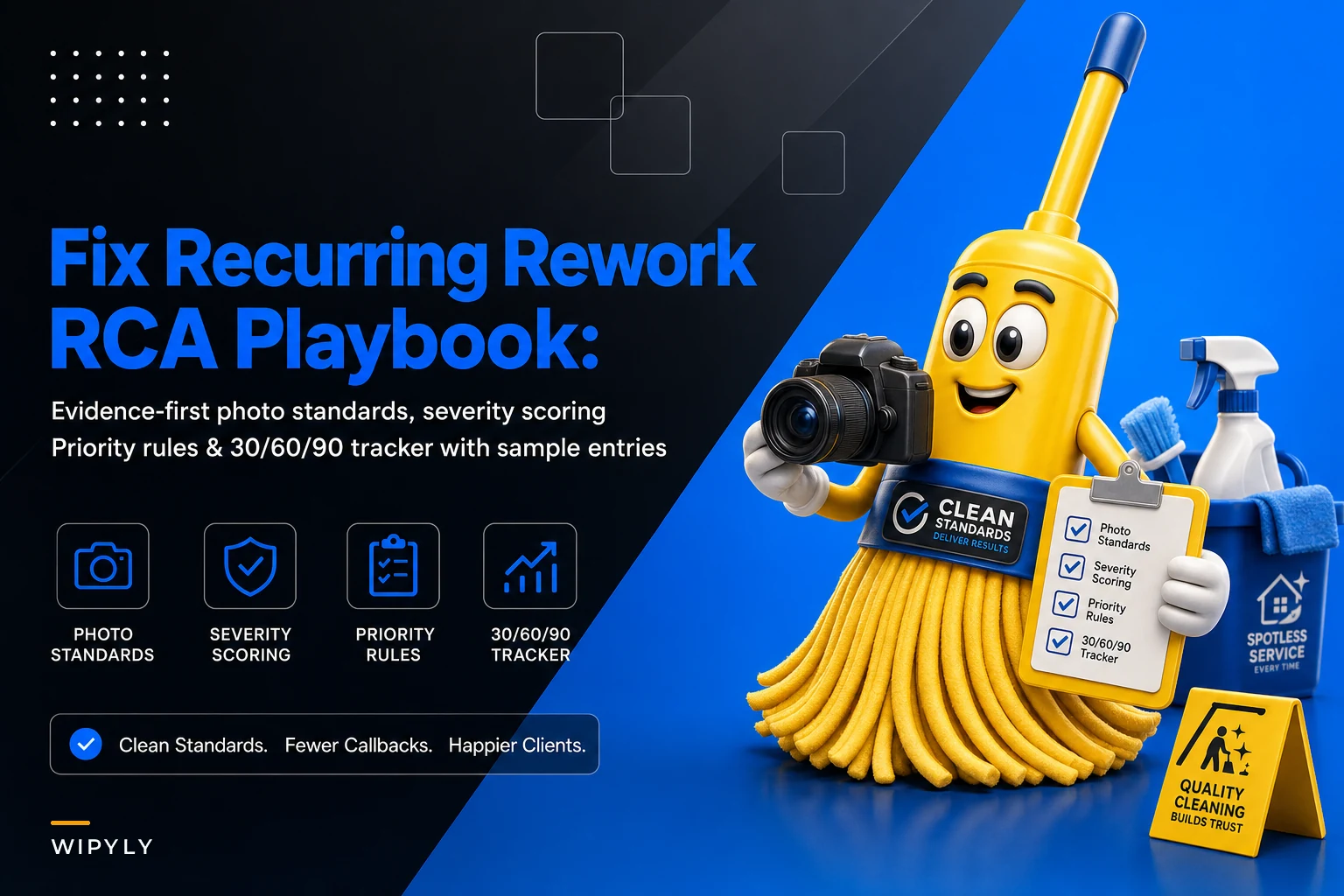
Forget complex quality management systems. You need simple, repeatable documentation that your team will actually use.
Photo Evidence Requirements
Every reported issue needs three photos minimum:
-
Wide shot showing the full area or room
-
Medium shot showing the specific problem zone
-
Close-up clearly displaying the defect
Take the classic "dusty baseboard" complaint. The wide shot proves which room. The medium shot shows which wall section. The close-up captures the actual dust accumulation. No more arguments about whether the problem existed or where exactly it was.
For before-and-after documentation on problem accounts, use the same three angles. This creates visual proof of work completed and protects against disputes. Store these in organized folders by property, not scattered across random devices.
Severity Scoring Matrix
Stop letting subjective judgment derail your analysis. Use this simple 1–5 scale:
Level 1 (Cosmetic): Minor issues clients might not notice. Single fingerprint on glass, slight trash liner misalignment, minimal dust in hidden corners.
Level 2 (Visible): Noticeable but not concerning to most clients. Light streaking on mirrors, small debris under furniture edges, minor soap residue.
Level 3 (Standard): Clear quality issues affecting appearance. Dusty surfaces, visible floor debris, bathroom fixtures with water spots, unorganized items.
Level 4 (Significant): Problems clients will definitely complain about. Uncleaned toilets, sticky floors, full trash bins, strong chemical smell, missed rooms.
Level 5 (Critical): Health hazards or contract violations. Mold left untreated, biohazard materials, damaged property, security breaches, complete service failure.
Train your team with actual photo examples of each level. Run calibration sessions where everyone scores the same issues until you get consistency. Without aligned scoring, your data is worthless.
Priority rules that prevent callback chaos
Not all rework is equal. Treating every issue with the same urgency burns out your team and wastes resources.
Immediate Response (Same Day)
-
Any Level 5 issue
-
Level 4 issues at key accounts
-
Multiple Level 3 issues at one property
-
Any issue that could trigger contract cancellation
Next-Day Response
-
Standard Level 4 issues
-
Level 3 issues at recurring clients
-
Pattern problems (third occurrence of same issue)
-
Time-sensitive areas (medical facilities, food service)
Scheduled Response (Within 72 Hours)
-
Level 2 issues when client requests
-
Level 3 issues at non-critical properties
-
Training opportunities that need documentation
-
Quality improvement reviews
Batch Response (Weekly)
-
Level 1 issues for record-keeping
-
Pattern analysis findings
-
Process improvement testing
-
Team feedback sessions
Stick to the priority rules even when clients push; documented criteria make it easier to explain response timing.
The key is sticking to these rules even when clients push for immediate response on minor issues. Having clear criteria lets you explain why certain problems take priority while showing you take all feedback seriously.
The 30/60/90 corrective action tracker
Most cleaning companies fail at root cause analysis for one reason: they fix individual problems but never track whether solutions actually hold. This tracker changes that.
30-Day Actions (Immediate Fixes)
| Date | Property | Issue | Severity | Immediate Action | Assigned To | Complete By |
|---|---|---|---|---|---|---|
| 1/3 | Office Building A | Dusty vents in conference rooms | Level 3 | Re-clean all vents, add to deep clean checklist | Maria T. | 1/4 |
| 1/5 | Medical Plaza B | Streaky glass doors | Level 2 | Switch to ammonia-free cleaner, retrain on technique | James K. | 1/7 |
| 1/8 | Retail Store C | Bathroom soap dispensers empty | Level 4 | Emergency refill, add to opening checklist | Lisa M. | 1/8 |
The goal at 30 days isn't analysis—it's stopping the bleeding while you gather enough data to actually understand what's going on.
60-Day Actions (Pattern Investigation)
| Pattern Identified | Root Cause Found | Corrective Action | Metric to Track | Review Date |
|---|---|---|---|---|
| Vents dusty at 4 properties | No ladder in supply kit | Add 6-foot ladder to each van | Vent-related callbacks | 3/3 |
| Glass streaking increasing | New cleaner formula issue | Test 3 alternative products | Streak complaints per 100 cleans | 3/5 |
| Supply shortages Fridays | Thursday inventory not done | Implement Thursday PM check | Supply-related delays | 3/8 |
This is where the tracker starts paying off. Individual issues that looked random at 30 days suddenly have obvious common causes at 60.
90-Day Actions (System Changes)
| System Issue | Evidence (90 days) | Proposed Change | Implementation | Success Metric |
|---|---|---|---|---|
| 40% of callbacks from missed areas | 127 documented cases | Implement room-by-room photo checkout | New workflow + training | Reduce to <15% |
| Supply costs up 22% from rush orders | 31 emergency supply runs | Centralized ordering system | Operations platform integration | <5 emergency orders/month |
| New cleaner complaints at 60% of sites | 203 negative mentions | Full product line evaluation | Vendor RFP process | Client satisfaction >4.5 |
Each phase builds on the previous one. You're not just fixing problems—you're building institutional knowledge about what actually causes rework in your specific operation.
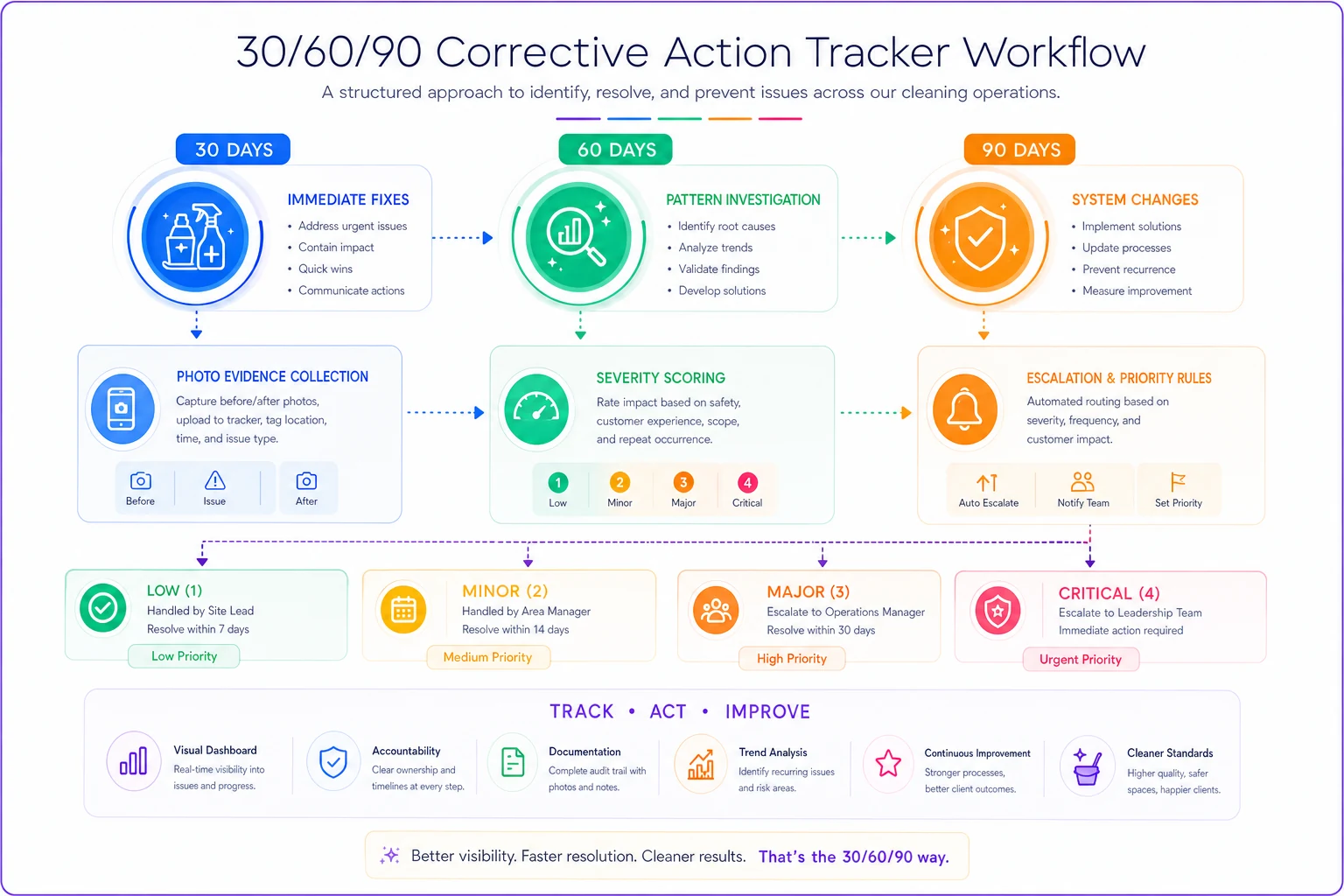
Use this workflow to visualize how immediate fixes feed into pattern analysis and then into system changes.
Sample corrective action entries to copy
Common Issue: Kitchen Grease Buildup
-
30-day
Double-check kitchen surfaces, use degreaser concentration at 1:8 ratio
-
60-day
Identified crews diluting incorrectly, implement pre-mixed bottles
-
90-day
Switch to color-coded dilution system, monthly testing protocol
Common Issue: Carpet Stains Reappearing
-
30-day
Re-treat with enzyme cleaner, document all treated areas
-
60-day
Found rushing extraction process, mandate 3-pass minimum
-
90-day
Invest in higher-powered extraction equipment, certification training
Common Issue: Dust on High Surfaces
-
30-day
Extension pole to all teams, add high-dusting to Week 1 rotation
-
60-day
Teams skipping due to time pressure, adjust time estimates +15 minutes
-
90-day
Separate high-dusting service tier, premium pricing for comprehensive coverage
Common Issue: Restroom Odor Complaints
-
30-day
Deep clean P-traps and floor drains, increase air freshener frequency
-
60-day
Discovered missing enzymatic treatment, add to daily bathroom protocol
-
90-day
Quarterly deep-sanitization service, preventive drain maintenance program
Common Issue: Streaky Stainless Steel
-
30-day
Switch to microfiber-only policy, train on with-grain technique
-
60-day
Wrong product on specific appliance types, create material reference guide
-
90-day
Client-specific product preferences database, customized supply kits
Each phase builds on the previous one. You're not just fixing problems—you're building institutional knowledge about what actually causes rework in your specific operation.
Connecting evidence to actual improvement
The uncomfortable reality about cleaning rework is that most of it comes from communication and documentation failures, not actual cleaning failures. When you implement proper evidence standards, a few things shift pretty quickly.
Your team stops getting blamed for problems they didn't cause. When a client claims the bathroom wasn't cleaned, you have timestamped photos proving it was spotless when your crew left. That protects your reputation and your team's morale at the same time.
You also start identifying where problems actually originate. Maybe one crew generates nearly half your callbacks. Maybe a specific supply vendor's products cause streaking. Maybe afternoon routes get rushed. Without evidence, you're guessing every single time.
Clients start trusting your process more, too. When you can show them the exact corrective actions taken after a complaint—photo documentation, follow-up verification—they see a professional operation, not just another cleaning company that apologizes and disappears.
Technology without the hype
Manual tracking works fine for businesses under around 30 clients. Beyond that, it gets messy fast.
Operational platforms built for cleaning services can automatically trigger priority rules when issues are logged, store photos in organized property files, and track whether 30/60/90 day actions actually reduce rework rates. When cleaners submit issue documentation from their phones and managers can see patterns across all properties in one place, root cause analysis stops being a monthly headache and becomes part of how the business actually runs.
The difference isn't really the technology itself—it's having all your evidence in one searchable system instead of scattered across emails, texts, and paper forms. AI automation can help surface patterns in your documentation faster, but the real value is simply having consistent documentation to analyze in the first place.
Making it stick: implementation timeline
Weeks 1–2: Train your team on photo standards and severity scoring. Start with just documenting callbacks—don't try to fix everything at once.
Weeks 3–4: Implement priority rules. Let your team see that not everything is a fire drill anymore.
Weeks 5–8: Begin 30-day tracking. Focus on immediate fixes while gathering pattern data.
Weeks 9–12: Add 60-day pattern investigation. Start connecting individual issues to systemic causes.
Month 4+: Implement 90-day system changes based on solid evidence. Track whether changes actually reduce rework.
Most cleaning companies see callback rates drop 20–30% just from consistent documentation, before implementing any real fixes. When teams know issues are being tracked and addressed, they naturally get more careful about quality.
The compound effect of proper root cause analysis
Six months into evidence-based tracking, the operational shift is real. Instead of your operations manager spending half their day managing callbacks, they're spending maybe an hour. Instead of losing good clients to repeated issues, you're retaining them with demonstrated improvements.
The financial impact goes beyond saved labor on callbacks. When you can show potential clients your quality tracking system during sales meetings, close rates improve. When you can prove your team's work quality with documentation, you avoid billing disputes that drain time and damage relationships. When you identify which types of rework are worth preventing versus accepting as occasional costs, you allocate resources more effectively.
The bigger shift is cultural. Teams that previously felt attacked by complaints start seeing them as data. Supervisors who used to play detective on every issue now have clear evidence to work with. Clients who threatened to cancel over repeated problems start seeing a company that actually follows through on what it says.
The cleaning companies that thrive aren't the ones with perfect cleaners—those don't exist. They're the ones with systems to identify why problems happen, fix root causes, and prove improvements with evidence. Clients don't expect perfection. They expect problems to get solved, not just apologized for.
Building this takes real effort upfront. But once it's running, it compounds. Better documentation leads to better analysis. Better analysis leads to permanent fixes. Permanent fixes lead to happier clients and less stressed teams. That's how you actually break the rework cycle—not through better training modules alone, but through systematic evidence-based improvement that turns every callback into useful operational intelligence.
Ready to simplify your cleaning operations?
Join 1,000+ cleaning businesses using Wipyly to save time, reduce scheduling conflicts, and enhance client satisfaction.