



There's a specific kind of meeting that happens in every growing cleaning company. Ops says a site was serviced 22 times last month. Billing invoiced for 20. The account manager swears the client agreed to 24. Nobody's lying. Everybody's looking at a different number, pulled from a different system, labeled with a slightly different name.
That gap — between what happened, what got recorded, and what got billed — is where margin quietly leaks and client trust erodes. And it almost never gets fixed by "being more careful." It gets fixed by governance: agreeing on what each number means, who owns it, and how often you reconcile it against reality.
This is the boring plumbing nobody wants to build until they've been burned a few times. But for cleaning operators past roughly 15–20 accounts, weak data governance is usually why your reports contradict each other and your reconciliation takes a full week every month. So let's build the plumbing properly.
Why the same "simple" metric ends up with three different values
Take something that sounds unambiguous: "visits completed this month." In a small operation running one system, that's fine. But as you grow, that number gets created independently in several places at once.
-
The scheduler shows planned visits.
-
The crew app / timesheet shows clock-ins, which drift from the schedule when routes get reshuffled.
-
The QA or evidence system shows visits with photos attached.
-
The billing system shows visits invoiced — which follows contract terms, not actual field activity.
Each of those is a legitimate source. None of them agree perfectly. A crew that clocked in but left early still shows a visit. A make-up clean that happened Saturday shows up in timesheets but not in the original schedule. A contract billed on a flat monthly fee ignores visit counts entirely, so "visits invoiced" is meaningless there but critical on a per-visit account.
The root problem isn't bad data — it's that nobody decided which source is canonical for which purpose. So five people build five reports off five sources, and every report is technically right in isolation and wrong in aggregate.
Canonical IDs: the thing everyone skips and later regrets
Before you can govern metrics, every entity in your business needs exactly one identity. In practice, most cleaning companies have the opposite: a client exists as "Riverside Medical" in the CRM, "Riverside Med Ctr" in the scheduler, and "RIVERSIDE MEDICAL CENTER LLC" in QuickBooks. To software, those are three different clients.
Stop losing bookings in operational chaos.
Wipyly helps you manage, confirm, and optimize every cleaning appointment efficiently.
- Centralized booking management
- Automated client notifications
- Staff scheduling & route optimization
No credit card required
You need a small set of canonical IDs that every system references:
| Entity | Canonical ID example | Why it matters |
|---|---|---|
| Client (legal biller) | CL-00417 | Ties every invoice, dispute, and payment to one account P&L |
| Site (physical location) | ST-01142 | A client can have 12 sites with different SLAs and frequencies |
| Contract | CT-00329 | Defines billing model, scope, and which metrics even apply |
| Service visit | SV-2026-08-004821 | The atomic unit everyone argues about |
| Crew / operator | CR-0087 | Links labor cost and QA back to the visit |
The distinction people most often botch is client vs. site vs. contract. A national account might be one client, eleven sites, and three separate contracts with different terms. If your metrics roll up by client when they should roll up by contract, your per-site profitability is garbage. If they roll up by site when finance needs them by billing entity, your AR aging is a mess.
Once these IDs exist and every system speaks them, reconciliation stops being detective work. A visit SV-2026-08-004821 either appears in billing or it doesn't — and you can prove which side dropped it.
Field-level metric ownership: one metric, one owner
Every metric has exactly one owner, and the owner is the person accountable for its accuracy — not whoever happens to look at it most.
Ownership isn't about who reads a number. It's about who fixes it when it's wrong. When "visits completed" is owned by everybody, it's owned by nobody, and when it disagrees across systems, three people spend a week pointing at each other.
A practical ownership map for a mid-sized operator looks something like this:
| Metric | Canonical source | Owner | Consumers |
|---|---|---|---|
| Visits scheduled | Scheduler | Ops manager | Billing, account mgmt |
| Visits completed | Crew app + QA evidence | Area/field manager | Billing, finance |
| Billable visits | Contract terms applied to completed visits | Billing lead | Finance, account mgmt |
| Revenue recognized | Billing system | Finance | Owner, account mgmt |
| Labor hours | Timesheets | Ops manager | Finance (for margin) |
| QA pass rate | QA/evidence system | Field manager | Account mgmt, client |
| Disputes raised | Billing/AR | Billing lead | Finance, account mgmt |
Notice "visits completed" and "billable visits" are separate metrics with separate owners. That single split eliminates a large share of ops-vs-billing conflict, because it makes explicit that not every completed visit is billable (make-ups under a fixed fee, for example) and not every billable line is a physical visit (flat-fee contracts). Once that's documented, the field manager owns what actually happened and the billing lead owns what the contract allows them to charge for. They stop arguing because they own different things.
The weekly reconciliation cadence
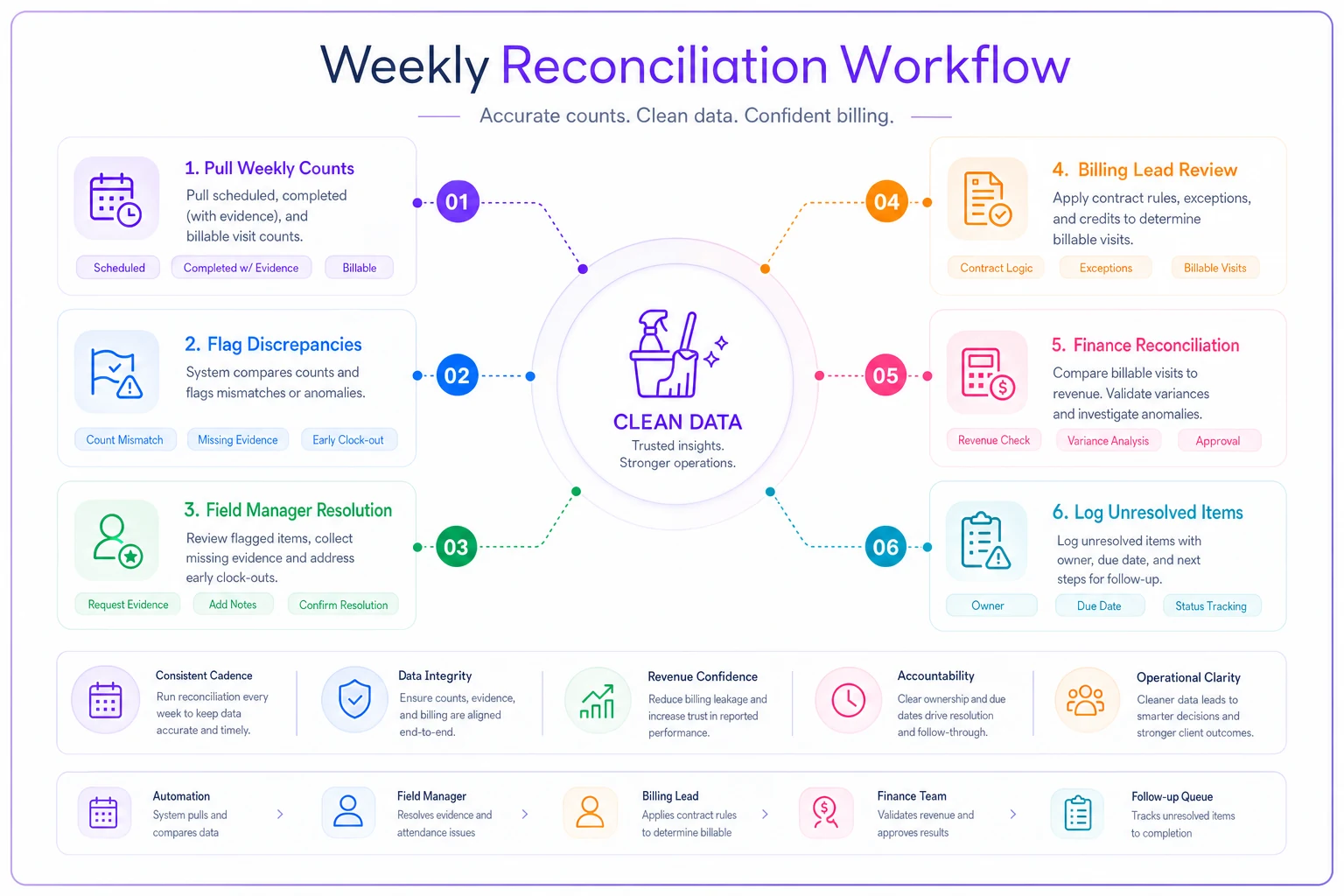
Monthly reconciliation is where a lot of operators get into trouble. If you only reconcile at month-end, you're hunting for discrepancies across 300–500 visits under invoice-deadline pressure, and half the crew members who could explain a weird entry have long forgotten the day. Weekly reconciliation turns a week-long forensic project into a 30–45 minute review.
-
Pull the three visit counts by contract
scheduled, completed (with evidence), and billable. Anything where completed ≠ billable, or where a scheduled visit has no completion record, gets flagged.
-
Resolve field discrepancies first. Missing evidence, early clock-outs, unlogged make-ups — the field manager clears these while memory is still fresh.
-
Apply contract logic. Billing lead confirms which completed visits convert to billable lines and why the others don't.
-
Check revenue vs. billable. Finance confirms the invoice-in-progress matches billable visits × rate, catching pricing errors before they reach the client.
-
Log unresolved items with an owner and a due date. Nothing carries silently into month-end.
The point of the cadence isn't a perfect close every Friday. It's that by month-end, you're reconciling four clean weeks instead of one chaotic month. Discrepancy volume drops because problems get caught while they're still cheap to fix.
Pro-tip: do the weekly reconciliation early in the week (Monday) while the field team's memory is fresh.
A simple visual of the weekly reconciliation workflow helps teams follow the steps.
This also feeds cleaner numbers into the reports that actually drive decisions. Your route-level P&L is only as trustworthy as the visit and labor data underneath it — reconcile weekly and your margin numbers stop lying to you.
Metric SLAs: putting deadlines on the handoffs
The piece almost nobody builds is metric SLAs — agreed deadlines for when a number must be accurate and handed off. Operational SLAs govern service delivery. Metric SLAs govern the data about that delivery, which is what finance and account management actually run on.
A few examples tied to real handoffs:
-
Visit completion + evidence logged within 24 hours of service. After that window, the field manager owns any missing record.
-
Weekly reconciliation closed by end of day Monday for the prior week. Billing can't invoice against unreconciled weeks.
-
Billable-visit sign-off within 2 business days of month-end. This is the ops → billing handoff. Miss it and invoicing slips.
-
Dispute-relevant data assembled within 48 hours of a client query. This is the metric SLA behind protecting AR.
Writing these down converts a vague expectation ("ops should get us the numbers on time") into an owned, dated commitment. When visit data is late, it's not a mystery — it's a named owner who missed a defined SLA, and you can coach or fix the process rather than relitigating who was supposed to do what.
These metric SLAs should map to the operational KPIs you already track. If you've built a dashboard around the KPIs that predict contract performance, the metric SLA is the guarantee that each of those KPIs is accurate and current by a specific time — otherwise the dashboard is confidently displaying stale numbers.
A real scenario: where the leak actually was
A commercial operator running around 30 accounts and somewhere between 380–420 visits a month kept ending each month with a billing-vs-ops gap of 10 to 18 visits. Ops insisted the work happened. Billing couldn't invoice without proof. Every month, a chunk of legitimately completed work either got written off or triggered a client dispute, and reconciliation ate roughly four working days.
When they mapped it out, the problem wasn't the crews. It was three things stacked on top of each other: no canonical site IDs (make-up cleans were getting logged against the wrong site), no split between "completed" and "billable" (so make-ups under fixed-fee contracts looked like missing revenue when they weren't), and reconciling only at month-end (so nobody caught mismatches while they were still fixable).
They fixed the IDs, split the two metrics with clear owners, moved to a weekly close, and set a 24-hour evidence SLA. Within a couple of months the monthly gap dropped to low single digits — most of which were legitimate non-billable make-ups that were now correctly labeled instead of chased. Reconciliation went from roughly four days to under one. They weren't finding more money so much as they stopped losing and re-arguing the same money every month.
When this is worth building — and when it isn't
Build this when:
-
You're past roughly 15–20 accounts or have multiple sites per client.
-
Ops and billing sit with different people or different systems.
-
Month-end reconciliation regularly takes more than a day or two.
-
You've had client disputes you couldn't quickly prove your way out of.
Don't over-build this when:
-
You're running under a dozen accounts out of one system with one person touching both ops and billing. You need clean records, not a governance layer.
-
Your contracts are almost all flat-fee with stable scope. Visit-level reconciliation matters far less here — focus your energy on scope-creep tracking instead.
Who should not do this yet: anyone whose underlying data is still a mess of duplicate clients and inconsistent naming. Governance sits on top of a canonical model. If your systems can't agree on who a client is, fix identity first — layering SLAs and ownership rules over dirty data just formalizes the chaos.
Where software quietly earns its keep
None of this requires fancy tooling to design. You can define IDs, owners, cadences, and SLAs on a spreadsheet in an afternoon. Where a proper operational platform helps is in enforcing it without someone manually babysitting every handoff — flagging visits where completed doesn't match billable, nudging a field manager when evidence is missing past the 24-hour SLA, surfacing the weekly reconciliation exceptions instead of making someone dig for them.
The governance is the thinking. The software removes the manual chasing so the cadence actually holds up when you're busy — which is exactly when it tends to fall apart otherwise. The goal isn't to automate judgment; it's to make sure the numbers reaching finance and clients are the same numbers, owned by the same people, on the same schedule, every week.
The ops-vs-billing argument isn't a personality conflict and it isn't carelessness. It's the predictable result of multiple systems producing overlapping numbers with no agreed meaning, owner, or deadline. Fix that layer — canonical IDs, one owner per metric, weekly reconciliation, and metric SLAs on every handoff — and the monthly fire drill turns into a routine review. You stop writing off real work, stop losing disputes you should win, and stop making decisions on numbers that quietly disagree with each other.
Ready to simplify your cleaning operations?
Join 1,000+ cleaning businesses using Wipyly to save time, reduce scheduling conflicts, and enhance client satisfaction.