

Most cleaning businesses nail their processes when they're small. The owner knows every client, every crew member follows the same playbook, quality stays tight. Then somewhere between crew three and crew ten, things start drifting. Not dramatically—just enough that your best techs are doing things one way, newer crews another, and suddenly you're fielding complaints about inconsistency that never existed before.
The governance paradox that kills consistency at scale
The problem usually isn't that your SOPs are bad. It's that you don't have SOP governance for cleaning operations that scales with the business. What worked when you personally trained every tech breaks down once you've got supervisors across three zones making their own "improvements" to processes.
This pattern destroys margins faster than most owners expect. A company grows from $400k to $1.2M in revenue, brings on regional supervisors, and within six months they're dealing with:
-
Different crews using completely different chemical dilution ratios
-
Supervisors skipping quality checks to hit time targets
-
Random process changes that nobody tracks or approves
-
Training materials that no longer match what's actually happening in the field
The operational mess compounds quickly. One supervisor decides pre-treating carpets isn't worth the extra time. Another creates their own bathroom cleaning sequence. A third starts approving overtime without checking if it's billable.
By the time you catch these drifts, you're already looking at significant rework costs and lost accounts.
Why local customization becomes operational chaos
When cleaning businesses grow without governance structure, the pattern is almost always the same. You promote your best tech to supervisor for Zone A. They're sharp, they know the work, they start making small tweaks. Meanwhile your Zone B supervisor—also competent—makes different tweaks. Both changes might be reasonable on their own, but now you've got two different operational standards running under one brand.
Stop losing bookings in operational chaos.
Wipyly helps you manage, confirm, and optimize every cleaning appointment efficiently.
- Centralized booking management
- Automated client notifications
- Staff scheduling & route optimization
No credit card required
The drift accelerates through delegation. Zone supervisors train new crews their way. Those crews develop their own shortcuts. Pretty soon you've got as many cleaning standards as you have teams. A medical office client with locations in both zones notices the inconsistency immediately. They're paying for standardized service but getting different results depending on which crew shows up.
This isn't a training problem or a people problem. It's a governance problem. Without clear versioning, approval workflows, and delegation rules, every well-meaning improvement becomes another step away from operational consistency.
-
12–18% increase in supply costs from non-standard product usage
-
8–15% more callbacks and rework
-
20–25% longer new crew training times
-
30–40% higher supervisor administrative burden
What's worse, these businesses usually can't identify which process changes caused which problems. No versioning means no audit trail. No approval workflows means no accountability. No delegation rules means chaos dressed up as "local flexibility."
Building a permission matrix that actually works
A functional permission matrix starts with understanding that not all process changes are equal. Changing which mop bucket goes in which van? Local decision. Changing the chemical concentration for hospital disinfection? That needs central approval.
Start by mapping your SOPs into three governance tiers.
Tier 1 - Core Standards (Central Control Only) These are your non-negotiables—regulatory compliance, safety protocols, client-contracted service levels. Nobody below operations director level touches these. Examples:
-
Hospital-grade disinfection procedures
-
OSHA-required safety protocols
-
Client SLA specifications
-
Insurance-mandated equipment checks
Tier 2 - Regional Adaptations (Supervised Flexibility) These processes can flex based on local conditions, but changes need supervisor approval and documentation:
-
Route sequencing within zones
-
Supply reorder triggers
-
Crew scheduling patterns
-
Local vendor relationships
Tier 3 - Tactical Adjustments (Crew-Level Discretion) Day-to-day operational choices that crews can modify based on immediate needs:
-
Task order within a location (as long as everything gets done)
-
Break timing
-
Equipment assignment to specific techs
-
Van loading sequences
The permission matrix becomes your control mechanism. A simple table showing who can modify what, who needs to approve it, and how changes get documented. Here's what a working version looks like:
| Process Category | Can Modify | Must Approve | Documentation Required | Review Cycle |
|---|---|---|---|---|
| Safety Protocols | Ops Director | Owner | Full SOP revision, training update | Quarterly |
| Chemical Standards | Regional Manager | Ops Director | Version update, crew notice | Monthly |
| Client Specifications | Account Manager | Regional Manager | Change order, client sign-off | Per change |
| Route Sequences | Supervisor | Regional Manager | Route sheet update | Weekly |
| Task Order | Crew Lead | Supervisor | Daily log note | As needed |
| Supply Requests | Any Tech | Crew Lead | Purchase order | Per request |
This structure prevents the two extremes that kill growing cleaning businesses: total rigidity that can't adapt to local needs, and total chaos where everyone does their own thing.
Version control that doesn't require a PhD
SOP versioning for cleaning companies doesn't need complex software—it needs discipline. Every SOP document gets a simple version number: 1.0, 1.1, 2.0. Major changes (new equipment, different chemicals, revised sequences) bump the main number. Minor tweaks (clarifications, small time adjustments) bump the decimal.
What most cleaning businesses miss: you need both a master version and local versions. The master version is your gold standard—what corporate expects everyone to follow. Local versions document approved regional variations. This dual-track system lets you maintain consistency while allowing necessary flexibility.
Your master floor care SOP might specify: "Apply stripper, let dwell 5–7 minutes, scrub with floor machine." Your Northeast region's local version might add: "Winter months: extend dwell time to 8–10 minutes due to lower ambient temperatures affecting chemical activation."
Track these versions in a simple spreadsheet if you're under 50 employees. Include:
-
SOP name and ID number
-
Current master version
-
Date of last revision
-
Who approved the change
-
Active local versions
-
Sunset dates for temporary modifications
The sunset date piece is critical. Maybe you approve extended cleaning times during flu season, but that modification expires in March. Without sunset dates, temporary changes quietly become permanent drift.
Every version change also needs a change log entry covering what changed, why it changed, who requested and approved it, which crews need retraining, and the expected operational impact.
Here's a quick visual of the SOP versioning workflow to make the tracking steps clear.
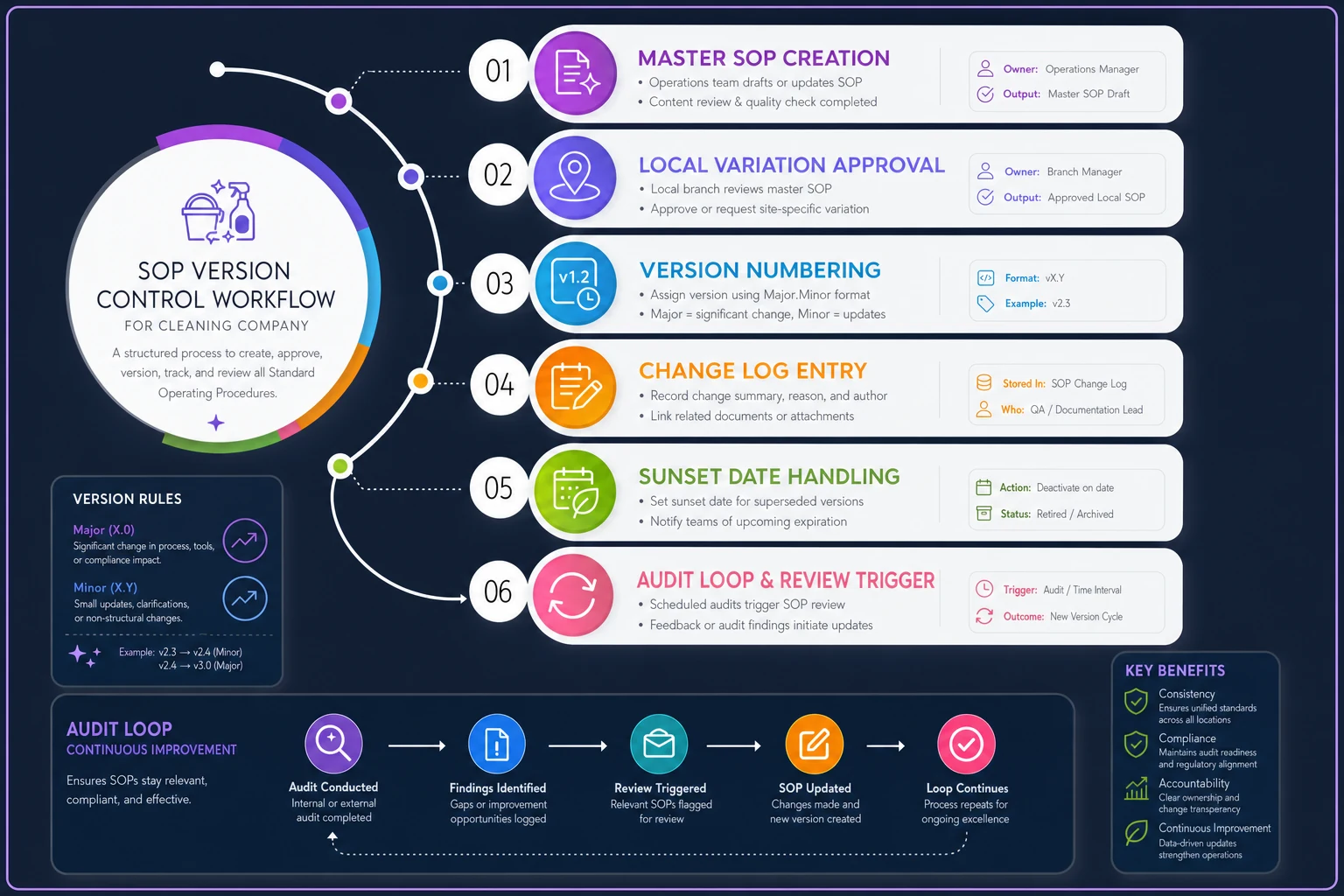
Use sunset dates as mandatory review triggers so temporary trials don't become permanent drift.
This audit trail saves you when quality issues surface. Instead of playing detective across three regions trying to figure out why callbacks increased, you check the version history and find exactly when someone changed the carpet cleaning sequence.
Delegated governance rules that prevent chaos
The hardest part about scaling cleaning operations is knowing what to delegate and what to hold onto. Too much central control and your supervisors can't respond to local needs. Too much delegation and you've effectively got five different companies operating under one brand.
Smart delegation starts with clear boundaries. Supervisors need to know exactly what they can change, what they can recommend, and what they absolutely cannot touch. But boundaries alone aren't enough—you need governance rules that make delegation actually work.
Rule 1: Changes Must Improve Measurable Metrics Any proposed process change needs to target a specific metric: time per task, chemical usage per square foot, client satisfaction score, callback rate. "I think this works better" isn't good enough. Your Zone B supervisor wants to change the restroom sequence? Show that it cuts cleaning time by 10% or reduces supply usage by 15%.
Rule 2: Document Before, During, and After Before implementing any approved change, document current performance. During the trial period—usually 30 days—track the same metrics. After implementation, compare results. This isn't bureaucracy; it's the only way to know if changes actually improve operations.
Rule 3: Parallel Testing Required Never roll out process changes system-wide based on one supervisor's hunch. Run parallel tests: one crew uses the new process, another sticks with standard. Compare results after two weeks. This approach has caught "improvements" that actually degraded quality before they became company-wide problems.
Rule 4: Escalation Triggers Built In Set automatic escalation triggers for changes that seem minor but can cascade:
-
Any change affecting chemical concentrations → Regional manager approval
-
Any change affecting time-per-task by more than 15% → Ops director review
-
Any change requested by a client → Account manager involvement
-
Any change affecting safety protocols → Full leadership review
These rules create structured flexibility. Supervisors can adapt and innovate, but within guardrails that prevent operational drift from taking hold.
The audit cadence that catches drift early
Most cleaning companies audit quality, but few audit process adherence. You're checking if the bathroom is clean, not if it was cleaned according to your SOP. That gap is exactly where drift hides until it becomes a crisis.
Weekly Spot Checks (Supervisor Level) Supervisors randomly observe two or three tasks per crew per week—not checking quality, checking whether the crew follows the documented process. Did they use the right chemical dilution? Did they follow the approved task sequence? Did they complete the safety checklist? These take about 10 minutes but catch drift before it becomes habit.
Monthly Process Audits (Regional Level) Regional managers audit full processes at two or three locations monthly. They watch entire room cleanings, not just task completion. They're looking for unauthorized process modifications, shortcuts that risk quality, improvised tools or techniques, and training gaps versus documented SOPs.
Quarterly Governance Reviews (Leadership Level) Every quarter, leadership reviews all approved local variations against master SOPs. Questions to address: Which local modifications actually improved metrics? Which should become standard across all regions? Which need to be sunset? Where are crews consistently deviating from SOPs?
The critical piece most companies miss: audit results must feed back into SOP updates. If three regions independently develop the same process modification, maybe your master SOP needs updating. If crews consistently skip a step, either the step is unnecessary or training is failing.
Create an audit findings tracker that captures deviation type and frequency, root cause (training, practicality, communication), corrective action taken, and follow-up results.
This tracker becomes your early warning system. When the same deviation shows up across multiple audits, you've got a systemic issue, not isolated incidents.
Governance KPIs that actually matter
You can't manage SOP governance by feel. You need hard metrics that tell you whether your processes are under control or quietly drifting toward chaos. Most cleaning companies either track the wrong things or track nothing at all.
Skip the vanity metrics. You don't need to know how many SOPs you have or how often they're accessed. You need to know if they're being followed and if they're working. Focus on these five:
1. Process Adherence Rate (Audits with zero deviations / Total audits) × 100 Target: above 85% Below 70% means your SOPs are either too complex or poorly communicated.
2. Approved Variation Ratio (Number of approved local variations / Number of master SOPs) Target: below 0.3 Above 0.5 suggests master SOPs don't reflect operational reality.
3. Change Success Rate (Process changes that improved target metrics / Total process changes) × 100 Target: above 75% Below 60% means you're approving changes without proper testing.
4. Drift Recovery Time Average days from identifying a process deviation to correction Target: under 7 days Above 14 days means your governance system is too slow to matter.
5. Training-to-SOP Alignment (Training materials matching current SOP version / Total training materials) × 100 Target: 100% Anything below 95% creates confusion and quality inconsistencies.
Track these monthly, but analyze trends quarterly. One bad month doesn't indicate governance failure. Three months of declining adherence rates means you've got structural problems worth addressing.
The relationship between these KPIs tells the real story. High variation ratio plus low adherence rate? Your master SOPs are probably too rigid. Low change success rate plus long drift recovery time? Your approval process is broken. High adherence but increasing callbacks? The SOPs themselves might need work.
Ready-to-implement templates for immediate governance
Building governance from scratch overwhelms most cleaning businesses. They know they need structure but don't know where to start. Here's a practical template set you can put to use this week:
Template 1: SOP Master Register
Create a spreadsheet with these columns:
-
SOP ID (CL-001, CL-002, etc.)
-
Process Name
-
Current Version
-
Last Updated
-
Owner (who maintains it)
-
Review Date
-
Active Local Variations (list region codes)
-
Training Materials Updated (Y/N)
Template 2: Change Request Form
Keep it to one page:
-
Requested by
[Name, Role, Region]
-
Current Process
[Brief description]
-
Proposed Change
[Specific modification]
-
Reason
[Problem being solved]
-
Metrics to Improve
[Time, quality, cost]
-
Test Plan
[How to validate]
-
Risk Assessment
[What could go wrong]
-
Approval Chain
[Supervisor → Regional → Ops]
Template 3: Local Variation Log
Document every approved regional difference:
-
Master SOP Reference
[ID and version]
-
Region/Location
[Where applicable]
-
Variation Description
[What's different]
-
Justification
[Why needed]
-
Approved By
[Name and date]
-
Sunset Date
[When to review/expire]
-
Performance Impact
[Measured results]
Template 4: Audit Checklist
Make it observable and binary (yes/no):
-
Correct chemicals used? Y/N
-
Proper dilution ratio? Y/N
-
Tasks completed in documented sequence? Y/N
-
Safety protocols followed? Y/N
-
Time within SOP guidelines? Y/N
-
Proper documentation completed? Y/N
-
Equipment used as specified? Y/N
Template 5: Monthly Governance Dashboard
One page showing current and 3-month average for process adherence rate, open change requests with aging, active local variations by region, top three audit deviation types, training gaps identified, and upcoming SOP reviews in the next 30 days.
These templates work because they're simple enough to actually use. No complex software, no extensive training required—just structured documentation that creates accountability.
The technology layer that makes governance manageable
Manual governance works until roughly 30 employees. Beyond that, you need operational software that enforces governance without creating extra administrative overhead. The key is choosing tools that integrate governance into daily operations rather than bolting it on as separate work.
AI-powered operational platforms make a real difference here. Instead of supervisors manually checking if crews follow SOPs, the software tracks task completion patterns and flags deviations automatically. When someone consistently finishes bathroom cleaning 40% faster than SOP standards, the system alerts supervisors to investigate—either they found a better method worth documenting, or they're cutting corners.
Operational platforms with built-in workflow automation also handle version control without the manual overhead. When you update an SOP, they can automatically archive the old version with full history, notify affected crews, update training requirements, adjust audit checklists, and track who's reviewed the changes.
Delegation rules get built directly into workflows. A crew lead trying to modify a Tier 1 safety protocol gets blocked at the system level. A supervisor proposing a regional variation gets automatically routed through proper approval channels. No more changes sneaking through because someone forgot to ask.
The subtler value comes from pattern recognition. When three regions independently start skipping the same SOP step, the platform surfaces it for review. When chemical usage creeps up 2% monthly across all crews, it triggers an investigation. These patterns are nearly invisible during daily operations but obvious when you're looking at aggregated data across the business.
Auditing also becomes more targeted. Instead of spot-checking random tasks, supervisors work through exception reports—which crews deviated from SOPs, which processes are running over standard time, where quality scores drop despite process compliance. That's a much better use of a supervisor's time than fishing for problems.
Making governance stick without killing morale
The fastest way to fail at governance is making it feel like punishment. Experienced crews who've successfully cleaned buildings for years suddenly need approval for every minor adjustment—that's how you lose good people.
Frame governance as a career path, not a restriction. Your best techs often have legitimate improvements in mind, and proper governance gives them a formal channel to implement those ideas across the organization. The supervisor who figured out a faster floor stripping method? Through the right structure, their innovation becomes company standard with their name behind it.
Start gradually. Don't drop fifty new SOPs and approval requirements on crews overnight. Pick your five most critical processes—probably your medical facility protocols or highest-value client standards. Get governance working there first, and show teams how structure reduces callbacks, confusion, and unrealistic expectations.
Connect governance to compensation. When crews consistently hit process adherence targets, it shows up in their bonuses. When supervisors implement changes that actually move metrics, they get recognition. Make governance success visible and worth caring about.
Most importantly, involve your front-line teams in building governance structures. They know which SOPs are outdated, which variations are genuinely necessary, which approval chains move too slowly. Governance designed in an office without field input will fail in the field.
Build this involvement into your operational lifecycle for cleaning companies—from initial process design through ongoing refinement. When crews help create standards, they're more invested in following them.
The compound effect of proper governance
When SOP governance actually works, problems get smaller and less frequent. Instead of discovering massive quality drift after losing a major account, you catch minor deviations during weekly audits. Instead of supervisors making conflicting changes that confuse crews, you have clear variation management that preserves consistency.
One commercial cleaning company went from ad-hoc processes across four regions to structured governance over about six months. The results were measurable: callbacks dropped from around 12% to roughly 4%, chemical costs decreased by about $2,800 monthly, training time for new crews dropped by five or six days, and client retention improved from around 82% to 94%.
The less obvious benefit was operational confidence. Supervisors knew exactly what they could modify and how. Crews knew which processes were fixed and which had flexibility. Leadership could see governance KPIs trending positive months before quality metrics visibly improved.
Governance also created unexpected selling opportunities. Documented process variations became proof points with prospective medical clients—they could see exactly how healthcare-specific SOPs differed from standard commercial cleaning. Audit trails proved compliance during insurance reviews. Version control impressed enterprise clients during procurement evaluations.
When you combine governance with systematic root-cause analysis for recurring issues, drift becomes nearly impossible. Problems get solved once and stay solved.
The cleaning companies that scale successfully aren't necessarily the ones with the best processes—they're the ones with governance structures that keep processes from drifting into chaos. Building that structure isn't complicated, but it does require discipline and a genuine commitment to documentation.
Getting started this week
Don't wait for a perfect governance system before doing anything.
First, pick your most problematic process—the one generating the most callbacks or the most confusion—and document its current state. Not the ideal state, not what the manual says, but what actually happens in the field. That's your Version 1.0.
Second, create a simple permission matrix for just that one process. Who can modify it? Who approves changes? How do modifications get documented? One page, and make sure every supervisor understands it before moving on.
Third, run a two-week audit checking adherence to that single process. Don't worry about quality outcomes yet—just check whether crews follow the documented steps. This baseline tells you immediately whether your SOP matches operational reality or needs work before you start enforcing it.
From there, expand gradually. Add one new process to governance each week. Build your audit rhythm. Start tracking your first governance KPIs. Within 90 days, you'll have functioning governance across core operations without overwhelming anyone in the process.
The cleaning companies that scale successfully aren't necessarily the ones with the best processes—they're the ones with governance structures that keep processes from drifting into chaos. Building that structure isn't complicated, but it does require discipline and a genuine commitment to documentation.
Your SOPs are only as good as your ability to maintain them as the business grows. Without governance, every new hire, every new supervisor, and every new region becomes another opportunity for drift. With governance, they become opportunities for controlled improvement and sustainable scaling.
Stop letting quality drift eat your margins and reputation. Build SOP governance that grows with your business, not against it.
Ready to simplify your cleaning operations?
Join 1,000+ cleaning businesses using Wipyly to save time, reduce scheduling conflicts, and enhance client satisfaction.