


The problem with most cleaning SOPs is that they're written for a generic office and quietly reused everywhere. That works fine until you win a dialysis clinic, a K-5 school, or a busy retail flagship — and suddenly the same checklist that passed inspection at a law firm gets you a corrective action notice from an infection-control nurse.
These three environments each have their own rulebook, their own frequency logic, their own evidence expectations, and their own way of failing an audit. Below are compact, ready-to-adapt playbooks for healthcare, education, and retail. Not encyclopedic — a supervisor should be able to read one page, hand it to a crew lead, and have them get it right the first time.
The healthcare cleaning playbook: where "looks clean" and "is clean" are two different jobs
Healthcare is the account type where crews get comfortable and then get burned. A waiting room and a treatment room look almost identical to an untrained cleaner. One is a low-touch public space. The other is a regulated clinical surface governed by dwell times, EPA-registered disinfectants, and documentation you'll be asked to produce months later.
The most common failure isn't skipping a room. It's using the wrong product in the right room, or wiping a surface before the disinfectant has had time to actually kill anything. A quat-based disinfectant might need anywhere from 3 to 10 minutes of contact time depending on the pathogen claim. Crews spray and wipe in one motion because that's the habit from every office they've ever cleaned. The surface looks spotless. It isn't disinfected. And there's no way to prove it either way.
Regulatory must-dos
-
Use EPA-registered, healthcare-grade disinfectants and follow the label's contact/dwell time exactly. The label is the law here.
-
Maintain SDS sheets for every chemical on site, accessible to staff.
-
Follow color-coded microfiber protocols to prevent cross-contamination (e.g., red for restrooms/high-risk, blue for general, separate cloth for patient-contact surfaces).
-
Handle regulated medical waste only per facility policy — cleaning crews generally do NOT touch sharps or biohazard containers unless explicitly contracted and trained.
-
Follow bloodborne pathogen procedures and keep spill kits stocked.
-
Terminal cleaning of treatment/procedure rooms follows a top-to-bottom, clean-to-dirty sequence.
Frequency logic
| Area | Frequency | Notes |
|---|---|---|
| Exam/treatment rooms | Between each patient + terminal daily | High-touch surfaces every turnover |
| Restrooms (public + clinical) | 2–3x daily minimum, logged | Frequency scales with traffic |
| Waiting areas / high-touch (door handles, chairs, kiosks) | Multiple times daily | Flu season pushes this up |
| Nurse stations / admin | Daily | Standard commercial |
| Isolation rooms | Per facility infection-control protocol | Never improvise |
Supplies checklist
-
EPA-registered hospital disinfectant (with the specific pathogen claims the facility requires)
-
Color-coded microfiber system, laundered separately
-
Disposable gloves + gowns, eye protection
-
Bloodborne pathogen spill kit
-
SDS binder or digital access on site
-
Dedicated cart per zone to prevent cross-contamination
Evidence expectations
This is where healthcare accounts are different from everything else. "We cleaned it" isn't enough. You need to show when, who, and with what. Restroom logs with times. Terminal clean sign-offs. Contact-time verification. If an infection-control audit comes and you have no timestamped record, you lose the account — whether or not the cleaning was actually done.
Sample audit checkpoints
-
Pull three random high-touch surfaces — were they disinfected with the correct product?
-
Ask a crew member the contact time for the primary disinfectant. If they don't know it, that's a finding.
-
Check that microfiber colors match zones and nothing crossed over.
-
Verify restroom logs are filled in with actual times, not batch-signed at end of shift.
-
Confirm SDS access and spill kit stock.
On that last point: batch-signed logs are the single most common reason a healthcare client stops trusting a cleaning vendor. A nurse who sees five identical "9:00 / 12:00 / 3:00" entries in the exact same handwriting knows they were filled in at 3:05. The moment your evidence looks fabricated, every clean you've ever done becomes suspect.
The education playbook: high volume, tight windows, and a parent audience that notices everything
Schools are a different beast. The regulatory pressure is lighter than healthcare, but the operational pressure is brutal — you're cleaning hundreds of touchpoints in a two-to-three hour window after dismissal, and your "auditors" include teachers, custodial supervisors, and parents who post photos of dirty cafeteria tables in Facebook groups.
Stop losing bookings in operational chaos.
Wipyly helps you manage, confirm, and optimize every cleaning appointment efficiently.
- Centralized booking management
- Automated client notifications
- Staff scheduling & route optimization
No credit card required
The mistake is treating a school like a big office. Offices have adults who are mostly sedentary. Schools have kids who touch everything, sit on floors, and turn a single norovirus case into a district-wide outbreak in about four days. Frequency and disinfection during illness season matter more than deep detail work.
Regulatory and policy must-dos
-
Use disinfectants that are safe for use around children and approved by the district — many districts maintain an approved product list, and going off-list is an instant problem.
-
Ventilation and dwell-time awareness
don't leave chemical residue on surfaces kids will lick, chew, or press their faces against (yes, they do).
-
Follow district green/low-tox cleaning policies where they exist.
-
Restroom sanitation logs are frequently required and reviewed.
-
Gym floors, cafeteria surfaces, and drinking fountains get specific attention because they're outbreak vectors.
Frequency logic
-
High-touch surfaces (door handles, light switches, shared desks, water fountains): daily, and 2x daily during flu/norovirus season.
-
Restrooms
daily deep clean + midday check where staffing allows.
-
Cafeteria
after every meal service.
-
Classrooms
daily; floors daily in lower grades where kids sit on them.
-
Gym
daily, with mat sanitation as scheduled.
Supplies checklist
-
District-approved, child-safe disinfectants
-
Restroom sanitation supplies stocked for high daily volume
-
Gym mat / equipment sanitizer
-
Color-coded cloths (cafeteria vs restroom separation is critical here)
-
Backpack vacuums or equipment suited to fast large-area coverage
Evidence expectations
Schools want proof that restrooms and cafeterias were handled on schedule — especially during illness outbreaks. Timestamped restroom logs, before/after photos of cafeteria turnover, and a clear record of what got the extra disinfection pass during a flare-up. During an active outbreak, the district may ask for daily documentation. If you can produce it immediately, you keep the contract through the panic.
Sample audit checkpoints
-
Are restroom logs current with realistic times?
-
Spot-check three high-touch classroom surfaces after a clean.
-
Was the approved product used — not a substitute the crew grabbed because they ran out?
-
Cafeteria tables and floors cleaned after last service?
-
During outbreak periods
is the elevated-frequency schedule actually being followed and logged?
During outbreak periods: is the elevated-frequency schedule actually being followed and logged?
The retail playbook: it's a sales-floor problem before it's a cleaning problem
Retail flips the priority order. In healthcare you clean for safety; in retail you clean for sales. A dirty fitting room or smudged entrance glass costs the store conversions, and the store manager feels that directly. Your audit isn't an infection-control nurse — it's a manager who will terminate your contract because customers complained about the restroom.
The mistake cleaning companies make with retail is scheduling around their own convenience instead of the store's traffic. Cleaning a high-traffic entrance at 2pm on a Saturday isn't just awkward — it's the store paying you to get in the way of shoppers. Retail cleaning lives and dies by timing.
Must-dos and priorities
-
Entrance glass, floors, and restrooms are the three surfaces customers judge a store by — these are non-negotiable.
-
Fitting rooms need frequent attention in apparel retail; they're the number one customer complaint area.
-
Floor care (buffing, spill response) tied to slip-and-fall liability — wet floor signage and prompt spill response protect the client legally.
-
Trash and cardboard management, especially back-of-house during restock cycles.
-
Work around store hours — most retail cleaning is pre-open, post-close, or low-traffic windows.
Frequency logic
| Area | Frequency |
|---|---|
| Entrance glass + floors | Daily, pre-open |
| Restrooms | Daily + midday touch on high-traffic days |
| Fitting rooms | Multiple times daily during open hours |
| Sales floor (vacuum/mop) | Daily, off-hours |
| Back-of-house / stockroom | Daily to weekly per volume |
| Floor buffing / deep floor care | Weekly to monthly |
The table above covers the baseline. Traffic spikes — holiday weekends, major sales events — usually warrant bumping restrooms and fitting rooms to a tighter cycle, even if the contract doesn't explicitly require it.
Supplies checklist
-
Streak-free glass cleaner (entrance glass is the first impression)
-
Floor care equipment matched to the flooring type (LVT vs polished concrete vs tile)
-
Wet floor signage — always on the cart
-
Restroom supplies stocked for customer-facing volume
-
Odor control for fitting rooms and restrooms
Evidence expectations
Retail managers care about the walk-through, not the paperwork. Your evidence is a clean store at open. That said, restroom logs still help, and dated photos of completed floor care justify the line item on your invoice when a regional manager questions cost. Photo evidence of pre-open condition is also the cheapest way to win a "the store looked bad this morning" dispute.
Sample audit checkpoints
-
Entrance glass streak-free at open?
-
Restrooms stocked and clean before first customer?
-
Fitting rooms free of trash, tags, and odor?
-
Floors dry and hazard-free — signage used where needed?
-
Back-of-house trash and cardboard cleared before restock?
Photo evidence of pre-open condition is also the cheapest way to win a "the store looked bad this morning" dispute.
A quick comparison so crews don't mix up the priorities
The fastest way to train a crew lead on multiple site types is to show them how the priorities differ, not just the tasks.
| Attribute | Healthcare | Education | Retail |
|---|---|---|---|
| Primary driver | Safety / infection control | Volume + outbreak prevention | Sales / customer perception |
| Toughest audience | Infection-control nurse | Parents + district supervisor | Store / regional manager |
| Evidence that matters most | Timestamped logs + contact time | Restroom/cafeteria logs, outbreak records | Pre-open condition, photos |
| Biggest crew mistake | Wiping before dwell time | Wrong/off-list product | Cleaning during peak traffic |
| Non-negotiable | Correct disinfectant + dwell | Approved child-safe products | Entrance, restrooms, fitting rooms |
Hand this to a new supervisor and they'll grasp in two minutes what usually takes a couple months of mistakes to learn.
How to actually deploy these without them sitting in a drawer
Templates fail for one boring reason: they get written, printed once, and never make it to the person holding the mop at 6am. Below is a deployment sequence that actually sticks.
Below is a deployment sequence that actually sticks.
-
Strip each playbook to one page per site. If a crew lead can't scan it in 60 seconds before a shift, it's too long.
-
Assign an evidence owner per account. Someone specific is responsible for logs and photos — not "the team."
-
Pre-load supplies against the checklist. Half of all findings come from the crew running out of the right product and substituting. Stock the cart to the playbook, not to habit.
-
Run a first-week shadow audit using the sample checkpoints above, before the client's own audit ever happens.
-
Fix findings within 48 hours and re-check. This is the difference between a corrective action and a lost account.
If you already run structured audits, these playbooks slot directly into the same scoring approach — the SLA-aligned commercial cleaning audit checklist with scoring and renewal triggers framework works well as the scoring layer on top of these site-specific checkpoints. And when you're onboarding a new specialized account, the handoff sequence in the operational client lifecycle for cleaning companies keeps the playbook from getting lost between sales and operations.
A note on keeping evidence honest
The batch-signed log problem shows up in all three sectors. The fix isn't nagging crews — it's making real-time logging faster than faking it. When timestamps and photos are captured on a phone at the moment of the clean, there's no incentive to backfill at end of shift. Whether that's a simple shared form or a proper operations platform, the goal is the same: make the easy path and the honest path identical.
A visual of the deployment workflow can help teams follow the sequence quickly.
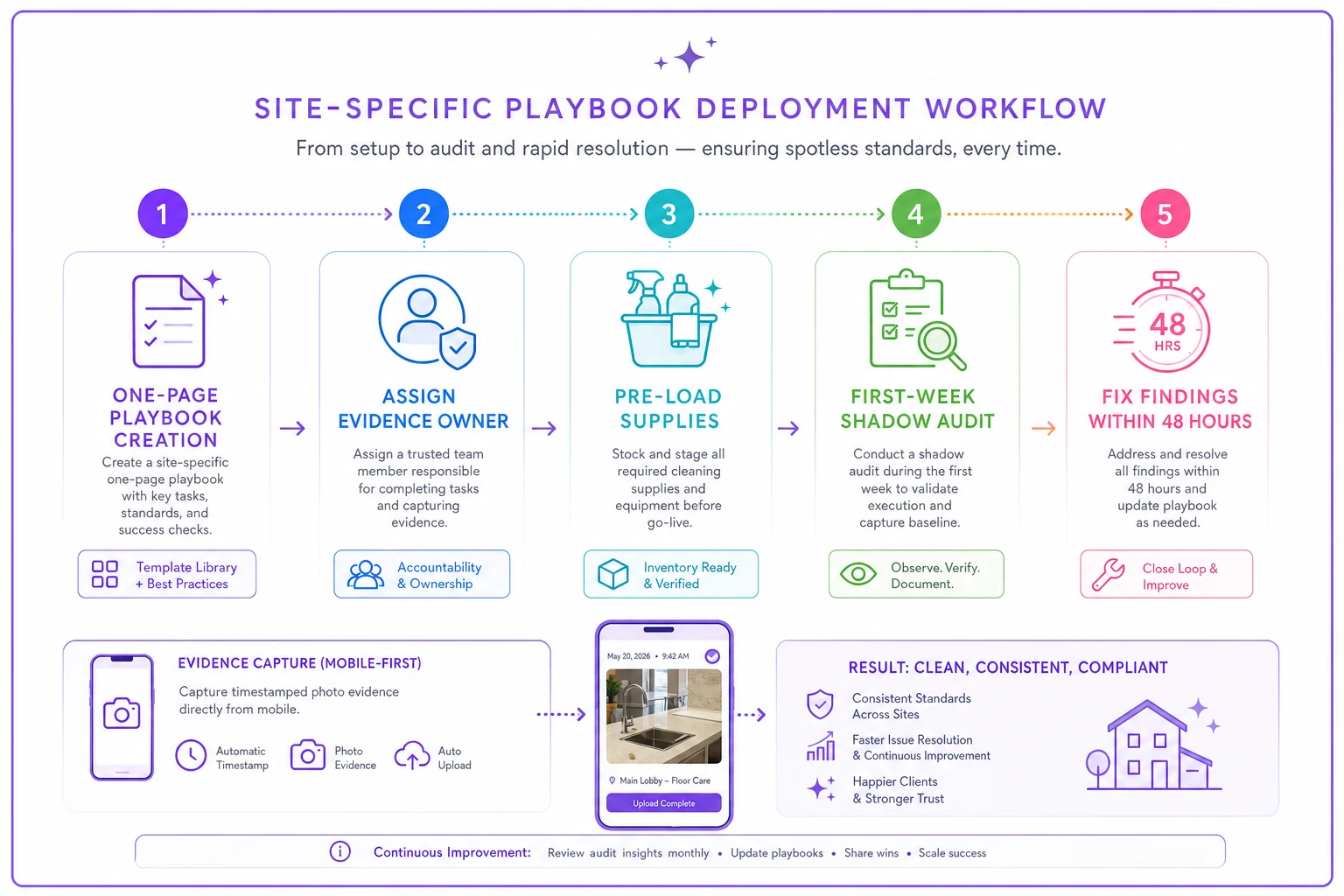
Use the visual as a quick reference for supervisors during onboarding and first-week audits.
Assign the evidence owner to a crew lead and put their name on the cart tag so accountability is clear.
Whether that's a simple shared form or a proper operations platform, the goal is the same: make the easy path and the honest path identical.
Real scenario: a mid-size company that kept losing its clinic accounts
A cleaning company running roughly 30 accounts kept winning medical office contracts and losing them within about six months. Their office and retail accounts were rock solid. The clinics churned.
The root cause wasn't cleaning quality — the office accounts proved the crews were capable. They were running clinics on their standard office SOP. No contact-time enforcement, restroom logs signed in a batch at shift end, crews using the same general-purpose disinfectant they used everywhere else. The first infection-control walk-through from a clinic manager surfaced all three problems at once.
They rebuilt the healthcare accounts around a one-page version of the playbook above: correct EPA-registered disinfectant with the dwell time printed right on the cart tag, color-coded cloths, and phone-based restroom logs with live timestamps. Retraining took about a week per site.
Over the next two quarters, clinic retention improved dramatically — going from losing most contracts to keeping nearly all of them. They also picked up two referral accounts because a clinic manager mentioned them to another practice. The cleaning didn't get dramatically better. The proof did — and in healthcare, the proof is half the job.
When a specialized playbook is worth it — and when it isn't
Not every account needs its own regulated playbook. If you're cleaning small standard offices, the generic SOP is fine and building custom playbooks is over-engineering.
Build the specialized playbook when:
-
The account is in a regulated or safety-sensitive environment (healthcare, food, childcare).
-
The client conducts formal audits or asks for documentation.
-
Getting it wrong means losing the account or facing liability.
Skip it when:
-
The site is low-risk and low-complexity.
-
The client has no audit process and no compliance exposure.
-
You're a solo operator with two similar accounts and no crew to train.
Draw that line clearly, because over-documented accounts create their own failure mode — crews stop reading anything when everything is a 12-page binder. Reserve the detailed playbooks for where the stakes actually justify them.
The three sectors above earn their playbooks because each one fails in a specific, predictable way: healthcare on dwell time and evidence, education on frequency and product approval, retail on timing and customer-facing surfaces. Match the template to how the account actually fails, keep it to a page, and make the honest path the fast path — that's the whole game.
The three sectors above earn their playbooks because each one fails in a specific, predictable way: healthcare on dwell time and evidence, education on frequency and product approval, retail on timing and customer-facing surfaces. Match the template to how the account actually fails, keep it to a page, and make the honest path the fast path — that's the whole game.
Ready to simplify your cleaning operations?
Join 1,000+ cleaning businesses using Wipyly to save time, reduce scheduling conflicts, and enhance client satisfaction.