


Most cleaning operators sign SLA-backed contracts without ever modeling what the penalty section can actually do to a month's profit. The language reads like boilerplate, the client's procurement team swears it's "standard," and everyone moves on. Then a bad week hits — two sick callouts, a van down, a restroom that didn't get flagged — and suddenly the credits stack on top of each other and your net on that account drops below zero.
This piece is narrow on purpose. It's about the mechanics of limiting what a penalty clause can cost you, and the operational proof you need to actually win a credit dispute. Not negotiation theater. The math and the guardrails.
The part nobody models: penalties compound
A single SLA miss rarely bankrupts an account. The damage comes from how misses interact.
A typical commercial contract might have three or four measured SLAs running at once — attendance, task completion, response time on reactive calls, and an audit score threshold. Each has its own credit. The problem is that one root cause often trips several at the same time. A crew that shows up two hours late fails the attendance SLA, probably blows the task-completion window, and if a client walkthrough happens that morning, tanks the audit score too.
Now you're not paying one credit. You're paying three, all triggered by the same late start. That's a cascade, and it's where real money leaks. Monthly credit exposure on a single mid-size office account can swing from a planned worst-case of maybe 4% of contract value to something closer to 11–12% once overlapping clauses all fire off the same incident.
The operators who survive penalty-heavy contracts aren't the ones who never miss. They're the ones who've structured the contract so one miss can only cost once.
Caps: the single most important number in the clause
If you negotiate nothing else, negotiate the cap. A penalty cap limits total service credits to a percentage of the monthly invoice, regardless of how many individual SLAs fail.
Stop losing bookings in operational chaos.
Wipyly helps you manage, confirm, and optimize every cleaning appointment efficiently.
- Centralized booking management
- Automated client notifications
- Staff scheduling & route optimization
No credit card required
Without a cap, your theoretical downside is unbounded — stack enough credits and a client could technically zero out your invoice. With a cap, you know the floor of your worst month in advance, and you can price for it.
Here's the distinction that matters most and gets missed constantly:
| Cap type | What it limits | Risk to you |
|---|---|---|
| Per-SLA cap only | Each individual SLA credit maxes out | Still unbounded in total — ten capped SLAs can add up badly |
| Aggregate monthly cap | Total credits across ALL SLAs in a month | Predictable worst case |
| Aggregate + per-incident cap | Total monthly AND limits one event to one credit | Best protection — kills the cascade |
Most contracts hand you a per-SLA cap and call it generous. That's the weak version. What you actually want is an aggregate monthly cap — something in the 5–10% of monthly fee range is defensible for standard commercial work — plus a per-incident clause stating that a single root-cause event counts as one SLA breach, not several.
That per-incident language is the quiet hero. It's the difference between a late crew costing you one credit or four.
Ask explicitly for an aggregate monthly cap plus per-incident language during renewal conversations; it's the clearest protection against cascades.
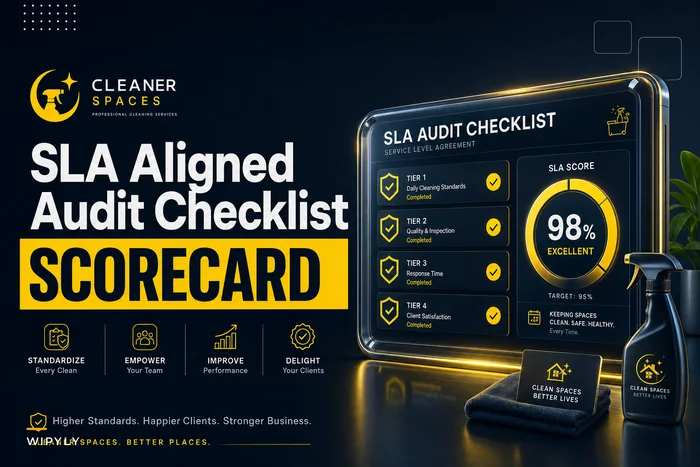
If you're building out your scoring and threshold logic before you ever get to the penalty section, the SLA-aligned commercial cleaning audit checklist with scoring and renewal triggers is worth working through first — because the audit score is usually one of the SLAs that gets dragged into the cascade.
Cure periods: the clause that saves marginal accounts
A cure period is a defined window — usually 24 to 72 hours — during which you can fix a documented deficiency before any credit applies. No cure period means the credit triggers the instant the miss is logged. With one, a missed trash pull flagged at 7am that your crew corrects by 11am never becomes a penalty at all.
In real operations, this is where a surprising amount of exposure gets erased quietly. A lot of what clients log as "failures" are things your team would have caught and fixed on the next cycle anyway. The cure period just formalizes the grace you were already extending.
A few things to insist on when you write it:
-
The clock starts at notification, not at occurrence. You can't cure something you don't know about. The cure window should begin when the client documents and sends the deficiency, not when they claim it happened.
-
Define the notification channel. If deficiencies get texted to a supervisor's personal phone, half of them never make it into the record. Specify a single logged channel.
-
Separate recurring from one-off. It's fair for clients to want the cure period to shrink or disappear for the same deficiency repeated three times in a month. Agree to that — it's reasonable and it signals good faith — but protect the cure period for first occurrences.
The mistake operators make is treating the cure period as a formality and then having no system to actually act inside it. A 48-hour cure window is worthless if the deficiency notice sits unread for two days. The clause only protects you if someone is watching the inbox and dispatching the fix.
The service-credit math most operators never run
You cannot evaluate a penalty clause by reading it. You have to run the numbers against your own failure rate.
-
List every measured SLA and its individual credit value (flat fee or percentage of monthly invoice).
-
Estimate your realistic monthly miss rate per SLA based on your actual historical performance — not your best month, your average one.
-
Model a bad-but-plausible month, not a catastrophe. Two attendance misses, one response-time miss, one audit dip.
-
Apply the cascade — map which single incidents would trip multiple SLAs if you have no per-incident protection.
-
Compare the total against your cap (if there is one) and against your net margin on the account.
A worked example. Say you've got a janitorial account billing roughly $14k a month at about 18% net margin — so around $2,500 of profit on the line. The contract has:
-
Attendance SLA
2% credit per miss
-
Task-completion SLA
1.5% credit per miss
-
Response-time SLA
1% per miss
-
Audit-score SLA
3% if below threshold
Model a rough month: two late starts (attendance), and because there's no per-incident clause, each late start also fails task completion and one of them drags the audit below threshold during a walkthrough.
Two attendance misses = 4%. Two task misses riding along = 3%. One audit miss = 3%. That's 10% of $14k — about $1,400 in credits — off an account that only makes you $2,500. One ordinary bad month just ate more than half your profit on the contract, and nothing catastrophic even happened.
Now re-run it with an aggregate cap at 7% and a per-incident clause. The two late starts count as two breaches, period. Attendance credits only: 4%, capped well under the ceiling. Roughly $560. Same operational reality, less than half the financial damage — because the clause structure refused to let one problem bill four times.
That gap between $1,400 and $560, month after month, is the entire game.
Operational evidence: credits are won or lost in the record
Negotiating good clauses is half the work. The other half is being able to prove, on demand, that a flagged miss either didn't happen or got cured in time. Procurement teams don't reverse credits out of goodwill — they reverse them when you hand over evidence they can't argue with.
-
Time-stamped arrival and departure per crew per site, not a daily timesheet reconstructed afterward.
-
Before/after photos tied to specific tasks, with automatic timestamps the crew can't backdate.
-
A logged deficiency-notice trail showing exactly when the client reported an issue and when your team closed it — this is what proves you cured inside the window.
-
Audit walkthrough records with the auditor named, the time logged, and the scored checklist attached.
The operators who lose disputes are almost always the ones reconstructing their defense after the fact — digging through text threads and asking a supervisor what time they think the crew arrived. By then the client already applied the credit, and you're trying to claw it back, which is a losing posture.
Here's a quick visual of the evidence workflow.
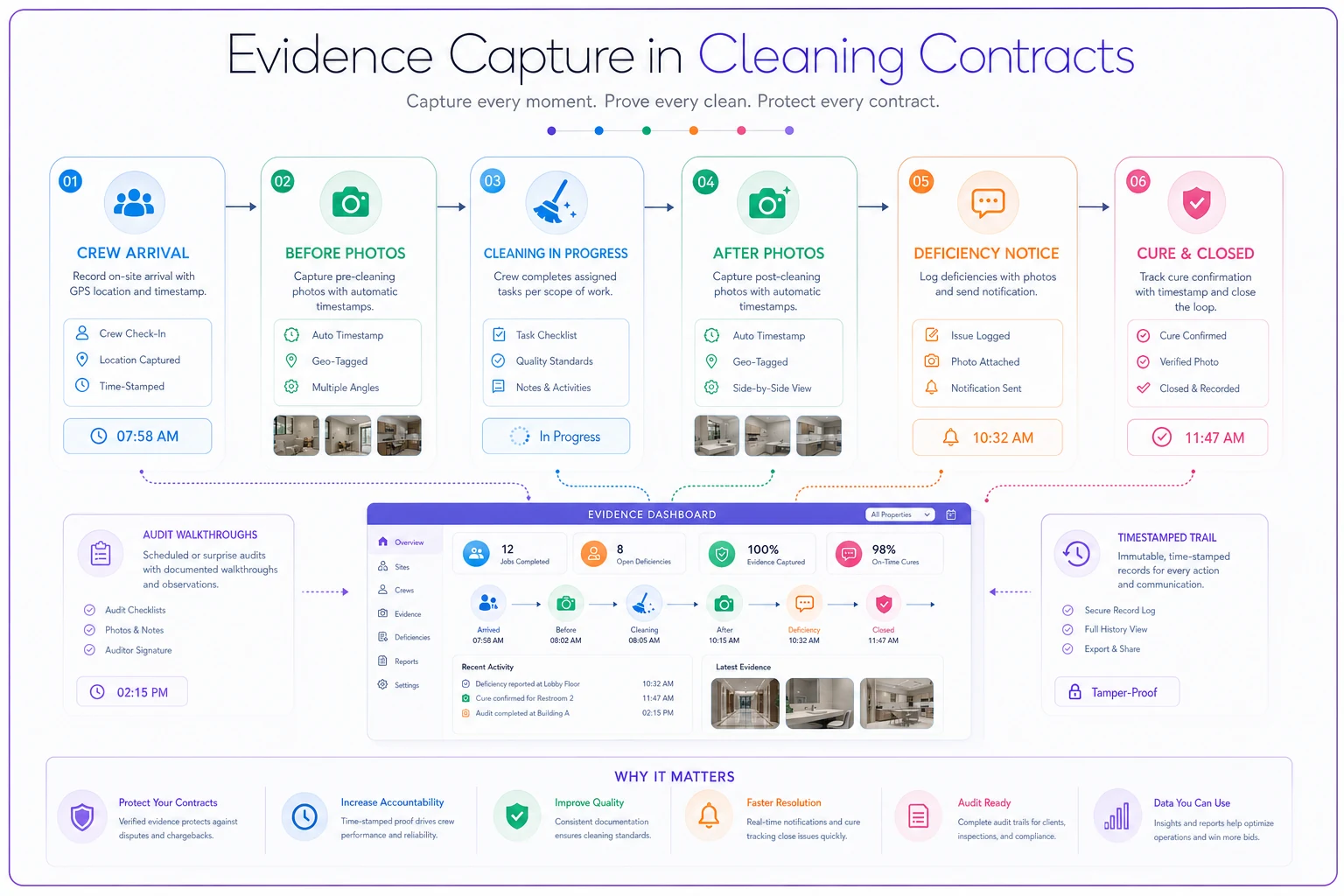
The ones who win have the evidence sitting ready before the dispute starts. When procurement flags a 6:40am attendance miss, they already have a geotagged clock-in at 6:28 and a photo of the completed lobby at 6:55. The conversation ends in a minute.
This is where the day-to-day system matters more than the contract language. If crews are capturing timestamps and task photos as part of their normal close-out — not as a special effort during a dispute — the evidence requirement stops being a burden and becomes your strongest card. Workflow platforms that log arrival, completion, and deficiency-resolution timestamps automatically are doing exactly one useful job here: making sure the record exists whether or not anyone remembered to build it.
Guardrails that actually stop the cascade
Contract language sets the ceiling. Operational guardrails keep you from hitting it. A few that pay for themselves:
-
A per-incident mapping sheet. For each account, document which SLAs a single root cause can trip. This tells you where your cascade risk is concentrated and which fixes protect the most ground.
-
A cure-window watch rule. Someone owns the deficiency inbox every working morning. Any flagged issue gets a dispatch decision within the first few hours of the cure window, not the last.
-
An escalation trigger before the audit SLA. If attendance or task completion slips at a site, trigger a supervisor walkthrough before the client's scheduled audit — so the audit-score SLA doesn't become the third domino.
-
A monthly credit-exposure review per account. Track credits applied versus your cap and versus net margin. Any account spending more than half its margin cushion on credits goes on a remediation list.
That last one connects to the broader money picture. Credits behave a lot like slow leaks — small, recurring, easy to ignore until they've quietly reshaped the account's profitability. The same discipline that keeps late payments from eating margin applies here; the stage-based collections ladder for cleaning companies is built on the same idea that recurring small drains deserve a tracked, staged response rather than reactive firefighting.
When aggressive penalty mitigation makes sense — and when it doesn't
When it's worth the fight: High-value contracts with layered SLAs, national or multi-site accounts where procurement wrote the terms, and any account where your modeled bad-month credit exposure exceeds roughly a third of your net margin. These are the contracts where cap and per-incident language directly protect your take-home.
When it's overkill: Small single-site accounts with one or two simple SLAs and a modest flat credit. Spending negotiation capital fighting over cure-period wording on a $3k/month account that bills one attendance credit a quarter isn't worth the friction. Get a reasonable cap and move on.
Who should be careful pushing too hard: If you genuinely can't hit the SLAs — if your attendance is unreliable and your evidence capture is nonexistent — aggressive clause negotiation is treating the symptom. A tight cap won't save an account you're failing operationally; it just delays the loss. Fix the delivery first, then the clause structure becomes the safety net it's meant to be, not a crutch.
The real scenario
A regional janitorial operator ran six commercial office accounts, all on SLA contracts with no aggregate caps and no per-incident language. On paper the credits looked small — 1 to 3% each. In practice, three of the six accounts were bleeding somewhere between 8% and 11% of monthly fees to stacked credits during any month with a staffing hiccup, which was most months.
They did two things. At the next two renewals they pushed for an aggregate monthly cap of 7% plus a one-incident-one-breach clause — and got both, because once they showed procurement their own clean evidence record, the clients had little reason to refuse. They also put a single person on the deficiency inbox each morning with authority to dispatch same-day fixes inside the cure window.
Over the following two quarters, credit payouts across the portfolio dropped by a bit more than half. Nothing dramatic changed in how often they actually missed — staffing was still messy. What changed was that one miss now cost once instead of three times, and a lot of flagged deficiencies got cured before they ever became credits. The accounts that had been hovering near break-even went back to carrying their intended margin.
That's the whole point of SLA penalty mitigation in cleaning contracts. You're not trying to be perfect. You're trying to make sure your imperfect weeks cost what they should — and not a dollar more.
Ready to simplify your cleaning operations?
Join 1,000+ cleaning businesses using Wipyly to save time, reduce scheduling conflicts, and enhance client satisfaction.