

Cash flow problems in cleaning businesses rarely start with deadbeat clients. They start with inconsistent collections processes that let small delays snowball into major receivables problems.
Most cleaning companies handle collections reactively—sending random reminders when someone notices an overdue invoice, then jumping straight to threats when patience runs out. This creates two problems: good clients feel attacked over minor delays, while problem accounts drag on for months eating up margin and admin time.
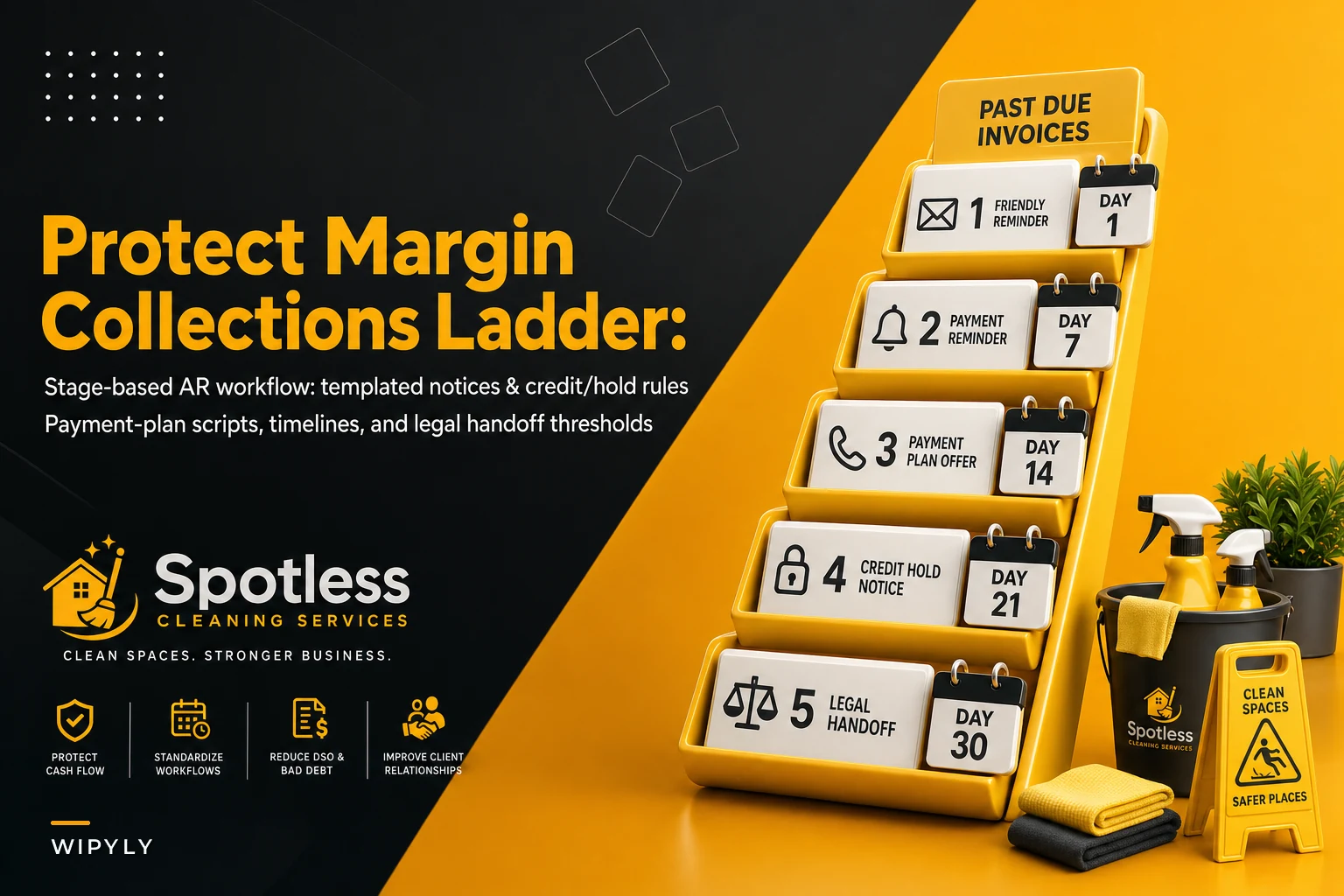
A stage-based collections ladder fixes this by creating predictable escalation paths that preserve relationships while protecting cash flow. Not the generic "30-60-90 day" templates you find online, but an operational system that accounts for client types, payment history, and the specific dynamics of cleaning contracts.
## The hidden cost structure of collections in cleaning operations
Collections costs compound differently in cleaning businesses than in other service industries. Every week a commercial account stays unpaid adds operational friction beyond just the missing revenue.
Your crews still cleaned those offices. Supply costs already hit. Payroll went out. Insurance premiums don't pause. The actual cost of carrying a 45-day overdue $4,800 monthly contract runs closer to $6,200 when you factor in float costs on materials and labor already spent, admin time chasing payment (usually 3–4 hours per problem account), opportunity cost of restricted cash flow limiting new contract starts, and crew morale issues when they know certain buildings aren't paying.
The worst part? Most cleaning companies don't track collection costs separately from general overhead. They just see margin erosion without realizing a single problem account can wipe out profits from three good ones.
## Building your AR ladder: stages, not just days
Generic payment terms create generic problems. A cleaning company collections playbook needs stages tied to operational realities, not arbitrary calendar math.
Stop losing bookings in operational chaos.
Wipyly helps you manage, confirm, and optimize every cleaning appointment efficiently.
- Centralized booking management
- Automated client notifications
- Staff scheduling & route optimization
No credit card required
Stage 0: Pre-emptive (Day -7 to 0)
Before invoices even go out. This catches issues before they become collections problems. Send upcoming invoice previews showing service dates covered, any add-ons or special requests completed, photo documentation of completed work, and next month's scheduled dates.
Message template: "Hi [Name], attached is your invoice preview for services completed this month. Please review and let us know if anything needs clarification before we send the official invoice on [date]. Photos from this month's cleanings are included."
Stage 1: Friendly (Day 1–10)
Payment technically due but within normal processing windows. Keep tone helpful, not pushy.
Decision rule: If payment history is clean (no late payments in 6 months), wait until day 10. If previous late payments exist, start on day 3.
Message: "Quick reminder that invoice #[number] for $[amount] was sent on [date]. If you've already sent payment, thank you! If not, here's the link for quick payment: [link]. Let me know if you need anything adjusted."
Stage 2: Concerned (Day 11–20)
Something's probably wrong but might still be administrative.
Decision rule: Add a service pause warning if the account has been late twice in the last 90 days.
Message: "We haven't received payment for invoice #[number] ($[amount]), now 12 days overdue. To avoid any service interruptions, please process payment by [date + 5 days]. If there's an issue with the invoice, please let me know today so we can resolve it."
Stage 3: Firm (Day 21–35)
Clear problem requiring action.
Decision rule: Implement credit hold procedures. No new work orders, special requests, or add-ons until resolved.
Message includes an itemized balance with late fees, a specific service suspension date, a payment plan offer (if appropriate for account size), and a request for a call to discuss.
## Client preservation language that actually works
The difference between keeping and losing a client during collections often comes down to word choice. Cleaning companies face a particular challenge here—you're frequently dealing with property managers who aren't the actual check signers, which adds communication layers that drag things out.
For property management companies:
"Hi [Name], I know you're waiting on the owner for this—we work with enough PMs to understand the payment chain. However, we need to pause service after [date] if we don't receive payment. Can you help me understand the timeline on your end? If the owner needs different terms, let's discuss options before service gets interrupted."
For direct commercial clients:
"We've been cleaning your offices for [time period] and value that relationship. The outstanding balance of $[amount] is affecting our ability to maintain service quality. Rather than suspending service, would you prefer to set up a payment plan? We can do [options]."
For problem residential accounts:
"Your cleaning service will be paused after [date] due to non-payment. To resume service, we'll need the full balance of $[amount] plus a deposit equal to one month's service. We can discuss payment arrangements if needed—please call by [date] if you'd like to keep your regular cleaning slot."
These templates work because they acknowledge the relationship, state consequences clearly, offer an alternative path, set specific deadlines, and avoid emotional language.
## Payment plan frameworks that protect margin
Payment plans in cleaning businesses need tighter controls than in other industries because you're providing ongoing service while collecting past debt.
Qualification thresholds
Only offer payment plans when the account has 6+ months of payment history, the balance is over $1,500 but under $10,000, the client commits to ACH or credit card autopay, and there are no previous payment plan defaults.
Structure rules
For commercial accounts owing 1–2 months: 50% down immediately, remaining 50% added to next invoice, current services continue at prepayment only.
For commercial accounts owing 3+ months: 35% down immediately, balance split over 3 months and added to regular invoices, 1.5% monthly interest, service continues at reduced frequency until current.
For residential accounts: Maximum 2-month payment plan, requires credit card on file, service reduced to monthly until caught up, no payment plans for balances under $500.
Script for offering plans
"Based on your account history, I can offer a payment arrangement to avoid service interruption. You'd pay $[down payment] today, then $[monthly amount] added to your regular invoice for [number] months. This keeps your service active while clearing the balance. The only requirement is setting up autopay. Does this work for you?"
## The credit hold decision matrix
Credit holds in cleaning operations aren't just about stopping service—they're about managing operational complexity. Different account types genuinely need different approaches.
| Account Type | Trigger Point | Hold Level | Resumption Requirements |
|---|---|---|---|
| New commercial (<6 months) | 15 days overdue | Full stop | Payment + deposit |
| Established commercial | 30 days overdue | No add-ons, base service only | Payment in full |
| Property management | 35 days overdue | Pause non-critical properties first | Payment plan or partial payment |
| Government/institutional | 45 days overdue | Written warning only | Payment commitment in writing |
| Residential recurring | 20 days overdue | Full stop | Payment + next month prepaid |
| Residential one-time | 10 days overdue | No rebooking allowed | Payment + 20% collection fee |
Blanket policies don't work here because different client types have fundamentally different payment processes. A hospital might consistently pay at 47 days due to internal approval chains—that's just how they operate. A residential client paying late is usually a real problem.
## When to involve legal (and when not to)
Legal action threshold should factor in more than just the dollar amount. The real calculation looks at the full picture.
Consider legal action when:
-
Balance exceeds $5,000
-
No communication for 60+ days
-
Client disputes quality without evidence
-
Multiple broken payment arrangements
-
Client is using another cleaning service (breach of contract)
Skip legal action when:
-
Recovery cost exceeds 40% of balance
-
Client has legitimate service issues documented
-
Business is clearly failing or closing
-
Amount under $2,000
-
No signed service agreement exists
The sweet spot for legal involvement in cleaning contracts is usually the $5,000–$15,000 range. Below that, collection agencies make more sense—typical recovery runs around 50–65% of the balance. Above that, you're probably dealing with larger commercial accounts where negotiating beats a courtroom.
Before any legal handoff, make sure you have a signed service agreement or email confirmation, all invoices and payment history, service logs showing dates and locations cleaned, any quality complaints and resolutions documented, all email and text communications about payment, and photos of completed work where available.
## Sample escalation timeline for different client profiles
Real collections processes need to adapt to client realities. Here's how the ladder plays out for different account types.
Office building (monthly contract, $3,200/month)
-
Day -5
Invoice preview with photos sent
-
Day 0
Invoice sent via email and portal
-
Day 7
Friendly text reminder
-
Day 14
Email with slight concern, cc property manager
-
Day 21
Phone call, offer payment plan
-
Day 28
Formal hold notice, service continues one more week
-
Day 35
Service suspended, final notice sent
-
Day 45
Account to collections
Residential recurring ($340/month)
-
Day 0
Invoice auto-sent
-
Day 5
Text reminder
-
Day 10
Email with warning
-
Day 15
Service pause notice
-
Day 20
Service suspended
-
Day 30
Final notice before collections
-
Day 40
Small claims filing or write-off
Post-construction cleanup (one-time, $8,500)
-
Day 0
Invoice with completion photos
-
Day 3
Confirmation call
-
Day 10
Firm email with late fee notice
-
Day 15
Certified letter
-
Day 25
Lien notice filed
-
Day 35
Legal consultation
-
Day 45
Formal legal action
The post-construction timeline moves faster despite the higher dollar amount—these clients are flight risks compared to recurring contracts. Once the job is done, there's no ongoing relationship keeping them accountable.
## Avoiding the collections death spiral
The biggest mistake cleaning companies make with collections is letting the process consume profitable operations. Problem accounts can easily eat 20+ hours monthly in admin time, phone calls, and plain old stress.
Signs you're in a collections death spiral:
-
Your team spends more than 2 hours weekly on past-due accounts
-
Good clients get worse service because you're chasing bad ones
-
You're accepting problem clients because you need the cash flow
-
Payment terms keep getting extended to avoid confrontation
-
Your AR aging shows a bell curve instead of a sharp decline
Breaking out of it requires operational discipline. Set hard limits: no more than 5% of revenue in 60+ day receivables. When you hit that threshold, stop taking new clients until you've cleaned up existing AR. It seems counterintuitive, but taking on more work when you can't collect on existing work just multiplies the problem.
## The tech stack that makes collections systematic
Manual collections processes fail because they rely on someone remembering to follow up. Cleaning companies need basic automation to make the ladder self-executing.
Essential capabilities include automated invoice sending on scheduled dates, trigger-based reminder sequences, payment method storage and retry logic, aging reports with stage indicators, communication logs tied to accounts, and escalation alerts for management.
This is where billing dispute workflows intersect with collections—you need to quickly identify whether non-payment is a service issue or a payment issue. AI-powered operational software helps here by tracking communication patterns and flagging accounts that go dark versus those actively disputing.
The automation shouldn't replace human judgment—it should enforce the timeline and free your team to handle exceptions. When everything is manual, every account becomes an exception.
Visualize the automated workflow that triggers reminders, stages, and escalations.
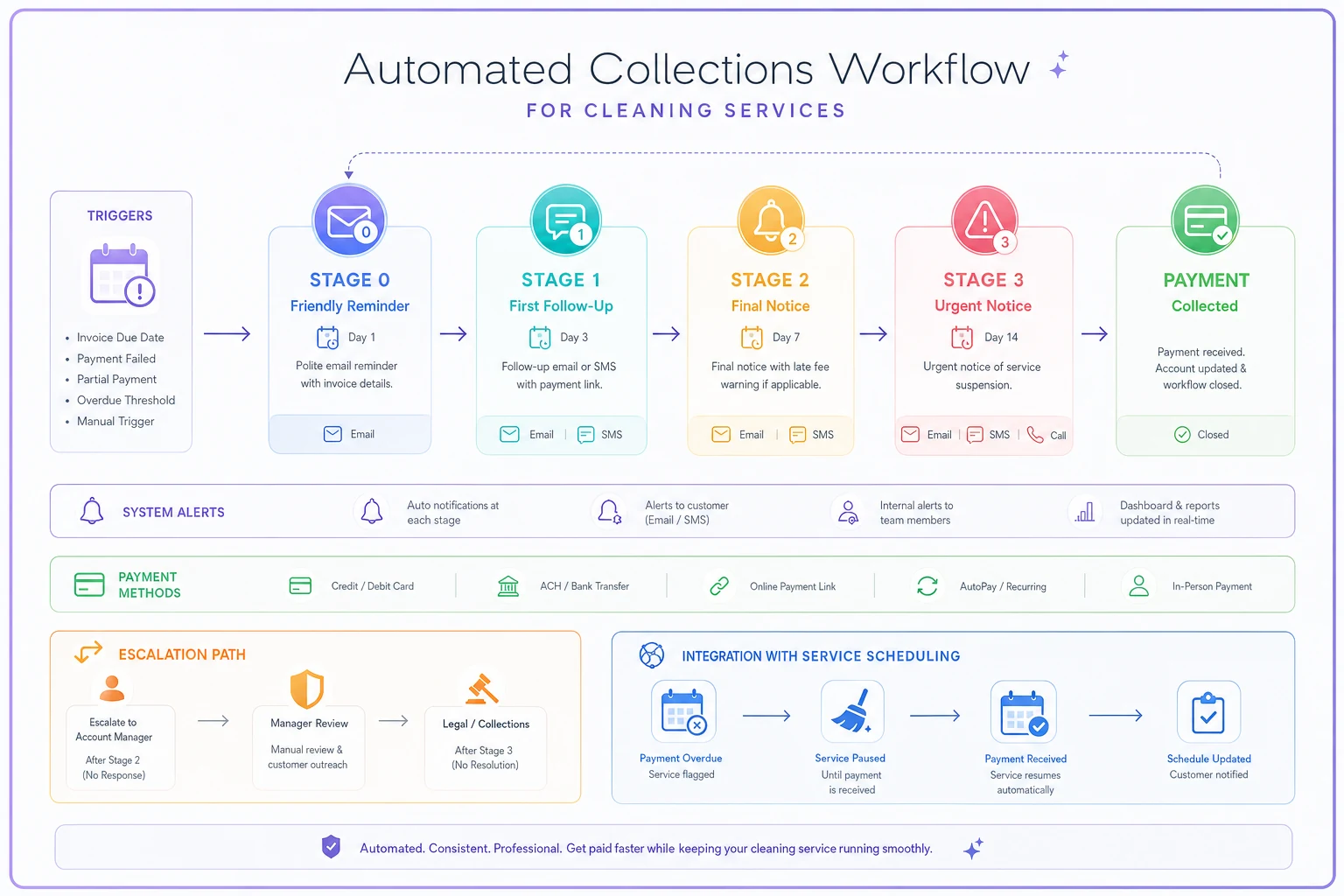
Automate Stage 0 invoice previews to prevent many late payments before they start.
When everything is manual, every account becomes an exception.
## Measuring collections effectiveness beyond DSO
Collection Efficiency Rate: (Amount collected / Amount attempted) × 100. Track this by stage. If Stage 1 collects 78% but Stage 2 only collects 15%, you know to strengthen that early messaging.
Client Preservation Rate: Percentage of accounts that resume normal payment after the collections process. Target 65% or higher. Lower means your process is too aggressive.
Cost per Dollar Collected: Total collection labor hours × hourly rate / dollars recovered. Anything above $0.12 per dollar collected means the process is too manual.
Stage Velocity: Average days accounts spend in each stage. If accounts linger in Stage 2 for 15+ days, your escalation triggers need adjustment.
Track these monthly and look for patterns. High-margin commercial clients might justify more collection effort. Residential accounts might need faster escalation to small claims.
## Building your cleaning company collections playbook
A functioning collections ladder isn't built overnight. Start with your worst 3 problem accounts and run them through this framework. Document what works, what doesn't, and what unique situations come up.
Key decisions to make upfront:
-
Who owns each stage of the ladder? (Usually
AR clerk for Stages 0–1, Operations Manager for Stages 2–3, Owner for legal decisions)
-
What are your non-negotiable cutoffs? (Service stops, legal thresholds)
-
Which clients get exceptions? (Document why)
-
How do seasonal patterns affect your ladder? (Summer vacations, fiscal year ends)
-
What's your write-off threshold? (Usually $200–$500 for cleaning companies)
As you refine the process, you'll find certain message templates work better for your market. Some areas respond to firm language, others need more relationship focus. The framework stays consistent, but the execution adapts.
The goal isn't perfection—it's predictability. When your team knows exactly what happens at each stage, when it happens, and who does it, collections becomes just another operational process instead of a constant crisis.
This is where AI-powered operational software makes a real difference. Instead of manually tracking where each account sits in the ladder, automated workflows trigger the right message at the right time. The system carries the payment history context you'd otherwise have to look up. It escalates appropriately without emotional involvement. It also frees your team from repetitive quoting tasks and collection calls to focus on actually running the cleaning operations that generate revenue in the first place.
The difference between cleaning companies that scale profitably and those that struggle isn't usually about getting more clients—it's about collecting from the ones they have without destroying relationships or operations in the process.
Ready to simplify your cleaning operations?
Join 1,000+ cleaning businesses using Wipyly to save time, reduce scheduling conflicts, and enhance client satisfaction.