


Most cleaning companies inspect quality and manage pay like they live on separate planets. The supervisor fills out QA forms. Payroll runs on hours and headcount. Coaching happens when someone screws up badly enough to notice. Bonuses get handed out based on gut feel, tenure, or who complained the least that month.
Then the owner wonders why quality keeps sliding even though they "do QA."
The problem isn't that QA doesn't exist. It's that QA is a dead end. Scores get recorded, filed, and forgotten. Nothing downstream reacts to them. A crew can score a 72 on Tuesday and get the exact same paycheck, same route, and zero coaching as a crew that scored a 96. When performance has no consequences and no feedback loop, quality drifts toward whatever the lowest-effort worker can get away with.
This article is about building the loop — not a checklist, not a form, but a connected system where a daily QA score triggers a root-cause step, feeds a coaching conversation, updates a performance plan, and eventually shows up in someone's pay. When those pieces are wired together, quality stops being a mood and starts being a mechanic.
Why quality drift happens even in companies that inspect
Drift is sneaky because it's slow. A crew skips the baseboards one week because they're behind schedule. Nobody notices. Next week they skip them again. By month three, "we don't really do baseboards on that account" has quietly become the standard. The SOP still says baseboards. The reality doesn't.
Across cleaning operations, the same few structural reasons keep showing up:
-
QA scores measure but don't route. A number gets written down. No rule says what happens at each score band.
-
Coaching is reactive, not scheduled. People only get coached after a client complaint, which means you're always fixing damage instead of preventing it.
-
Root cause never gets found. The same issue repeats because nobody asks why it happened — they just re-clean it and move on.
-
Pay is disconnected from quality. Your best and worst cleaners cost you roughly the same per hour, so there's zero financial signal telling anyone that quality matters.
That last one is the killer. When compensation ignores quality entirely, you're not neutral on it — you're actively teaching your team that speed and showing up are the only things that pay. They're rational actors. They optimize for what you reward.
What breaks as you scale
At two or three crews, the owner is the QA system. You walk the sites, you know who's slipping, you have the awkward conversation in the van. It's informal but it works because everything runs through one brain.
Stop losing bookings in operational chaos.
Wipyly helps you manage, confirm, and optimize every cleaning appointment efficiently.
- Centralized booking management
- Automated client notifications
- Staff scheduling & route optimization
No credit card required
At eight, twelve, twenty crews, that brain runs out of bandwidth. Now you've got supervisors doing QA, and here's what typically breaks:
Inconsistent scoring. Supervisor A gives a hard 78 for a floor that Supervisor B would've called a 90. Without a defined rubric, a "score" means nothing across the company. You can't compare crews, set thresholds, or tie anything to pay because the underlying number is subjective.
QA becomes theater. Supervisors under time pressure start rubber-stamping. Everyone gets an 88–92 because a real inspection takes 20 minutes they don't have. The scores look fine and quality is quietly rotting.
No memory. The floor tech who caused three streak-related redos in April is on a totally different route by June, with a new supervisor who has no idea about the pattern. Problems don't follow people, so they never get solved.
At scale, the fix isn't more inspecting. It's a system where scoring is standardized, low scores automatically trigger the next step, and history follows the person and the site. That's the difference between a company that gets worse as it grows and one that gets tighter.
The five-part loop that holds quality steady
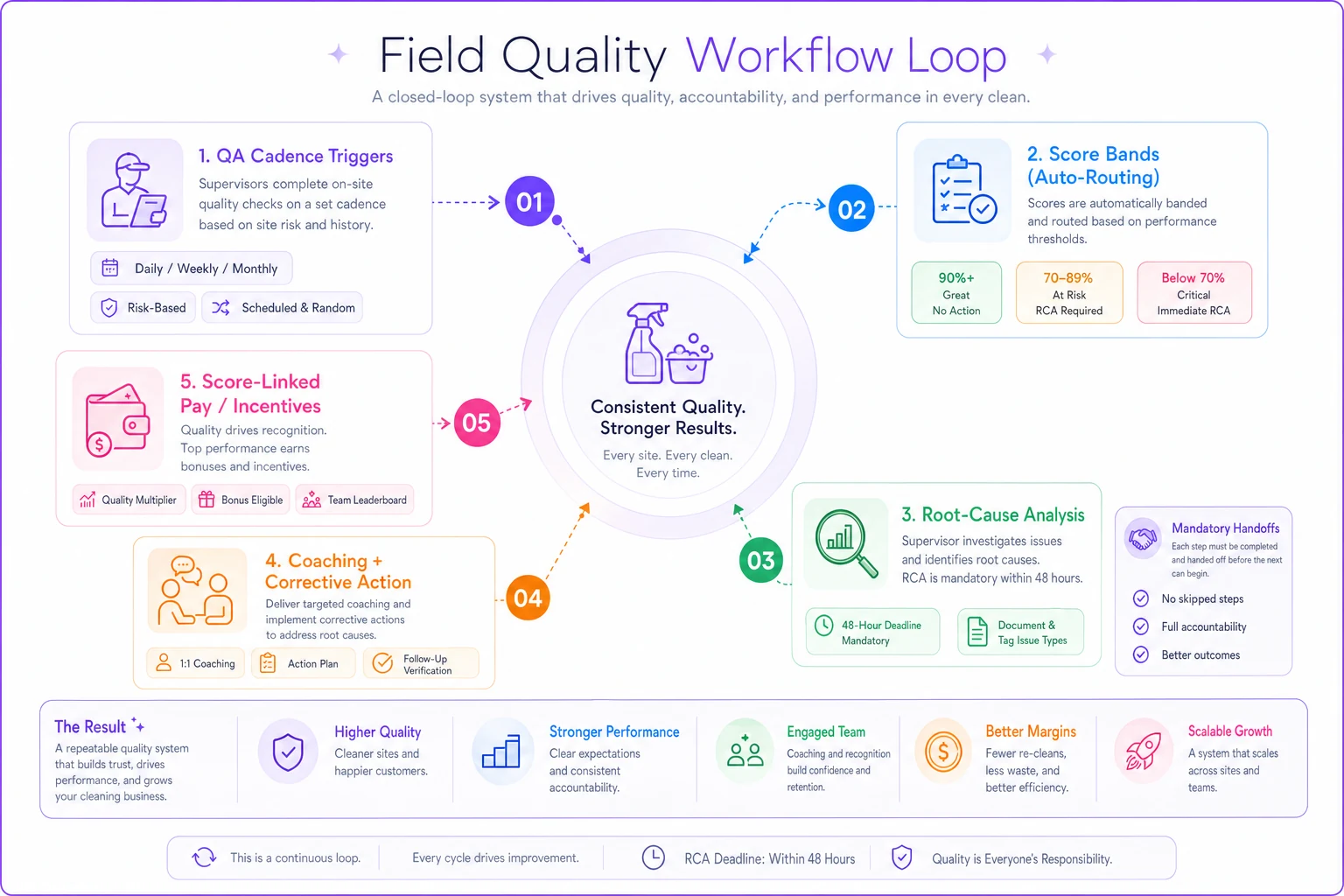
Here's the full system in order. Each part hands off to the next. Break any handoff and you're back to filing scores in a drawer.
-
QA cadence — a predictable inspection rhythm with a standardized rubric
-
Score bands — defined thresholds that route each score to an action
-
Root-cause analysis — a fast structured "why" step for anything below the pass line
-
Coaching + corrective-action plans — the conversation and the written follow-through
-
Score-linked pay/incentives — compensation rules tied to sustained KPI thresholds
Each one matters, but the value is entirely in how they connect.
A simple visual helps show how the pieces hand off from QA to RCA to coaching to pay.
1. QA cadence: inspect on a rhythm, not on complaints
The cadence should scale with risk and account value, not treat every site the same. A high-visibility medical office and a small back-office suite don't need identical inspection frequency.
A workable baseline:
| Account type | Full QA inspection | Spot check |
|---|---|---|
| High-risk / high-value (medical, flagship accounts) | Weekly | 2x/week |
| Standard commercial | Every 2 weeks | Weekly |
| Low-risk / small accounts | Monthly | Every 2 weeks |
| New crew or new account (first 60 days) | Weekly regardless | 2x/week |
The "new crew" row matters more than people think. The first 60 days set the baseline. If you don't inspect tightly early, the crew defines "acceptable" before you ever weigh in.
The rubric itself should be dead simple to score consistently. Break the site into weighted zones — restrooms and entrances weigh more than a storage closet — score each zone 1–5 against photo standards, and roll it into a weighted percentage. The point is that two supervisors scoring the same site land within a few points of each other. If they don't, your rubric is too vague to build pay on.
Tighten inspection frequency for new crews in the first 60 days to lock in the correct standard before habits form.
2. Score bands: turn a number into an action
This is the part almost everyone skips, and it's what makes the whole thing a system instead of a report. Every score falls into a band, and every band has a mandatory next step.
| QA score | Band | Automatic action |
|---|---|---|
| 93–100 | Green | Log it. Eligible for quality incentive. |
| 85–92 | Yellow | Note the gap. Verbal coaching at next check-in. |
| 75–84 | Orange | RCA required within 48 hrs + written corrective action |
| Below 75 | Red | Immediate RCA + re-clean + formal performance plan |
The word mandatory is doing heavy lifting here. The band isn't a suggestion for the supervisor — it's a rule the system enforces. An orange score without a completed RCA 48 hours later is itself a process failure that should escalate to the ops manager. That's how you stop QA from turning into theater.
3. Root-cause analysis: stop re-cleaning the symptom
An orange or red score means something failed. Re-cleaning fixes today's site and guarantees the same failure next week. The RCA step forces the "why" before anyone moves on.
-
What specifically failed? (Not "restroom was bad" — "urinal edges and floor grout had buildup")
-
Why did it happen? (Rushed close, wrong product, no time budgeted, tech never trained on grout)
-
Is this a person problem or a system problem?
That last question is the one that saves you. A typical example: a crew keeps missing high dusting. The easy read is "the tech is careless." The RCA read is "high dusting was never in the task time budget, so the crew literally never had the minutes for it." One of those gets fixed by coaching a person. The other gets fixed by re-quoting the job. Skip RCA and you'll coach the person forever without fixing the real cause.
4. Coaching and corrective-action plans
Coaching is where scores become behavior change — but only if it's structured and scheduled, not just a reaction to blowups. The most effective operations pair short, focused retraining with a written plan so nothing evaporates after the conversation.
A corrective-action template that actually works stays on one page:
-
Issue what was observed, with QA score and photos
-
Root cause from the RCA step
-
Standard what "correct" looks like (link to the photo standard)
-
Action specific fix — retrain on X, add Y minutes to route, replace tool Z
-
Owner + date who does what by when
-
Re-check the next QA date this specific issue gets verified
For retraining, don't pull people into an hour-long meeting. Short, targeted modules work far better in the field — the same logic behind 5-minute micro-training modules to cut rework and boost first-time quality. A tech who scored orange on floor edging watches one focused module on edging, then gets re-checked next inspection. Tight, specific, verifiable.
The re-check line matters. A corrective action with no scheduled verification is just a wish. You want the next QA inspection to specifically confirm the exact issue got fixed, and that confirmation feeds right back into the scoring history.
5. Score-linked pay and incentives
Now the loop closes. If quality never touches pay, everything above is optional in the eyes of your crew. Tying compensation to sustained QA performance is what makes the whole system self-enforcing.
The key word is sustained. Never pay a bonus off a single good score — that just rewards someone for having a good day or gaming one inspection. Tie incentives to a rolling average over 60–90 days.
A sample quarterly quality bonus table:
| Rolling 90-day avg QA | Client complaint rate | Quarterly bonus |
|---|---|---|
| 93%+ | Under 2% | Full bonus (e.g. $300–$450) |
| 88–92% | Under 4% | Partial (e.g. $150–$200) |
| 85–87% | Any | None — hold steady |
| Below 85% | Any | None + active performance plan |
Two things make this fair and effective. First, it uses a second gate — complaint rate — so someone can't score well on inspections while quietly generating client friction. Second, it rewards consistency, not heroics. The crew that quietly holds a 94 for three months is worth far more than one swinging between 78 and 99.
For persistent red-band performance, the pay side becomes a real decision:
| Situation | Decision |
|---|---|
| Below 85 for 1 quarter, first time | Performance plan, no pay change |
| Below 85 for 2 consecutive quarters | Formal plan + supervisor shadowing, no incentive eligibility |
| Red scores + repeated same RCA cause | Reassign role or exit process |
| Consistent green + trains others | Raise / lead-tech track |
Two things make this fair and effective. First, it uses a second gate — complaint rate — so someone can't score well on inspections while quietly generating client friction. Second, it rewards consistency, not heroics. The crew that quietly holds a 94 for three months is worth far more than one swinging between 78 and 99.
A real scenario
A commercial cleaning company running about 14 crews had "good QA" on paper — supervisors filled out forms every week. But callbacks and re-clean requests were eating roughly 6–8 hours of unbilled rework per week, and two mid-size accounts had drifted toward non-renewal.
When they actually looked at the data, QA scores were clustered suspiciously between 87 and 92 across almost every crew — the classic sign of rubber-stamping. Nobody could identify which crews were actually the problem because the numbers had been flattened into mush.
They rebuilt it around the loop above. Standardized rubric so scores meant something. Hard bands with mandatory RCA under 84. Corrective actions tied to short retraining modules. And a rolling 90-day quality bonus of around $300–$400 per quarter for green-band crews.
Two things happened fast. First, the scores spread out — because supervisors could no longer safely park everyone at 89, the real distribution showed up, and two crews clearly emerged as the source of most rework. Second, once those two crews saw green-band peers pulling a real quarterly bonus, the RCA work actually got engaged instead of ignored.
Over about two quarters, weekly rework dropped from 6–8 hours down to under three, and both at-risk accounts renewed. The bonus payout cost real money, but it was a fraction of the rework hours and the near-loss of two contracts.
When this system makes sense — and when it doesn't
It makes sense when you're past the point where the owner can personally walk every site, you have supervisors doing QA, and you're seeing repeat quality issues or renewal risk. That's usually somewhere north of five or six crews.
It's overkill when you're a two-crew operation and you're on-site daily. Building formal pay tables and RCA workflows for a team you can watch in person just adds bureaucracy. Keep it informal until the informal system starts failing.
Don't do this if your QA rubric isn't standardized yet. Tying pay to inconsistent scores is worse than no system at all — you'll create loud fairness disputes and your best people will feel cheated when a lenient supervisor's crew "outscores" them. Fix scoring consistency first, run it for a quarter to validate it, then attach money to it.
One more caution: don't launch the pay piece the same day as everything else. Run the QA cadence, bands, RCA, and coaching for a full quarter so the numbers are trustworthy. Only then wire in compensation. If pay hits before the data is reliable, every dispute becomes a fight about whether the score was even fair.
Where the coordination usually falls apart
The single most common failure isn't in any individual step — it's the handoffs between them. An orange score gets logged but the RCA never happens. The RCA gets done but no corrective action is written. The corrective action exists but nobody schedules the re-check. The re-check happens but the pay system never sees the 90-day trend.
Each broken handoff quietly turns the whole thing back into filing scores in a drawer.
This is exactly where a workflow platform earns its keep — not as anything fancy, just as the thing that refuses to let a step get skipped. When a supervisor logs an orange score on a tablet, the RCA task should auto-generate with a 48-hour deadline. When the corrective action gets written, the re-check date should land on the next inspection automatically. When quarter-end comes, the rolling QA average and complaint rate should already be calculated per crew, so the bonus decision is a two-minute review instead of a spreadsheet archaeology project.
It also solves the memory problem at scale. Because scores, RCAs, and corrective actions attach to both the person and the site, a problem follows a tech across route changes and supervisor changes. The June supervisor sees April's pattern. That continuity is what keeps quality tight as you add crews.
Tie it back to staffing
Quality and turnover are the same problem viewed from two angles. Crews that consistently score red are usually overloaded, under-trained, or on routes with no realistic time budget — and those same crews burn out and quit. When you fix the system causes surfaced by RCA (bad time budgets, missing training, wrong tools), you're improving retention at the same time you're improving quality.
That's why this connects directly to how you build your teams in the first place. The staffing and schedule patterns that let cleaning teams scale with less turnover feed straight into whether your QA scores are even achievable. A crew set up to fail on the schedule will fail on QA no matter how much you coach them.
QA on its own doesn't hold quality — it just measures the decline. What holds quality is the loop: a consistent inspection cadence, score bands that force the next step, a fast root-cause read on every miss, coaching backed by written corrective actions, and pay that rewards sustained performance instead of a good day.
Build each piece so it hands cleanly to the next, protect the handoffs, and quality stops drifting because there's finally a consequence and a correction attached to every score. That's the whole game — not inspecting harder, but making sure something downstream actually reacts when the number comes in low.
Ready to simplify your cleaning operations?
Join 1,000+ cleaning businesses using Wipyly to save time, reduce scheduling conflicts, and enhance client satisfaction.