

Most cleaning companies don't have a hiring problem at the cleaner level. Cleaners come and go, and you've probably built your staffing around that reality. The expensive mistakes happen one level up — when you promote or hire a supervisor who looks fine in the interview, says all the right things about "leading by example," and then quietly wrecks three accounts over four months before anyone connects the dots.
A bad supervisor hire doesn't fail loudly. It fails as a slow drift: QA scores slipping, a crew that stops showing up on time, a client who used to be quiet suddenly emailing about streaky glass and missed restrooms. By the time you're reviewing the numbers, you've lost a contract and burned through two cleaners who quit because the supervisor didn't back them up.
This piece is about the paperwork that actually prevents that — a validated supervisor hiring scorecard for cleaning operations, role-specific interview questions, trial tasks you can run in a real building, and a 30/60/90 onboarding plan that turns coaching into something measurable instead of a vibe. Everything here is copy-and-use.
Why "they interviewed well" keeps burning cleaning operators
The standard supervisor interview rewards the wrong traits. Confident talkers do well. People who've memorized the phrase "attention to detail" do well. What you actually need is someone who can walk a 40,000 sq ft office at 6am, spot the three things that'll trigger a client complaint, redirect two crew members without a fight, and log it so you have a record.
Those are different skills. And none of them show up in a conversation about "tell me about a time you dealt with conflict."
Here's a typical scenario: an operator promotes their best cleaner to supervisor because she's reliable and the clients like her. Six weeks later, two newer cleaners have quit. Turns out she was doing the work herself instead of correcting anyone — because confronting people made her uncomfortable, and nobody tested for that before handing her a crew of five. She was a great cleaner and a poor supervisor, and the interview had no way of catching the difference.
The fix isn't a better gut feeling. It's artifacts that force the signal to show up before you make the offer.
The supervisor hiring scorecard
A scorecard works because it forces every interviewer to rate the same traits on the same scale, then forces a conversation when scores disagree. Without it, hiring decisions collapse into "I just got a good feeling about her," which is exactly how you end up re-hiring the same mistake.
Stop losing bookings in operational chaos.
Wipyly helps you manage, confirm, and optimize every cleaning appointment efficiently.
- Centralized booking management
- Automated client notifications
- Staff scheduling & route optimization
No credit card required
| Dimension | What you're actually measuring | Weight | 1 (red flag) | 5 (strong) |
|---|---|---|---|---|
| Quality eye | Can spot defects a client would notice | 20% | Misses obvious streaks, dust lines | Catches edge cases, prioritizes client-visible issues |
| Crew redirection | Corrects work without blowing up the shift | 20% | Avoids conflict or gets aggressive | Firm, specific, keeps the person working |
| Standards consistency | Applies the same bar every shift | 15% | Depends on mood or who's watching | Same checklist, same bar, every time |
| Documentation habit | Actually logs issues and photos | 15% | "I'll remember it" | Logs by default, timestamps, photos |
| Scheduling judgment | Covers callouts without creating chaos | 10% | Panics or no-shows the account | Reshuffles calmly, communicates early |
| Client composure | Handles a complaint without escalating it | 10% | Defensive or over-promises | Owns it, commits to a fix, follows up |
| Reliability signal | Shows up, finishes, closes the loop | 10% | Vague references, gaps | Verifiable track record |
A few rules that make the scorecard actually work:
-
Two raters minimum. One interviewer plus whoever runs the trial task.
-
Anything scored 1 or 2 on "crew redirection" or "quality eye" is a hard stop, regardless of total. Those two don't recover with training.
-
Write one sentence of evidence per score. "Strong — caught the baseboard dust I planted" beats a bare number every time.
-
Aggregate below 3.5 means no. Not "let's discuss." No.
The weights aren't sacred — if you run healthcare or food-plant accounts, crank documentation and standards consistency higher because an audit miss there costs you the contract. The point is to decide the weights before you meet anyone, so you're not quietly inflating the categories your favorite candidate happens to be strong in.
Role-specific interview questions that actually sort people
Generic behavioral questions get generic rehearsed answers. These are built to produce signal you can score. Pair each one with what a weak answer looks like, because that's usually clearer than describing the ideal.
On quality standards: > "You walk into a restroom your crew cleaned 20 minutes ago. Walk me through exactly what you check, in order, in the first 30 seconds." Weak answer: "I'd make sure it's clean." Strong answer names specifics — mirror streaks, under the rim, dispenser stock, floor corners, trash — and has an order to it. Someone who's actually supervised restrooms has a mental checklist. Someone who hasn't will wave at it.
On crew redirection: > "A cleaner who's been with you two years is cutting corners on dusting because she's fast and wants to leave early. How do you handle the next shift?" Weak answer: "I'd talk to her." Push for the actual words. The strong ones say something concrete — "I'd show her the dust on the ledge, tell her the account checks these, and tell her I need it done before she clocks out." The weak ones keep it abstract because they've never actually done it.
On scheduling under pressure: > "Two of your five crew call out an hour before an evening commercial clean. What do you do in the next 15 minutes?" You're listening for sequence and calm: who they call, what they triage first, whether they communicate to the client proactively or hide it and hope.
On documentation: > "A client says restrooms weren't done Tuesday. You know they were. How do you prove it?" If the answer is "I'd tell them we did it," that's a 2. If it's "I'd pull the photos and the completion log," you've found someone who already works with a paper trail — which matters enormously when a billing dispute shows up.
On the honest gap: > "What part of being a supervisor are you worst at?" Anyone who says "I'm a perfectionist" or "I care too much" is giving you a rehearsed non-answer. Real supervisors know their weak spot — usually either "I avoid hard conversations" or "I do the work myself instead of training." Both are coachable if they're honest about it. The dishonesty is the red flag, not the weakness.
Trial tasks: the part most operators skip and shouldn't
Interviews measure how people talk about work. Trial tasks measure work. For a cleaning supervisor, you can run a genuinely useful trial in about 90 minutes in a real building, and it'll tell you more than three rounds of conversation.
Run the planted-defect walk in a real account — it's the highest-signal, lowest-effort test you can run.
Trial 1 — The planted-defect walk (quality eye + documentation) Before the candidate arrives, plant 6–8 realistic defects in a space your crew just cleaned: a dust line on a high ledge, a smudged glass door, a half-empty dispenser, a trash liner not replaced, a streak on a mirror, a missed corner. Hand them a phone and tell them they have 10 minutes to inspect and log anything a client would flag.
What you're scoring: how many they catch, whether they photograph, whether they prioritize client-visible issues over trivia. A strong candidate finds 6 of 8 and tells you which two matter most. A weak one finds 2 and photographs none.
Trial 2 — The redirection roleplay (crew redirection + composure) You play a defensive cleaner who did a rushed job and has an excuse ready ("I ran out of time, the last crew left it like this"). The candidate has to get the work fixed without the shift falling apart. Give it five minutes.
What you're scoring: do they stay specific and firm, or do they either cave or escalate? This is the single best predictor of whether a supervisor will hold your standards or quietly let them erode.
Trial 3 — The coverage puzzle (scheduling judgment) Hand them a one-page scenario: a four-site evening route, two callouts, one site with a strict 9pm lockup, and a client who's already complained once this month. Ten minutes, a pen, and "show me your plan."
What you're scoring: triage logic, whether they protect the at-risk account, and whether they communicate early. There's no perfect answer — you're watching how they think under a constraint.
A copy-and-use trial scoresheet:
-
- [ ] Defects caught
___ / 8
-
- [ ] Photographed defects by default (Y/N)
-
- [ ] Prioritized client-visible issues (Y/N)
-
- [ ] Stayed specific during redirection (1–5)
-
- [ ] Kept the "cleaner" working, didn't cave or escalate (1–5)
-
- [ ] Protected the at-risk account in the coverage puzzle (Y/N)
-
- [ ] Communicated proactively to the "client" (Y/N)
-
- [ ] Overall
would you put them on your worst account? (Y/N)
That last line is the honest gut-check. If the answer is no, the scorecard total doesn't matter.
The 30/60/90 onboarding plan that makes coaching measurable
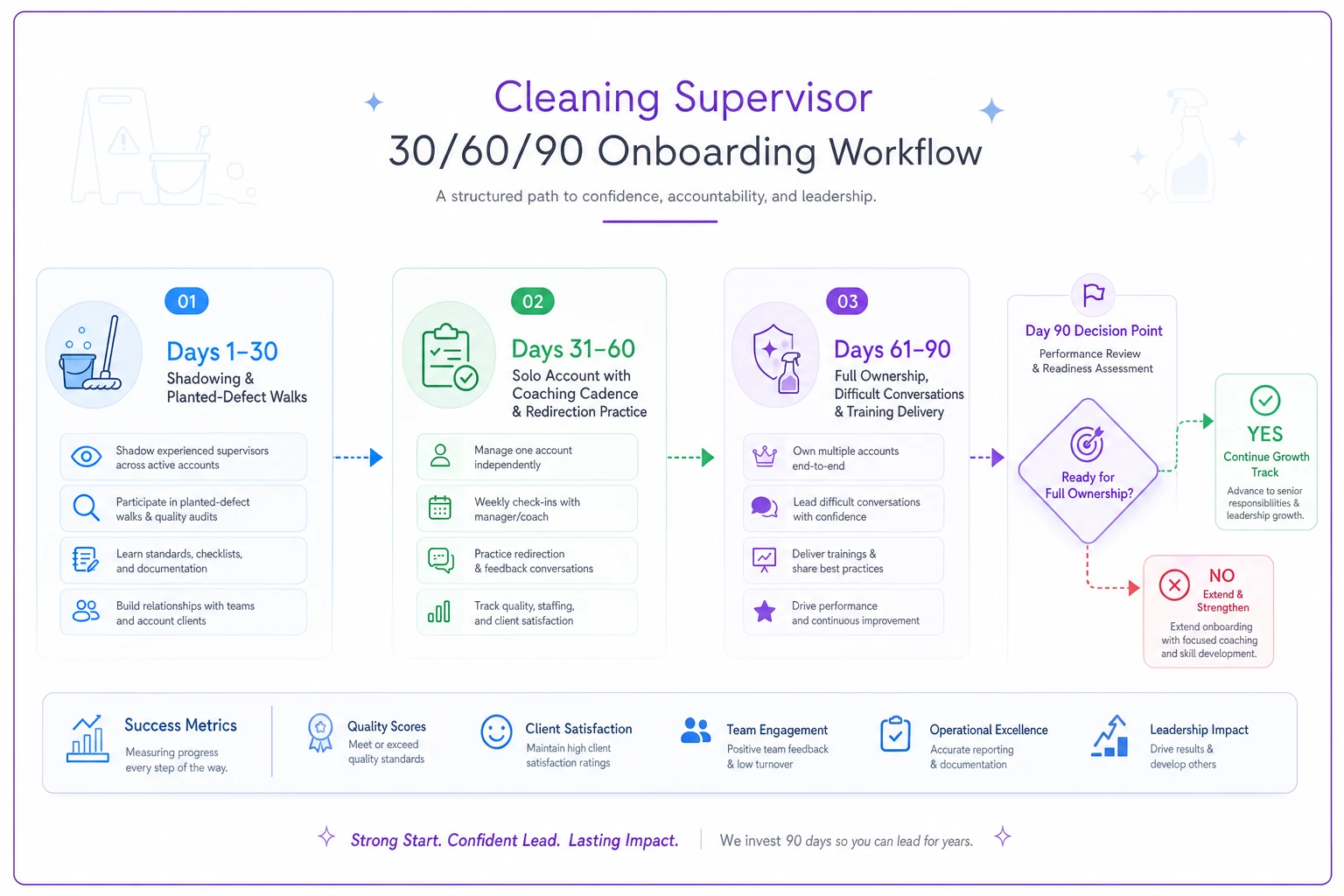
Hiring right is half the job. A good hire with no onboarding structure still drifts, because "shadow me for a week and you'll pick it up" isn't a plan — it's a hope. A 30/60/90 ties specific competencies to specific windows so you and the new supervisor both know whether it's working before you've lost an account finding out.
Days 1–30: Learn the standard, don't own it yet.
-
Shadow a strong existing supervisor on at least three different account types
-
Run the planted-defect walk weekly — on a real account, logged — until they're consistently catching client-visible issues
-
Own documentation for one account
photos, completion logs, issue tracking
-
Do not hand them a crew of their own yet
The milestone at day 30: can they inspect a building and produce a log you'd trust? If not, that's a coaching conversation now, not a surprise at day 90.
Days 31–60: Hold the standard with support.
-
Run one account solo, with you reviewing their QA logs weekly
-
First real redirection conversations happen this window — you debrief each one
-
Introduce the coaching cadence you run across the company; the rhythms in the area manager playbook map directly onto how a new supervisor should structure their own daily and weekly checks
-
Watch for the single most common failure mode
doing the work instead of correcting it
Milestone at day 60: is quality holding on their account without you in the building? Are they correcting crew, or quietly covering?
Days 61–90: Own it, including the hard parts.
-
Full ownership of their account(s)
-
Lead at least one difficult conversation (a write-up, a schedule conflict, a client complaint) with you only debriefing after, not stepping in
-
Build or deliver a short training for their crew — this is where short, repeatable micro-training modules pay off, because a new supervisor can run a five-minute module far more easily than a full retraining session
-
Review their QA trend across the full 90 days
Milestone at day 90: would you expand their responsibility, keep them where they are, or exit? Decide explicitly. The whole point of the 30/60/90 is that this decision is based on logged evidence, not a feeling you've been sitting on.
Here's a visual workflow for the 30/60/90 plan.
The milestone at day 30: can they inspect a building and produce a log you'd trust? If not, that's a coaching conversation now, not a surprise at day 90.
When this full process is overkill — and when it's non-negotiable
If you're running two or three residential crews and your "supervisor" is really just a lead cleaner who closes the van, the trial tasks and 90-day plan are more structure than you need. Run the scorecard, skip the rest, and don't overbuild.
It becomes non-negotiable the moment a supervisor controls work you can't personally inspect — multi-site commercial, healthcare, food plants, or any account with an SLA and penalties attached. There, a bad supervisor hire isn't an awkward few weeks. It's a lost contract and a reference you can't use. The 90 minutes of trial tasks is the cheapest insurance you'll buy all year.
One group that should not lean on this: operators who won't actually use the scorecard honestly. If you're going to hire the candidate you liked and backfill the scores to justify it, the paperwork makes things worse, not better — now you've got a document that says the mistake was deliberate.
A real scenario
A commercial cleaning operator running around 11 janitorial accounts kept losing supervisors to the same cycle: hire, six weeks of fine, slow quality drift, a client complaint, scramble to replace. Two accounts went to formal cure notices in a single year, and one didn't renew.
They put in the scorecard and the planted-defect trial — nothing fancy, a shared sheet and a 90-minute trial in a real building. The next two hires scored strong on quality eye and redirection; one candidate who'd interviewed beautifully scored a 2 on the redirection roleplay and got passed over. That candidate, they later learned, had been let go from a competitor for exactly the crew-management problems the roleplay surfaced.
Over the following year, supervisor turnover dropped from roughly four churned hires to one, and no account hit a cure notice. The owner's own estimate of time spent personally covering for weak supervisors dropped by something like two full days a month. Nothing dramatic — they just stopped making the same hiring mistake on repeat.
Where to start
Don't try to roll out all four artifacts at once. Build the scorecard first, because it's the thing you'll use on every single hire and it forces the rest of your thinking into the open. Add the planted-defect trial next — it's the highest-signal, lowest-effort test you can run. The interview questions and the 30/60/90 plan slot in once those two are habit.
The supervisors who hold your quality and the ones who quietly erode it look nearly identical across a conference table. The entire job of these artifacts is to make them look different before you've handed one of them your toughest account and your best crew.
The supervisors who hold your quality and the ones who quietly erode it look nearly identical across a conference table. The entire job of these artifacts is to make them look different before you've handed one of them your toughest account and your best crew.
Ready to simplify your cleaning operations?
Join 1,000+ cleaning businesses using Wipyly to save time, reduce scheduling conflicts, and enhance client satisfaction.