

The moment a cleaning business crosses about 8–12 accounts per manager, something quietly breaks. The owner stops being the person who catches problems, and the area manager becomes the buffer between the field and the office. That handoff is where most growing cleaning companies stall — not because the manager is bad, but because nobody ever gave them a rhythm. They inherited a phone full of angry texts and a vague mandate to "keep things running."
An area manager without a cadence is just a very expensive complaint desk. They spend their day reacting to whatever screams loudest, which means the quiet accounts drift, the profitable ones get ignored, and the owner keeps getting pulled back into the field wondering why they hired a manager at all.
This is a systems problem. The fix isn't hiring "better people" — it's giving mid-level ops a structured operating rhythm: what they check daily, what they review weekly, what they plan monthly, and a clear ladder for when to escalate versus when to just handle it.
Why the same breakdown happens across almost every cleaning company
Most area managers are promoted from the field. They were great cleaners or great crew leads, so they got handed a region. The problem is that being good on-site and being good at running the system that runs the sites are two completely different skills.
New area managers default to the one thing they already know — being physically present. So they drive site to site, fix things by hand, and feel productive. But driving around isn't management. It's high-paid inspection. The accounts they visited that day look great; the six they didn't visit are where the churn is quietly building.
The second failure is invisible priorities. Without a cadence, everything feels equally urgent. A missed trash pull at a $900/month account gets the same panic as a compliance miss at a $6k/month medical building. The manager has no framework for deciding what actually matters, so they treat their inbox as their to-do list.
And then there's the one that really kills growth — owners never define what a manager is responsible for versus what needs to go up the chain. So the manager either escalates everything (and the owner is still doing the job) or escalates nothing (and small problems quietly become lost contracts). Both look like management failure. Neither is. It's a missing decision structure.
What actually breaks as you add accounts and managers
Here's the progression almost every cleaning company follows, and where each stage cracks:
Stop losing bookings in operational chaos.
Wipyly helps you manage, confirm, and optimize every cleaning appointment efficiently.
- Centralized booking management
- Automated client notifications
- Staff scheduling & route optimization
No credit card required
| Stage | Accounts per manager | What breaks first | Root cause |
|---|---|---|---|
| Owner-run | 1–8 | Nothing yet — owner sees everything | Doesn't scale past owner's hours |
| First manager | 8–15 | Quality drift on unvisited sites | No structured check rhythm |
| Two+ managers | 15–30 each | Inconsistency between managers | Every manager runs their own system |
| Regional layer | 30+ | Escalations either flood or vanish | No shared decision ladder |
The subtle one is the two-manager stage. Once you have more than one area manager, you don't just have a management problem — you have a consistency problem. Manager A runs tight coaching and photo checks. Manager B runs on vibes and relationships. Same company, two totally different client experiences. When a client with sites under both managers compares notes, you look disorganized. That inconsistency compounds fast, which is why SOP versioning and delegated governance becomes non-negotiable before you add a third manager.
The other thing that breaks: coaching disappears. A stretched area manager will always cut coaching first because it feels optional. Nobody complains today if you skip it. But six weeks of skipped coaching shows up as rework, re-cleans, and a crew lead who never got better. It's the highest-leverage thing a manager does and the first thing they drop.
The core idea: timeboxed cadences, not open-ended responsibility
Stop asking managers to "manage" and start giving them a fixed rhythm with time budgets. When a task has a time box, it gets done. When it's open-ended, it expands or disappears.
Think of the manager's job as three loops running at different speeds:
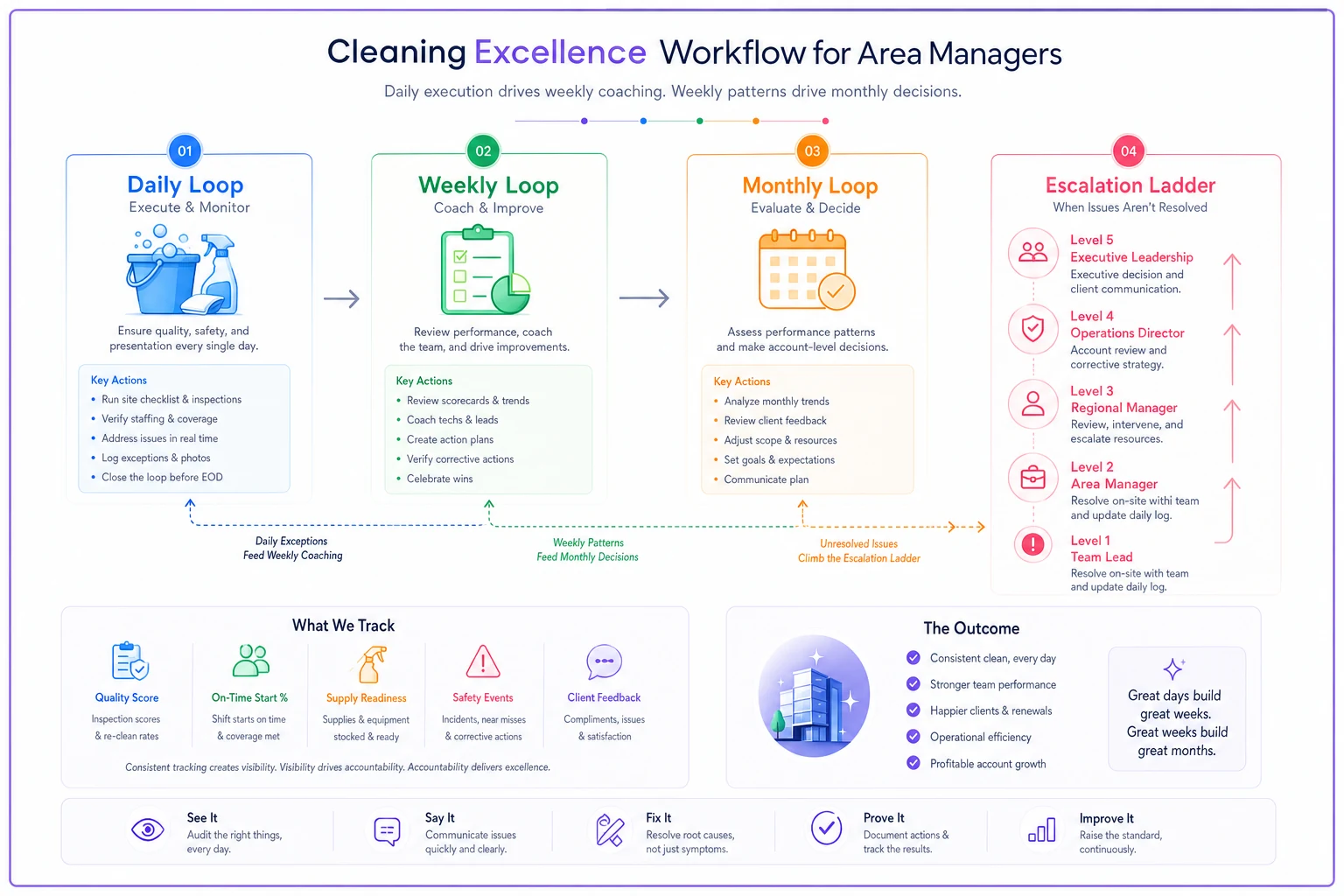
DAILY LOOP (45–75 min) Morning readiness → Overnight review → Exception handling → End-of-day flags ↓ Recurring issues surface WEEKLY LOOP (3–4 hours) KPI review → Coaching sessions → Account risk scan → Week-ahead planning ↓ Patterns that don't resolve MONTHLY LOOP (half day) Account P&L → Retention risk → Coaching outcomes → Staffing check ↓ Decisions requiring authority ESCALATION LADDER Green → Yellow → Orange → Red (owner takes the wheel)
A quick visual of how these loops connect:
The daily loop (target: 45–75 minutes total, not all at once)
-
Morning readiness check (10–15 min) Confirm every scheduled crew is staffed and dispatched. Flag any callout or no-show before the client notices, not after.
-
Overnight/prior-shift review (15–20 min) Scan completion evidence — photos, checklists, timestamps — for the sites cleaned since the last check. You're looking for the two or three that don't look right, not admiring the ones that do.
-
Exception handling (15–30 min) Respond only to flagged issues. Client complaint, failed checklist, missing crew. Everything green gets no attention.
-
End-of-day flag list (5 min) Note anything that needs to carry into the weekly loop.
The mistake here is managers trying to look at everything daily. You don't review 25 accounts by hand every morning — you review the exceptions. If your day-of visibility depends on texting crew leads "did you finish?" you don't have a daily loop. You have a rumor mill.
The weekly loop (target: 3–4 hours, blocked on the calendar)
-
KPI review (45 min) Pull the numbers that predict trouble — first-time-quality rate, re-clean/rework count, complaint count, on-time completion, labor hours vs. quoted. Look for trend, not just this week's value.
-
Coaching sessions (60–90 min) One structured conversation per crew lead or problem cleaner. Not a lecture — a specific behavior tied to a specific number.
-
Account risk scan (30 min) Which accounts had two or more issues this week? Those go on a watch list.
-
Week-ahead planning (30 min) Staffing gaps, coverage for PTO, any special requests or scope changes.
A weekly loop that skips coaching isn't a weekly loop. It's a status meeting. The whole point is to turn this week's problems into next week's improvements, and that only happens through the coaching conversation.
The monthly loop (target: half a day)
-
Account P&L glance Which accounts are quietly losing margin from creeping labor hours or repeated re-cleans?
-
Retention risk review Any account trending toward churn — rising complaints, cooling communication, an SLA miss they haven't forgiven?
-
Coaching outcomes Did last month's coaching actually move the numbers? If a crew lead's rework rate didn't drop after four weeks, that's now a different decision.
-
Staffing and turnover check Where is the manager one callout away from missing an account? Chronic understaffing is usually a scheduling design problem, not a hiring problem — and the fix tends to live in better staffing and schedule patterns rather than just posting more job ads.
Monthly is where the manager thinks like a small business owner over their region.
The coaching checklist that keeps quality from decaying
Coaching falls apart when it's vague. "You need to do better" changes nothing. It works when it's tied to one observable behavior and one number. Here's the checklist a manager should be able to run in a 15-minute conversation:
-
Name the specific gap. "Your restroom checklist has been marked complete but the photos show streaked mirrors three times this week."
-
Show the evidence. Pull the actual photos or the actual KPI. No memory-based coaching.
-
Ask before telling. "What's making this hard?" Half the time it's a supply issue or a time-pressure issue, not a skill issue.
-
Agree on one change. One. Not five. "This week, mirrors get wiped last and photographed after."
-
Set the check date. "I'll look at your next four restroom cleans on Friday."
-
Close the loop next week. If it improved, say so. If it didn't, you escalate.
That last point is where coaching connects to consequences. Coaching without follow-through is theater. When coaching, QA, and pay are actually linked, the conversations land differently — this is the real difference between a field performance system that connects QA, RCA, coaching and pay and a manager just nagging people.
Delegation rules: what the manager owns vs. what the owner owns
The hardest part of scaling mid-level ops is drawing the line. Here's a workable split that most cleaning companies can adapt:
| Decision type | Area manager decides | Escalate to owner/ops director |
|---|---|---|
| Crew scheduling & coverage | Yes | Only if it needs new hires |
| Client complaint resolution | Up to a set credit/comp limit | Above limit, or contract threat |
| Small scope adjustments | Within a defined dollar/time band | Repricing or contract changes |
| Coaching & corrective action | Yes, through documented steps | Termination decisions |
| Supply/equipment purchases | Under a set threshold | Capital or recurring cost changes |
The rule of thumb: managers own execution and recurring decisions inside defined bands; owners own money, contracts, and people-exit decisions. The dollar bands are what make delegation real. If your manager can comp a client up to $150 to save a relationship without calling you, you've actually delegated. If every $40 credit needs your approval, you haven't — you've just added a step.
The escalation ladder tied to KPIs
Escalation shouldn't depend on how upset someone sounds. It should depend on where a number sits. This is the piece that stops both over-escalation and silent problems.
-
Green (handle in normal loop) One-off miss, first complaint, quality still inside target. Manager handles it in the daily/weekly rhythm.
-
Yellow (manager owns, documents, watches) Two issues at one account in a month, or a crew lead whose rework rate is trending up. Goes on the watch list, gets a coaching plan, no owner involvement yet.
-
Orange (loop in owner, keep ownership) Three-plus issues, an SLA breach, or an account that mentions "reconsidering." Manager still runs it but the owner is now informed and consulted.
-
Red (owner takes the wheel) Contract cancellation threat, safety/compliance incident, or a client above a certain revenue line that's at risk. Immediate escalation, owner leads response.
The piece most companies miss: escalation should be triggered by thresholds, not feelings. When the trigger is "the client sounded really mad," managers escalate inconsistently and owners get pulled in randomly. When the trigger is "this account has hit three documented issues," everyone knows exactly when it climbs the ladder — including the manager, who no longer has to guess.
A real scenario: mid-sized janitorial company, three area managers
A commercial cleaning company running around 40 accounts across three area managers kept losing accounts in the 6–9 month range. Not their worst accounts — their middle ones. Big accounts got the owner's attention; tiny ones didn't matter much. The middle drifted.
When they dug in, the pattern was obvious. Managers were spending most of their week driving to whatever site had complained most recently. Coaching was basically nonexistent — one manager admitted he hadn't had a real coaching conversation in over a month. There was no shared definition of when something got escalated, so the owner was either surprised by a cancellation or drowning in tiny questions.
They put in a timeboxed cadence: a 60-minute daily exception review instead of driving, a hard-blocked 3-hour weekly window with mandatory coaching, and the KPI escalation ladder above with dollar bands on comps and scope.
The change wasn't instant. But over the next couple of quarters, rework and re-clean events dropped noticeably, and the mid-tier churn that had been bleeding them slowed to a trickle. The owner's biggest surprise wasn't a metric — it was that they stopped getting pulled into small decisions. The managers had a rhythm and a rulebook, so the owner could actually work on the business. They figured they kept two or three accounts that would've quietly churned, which more than covered the overhead of running the cadences properly.
When this playbook makes sense — and when it doesn't
When it makes sense: You have at least one area manager (or you're about to hire one), more than 8–10 accounts per manager, and you're the bottleneck for daily decisions. If you're still personally answering "should we comp this client?" every week, you need this. When it's overkill: If you're running 5 accounts yourself, don't build a three-loop cadence system for a team of one. You are the loop. Build the habits informally and formalize them when you hire your first manager.
Who should not just copy this wholesale: Companies with wildly different account types under one manager — say, a couple of hospitals and a bunch of small offices — shouldn't use one flat KPI ladder. Medical sites need tighter thresholds and faster escalation. Adjust the triggers per account tier instead of applying one blanket rule.
Making the cadence stick
The reason cadences fail isn't the design — it's that they live in someone's head and quietly erode under pressure. The daily exception review gets skipped on a busy Monday. The weekly coaching block gets eaten by a client emergency. Within a month, the manager is back to reactive firefighting.
What keeps a cadence alive is making the loops visible and checkable. The KPIs the manager reviews weekly should come from one place, not from chasing crew leads by text. Escalation thresholds should be tied to numbers the system already tracks, so "this account hit three issues" is a fact, not an argument. When the daily exception list, the coaching history, and the escalation triggers all live in one operational view instead of scattered across texts, spreadsheets, and memory, the cadence runs whether the manager is having a great week or a terrible one.
Tie the weekly KPI pulls to a single dashboard so the manager spends the 45 minutes reviewing facts, not hunting for spreadsheets.
That's the real goal — not adding process for its own sake, but building a rhythm reliable enough that your area managers scale the same way you would: catching problems early, coaching consistently, and knowing exactly when to climb the ladder. Get that right and your area manager playbook stops being a document you wrote once and becomes the way your operation actually runs.
That's the real goal — not adding process for its own sake, but building a rhythm reliable enough that your area managers scale the same way you would: catching problems early, coaching consistently, and knowing exactly when to climb the ladder. Get that right and your area manager playbook stops being a document you wrote once and becomes the way your operation actually runs.
Ready to simplify your cleaning operations?
Join 1,000+ cleaning businesses using Wipyly to save time, reduce scheduling conflicts, and enhance client satisfaction.