


Most cleaning companies find out their vendor contracts don't match their client contracts the expensive way. A service credit shows up on a client invoice. Someone tries to pass it along to the vendor who caused the miss, and the vendor agreement doesn't allow it. Sometimes there's no vendor agreement at all, just a quote from 2021 and an email thread.
That's what vendor governance means in cleaning. It isn't about picking good vendors, and you probably have decent ones already. It's about whether the promises you buy from vendors are tight enough, timed right and documented well enough to back up the promises you sell to clients. When they aren't, you don't get one big failure. You get a slow leak across credits, short-pays, invoice variances, missed periodics and uncomfortable calls with facility managers.
This post traces how that leak happens, where it breaks as you add sites, and how to rebuild procurement so vendor SLAs, coordination and invoice reconciliation all point at the same client obligations. There's a clause list, an alignment checklist, a runbook, a recon template and an escalation ladder. Take what fits your size and skip the rest.
Trace one service credit backwards
The easiest way to see the system is to pick a single credit and walk it back.
Say a client contract has a 24-hour cure window for reported defects, plus a 4% monthly credit on that site if more than two defects go uncured in a month. The client reports scuffed, dull VCT in a main corridor on a Tuesday afternoon.
The facility manager emails your account manager at 3:40pm. The account manager forwards it to the area supervisor around 5. The supervisor sees it the next morning and realizes the floor work belongs to your floor-care subcontractor, so they text the sub's owner. The sub says Thursday night, which is their normal schedule, and their quote says "service within 2 business days of request." Thursday night happens, the floor gets burnished, and the photo goes to the supervisor's phone and never reaches anything the client sees. Meanwhile the client logged the defect as uncured at the 24-hour mark.
Let that happen once more in the same month and you owe a 4% credit on the site. Then the sub's invoice shows up three weeks later, billed as a normal visit plus an "extra trip charge" for Thursday. Your AP person pays it because it looks fine.
Count the breaks in that chain:
-
The clocks didn't match. The client's clock started at 3:40pm Tuesday. The vendor's started whenever your supervisor texted Wednesday morning, and it's measured in business days.
-
The definitions didn't match. "Cured" meant verified to the client. To the vendor it meant "we showed up."
-
Penalties only flowed one way. You ate the credit. The vendor got a premium.
-
The calendars didn't match. The credit hit the client invoice before the vendor invoice even arrived, so nobody connected the two.
-
Escalation stopped at your door. The client could escalate to you. You had no matching lever on the vendor.
Nobody in that chain broke their own rules, which is why it's so hard to spot. Every role followed its own process. The processes just weren't connected.
Break point 1: the clocks don't match
This is the most common gap and the least noticed, because each contract looks reasonable when you read it alone.
Stop losing bookings in operational chaos.
Wipyly helps you manage, confirm, and optimize every cleaning appointment efficiently.
- Centralized booking management
- Automated client notifications
- Staff scheduling & route optimization
No credit card required
Client SLAs are written in elapsed hours from the moment the client reports something. Vendor terms are usually business days from when the vendor gets notified. Sometimes they say "next scheduled visit," which is worse. If your client gives you 4 hours on emergency response and your extraction vendor promises "same day," you're structurally late on most after-lunch calls. No amount of hustle fixes that.
Timestamp client reports in a single intake system so you can measure and reduce routing lag.
There's also internal lag nobody counts. Between a client reporting something and the vendor receiving a usable request, you can easily burn 1 to 6 hours. Usable means site address, access instructions, what's wrong and a photo. That lag eats your buffer before the vendor's clock even starts, and most owners plan around the vendor's response time while forgetting their own routing time.
Definitions are tangled up with clocks. "Response" can mean acknowledgment, dispatch or arrival on site. "Completion" can mean the vendor left, or the client accepted the work. If your client contract defines completion as "verified by the provider's supervisor or the client," and your vendor contract doesn't define it at all, you will end up arguing about it. If your own internal metric definitions are fuzzy too, the metric governance post covers how to lock those down first. Vendor definitions should inherit from those, not get invented separately.
Break point 2: penalties only flow in one direction
Client contracts of any real size carry service credits, holdbacks or fee-at-risk structures. Vendor contracts at small cleaning companies almost never do. Sometimes the vendor is a long-time relationship and asking feels rude. Sometimes it's a big distributor that won't negotiate. Often nobody thought about it, because the vendor relationship predates the client contract that introduced credits.
So the risk is lopsided. You carry 100% of the downside on a failure where the vendor might have had 70% of the causal role.
When owners finally notice, they tend to overcorrect and push full penalty pass-through onto a 3-person window crew. Small vendors either refuse, pad their price by 15–20% to cover it, or sign and then quietly go under when the first big credit lands. Proportional pass-through with a cap works better (clause section below). The vendor should feel the miss. They don't need to insure your whole client relationship.
Break point 3: invoices and credits run on different calendars
This is the one that turns SLA problems into billing disputes.
The typical setup: you bill clients on the 1st for the prior month, and credits get calculated when you build the invoice. Vendors bill whenever. The distributor bills weekly. The floor sub bills monthly, around the 20th. The window contractor bills per job, sometimes 5–6 weeks after the job. The equipment repair shop bills when someone in their office remembers.
So on the 1st, when you calculate client credits, you don't know yet which vendor failures caused them. When vendor invoices trickle in later, nobody compares them to the client credit log. AP checks the invoice against the quote, maybe, and pays it.
Two things leak out of this:
-
Unrecovered credits. You never back-charge the vendor, because by the time the invoice arrives the connection is gone.
-
Unbilled pass-throughs. It works in reverse too. A vendor does approved extra work, like a client-requested strip-and-wax in a lobby, and invoices it after you've already billed the client for that month. Now you're adding a line to next month's client invoice, and the client's AP pushes back because it doesn't match a PO period.
The second leak is often bigger than the first, and almost nobody tracks it. Approved extras that never get rebilled, or get rebilled late and disputed, can quietly cost a few points of margin on vendor-heavy accounts.
Break point 4: every site becomes its own procurement department
At a handful of sites, the owner does the buying. Procurement governance is basically the owner's memory.
Somewhere past 10–15 sites, especially once you've added area managers, buying fragments. One manager orders consumables from the distributor on the master account. Another runs to a local supply store because it's faster. A third has a "guy" for carpet extraction. Each choice makes sense in the moment. Six months later you have maybe three times as many vendors as you think, half of them with no agreement on file, and your client SLA coverage depends on which manager runs which site.
You'll usually spot it in card statements and expense reports before the AP ledger. Recurring small purchases from the same non-contracted supplier across several months means you have an unofficial vendor relationship, and it carries none of the commitments your client contract assumes.
Multi-site clients make this worse. A national or regional account expects consistent service at every location. If location A gets restroom paper from your contracted distributor with a 97% fill commitment, and location B gets it from wherever the site lead shops, you can't produce a consistent SLA roll-up, and you can't defend one either. The multi-site account playbook goes deep on central vs. site responsibility. Procurement is one of the areas that almost always has to be central, even when service delivery is local.
Break point 5: escalation stops at your door
Client contracts usually have an escalation path. Account manager, then ops director, then owner or exec sponsor, with timeframes. Clients use it.
Vendor relationships usually have one escalation step, which is calling the owner's cell. When the client escalates to your level 2 or 3, you're still at level 1 with the vendor, asking nicely by text, with no defined response time and nothing behind it.
That mismatch is why client escalations feel so helpless from the inside. Your ops director is on a call with an angry facility manager, promising a corrective plan by Friday, and has no documented way to get a corrective plan out of the vendor who caused the problem by Thursday.
What changes as the portfolio grows
These five break points don't all show up at once. Roughly:
Under ~8 sites. Clock mismatches and missing definitions exist, but the owner bridges them personally by being on the phone. Credits are rare because the owner fixes things before the client clock runs out. The cost is the owner's time, which nobody counts.
Around 10–30 sites. Site-level buying sprawl starts and invoice calendars drift apart. The owner can't bridge every gap anymore, so the gaps turn into credits. This is usually when "vendor problems" first become a line item.
30+ sites, or any national/regional account. Clients start asking for consolidated SLA reporting, vendor certificates, flow-down of site rules like background checks and badge policies, and sometimes audit rights over your subcontractors. At this point missing vendor governance isn't a margin problem anymore, it's a renewal problem. You can't produce the evidence the client asks for.
The middle stage is the one that catches people. At 10–30 sites the gaps cost real money, but you're still small enough that formalizing vendor management feels like overkill. That's usually the right time to do it.
Rebuilding it: start with an SLA map, not a vendor list
Most "vendor management" efforts start by listing vendors and scoring them. For this problem that's backwards. Start with what you owe clients, then work out which vendors touch each obligation.
-
Extract every client obligation into one register. For each client contract, pull out each SLA item: the metric, where the clock starts, the cure window, the penalty or credit, and the reporting deadline. Don't summarize. Copy the actual language, because the wording matters later.
-
Tag each obligation with the vendors it depends on. Restroom consumables availability depends on the distributor. Periodic floor care depends on the floor sub and maybe the equipment repair shop. Emergency response might depend on a restoration vendor. Some obligations depend on nobody but your own crew. Mark those and move on.
-
Put the vendor's actual commitment next to each one. Use what's in writing, not what the vendor usually does. If nothing is in writing, write "none." You'll write "none" a lot.
-
Classify each pairing. Covered
the vendor commitment is tighter than the client obligation with room to spare. Thin: technically tighter, but your internal routing lag eats the buffer. Uncovered: no vendor commitment. Conflicting: the vendor terms contradict the client terms, for example vendor price increases on 30 days' notice when your client price is locked for 12 months.
-
Rank by exposure. Multiply the client penalty by how often the vendor currently misses. Fix the top handful first. Trying to renegotiate everything at once makes vendors dig in.
-
Re-time vendor renewals. Where you can, set major vendor agreements to renew 60–90 days before the client renewals they support. Then when a client asks for a tighter SLA at renewal, you've already secured the vendor side, or you know you can't and you don't agree to it.
Almost nobody does step 6, and it's the one that keeps the problem from coming back. If vendor and client renewals sit on random calendars, every new client term opens a fresh gap.
Below is roughly what a map looks like for a mid-size commercial portfolio. Your numbers will differ. The buffer logic is the part to copy.
| Client obligation (typical wording) | Vendor involved | Vendor commitment you actually need | Why the buffer matters |
|---|---|---|---|
| Emergency response on site within 4 hrs of report | Extraction / restoration vendor | On site within ~2–2.5 hrs of your call, 24/7 named contact | Your internal routing eats 30–90 min. "Same day" or "within 4 hrs" means you're late every time |
| Defects cured within 24 hrs of client report | Floor care sub | Cure within ~12–16 hrs of your notice, photo evidence required | Your notice lags the client report, sometimes by half a day |
| No restroom consumable stockouts | Consumables distributor | ~2 business day delivery, high fill rate on core SKUs, substitutions pre-approved | A distributor can "deliver on time" with backorders and you still fail the client SLA |
| Monthly periodics completed on schedule | Equipment repair | Loaner unit or repair within ~48 hrs | One dead autoscrubber can wipe out a month of periodics across several sites |
| Quarterly exterior windows on fixed dates | Window contractor | Dates locked ~60 days out, weather reschedule within a week | Client calendars are fixed. Vendor calendars float unless you lock them |
| SLA report delivered by 5th business day | All service vendors | Completion data and evidence by 2nd business day | You can't report what you don't have. This one is a data SLA, not a service SLA |
The last row trips up a lot of operators. Even if every vendor performs perfectly, you can still breach a reporting SLA because vendor completion data arrives late or in a format you can't use. Treat data delivery as its own vendor obligation.
Minimum contract clauses for vendors
This is the vendor-facing side. For the client-facing side, meaning how to keep client SLAs and credits from being unreasonable in the first place, see the contract red-lines and SLA language post. The two work as a pair. Defensive client terms reduce what you owe, and these clauses make sure the vendors who cause misses carry some of it.
Back-to-back SLA clause. Something like: "Vendor acknowledges that Services support Company's obligations to its clients. Vendor service levels in Schedule A are set to enable Company's compliance with those obligations, and Company may update Schedule A on 30 days' written notice where client obligations change, subject to good-faith price adjustment." This gives you a contractual path to tighten terms when a client does, without reopening the whole agreement.
Clock and definition clause. Define when the clock starts (your notification, timestamped, through a specified channel), what "response" means (on site, not acknowledged), and what "complete" means (work done and evidence submitted). If your own metric definitions exist, reference them directly.
Evidence clause. Completion isn't complete without the evidence you specify, delivered within a set window. No evidence means no completion for SLA purposes, and the line isn't billable until the evidence arrives. That last part changes vendor behavior fast.
Proportional credit pass-through with a cap. "Where a Vendor failure causes Company to incur a client service credit, Vendor will credit Company [50–100]% of the attributable credit, capped at [X]% of Vendor's fees for the affected site in that month." Pick the percentage and cap based on how much risk the vendor can realistically carry. For small vendors a lower cap gets you a signature. From a national distributor you may only get fill-rate credits, and that's fine.
Invoice format and timing clause. Invoices due by a set business day after month end. Every line mapped to a site ID and a work order or ticket number you issued. Invoices that arrive late or without mapping go to the next cycle. This one clause probably prevents more billing disputes than the rest of the list put together.
Dispute window. You get a set number of days to dispute a line, and undisputed lines get paid on terms. It protects the vendor from you sitting on payments, which makes them more willing to accept everything else.
Price change notice that's longer than your client notice. If clients need 60 days' notice for price changes, vendors give you at least 90. Otherwise you absorb the gap.
Substitution approval. Mostly for consumables: no product substitutions on client sites without written approval. It matters a lot more if you've made green-certified or chemical-restricted commitments to clients.
Flow-down of site rules. Background checks, badging, PPE, security protocols, confidentiality. Whatever the client requires of you, the vendor accepts for their people on that site.
Named escalation contacts with response times. Real names and real phone numbers at two or three levels, with how fast each level responds. Not "contact our office."
Termination tied to client risk. You can terminate or suspend the vendor at a site if their performance puts you in breach with the client, for example by triggering a formal cure notice. Without this you can get stuck with a vendor who's actively costing you an account.
Vendors push back less on these than owners expect, as long as you frame it as "my client requires X, so I need Y from you." They understand flow-down. What they resist is anything that feels arbitrary.
Vendor-SLA alignment checklist
Run this per vendor, per client contract they support. Do it at onboarding and again before any client renewal.
-
Vendor response time is shorter than the client response time minus your realistic internal routing lag
-
Vendor cure/completion window ends before the client cure window, with at least a few hours of buffer for your own verification
-
"Response" and "complete" are defined the same way in both contracts, or the vendor definition is stricter
-
Evidence requirements match what the client can ask you for, in format and timing
-
Vendor completion data arrives before your client SLA reporting deadline
-
There's a credit or pass-through mechanism for vendor-caused client credits, even if capped
-
Vendor price change notice is longer than your client price change notice
-
Vendor renewal date lands before the client renewal date, or you know the gap and have a plan for it
-
Client site rules (security, background, PPE, chemical restrictions) are flowed down in writing
-
Vendor has named escalation contacts at a level that matches your client's escalation path
-
Invoices map to your site IDs and work order numbers
-
There's a backup vendor identified for that service in that area, even an informal one
If a vendor fails three or more of these on an account with meaningful credit exposure, that relationship goes to the top of your renegotiation list. If it fails one or two, write down the gap and move on. Perfect alignment everywhere isn't the goal.
The coordination runbook: when a vendor-dependent request comes in
Clean contracts don't help if the day-to-day flow still runs through texts. This workflow holds up at roughly 15–50 sites. Adapt the roles to your org.
A client request or defect report comes in by email, portal or phone. Whoever receives it logs it once, in one place, with a timestamp. That timestamp is the client clock start, and it's the only one that matters. Doing this consistently is half the battle.
Below is a simple workflow diagram of the coordination runbook.
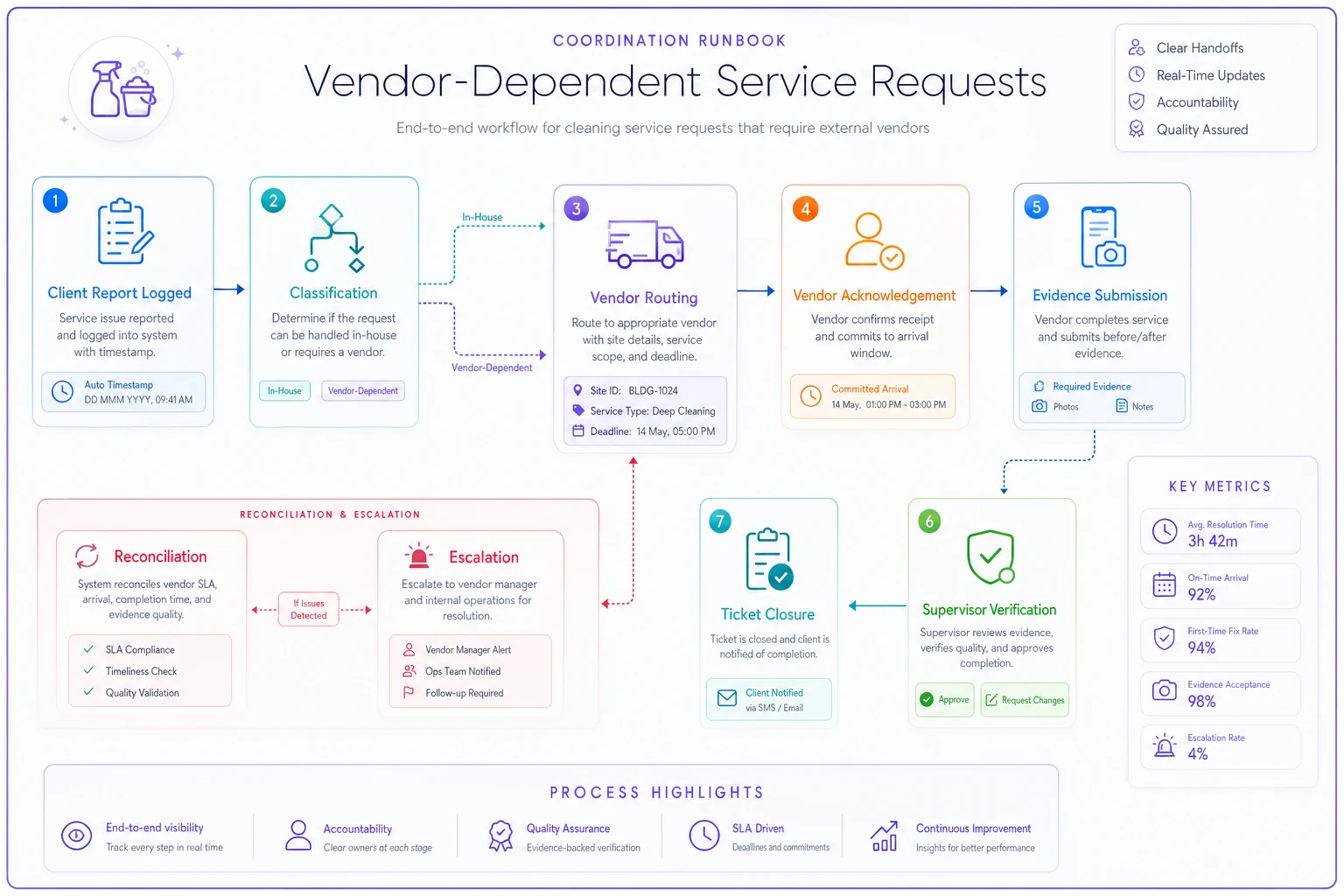
This diagram shows the main hand-offs and timing checkpoints.
The intake person, or the system, classifies it as in-house crew or vendor-dependent. If vendor-dependent, it goes straight to the vendor through their contracted channel with the site ID, location in the building, description, a photo if there is one, access instructions and the deadline. State the deadline as a clock time, like "on site by 2:15pm," not "ASAP." The routing step needs its own internal target too. Under an hour during business hours is realistic for most mid-size operators.
The vendor acknowledges and commits to an arrival time. If that time doesn't leave buffer against the client deadline, the site supervisor or area manager gets flagged immediately. Waiting until the deadline passes is too late, and most companies skip this step and only learn about the miss after it happens.
The vendor completes the work and submits evidence through the agreed channel. Your supervisor verifies, on site or from the evidence, and marks it complete. Only then is the client notified and the ticket closed. If verification fails, it goes back to the vendor with the remaining time on the client clock clearly stated.
At closing, the ticket records the client clock result (met/missed), the vendor clock result (met/missed) and, if it was missed, whose miss it was. That last field makes reconciliation possible later. Without it you're reconstructing causes from memory at month end.
The weak point is almost always the hand-off between "vendor says done" and "we verified." Supervisors are busy, the evidence sits unreviewed for a day, and the client clock runs out on work that was actually finished on time. Put a hard rule on verification turnaround, even if that means accepting photo evidence without a site visit for low-risk items.
Invoice reconciliation cadence (and a template you can use)
Cadence matters more than the template. The rule is simple and almost universally broken: reconcile vendor activity before you issue client invoices, not after.
-
Month end. Service period closes.
-
Business day 2. Vendor completion data and evidence due, per the data SLA above.
-
Business day 3–4. Vendor invoices due. Lines without site ID and work order mapping get bumped to next cycle.
-
Business day 4–5. Internal reconciliation
match vendor lines to tickets, flag variances, tag vendor-caused client misses, identify rebillable extras.
-
Business day 5–6. Client invoices go out, with credits calculated and approved extras included.
-
Business day 6–10. Vendor disputes and credit claims issued, within the dispute window.
High-volume vendors, mostly consumables distributors, should be reconciled weekly as well as monthly. Otherwise the line count gets unmanageable at month end and substitutions or short-ships slip through.
VENDOR RECON LINE ------------------------------------------------------------ Vendor / vendor invoice # : Vendor invoice line # : Site ID : Client / client contract ref : Work order / ticket # : Service date : Service type : (routine / periodic / reactive / extra) Contracted qty / rate : Billed qty / rate : Variance ($) : Variance reason : (rate / qty / unmapped / substitution / duplicate / other) Evidence on file? : Y / N (ref) Vendor SLA met? : Y / N / N/A Client SLA met? : Y / N / N/A Client credit incurred ($) : Vendor-attributable? : Full / Partial / No Vendor credit claim ($) : (per pass-through %, after cap) Rebillable to client? : Y / N Client invoice line ref : Approved by / date : Status : (matched / disputed / held / credit claimed / closed) Owner : Resolved date : ------------------------------------------------------------
Two fields carry most of the value. "Vendor-attributable?" is what turns client credits into recoveries. "Rebillable to client?" plus the client invoice line ref is what stops approved extras from leaking. If you only add two columns to whatever you use today, add those.
Expect the first two or three months of doing this properly to dig up a pile of old variances: duplicate billing on reactive visits, rates that crept up without a signed change, consumables billed at list instead of contract price. Don't try to claw all of it back at once. Pick a lookback period you can defend, settle it, and enforce cleanly going forward. Vendors accept that far better than a surprise audit of the last two years.
The escalation ladder (mirrored to your client's)
Your vendor ladder should always be a step ahead of your client ladder. When a client escalates to level 2 with you, you should already be at level 2 or 3 with the vendor.
Level 0, day-to-day. Site supervisor ↔ vendor dispatcher or crew lead. Handles normal requests within the vendor SLA window. No written follow-up needed.
Level 1, operational. Area or ops manager ↔ vendor operations lead. Triggered by any missed vendor SLA, or a second near-miss on the same site within 30 days. Expect a verbal fix and a date. Gets logged.
Level 2, management. Your ops director ↔ vendor owner or GM. Triggered when a vendor miss causes a client credit, or when a client escalates beyond the account manager. Vendor provides a written corrective plan within a set number of business days. It should land before you owe your client their corrective plan, so you can include the vendor's commitments in yours.
Level 3, commercial. Owner or finance ↔ vendor owner. Triggered by repeated breaches, say three in a quarter on one account, or any vendor miss that leads to a formal client cure notice. Actions here include invoking the credit pass-through, holding disputed payments, putting the vendor on probation with specific exit criteria, and narrowing their scope.
Level 4, replacement. Activate the backup vendor on affected sites. Triggered when a client cure period is open and the primary vendor can't credibly close it. You don't have to terminate the primary vendor everywhere. Often you pull them from one sensitive account and keep them elsewhere.
The classic mistake is jumping from level 0 straight to level 3 because someone got angry. A vendor threatened with replacement over the first miss stops being a partner. Skipping levels 1–2 also leaves you with no paper trail when you really do need to replace them.
Real scenario: regional commercial cleaner, two metros
Business type: commercial cleaning company, roughly 22 sites across two metro areas, mostly multi-tenant office plus a few light-industrial facilities. Revenue somewhere around $3M. Vendors: one floor-care subcontractor per metro, a window contractor, a consumables distributor, an equipment repair shop and a restoration vendor for floods and big spills.
The problem: Over one bad quarter, the company issued roughly $18k–$20k in client service credits. When they traced them, more than half involved a vendor somewhere in the chain. Most were floor defects not cured in the client window, plus a run of restroom stockouts during a distributor backorder. They recovered about $2k from vendors, mostly because the owner called in favors.
Separately, consumables invoices were producing 25–35 disputed lines a month: substitutions, list-price billing and deliveries to the wrong site. Approved extra floor work was getting rebilled to clients late or not at all, and nobody had sized that leak until they went looking.
What they changed:
-
Built the SLA map across all client contracts. Found the floor subs were on "2 business days" terms against client cure windows of 24 hours, and restoration was on "same day" against a 4-hour client emergency clause.
-
Renegotiated the floor subs to a 14-hour cure from notice, with evidence required and a 50% pass-through on attributable credits, capped. One sub accepted with a small rate increase. The other declined, so the company moved that metro's reactive floor work to a different sub and kept the original for scheduled periodics.
-
Put the distributor on site-ID-mapped invoicing and pre-approved substitutions, with weekly reconciliation.
-
Moved vendor invoice deadlines to business day 3 and client invoicing to business day 5.
-
Re-timed the floor sub agreements to renew about 75 days before their two biggest client renewals.
After (roughly two quarters later): Client credits ran around $7k–$8k a quarter, and vendor recoveries were around $4k–$5k of that, so net credit exposure dropped by a lot more than the headline number suggests. Disputed distributor lines fell to under 10 a month. Rebilled extras started going out in the same cycle as the work, which also cut client AP disputes on those lines. The owner said the biggest change wasn't the money. It was no longer hearing about vendor problems from angry facility managers.
It wasn't free. Renegotiation took about two months of the owner's and ops director's attention. One vendor relationship ended, and the new reactive floor sub was rough for the first few weeks.
When this makes sense
This level of procurement governance pays off in a few situations, and most operators who need it will recognize themselves in more than one:
-
You have client contracts with real credits, holdbacks or fee-at-risk, not just "we'll make it right."
-
More than one or two vendors touch services that show up in client SLAs.
-
You're past roughly 10 sites, or you have any multi-site client that expects consistent service across locations.
-
Vendor invoices regularly land after you've billed clients for the same period.
-
You're heading into a big client renewal and expect the client to tighten terms.
If two or three of those are true, the leak is probably already costing you more than the cleanup would. The last one is the hardest to ignore, since a renewal is the moment your gaps get exposed in front of the client.
When it's overkill
If most of your work is residential or small commercial without formal SLAs, building a full SLA map is wasted effort. A simple vendor list with prices and a monthly invoice check is enough.
It's also overkill if vendors are a tiny share of your delivery. If your own crews do 95% of the work and you buy consumables at a local store, the clause list will cost you more time than the leak does.
Who should NOT do this (yet)
Owners who haven't sorted their own internal service definitions. If you can't say what "complete" means for your own crews, you can't hold vendors to it. Fix your metrics first.
Owners in the middle of a software migration or a big org change. Renegotiating vendor terms on top of that is too much load. Stabilize first, then do the vendor work.
And anyone whose cash position is tight enough that one vendor walking away would cause a service gap you can't cover. Line up backup vendors before you start pushing on terms. They don't need to be under contract. You just need to know who you'd call.
Where software helps (and where it doesn't)
Most of this can run on spreadsheets at 10–15 sites if someone disciplined owns it. It starts to buckle when ticket volume, invoice line count and number of client contracts all grow together, because the work is mostly matching. Client clock against vendor clock. Vendor invoice line against ticket. Client credit against vendor cause. People are slow and inconsistent at matching.
That's where operational software with some AI automation earns its keep. It logs one client clock per request. It routes vendor-dependent tickets automatically with the deadline attached. It flags when a vendor's committed arrival leaves no buffer. It auto-matches vendor invoice lines to work orders and site IDs, so a person only looks at the exceptions. Keeping vendor agreements, renewal dates and SLA terms in the same place as the client contracts also means the alignment check is something you can re-run before renewals instead of rebuilding from scratch.
What software won't do is negotiate the clauses or decide whether to replace a vendor. Those still need an owner who knows the relationships.
Where to start this week
Skip the clauses at first. Take the last full quarter of client credits and short-pays, and for each one write down whether a vendor was involved and whether you recovered anything. That one exercise usually shows you which two or three vendor relationships matter, and whether your bigger leak is credits or unbilled extras.
From there, build the SLA map for just your top few accounts by credit exposure. Fix the clock and invoice-timing gaps with the vendors who support those accounts, and move your reconciliation date ahead of your client invoicing date. The full clause set, the ladder and the recon template can roll out over the next couple of vendor renewal cycles. Pushing it all through in one month tends to burn goodwill with vendors you'll still need.
If you run national or regional accounts, connect this to your site responsibility matrix and SLA roll-ups early. Vendor data feeds directly into what those clients will ask you to prove.
Credits and billing disputes usually aren't a vendor quality problem. They're a mismatch problem: different clocks, different definitions, different invoice calendars, and no lever on the vendor side when the client pulls one on you. Fixing that means starting from what you've promised clients and working backwards into the vendor terms, not the other way around.
Ready to simplify your cleaning operations?
Join 1,000+ cleaning businesses using Wipyly to save time, reduce scheduling conflicts, and enhance client satisfaction.