

Multi-location contracts are the accounts everyone chases and almost nobody manages well. The pitch is easy — one logo, predictable monthly revenue, a facilities director who can sign for all sites. The reality is messier. You win a regional bank with 14 branches, and within four months you've got three branch managers texting your crew leads directly, one location that never got the right supply list, and a corporate contact who thinks everything is fine because nobody's escalated anything to her.
That gap — between what the site sees and what corporate believes — is where multi-site accounts die. Not from one bad clean. From drift. Twelve locations each slipping 5% in quality is invisible at any single site and catastrophic on the renewal call when the facilities VP pulls a report you didn't know she was keeping.
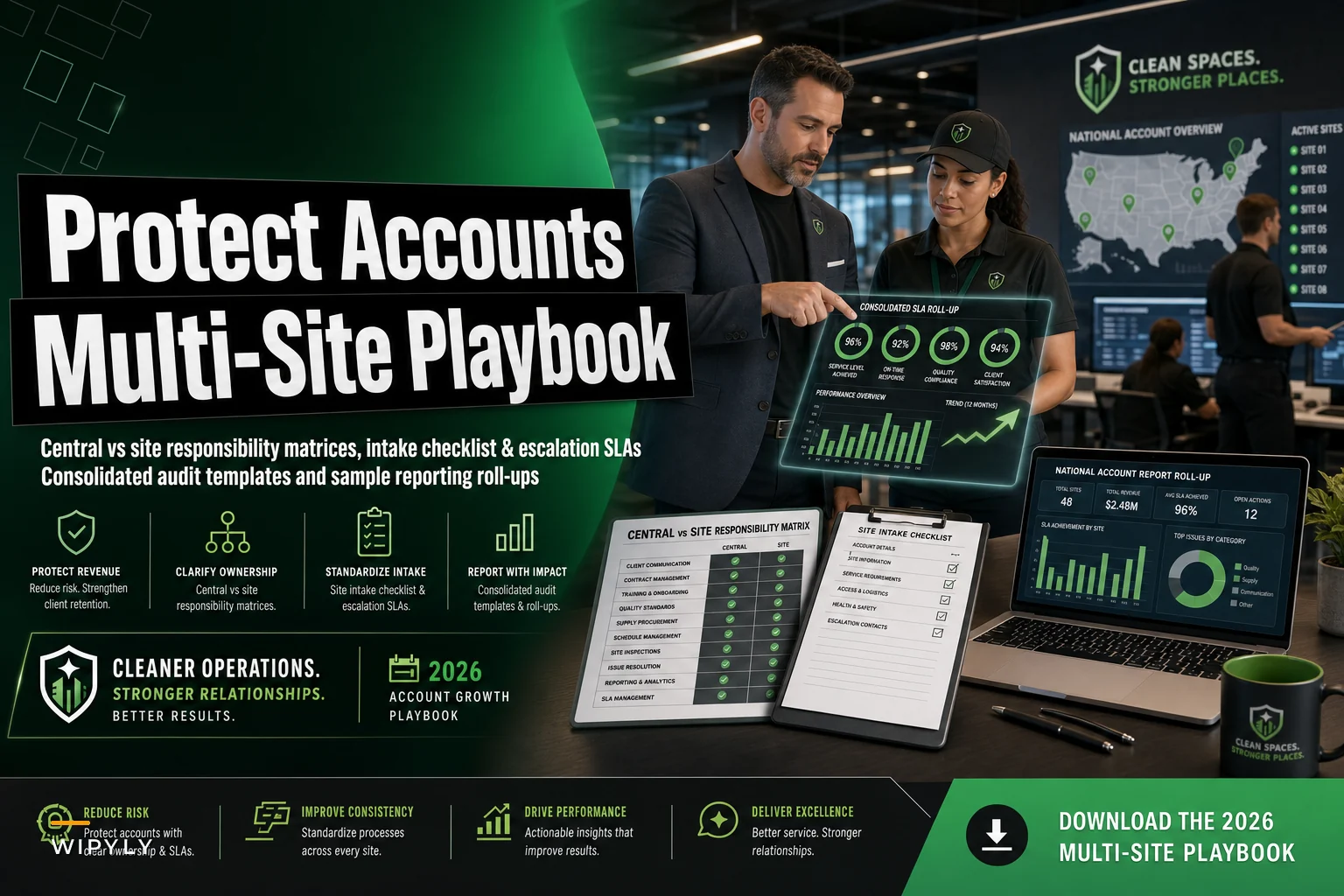
This is a tactical playbook for the boring infrastructure that actually keeps these accounts: who owns what between central and site, how you consolidate audits into something a corporate buyer trusts, what your intake checklist needs before you touch a single location, and how escalations should flow so problems reach the right person before they reach the person who signs the check.
The core problem: two customers pretending to be one
A single-site janitorial contract has one customer. A national account has at least two, usually more, and they want opposite things.
Corporate wants standardization, one invoice, one report, no surprises. The site — the branch manager, the store lead, the office administrator — wants their specific problem solved today, and they don't care about your standardization. When the break room smells or the glass entrance has streaks before a client visit, the site person calls whoever they can reach fastest. Usually your crew lead. Usually off-book.
The mistake owners make is treating this like one relationship with one set of rules. What plays out in the field is that every location develops its own informal service agreement, negotiated by whoever showed up that week. Site 4 gets extra restroom checks because the manager complained loudly once. Site 9 quietly dropped floor buffing because nobody there ever mentioned it and your crew was rushed. None of this is in your system. All of it surfaces at once when corporate audits.
So before any template, get the mental model right: you are running one contract across many small customers, each of whom can damage the whole account without corporate ever knowing until it's too late.
Central vs site: build the responsibility matrix first
The single most useful document for a multi-location account isn't the SOP. It's a responsibility matrix — for every recurring decision, who owns it: central (your account manager and the client's corporate contact) or the site. Get this wrong and you get two failure modes: everything funnels to corporate and nothing gets solved fast, or everything gets decided at the site and your standardization collapses.
Stop losing bookings in operational chaos.
Wipyly helps you manage, confirm, and optimize every cleaning appointment efficiently.
- Centralized booking management
- Automated client notifications
- Staff scheduling & route optimization
No credit card required
Explicitly block 'site-level permanent schedule changes' in the responsibility matrix to prevent routing drift.
| Decision / Task | Central (Account Level) | Site (Location Level) |
|---|---|---|
| Scope of work definition | Owns — one master scope | Cannot alter without change order |
| Supply ordering & standards | Owns — approved product list | Requests within approved list |
| Schedule changes (permanent) | Owns — updates master | Cannot make permanent |
| Same-day access / one-off requests | Notified | Owns — handles directly |
| Quality audits | Owns — consolidated scoring | Hosts, signs off on walk |
| Complaints / issue logging | Owns escalation path | Owns first report |
| Invoicing & billing questions | Owns | Redirects to central |
| Emergency response (spill, flood) | Notified | Owns immediate action |
| Change orders / added scope | Owns — pricing & sign-off | Requests, cannot approve |
The pattern that matters: sites own speed, central owns consistency. A site should be able to handle the urgent restroom refill or the one-time event clean without waiting on anyone. But the moment something permanently changes the scope, the schedule, or the price, it routes to central. Let site managers permanently reshape service and you've got 14 different contracts with no way to price a renewal.
One overlooked line in that table is "schedule changes (permanent)." This is where accounts bleed quietly. A branch manager asks your crew to come Tuesdays instead of Mondays "from now on," your crew lead agrees to be helpful, and six weeks later your routing is broken across three sites and nobody at central knows why. Write it down explicitly: no permanent schedule change at the site level, ever.
The intake checklist: what you needed to know before you signed
Most multi-site problems trace back to a rushed onboarding where someone treated 12 locations like one location copied 12 times. They're not. A downtown flagship and a suburban strip-mall branch of the same chain have different access rules, different traffic, different floor types — different everything.
-
Access details — keys, codes, badge process, who to call if locked out, and the exact hours the space is available
-
Site contact — name, cell, and their actual role (are they authorized to sign a walk-through or just report problems?)
-
Floor and surface inventory — square footage by surface type, because "10,000 sq ft" tells you nothing about labor if 4,000 of that is polished concrete and the rest is carpet tile
-
Fixed obstacles — the conference room that's always booked, the loading dock active until 8pm, the server room nobody enters
-
Supply storage — is there a closet on-site or does your crew haul everything in on every visit?
-
Existing pain points — what the last vendor got wrong here specifically (sites will tell you this readily and it's genuinely useful)
-
Photo baseline — a walk-through photo set of every space at day zero, timestamped
That last one saves accounts. When a site claims "the floors have looked bad since you started," a day-zero photo set ends the argument in ten seconds. Skip it and you're debating feelings on a renewal call.
The intake also feeds pricing accuracy. A proper per-location scope is the foundation of a clean lifecycle — if you want the broader framing on how onboarding hands off into ongoing service, the operational client lifecycle for cleaning companies walks through the template handoffs that keep a signed contract from turning into a mystery three months in.
Consolidated audits: giving corporate the report they'll actually renew on
Corporate buyers don't renew on vibes. They renew on evidence, and if you're not producing it, they're producing their own — which is always worse for you, because their version only records what went wrong.
The problem with multi-site auditing is that a stack of 14 individual audit sheets is useless to a facilities VP. She can't read 14 forms. She wants one page that tells her the account is healthy and flags the two sites that need attention. That's a roll-up.
Your per-site audit should already exist and score consistently — if you haven't standardized the underlying scoring yet, that's step zero, and the SLA-aligned audit checklist with scoring covers how to build that site-level instrument. The multi-site layer sits on top of it.
A consolidated monthly roll-up should show, at minimum:
-
Each location, its current audit score, and the change from last month
-
A portfolio average score with the trend line
-
Any site below the SLA threshold, flagged
-
Open issues by site with age (how long each has been unresolved)
-
Actions taken since last report
Here's a sample roll-up format that reads well to a corporate contact:
| Location | This Month | Last Month | SLA Floor | Status | Open Issues |
|---|---|---|---|---|---|
| Branch 01 – Downtown | 94 | 92 | 85 | On track | 0 |
| Branch 04 – Eastgate | 81 | 88 | 85 | Below floor | 2 (restroom, glass) |
| Branch 07 – Midtown | 96 | 95 | 85 | On track | 0 |
| Branch 09 – Suburban | 86 | 79 | 85 | Recovering | 1 (floor buff) |
| Portfolio Avg | 89 | 88 | 85 | Healthy | 3 |
The thing that separates good account managers from average ones: you flag your own problems before corporate finds them. A report showing Branch 04 dropped below the floor, with a note that says "crew reassigned, re-audit scheduled Thursday," builds more trust than a report where everything is green. Green-everything reports get audited independently because nobody believes them. A report that admits and manages a real issue makes corporate stop double-checking you.
SLA escalation rules: the flow that stops small problems from becoming lost accounts
The escalation path is the piece almost everyone skips, and it's the piece that determines whether a bad week costs you a re-clean or costs you the whole logo.
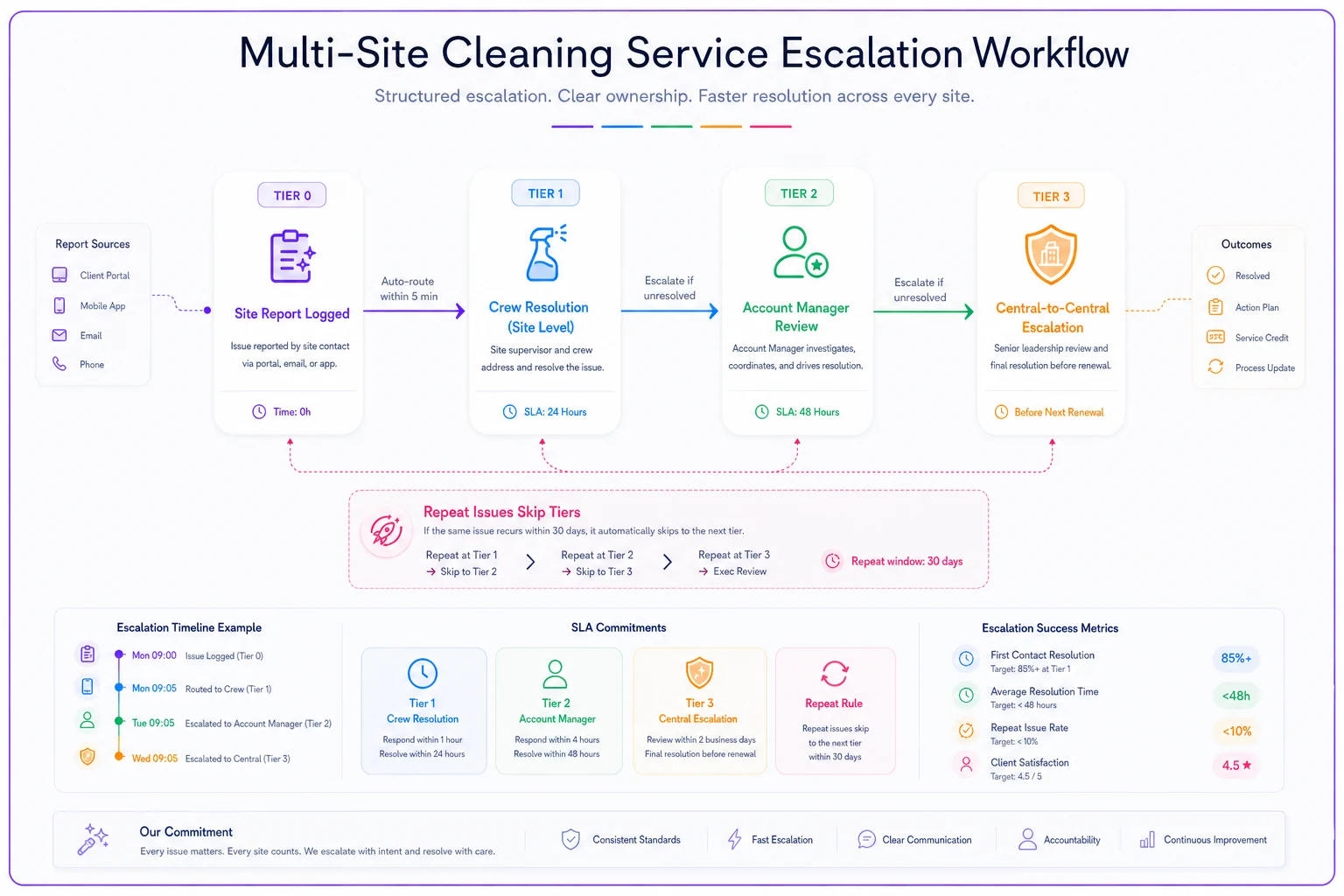
Here's a simple escalation workflow visualization.
-
Tier 0 — Site report logged. Any site issue gets logged the moment it's reported, timestamped, with location and category. Nothing is "handled verbally." If it isn't logged, it didn't happen.
-
Tier 1 — Crew resolution, 24 hours. Routine issues (missed trash, streaked glass) resolved by the crew within one business day. Resolution noted and closed.
-
Tier 2 — Account manager, 48 hours. Anything unresolved at 24 hours, or any repeat of the same issue at the same site, auto-escalates to the account manager, who contacts the site directly.
-
Tier 3 — Central-to-central, before it hits renewal. Any issue open past 72 hours, or any pattern across multiple sites, gets surfaced by you to the corporate contact — proactively — with an action plan.
The rule that makes this work: a repeat issue at the same site skips a tier. The second missed restroom clean at Branch 04 doesn't get another 24 hours of crew grace. It goes straight to the account manager, because a repeat is no longer an incident — it's a pattern, and patterns are what corporate buyers punish.
Billing issues deserve their own note here. On multi-site accounts, a single disputed invoice can freeze payment across all locations. When a site questions a charge, it should route to central immediately and never get debated in the field — the same triage discipline in this billing dispute workflow applies, just multiplied by however many locations share the invoice.
A real scenario: the 11-site retail account that almost walked
A mid-sized janitorial company picked up a regional apparel retailer — 11 stores, roughly $9k–$11k monthly across the portfolio. The first quarter went fine on paper. No formal complaints. The account manager was servicing all 11 as one blended contract, one report line, one crew rotation.
At month five the facilities director asked for a review. She'd been collecting store-manager feedback the whole time. Three stores rated service "poor." Two had quietly stopped getting the monthly detail clean because the crew was compressed for time and those sites never complained loudly. The company had no record of any of it — no per-site scores, no logged issues, no photos.
The account went on 60-day notice.
What saved it wasn't heroics. It was building the boring infrastructure retroactively: a per-location intake redone across all 11 sites, a responsibility matrix so store managers stopped freelancing schedule changes with the crew, a consolidated monthly roll-up delivered to the facilities director before she asked, and a three-tier escalation so repeat issues stopped disappearing. Within two months the portfolio average moved from the low 80s to around 90, the two worst stores recovered, and the notice was pulled. The account renewed the following year and added two locations.
The lesson wasn't that the cleaning got dramatically better. The crews were mostly fine the whole time. Corporate couldn't see that it was fine, and on a multi-location account, invisibility reads exactly like failure.
When a multi-site account is worth this overhead — and when it isn't
This makes sense when:
-
You have four or more locations under one contract or one decision-maker
-
Sites are geographically spread enough that no single crew lead sees them all
-
The corporate contact is different from the people at the sites
-
The account is large enough that losing it would hurt (usually 8%+ of monthly revenue)
This is premature when:
-
You've got two or three sites all serviced by the same crew on the same day — a shared checklist is enough
-
The decision-maker is also the on-site person, so there's no visibility gap to bridge
-
You're still stabilizing your single-site quality; fix that first, because multi-site infrastructure on top of inconsistent cleaning just documents your problems faster
Who should not take on national accounts yet: any company that can't reliably produce a consistent per-site audit score. If your quality wobbles site to site and you can't measure it, a multi-location contract will expose that at scale and on a schedule you don't control.
Where software quietly earns its place
None of this requires software to work. You can run a responsibility matrix in a shared doc and roll up audits in a spreadsheet, and plenty of companies do exactly that for their first national account.
It stops being manageable around the point where logging, timestamping, and escalating issues across a dozen sites eats more of your account manager's week than the actual account management does. When issue logs live in one crew lead's head and audit photos are scattered across three phones, the roll-up you promised corporate takes a full day to assemble and it's stale by the time you send it.
AI-assisted operational platforms help here mostly by removing the manual assembly work — pulling per-site audits, issue logs, and escalation timers into one consolidated view, flagging repeat issues automatically before a human has to notice the pattern, and generating the corporate roll-up on a schedule instead of in a scramble. The value isn't automation for its own sake. It's that the visibility layer stops depending on someone remembering to update it.
But the sequence matters. Get the responsibility split, the intake discipline, and the escalation rules right on paper first. Software makes a working system faster. It won't fix one that was never designed.
Closing thought
Multi-site accounts reward operational discipline and punish improvisation, and the punishment is delayed — you feel great for four months and lose the account in month five. The companies that keep national logos aren't the ones with the best crews. They're the ones who decided, before the first clean, exactly who owns what, what gets logged, how problems travel upward, and what corporate sees every month. Build that, and a 12-location contract stops being 12 chances to fail and starts being what you sold it as: one account, running clean, on record, and hard to walk away from.
Ready to simplify your cleaning operations?
Join 1,000+ cleaning businesses using Wipyly to save time, reduce scheduling conflicts, and enhance client satisfaction.