


Most cleaning companies don't lose dispute money because their crews did bad work. They lose it because when a client's AP manager says "we're holding this invoice until you prove the Tuesday service happened," nobody can find the Tuesday photos fast enough, the timestamps are ambiguous, and the one person who remembers the account is on a job across town.
That's not a quality problem. It's a governance problem. The evidence exists somewhere — on a tech's phone, in a group text, in a supervisor's camera roll — but it's never organized into something your finance team can actually use to release a held invoice or kill a chargeback.
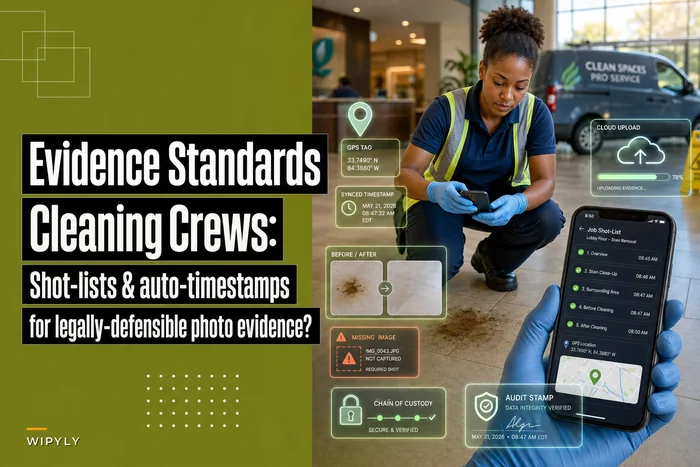
What follows isn't a lecture on taking better before-and-after photos. We've covered field capture in detail over at mobile evidence standards for cleaning crews. This is about the layer above that: how all that evidence gets governed, retained, redacted, and surfaced on demand so it directly shortens your days-sales-outstanding and shrinks write-offs. That's the whole point of evidence governance cleaning operators keep ignoring — until a national account holds $40k and asks for records that should have been in a folder three weeks ago.
Why evidence falls apart between the field and finance
The field side usually works better than people think. Crews take photos. Supervisors spot-check. The breakdown happens in the handoff — the moment evidence has to travel from an operational context ("did we clean the lobby?") into a financial context ("prove it so we get paid").
Those two worlds store information completely differently. Operations thinks in jobs, sites, and shifts. Finance thinks in invoices, line items, and billing periods. When a dispute lands, someone has to translate "the North tower, floor 3, Thursday night crew" into "invoice #4471, line 2, service date 10/9." Nobody owns that translation, so it happens by frantic text thread every single time.
-
Evidence lives on personal devices, so when a tech quits, their proof leaves with them.
-
Photos are named
IMG_8821.jpgwith no link to a site, date, or invoice. -
Clients dispute 45 days after service, by which point auto-delete settings on phones have already wiped the files.
-
Nobody redacts anything, so the one time you do send proof, there's a visible access badge, a license plate, or a patient-area door sign in frame — and now you've got a privacy problem stacked on top of a billing one.
Evidence governance isn't a filing habit. It's the connective tissue between your service delivery and your accounts receivable. When it's weak, disputes become open-ended negotiations. When it's strong, they become a lookup followed by a one-line reply.
What actually breaks as you scale
At one or two vans, the owner is the governance system. You remember every account. You took half the photos yourself. If a client disputes, you know within thirty seconds whether they're right.
Stop losing bookings in operational chaos.
Wipyly helps you manage, confirm, and optimize every cleaning appointment efficiently.
- Centralized booking management
- Automated client notifications
- Staff scheduling & route optimization
No credit card required
That model quietly dies somewhere between 8 and 20 crews. Here's the sequence:
Stage 1 — the memory runs out. You can no longer personally recall which crew hit which site. Disputes start taking days instead of minutes because you're relaying questions to supervisors who relay them to techs.
Stage 2 — the evidence volume explodes. Say you're running around 300 service visits a month, each generating 6–10 photos. That's roughly 2,000–3,000 images a month with no naming convention, no retention rule, and no redaction policy. The archive becomes unsearchable, which means it functionally doesn't exist when finance needs it.
Stage 3 — the legal and privacy exposure shows up. You win a healthcare or financial-services account. Now you're photographing inside regulated spaces. A badge reader, a visitor log, a name on a door — any of it in an un-redacted photo you emailed to a client's AP team is a compliance incident waiting to happen.
Stage 4 — disputes become systemic margin leak. What started as the occasional held invoice is now a predictable percentage of AR sitting in dispute limbo every month, and some of it ages out into write-offs simply because you couldn't produce evidence inside the window.
The core issue is that evidence governance depending on one person's memory and one person's phone can't survive the jump to multi-crew, multi-site operations. You need rules that work when the owner isn't in the loop.
The four policies that make evidence usable for finance
Governance sounds abstract until you break it into the specific rules a dispute actually tests. There are four, and they map directly to the four questions a client's AP team will ask.
1. Retention windows (answers "do you still have it?")
| Account type | Minimum retention | Driver |
|---|---|---|
| Standard commercial (net-30) | 90 days | Covers the typical dispute lag after invoice |
| Net-60 / slow-pay accounts | 120–150 days | Longer AP cycles push disputes later |
| Healthcare / regulated sites | 12 months+ | Compliance and audit requirements |
| Accounts with active dispute history | 180 days | These clients dispute more; hold longer |
| Contract explicitly specifies | Per contract | Contract overrides your default |
The mistake most operators make is a single global setting — usually whatever their phones or app default to, often 30 days. Net-60 clients dispute on day 50. The evidence is already gone. You eat it.
2. PII redaction templates (answers "can you share this safely?")
-
Blur all access badges, key cards, and license plates
-
Mask any visible names (door plates, desk signs, visitor logs)
-
Remove or crop any screens showing client data
-
In healthcare or legal spaces, blur anything that identifies a patient or case
-
Strip GPS metadata if the client is sensitive about exact-location logging — but keep your internal copy intact
The redacted copy is what you send. The original stays in your vault for chain-of-custody. Never redact your only copy.
Build redaction templates once and apply them automatically at share to avoid last-minute manual mistakes.
3. Chain-of-custody rules (answers "can you prove it's real?")
A photo with no provenance is just a picture. Chain of custody is what makes it defensible: who captured it, when, where, and proof it hasn't been altered since. The field-capture mechanics — auto-timestamps, geotags, sequence — are covered in the mobile evidence standards post. The governance layer adds: every piece of evidence is locked at capture, logged against a specific job and site, and any later access is recorded.
The practical test: if a client's attorney asked "how do we know this photo is from the date you claim and wasn't staged later," do you have an answer that isn't "trust us"?
4. Digital acceptance flows (answers "did the client already agree it was fine?")
-
Crew completes service, captures required evidence.
-
Site contact gets a completion summary (checklist + key photos).
-
Contact approves, flags an issue, or doesn't respond.
-
No response within the agreed window (say 48 hours) = deemed accepted, logged automatically.
-
That acceptance record attaches to the invoice line when billing runs.
Once acceptance is on record, a billing dispute 40 days later has to overcome the client's own prior sign-off. That shifts the entire negotiation. It's hard for a client to argue the work wasn't done when they had the chance to say so at the time and didn't.
Wiring evidence into invoice-hold playbooks
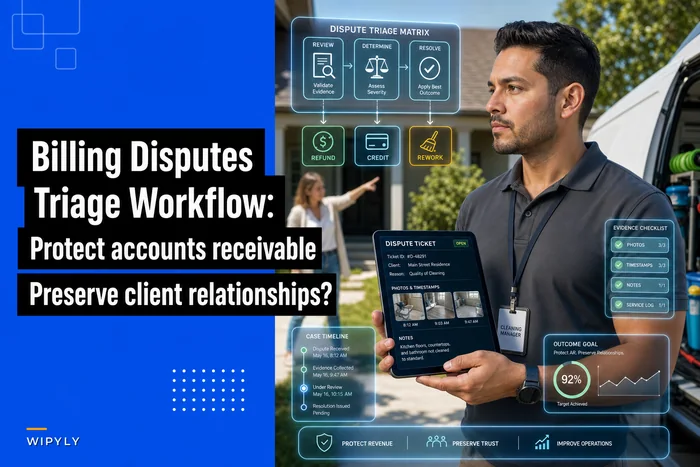
Policies are useless if they don't change what happens when an invoice gets held. The goal is to connect your evidence vault directly to your AR process so a dispute triggers a defined sequence, not a scramble. This pairs closely with a structured billing-dispute triage workflow — governance supplies the proof, triage decides how to deploy it.
Here's the escalation ladder that works:
Tier 0 — Auto-resolve. Dispute lands. Evidence and digital acceptance get pulled and attached to a reply. Many "we don't think this was done" holds die here, same day, because the client sees their own sign-off.
Tier 1 — Supervisor review. Evidence exists but the client contests quality, not occurrence. Supervisor reviews against the service standard, decides credit vs. defend within a set dollar threshold (e.g., up to $250 they can settle without escalation).
Tier 2 — Account manager. Larger holds, or repeat disputes from the same account. Now it's a relationship conversation backed by a full evidence packet, not a reactive apology.
Tier 3 — Finance/legal. Evidence is missing, the amount is significant, or the client is using disputes to stall payment. This is where retention policy pays off — if you still have the records, you have leverage; if you don't, you're negotiating a write-down.
Each tier needs a dollar threshold, an evidence requirement, and a response-time target. Without those, every dispute floats up to the owner and nothing resolves fast.
Visualize this escalation ladder as a step-by-step workflow.
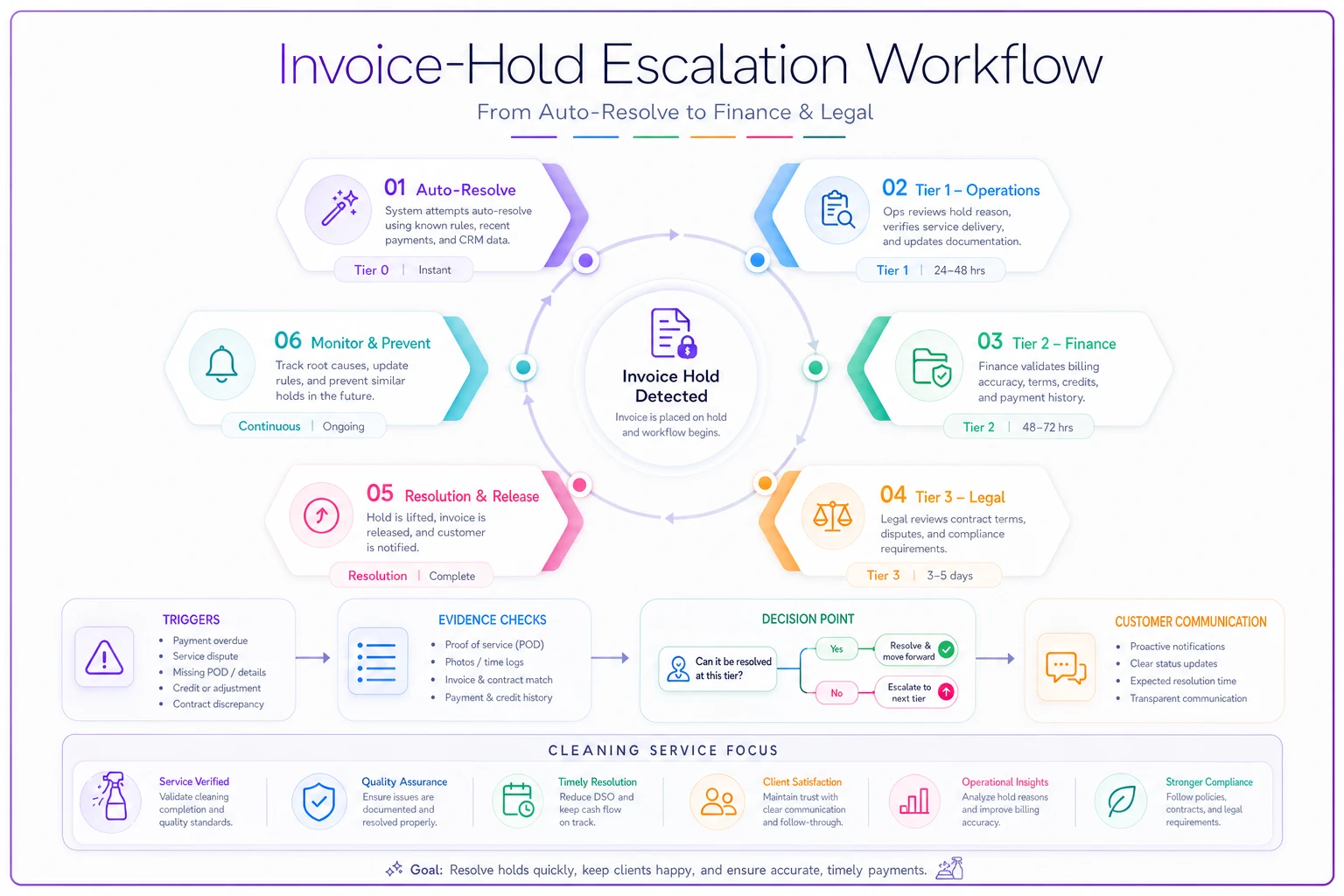
The ladder ties into your dispute triage and evidence vault.
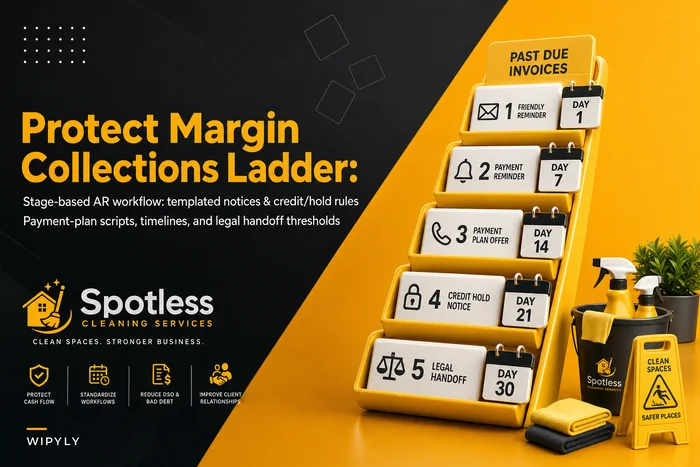
Worth flagging: some "disputes" are really just slow-pay stalling dressed up as quality complaints. Strong evidence governance lets you tell the difference quickly and route the stall tactics into your collections ladder instead of wasting account-manager time re-proving work that was clearly done.
A real scenario
A mid-size commercial operator running roughly 320 monthly visits across office and medical sites had about 11–14% of their AR sitting in dispute at any given time. Most of it wasn't bad work — it was un-findable proof. Techs used personal phones, photos auto-deleted after 30 days, and net-60 medical clients routinely disputed around day 50, past the deletion window.
They did three things. Set retention to 150 days for net-60 accounts and 12 months for medical. Added a digital acceptance step so site contacts signed off at completion. Built a two-tier triage so supervisors could auto-resolve occurrence disputes without pulling in the owner.
Inside about four months, disputed AR dropped to roughly 4–5%. Monthly write-offs shrank to near-negligible. The bigger shift was time: disputes that used to eat days of back-and-forth were closing same-day because the acceptance record and evidence packet were one lookup away. DSO on the medical book came down by close to two weeks.
Nothing about the cleaning changed. Only the governance did.
When heavy governance makes sense — and when it doesn't
This isn't a universal mandate. Calibrate to your situation.
It makes sense when:
-
You run multiple crews and can't personally remember every account.
-
You hold net-60+ or regulated accounts where disputes arrive late and privacy matters.
-
Disputed AR regularly exceeds a few percent of receivables.
-
You're pursuing or holding national/multi-site accounts that demand audit-ready records.
It's overkill when:
-
You're a one- or two-van operation and the owner still knows every job.
-
All your accounts are net-15 residential with near-zero dispute history.
-
Your total monthly AR is small enough that a formal four-tier ladder costs more administrative effort than it saves.
One group that should not bolt this on wholesale: operators whose field capture is still broken. If crews aren't reliably taking usable photos yet, fix capture first. Governance organizes evidence — it can't conjure evidence that was never collected.
Where the tooling earns its keep
At small scale, most of this can run on folders, naming conventions, and discipline. The reason it collapses as you grow is purely volume. Nobody can hand-tag 3,000 photos a month, match them to invoice lines, apply redaction templates, enforce per-account retention windows, and surface the right packet in seconds when a dispute lands.
That's where operational software with AI automation starts carrying real weight. Evidence gets auto-linked to the right job, site, and invoice at capture. Retention rules apply per account type without anyone managing them manually. Redaction templates run before anything is shared externally. And when a hold comes in, the system assembles the acceptance record and evidence packet instead of a human combing through camera rolls.
The policies are still yours — the automation just removes the translation work that breaks down once you're past a dozen crews.
Evidence governance is what connects the work your crews actually do to the money you actually collect. Get the retention windows, redaction rules, chain of custody, and acceptance flows right, and billing disputes stop being open-ended arguments and start closing fast — which is exactly where your AR wants them to be.
Ready to simplify your cleaning operations?
Join 1,000+ cleaning businesses using Wipyly to save time, reduce scheduling conflicts, and enhance client satisfaction.