

The worst time to decide how much a job is worth is while the client is panicking on the phone. A flood in a daycare, a post-construction turnover that got moved up two days, a restaurant that failed a surprise inspection and needs a kitchen degreased before service tomorrow—these calls come in hot, and almost every cleaning operator handles them the same way: they guess.
Someone quotes a number off the top of their head, scrambles to pull people off scheduled routes, and then spends the next week arguing about what was actually promised. The job gets done, but the margin disappears somewhere between the verbal quote and the invoice. Nobody can point to exactly where it happened.
The emergency deep clean workflow exists to kill that improvisation. Not to slow you down—emergencies are your highest-margin work when handled right—but to make sure the speed happens inside guardrails instead of outside them.
The pattern that quietly bleeds these jobs
Emergency work fails in a predictable sequence, and it almost never fails at the cleaning stage. The crew does fine. It falls apart at the two ends: the quote and the sign-off.
A property manager calls Friday afternoon about standing water in a vacant unit. Your office person—maybe you—quotes "around $1,800, we'll get someone there tonight." The crew shows up and finds it's not just water extraction but drywall-adjacent contamination, two rooms of carpet that need pulling, and a tenant's leftover furniture nobody mentioned. They work until 1 AM.
Now you've got a problem. The verbal quote was $1,800. The actual work was closer to $3,400 in labor and disposal. No documentation of expanded scope, no client acknowledgment, and the property manager "doesn't remember agreeing to anything over two grand." You eat the difference or you fight for it. Either way you lose—money or the relationship.
What makes this worse than normal scope creep is the speed. On a planned job you have time to write things down. On an emergency, the whole appeal is that you move fast, so the paperwork gets skipped precisely when the dollar amounts are most volatile. The urgency that makes the job profitable is the same urgency that makes it undocumented.
Triage severity bands: decide the lane before you decide the price
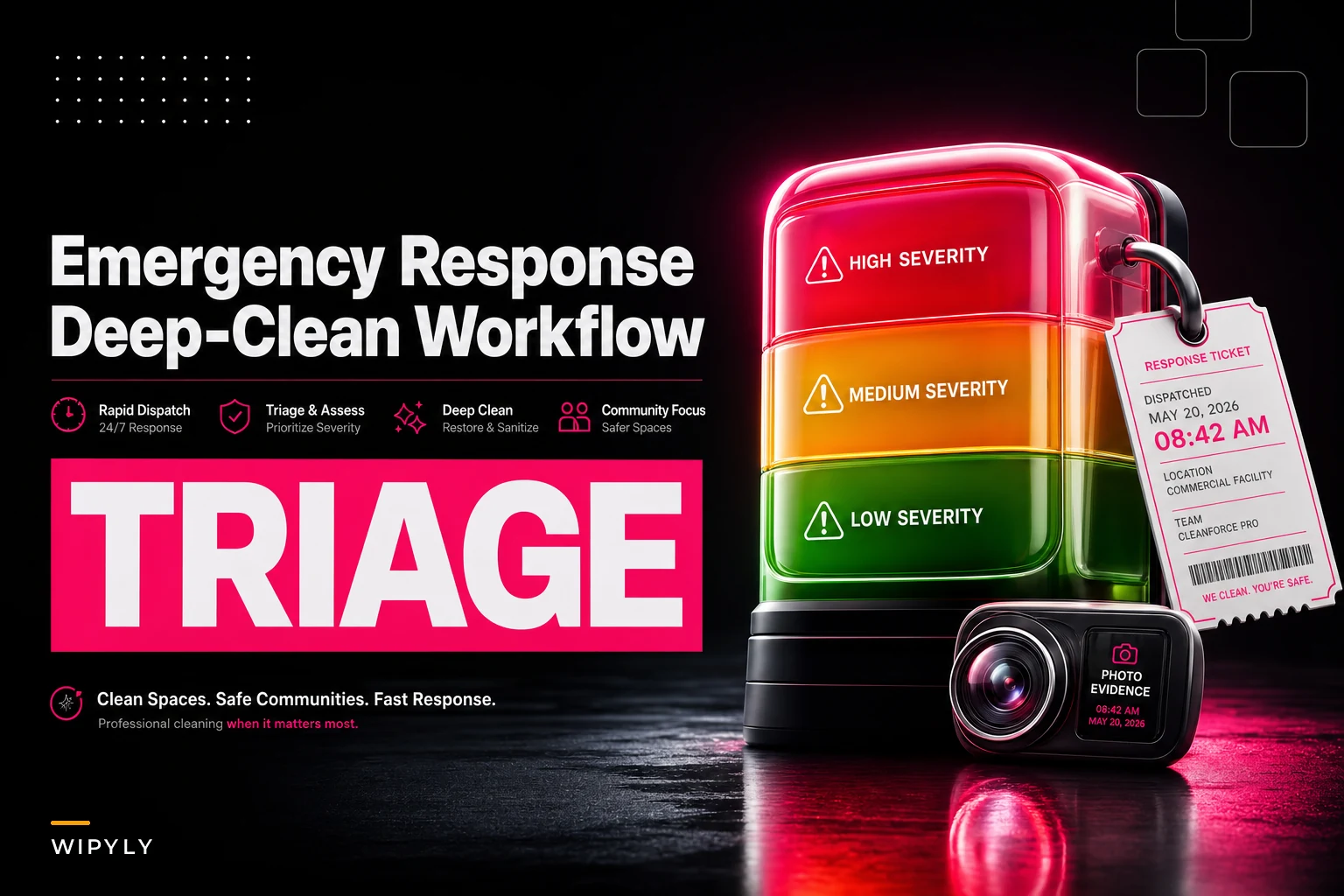
The first fix is refusing to treat every emergency as one undifferentiated "urgent." They're not. A clogged floor drain and a sewage backup across 4,000 square feet are both "emergencies" to the client, but they live in completely different pricing and staffing realities.
Stop losing bookings in operational chaos.
Wipyly helps you manage, confirm, and optimize every cleaning appointment efficiently.
- Centralized booking management
- Automated client notifications
- Staff scheduling & route optimization
No credit card required
| Band | Trigger examples | Response commitment | Staffing source |
|---|---|---|---|
| S1 – Containment-critical | Sewage, biohazard, active water spread, health-inspection shutdown | On-site within 2–4 hrs | Pull from routes + on-call |
| S2 – Time-boxed turnover | Post-construction moved up, pre-event, move-out with hard deadline | Same day or next morning | Shift non-urgent recurring work |
| S3 – Urgent but schedulable | Odor complaint, one-room deep clean, spot remediation | Within 24–48 hrs | Existing capacity, minor reshuffle |
The point isn't bureaucracy. It's that whoever answers the phone can classify the job in thirty seconds and immediately know which playbook they're running. No judgment call about whether it's "really an emergency"—the triggers decide. S1 means you're allowed to pull crews off scheduled work and the premium is non-negotiable. S3 means slow down, you have room to quote properly.
The mistake operators make: letting the client's panic set the band. Clients will tell you everything is an S1. Your classification has to be based on what the work actually requires, not on how stressed the caller sounds.
Templated immediate offers: quote the band, not the job
Once the band is set, you should be presenting a pre-built offer, not inventing one. This is where most of the margin leak gets sealed.
-
S1 containment "$X base response fee covers first 4 labor-hours, two technicians, standard extraction and sanitization. Work beyond that is billed at $Y/tech-hour. Disposal, drywall contact, and furniture removal are separate line items confirmed on-site before we proceed."
-
S2 turnover fixed square-foot rate with a minimum, plus a surcharge band if the deadline is under 24 hours.
-
S3 closest to your normal deep-clean pricing, lightly premium.
The template does two things at once. It gives the client a fast, confident answer—which is exactly why they called you instead of the competitor who said "we'll get back to you." And it bakes the exclusions into the conversation from minute one, so when the crew hits the inevitable surprise, nobody is blindsided.
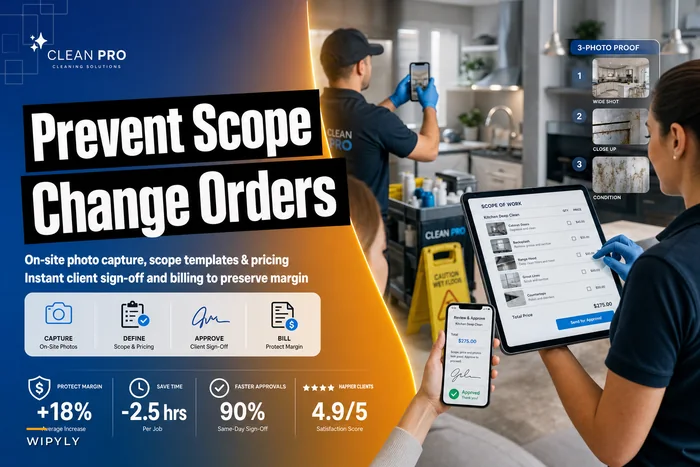
The real discipline is listing exclusions before the job, not discovering them after. Furniture removal, hazardous disposal, anything requiring rented equipment—these are the recurring surprises. If your template already names them as "confirmed on-site, billed separately," the expanded scope becomes a predicted event instead of an argument. This is the same logic behind a good on-site change-order workflow with photo capture and client sign-off—you're just moving that protection upstream into the quote itself.
Surge staffing rules: decide who moves before you need them to move
The part operators underprice most badly is the staffing disruption. When you pull two techs off a Friday route to handle an S1, you're not just spending their hours—you're degrading or delaying the scheduled accounts they were supposed to service. That cost is real and it rarely shows up in the emergency quote.
-
On-call first. Every week, one or two techs are designated on-call with a small stipend. S1 and S2 jobs draw from them before touching routes.
-
Protected accounts never get pulled. Flag your SLA-penalty and high-value accounts as off-limits for surge reassignment. Pulling a crew off a contract that charges you for a missed service to chase an emergency is how you win $900 and lose a $40k account.
-
Route-pull tiers. If on-call is exhausted, define which recurring work can slip a day without client impact versus which cannot. Rank it in advance.
-
Premium funds the disruption. Your S1 base fee should be sized to cover the overtime, the stipend, and the reshuffling cost. If the premium doesn't cover the disruption, you're subsidizing emergencies with your stable revenue.
Most operators think the emergency premium is for urgency. It's not—it's for the staffing chaos the urgency causes. Price the chaos, not the clock.
Evidence-captured acceptance: lock the price and the scope in the same moment
This is the hinge of the whole workflow. A verbal "yes, go ahead" is worthless when the invoice gets disputed three weeks later. You need the client to accept the band, the ranged price, and the exclusions in a way that's time-stamped and recoverable.
Practically, that means a short acceptance step the client completes before work starts—even on a 2-hour S1. It doesn't have to be a formal contract. A text-back confirmation, a quick form, a signed line on a mobile device. What matters is that it captures:
-
The severity band and what it includes
-
The base price and the hourly rate beyond the base
-
The named exclusions acknowledged
-
A timestamp and the client's identity
Then, when the crew arrives and finds the furniture nobody mentioned, the expanded scope gets its own evidence step: photos, the added line item, and a second quick acceptance before they touch it. Two acceptance gates—one at quote, one at any scope expansion.
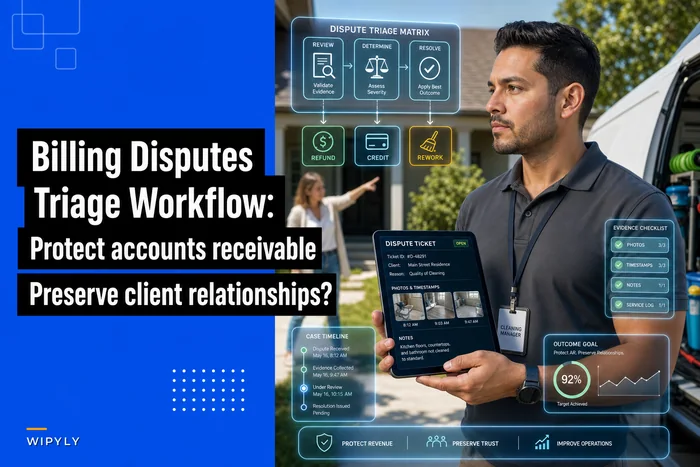
This matters so much on emergency work specifically because these are the jobs most likely to end in a billing fight. They moved fast, the dollar amounts jumped mid-job, and both sides remember the conversation differently. Having captured acceptance turns a he-said-she-said into a closed case. If you've dealt with the aftermath of undocumented work before, the value here is obvious—it's the front-end version of a billing-dispute triage workflow, except you're preventing the dispute instead of resolving it.
Fulfillment SLAs: finish the way you promised
The quote locks the money. The fulfillment SLA locks the delivery. On emergency work, clients remember two things: did you show up when you said, and was the result what you implied. Define both, so the crew isn't improvising the finish line either.
A fulfillment SLA for emergency work should specify:
-
Response window tied to the band (the 2–4 hr, same-day, 24–48 hr commitments)
-
Completion definition—what "done" looks like, with the specific standard for that job type
-
Sign-off requirement—the client or their rep confirms completion, ideally with before/after evidence attached
-
Handoff note—anything the client needs to know (areas that need to air out, follow-up recommended, what falls outside your scope)
The quiet failure here is finishing the work but not closing it. The crew leaves, nobody confirmed completion, and later the client claims the odor came back or a room was missed. Without a signed-off completion with evidence, you're defending work you can't prove you did to standard.
A real scenario
A mid-sized operator running around 14 crews did somewhere between $90k and $110k a year in emergency and rush work—mostly post-construction turnovers and water events for a handful of property management clients. The problem wasn't volume. It was that emergency jobs had the worst margins in the whole business. Verbal quotes, scope surprises, and disputed invoices meant they were collecting maybe 70–75 cents on the dollar of what the work actually cost them.
They put in three bands, templated ranged offers for each, and a two-gate acceptance step done over text and a mobile form. Nothing fancy. The first noticeable change was that scope-expansion arguments basically stopped—because the exclusions were named up front and the second acceptance gate caught the surprises in real time. Within a couple of months, the disputed-invoice rate on rush jobs dropped from "most of them had at least one line item in question" to a handful a quarter.
The margin recovery was less dramatic than the dispute reduction but steadier. Emergency work went from their least profitable category to roughly on par with planned deep cleans—which for an operator that size is a real shift. The deeper benefit was that the office stopped dreading these calls. A panicked 6 PM call became a thirty-second classification and a template pull, not an hour of improvisation.
When this workflow makes sense—and when it doesn't
This makes sense when emergency and rush work is a recurring part of your mix, when you serve property managers or commercial clients who call with hard deadlines, and when you've already been burned by at least one disputed emergency invoice. If you're doing more than a handful of these a month, the undocumented ones are quietly costing more than you think.
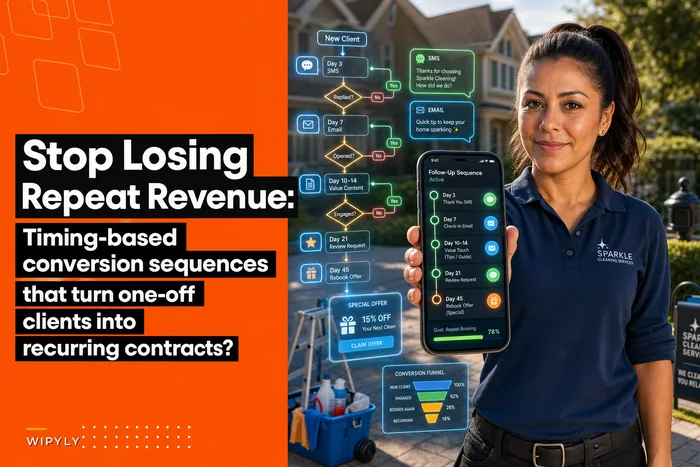
This is overkill when emergencies are genuinely rare—a true one-off per quarter doesn't justify building bands and templates, though even then a captured acceptance step is still worth doing. It's also the wrong tool if your real problem is that emergencies are eating your scheduled recurring revenue entirely. In that case the fix isn't a better emergency workflow—it's reconsidering whether you should be taking that volume at all, or figuring out how to convert one-off rush jobs into recurring contracts instead of ongoing scrambles.
Who should not rush into this: operators without any mobile evidence habit yet. If your crews can't reliably capture a timestamped photo and a quick acceptance in the field, start there. The whole workflow depends on evidence being captured at the moment of the quote and at the moment of scope change. Without that, you've built a nice-looking process that collapses at exactly the points it's supposed to protect.
Where the system pays off
The honest reason this is hard to run on paper is that emergencies happen at the worst times—end of day, weekends, mid-route—and the person classifying the band, pulling the template, and capturing acceptance is usually also the person trying to keep the rest of the day from falling apart.
That's where workflow software earns its place. When the band selection, the matching offer template, the two acceptance gates, and the completion sign-off all live in one flow on a phone, the field confirmation and the office record become the same record. The documentation happens automatically at the two moments you'd otherwise skip it—not because someone remembered to do it, but because the next step in the workflow won't proceed without it.
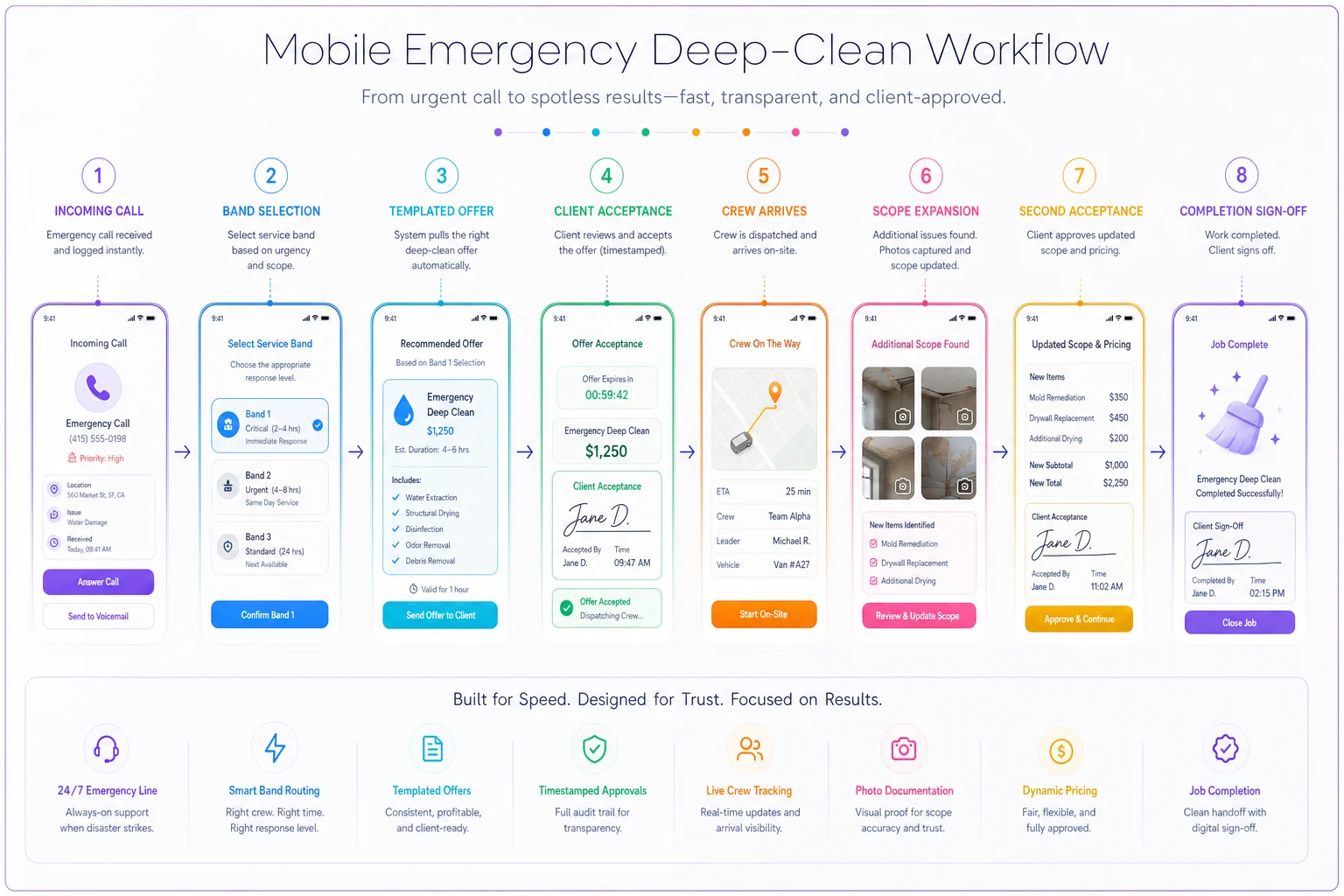
This sketch shows the minimal flow you'd enforce in software so the two evidence gates are unavoidable and time-stamped.
But the tooling is downstream of the thinking. Build the three bands, write the ranged templates with named exclusions, set the surge rules before you need them, and require captured acceptance at quote and at any scope change—and you've already solved most of the leak.
But the tooling is downstream of the thinking. Build the three bands, write the ranged templates with named exclusions, set the surge rules before you need them, and require captured acceptance at quote and at any scope change—and you've already solved most of the leak. The emergency deep clean workflow doesn't make you slower. It makes the speed safe, so the jobs you used to dread become the ones you actually want on the board.
Ready to simplify your cleaning operations?
Join 1,000+ cleaning businesses using Wipyly to save time, reduce scheduling conflicts, and enhance client satisfaction.