

Most cleaning operators don't fail an insurer review because they lacked coverage. They fail because the day a slip-and-fall claim lands, nobody can produce the evidence that proves the floor was signed off three hours earlier. The certificate of insurance existed. The site had the right indemnity limits. But the chain connecting what happened on the floor to what the contract required to what the insurer needs to see was never built.
That gap is the real subject of risk governance for cleaning operators. Not the paperwork — the system that keeps the paperwork honest and retrievable under pressure. And this system is almost never designed on purpose. It accumulates. A contract clause here, a COI request there, a safety log someone started during an audit panic. By the time you're running 15 commercial sites, you have risk fragments scattered across email, a shared drive, three supervisors' phones, and your broker's inbox.
This article walks through how the whole thing connects — policy layers, evidence, claim timelines, indemnity specs, and escalation — and where it quietly breaks as you scale.
The three policy layers most operators collapse into one
Here's a distinction that saves a lot of pain once you see it. Risk governance in cleaning isn't one policy. It's three layers stacked on top of each other, and they have different owners, different update cadences, and different failure modes.
Company layer. Your master insurance program — general liability, workers' comp, auto for the vans, umbrella coverage. This is the floor. It rarely changes except at renewal.
Contract layer. What each client's agreement actually requires of you — minimum indemnity limits, additional-insured endorsements, waiver of subrogation, hold-harmless language, specific incident-reporting windows. This varies wildly. A healthcare account might demand $5M aggregate and 24-hour incident notification. A small retail strip wants $1M and doesn't care.
Site layer. The operational reality on the ground — the safety protocols, wet-floor signage rules, chemical handling, restricted-access procedures that a specific building enforces regardless of what the contract says.
The common mistake is treating these as one blob. An operator pulls the company COI, sends it to every client, and assumes they're covered. Then a hospital account's contract required a waiver of subrogation that the standard policy didn't include, and now there's a coverage gap nobody noticed until a claim exposed it.
What breaks at scale is the mapping between layers. At three accounts, the owner remembers which contract needs what.
| Layer | Owner | Update cadence | Typical failure |
|---|---|---|---|
| Company | Owner / broker | Annual renewal | Lapsed endorsement nobody flagged |
| Contract | Account manager | Per contract + renewal | Indemnity requirement missed at signing |
| Site | Area / site supervisor | Ongoing | Safety log stops being filled in month 2 |
At thirty, that knowledge lives in one person's head, and when they're out sick during an insurer request, the whole thing stalls. A clean risk governance model keeps an explicit matrix: this site, this contract, these indemnity requirements, this evidence standard, this reporting window. The matrix is boring. It's also the single most valuable document you'll build.
Why this falls apart the same way across almost every operator
The pattern is remarkably consistent. Risk governance starts strong — usually right after a scare or a lost account — and then decays because nobody owns the maintenance of it.
Stop losing bookings in operational chaos.
Wipyly helps you manage, confirm, and optimize every cleaning appointment efficiently.
- Centralized booking management
- Automated client notifications
- Staff scheduling & route optimization
No credit card required
In real operations, this usually happens in a predictable sequence. A claim or a demanding new client forces you to tighten up. You build checklists, you start logging incidents, you get your COIs organized. For about two months everything is sharp. Then the operational pressure returns. A supervisor quits. Two accounts onboard the same week. The logging slips from daily to "when something feels risky." Six months later your evidence trail has holes exactly where you'd need it most.
The deeper reason is that risk evidence produces no visible value on normal days. Routing saves fuel you can measure. QA scores move renewal odds you can see. But a perfectly documented wet-floor sign-off on a day nothing went wrong feels like wasted effort — until the one day in 400 it isn't. Human nature quietly deprioritizes insurance you don't think you'll use.
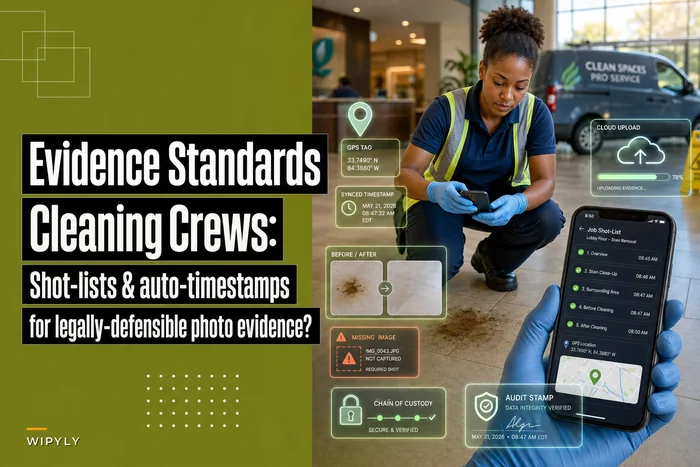
What tends to separate the operators who actually maintain governance from the ones who don't is that the former don't rely on willpower. They tie evidence capture to work that has to happen anyway. The crew already photographs completed restrooms for QA. The governance system just makes sure those photos carry timestamps, location data, and a chain-of-custody trail that would survive an insurer or a courtroom. If you're building that capture discipline, the mechanics in mobile evidence standards for cleaning crews are the foundation — governance sits on top of them.
The evidence bundle: what an insurer actually wants to see
When a claim hits, the insurer or their adjuster asks for a bundle. Not a story. A bundle. The operators who get claims resolved fast — and keep their premiums from spiking — are the ones who can assemble it in hours, not weeks.
-
The scope of work for that site, showing what you were and weren't responsible for
-
The schedule record proving who was on site and when
-
Timestamped completion evidence for the relevant area (the sign-off photos, the task log)
-
The incident report filed within the contract's required window
-
Safety protocol records — signage logs, training records for the crew on site, chemical handling compliance
-
The relevant COI and endorsements proving coverage was active and matched the contract
-
Communication trail — any client notifications, maintenance requests you flagged, prior complaints about that area
The point most operators miss: the bundle isn't assembled after a claim. It's assembled continuously, and the claim just triggers retrieval. If you're scrambling to reconstruct who cleaned the lobby three weeks ago, you've already lost. The adjuster reads scrambling as weak documentation, and weak documentation shifts liability toward you.
A typical example looks like this. A grocery client reports a customer slip in an aisle your crew serviced. Your contract required incident notification within 24 hours and wet-floor signage during any wet process. If you can produce a timestamped photo showing the floor was dry and signed off at 6:10 AM, the store opened at 7, and the fall happened at 11:30 — the evidence points squarely away from your crew. Without that photo, it's your word against a claim, and insurers settle those by paying.
Minimum indemnity specs — and the trap of saying yes to everything
Indemnity requirements are where contract negotiation and risk governance collide. Clients increasingly push for higher limits, broad hold-harmless clauses, and additional-insured status that extends your coverage to protect them for their negligence.
The mistake operators make under revenue pressure is agreeing to indemnity language they never priced. A client demands $5M aggregate and a hold-harmless clause so broad it covers claims arising from the building's own conditions. The operator signs, because the account is worth roughly $90k a year and losing it feels worse. Then the premium increase to support those limits eats $4k–$6k of margin they never built into the quote, and the broad clause creates exposure their policy might not even cover.
A disciplined minimum-indemnity spec does two things. First, it sets your standard limits per contract tier — small sites, mid accounts, large institutional. Second, it defines which clauses you'll accept, which you'll negotiate, and which are hard stops. Broad hold-harmless that covers the client's sole negligence? Usually a hard stop or a serious reprice. Mutual indemnity where each party covers their own fault? Reasonable.
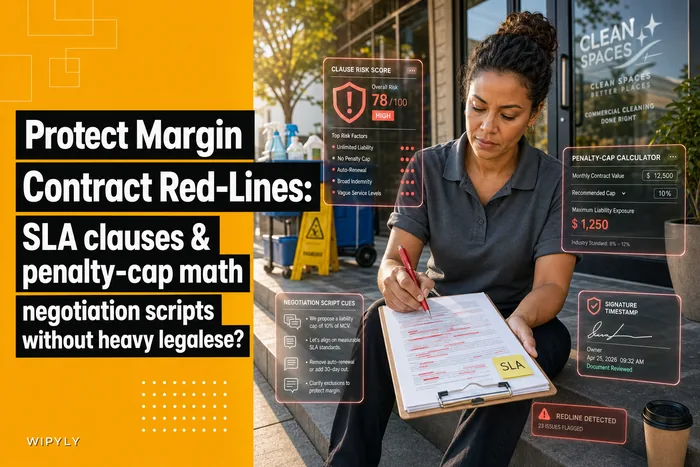
This is really a pricing-and-protection problem, and it connects directly to how you write contracts. The defensive clauses and negotiation moves in contract red-lines and SLA language that protect margin pair with your indemnity spec — one sets the limits, the other sets the language that keeps those limits from becoming a trap.
When higher indemnity actually makes sense
Not every demand for higher limits is a trap. Institutional accounts — hospitals, universities, large property managers — genuinely carry more risk and more claim exposure. If the account is large enough to absorb the premium cost in the quote, and the work is high-stakes, carrying $5M isn't overkill. It's the price of playing in that tier.
When it's a bad idea
If a small account with $30k annual value demands institutional-grade limits and broad indemnity, the math rarely works. You either reprice it to reflect the real risk cost or you walk. Operators who say yes to subsidize a relationship usually discover the relationship wasn't worth the exposure.
Claim timelines and escalation ladders tied to real operations
A claim has a clock the moment it exists, and most of that clock runs before you even know there's a problem. The contract's notification window started when the incident happened, not when the client called you. If your contract requires 24-hour notification and the client tells you on day three, you may already be out of compliance — which insurers use to contest coverage.
This is why the escalation ladder has to be wired into daily operations, not stored as a policy document. The ladder defines who does what, in what order, within what timeframe, the moment something goes wrong on a site.
-
Crew-level (immediate) Anyone who witnesses or learns of an incident reports it to the site supervisor before leaving. No exceptions, no "I'll mention it tomorrow."
-
Supervisor (within the hour) Supervisor secures the scene if needed, captures evidence — photos, witness names, conditions — and logs a preliminary incident report.
-
Account manager (same day) Reviews the report against the contract's notification window and indemnity terms, notifies the client if required, and flags the broker.
-
Owner / risk lead (within 24 hours) Decides whether this is a notify-the-insurer event, assembles the evidence bundle, and starts the claim file.
-
Broker / insurer (per contract window) Formal notification with the bundle attached.
The failure point is almost always step one. Crews under-report because they're worried about blame, or they genuinely don't recognize what counts as an incident. A near-miss, a client complaint about a wet floor, a mop bucket left in a corridor — these feel minor until one becomes a claim. Governance that works makes reporting safe and routine so the ladder actually starts when it should.
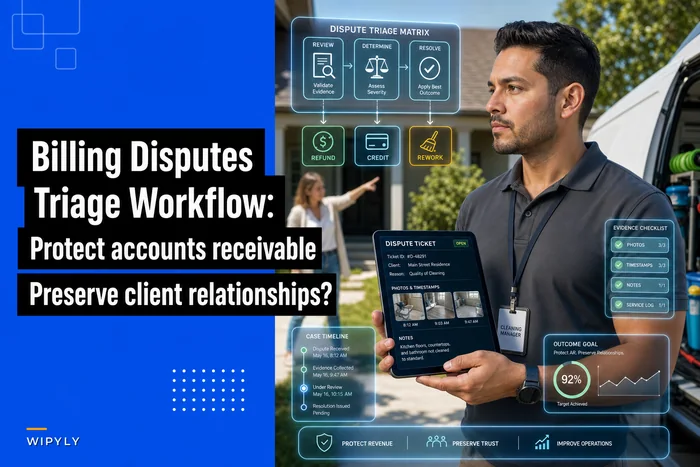
Billing and disputes ride on this same backbone. A client who files a claim often disputes the invoice too. The same evidence discipline that protects you on liability protects your receivables — the logic in a billing-dispute triage workflow runs on the same documentation your claim bundle uses.
Audit cadences: how you keep the system from decaying
The whole point of governance is surviving the slow decay that kills every un-maintained system. That means cadences — scheduled checkpoints where someone verifies the risk layers still match reality.
-
Weekly (supervisor) Spot-check that evidence capture is happening on each site. Are sign-off photos landing with timestamps? Are safety logs current?
-
Monthly (account manager) Verify each active contract's COI is current, endorsements match requirements, and no incident reports are sitting unresolved.
-
Quarterly (owner / risk lead) Reconcile the full policy-layer matrix. Any new contracts added? Any indemnity requirements that slipped through at signing? Any sites where the safety protocol drifted?
-
Annually (with broker) Full program review before renewal — claims history, limit adequacy, premium drivers, any gaps a claim exposed during the year.
Tie monthly COI checks to invoice cycles so missing endorsements surface during billing.
SLA governance and risk governance overlap more than most operators realize. The same monthly review that checks service performance should check evidence integrity. When penalties and cure periods are on the line, your evidence is your defense — which is why the audit mindset in SLA penalty mitigation for cleaning contracts and risk evidence standards are really the same discipline pointed at different threats.
Where software quietly carries the weight
None of this survives on spreadsheets past a certain size. The reason isn't that spreadsheets can't hold the data — it's that they can't enforce the connections. A spreadsheet won't stop a supervisor from skipping a sign-off photo. It won't flag that an account's COI expired last Tuesday. It won't assemble a claim bundle by pulling schedule, evidence, and contract records into one file.
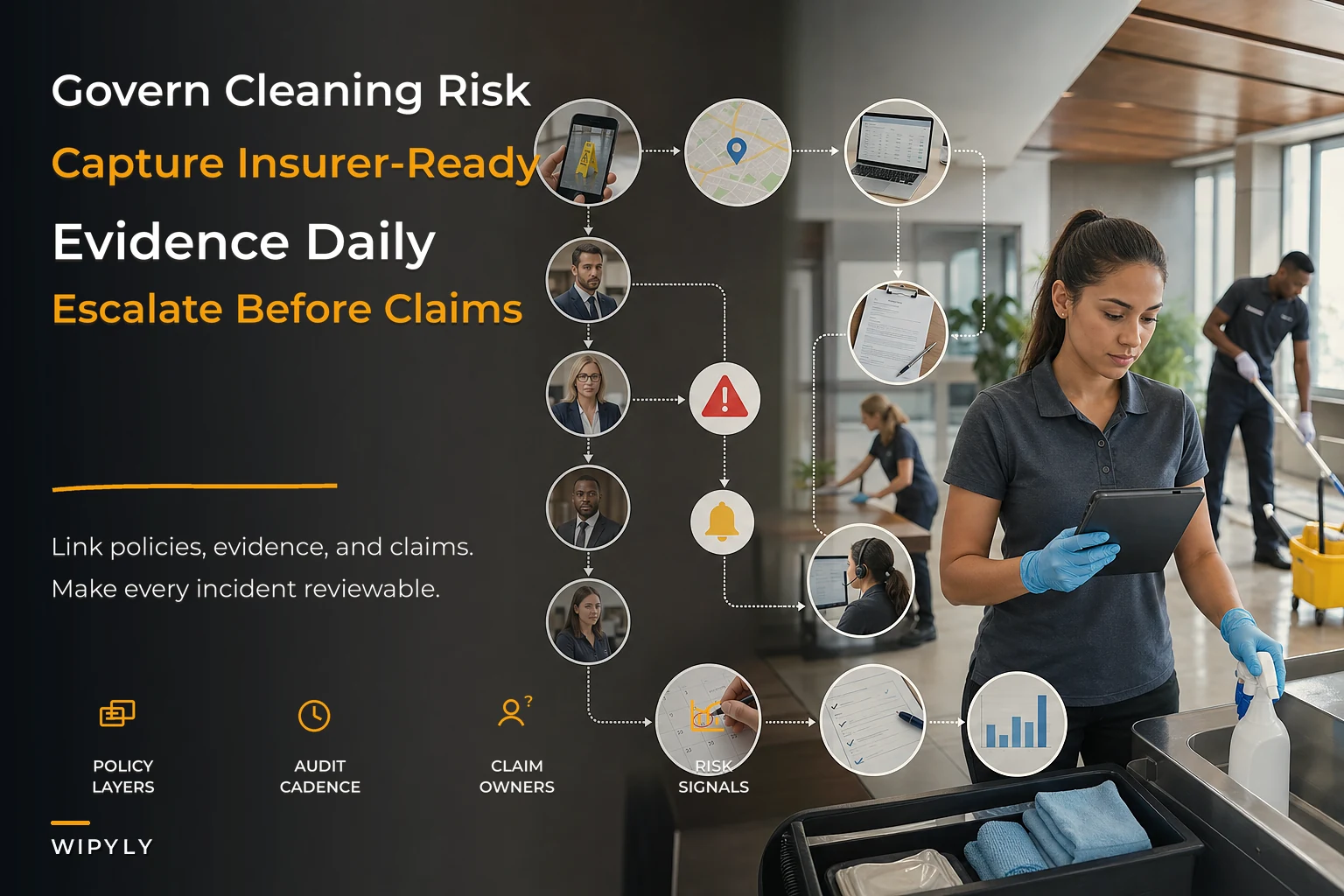
This is where an operational platform earns its place — not as a risk product, but because the evidence you need for governance is already flowing through the system that runs your daily work. When crews log completions, timestamps and photos are captured automatically. When a contract is onboarded, its indemnity requirements and notification windows attach to the account record. When an incident is reported, the escalation ladder triggers and the relevant records are already linked. AI-assisted capture can flag a missing sign-off before the crew leaves the site, or surface a lapsing COI during the monthly review instead of after a claim.
Below is a simple visual of how workflow, capture, contracts, and audits connect in a system that builds the claim bundle automatically.
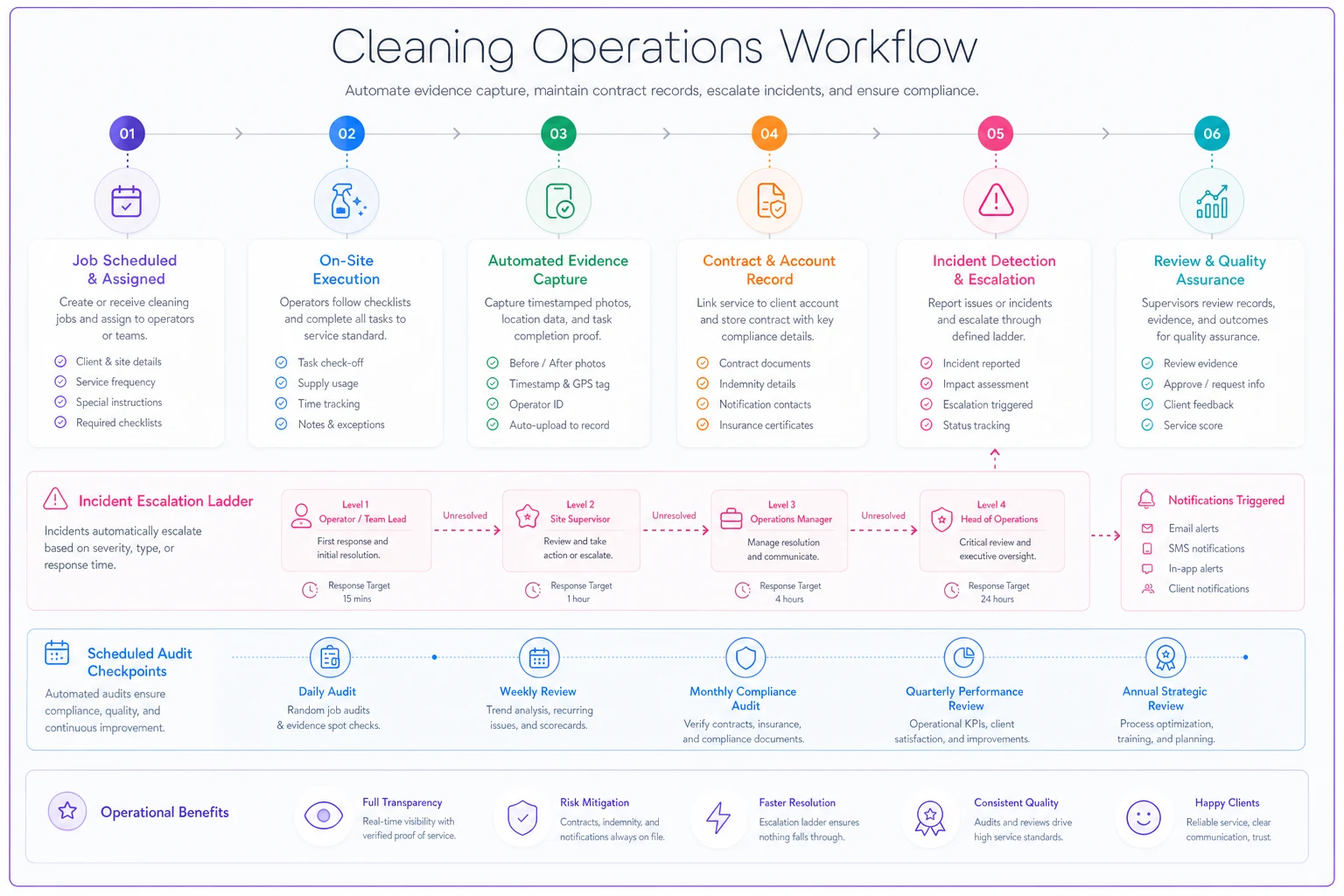
The point isn't automation for its own sake. Governance built on manual discipline decays. Governance built into the workflow doesn't — because the evidence gets created as a byproduct of work that has to happen anyway.
A real scenario
A mid-sized operator running about 22 commercial accounts — mix of retail, two medical office buildings, and a few schools — got hit with a liability claim at one of the medical sites. A patient slipped near a restroom their crew had serviced that morning. The contract required 24-hour incident notification and specific signage during wet work.
The problem: their evidence lived in four places. Sign-off photos were on the supervisor's personal phone with no reliable timestamps. The safety log hadn't been updated in weeks. The COI on file was the company default — it was missing the additional-insured endorsement the medical contract required. It took them close to three weeks to assemble a partial bundle, and the missing endorsement triggered a coverage dispute with their own insurer.
The claim ultimately settled, but between the settlement contribution, legal time, and the premium bump at renewal, the real cost landed somewhere around $14k–$18k — on an account worth roughly $70k a year. The medical client put them on notice shortly after.
After that, they rebuilt governance around connected capture. Sign-off photos now carry automatic timestamps and site tags. Each contract's indemnity requirements and notification windows live on the account record. Monthly reviews catch expiring COIs. When a near-miss happened at a school site eight months later, the supervisor logged it within the hour, the account manager notified the client the same day, and the bundle was retrievable in under an hour. No claim materialized — but if it had, they'd have been ready. The difference wasn't more paperwork. It was paperwork that assembled itself from work already being done.
Who should not over-build this
Worth saying plainly: if you're running two or three small residential-heavy accounts, a full enterprise governance program is overkill. You need current insurance, basic incident logging, and clean COIs. Building quarterly matrix reconciliations for three accounts is wasted motion.
The inflection point is usually institutional or multi-site commercial work — the moment a client's contract starts dictating your indemnity limits, notification windows, and evidence standards. That's when fragments stop being survivable and the connected system starts paying for itself. If your accounts aren't demanding that yet, build the habit of timestamped evidence capture now, and let the governance layer grow as the contracts do.
Pulling it together
Risk governance for cleaning operators isn't a binder and it isn't a certificate. It's a living connection between what your contracts require, what your crews do on site, and what your insurer needs to see when something goes wrong. The three policy layers have to stay mapped to each other. Evidence has to be captured continuously, not reconstructed in a panic. Indemnity specs have to be priced, not just signed. Escalation has to start at the crew the moment an incident exists. And audit cadences have to keep the whole thing from quietly decaying the way it always tries to.
The operators who get this right don't treat risk as a separate function bolted onto the business. They treat it as something that emerges from running operations well — tight evidence, clean contracts, disciplined reporting. Do the daily work properly, capture it as you go, and the governance mostly takes care of itself. Skip it, and you'll build the whole system anyway — just under the worst possible conditions, right after a claim, when it's already too late.
Ready to simplify your cleaning operations?
Join 1,000+ cleaning businesses using Wipyly to save time, reduce scheduling conflicts, and enhance client satisfaction.