

Most cleaning company owners don't lose control all at once. It happens in pieces — a pricing call made without them here, a client concession there, a supervisor who quietly changed a scope and nobody wrote it down. Individually, none of it feels dangerous. But stack twelve months of those small decisions and you end up with an operation that technically has managers, yet still routes every real decision back to the founder's phone at 7pm.
That's not a delegation problem. It's a governance problem. And it behaves very differently depending on how big you are.
At 3 vans, "governance" is you remembering everything. At 15 vans, it's a set of rules about who is allowed to decide what, how fast, and what triggers a decision to move up. Skip building that middle layer and growth doesn't make you money — it makes you a bottleneck with a bigger payroll.
This article covers the actual wiring: mapping decision domains to roles, setting the gates and dollar limits that let people act, building escalation ladders with timing so nothing rots in someone's inbox, and tying it all to dashboards that have real owners. Not theory. A skeleton you can copy.
Why control quietly leaks as you grow
Almost every scaling cleaning business hits the same pattern. In the early days the founder is the governance layer. Pricing, hiring, client complaints, supply orders, scope changes — everything flows through one head. That works surprisingly well up to a point because the founder has full context on every account.
-
The founder holds on. Decisions queue up behind them. Crews wait. Clients wait. A same-day scope question that should've taken 90 seconds sits for six hours because "let me check with the owner." You've built a fast field team feeding a slow brain.
-
The founder lets go, but without rules. Supervisors start deciding things — pricing exceptions, comps, overtime approvals — and everyone's calibrated differently. One supervisor gives away $400/month in goodwill cleans. Another refuses a reasonable ask and loses a $30k account. The founder has no idea either happened until the numbers show up funny.
Both failure modes come from the same missing piece: nobody wrote down which decisions belong to which role, or what the limits are.
What shows up repeatedly across these operations is that owners over-delegate tasks and under-delegate decisions. They'll happily hand off "go clean the building" but not "you're allowed to approve up to $150 of extra work on-site without calling me." The task moves. The decision doesn't. The whole thing jams at exactly the points where speed matters most.
The core idea: decision domains, not job titles
The mistake is trying to delegate by title — "area managers handle operations." Too vague. What counts as an operational decision? Is a client refund operational? Is buying a replacement machine operational?
Stop losing bookings in operational chaos.
Wipyly helps you manage, confirm, and optimize every cleaning appointment efficiently.
- Centralized booking management
- Automated client notifications
- Staff scheduling & route optimization
No credit card required
Governance works when you break the business into decision domains and assign each domain a gate per role. A gate is just: at what threshold can this person decide alone, and above which threshold does it move up?
-
Pricing & scope (quotes, discounts, change orders, comps)
-
Client relationship (concessions, complaint resolution, contract terms)
-
Labor (overtime, hiring, disciplinary action, subcontractor use)
-
Spend (supplies, equipment, repairs, fuel exceptions)
-
Quality & compliance (failed audits, safety incidents, regulatory issues)
-
Schedule & routing (reassignments, emergency dispatch, coverage gaps)
Once you name the domains, delegation stops being a personality thing and becomes a table. And a table is something you can train people on, audit, and adjust.
One thing worth saying upfront: your thresholds will be wrong the first time. Everyone's are. The point isn't to get the numbers perfect — it's to get them written down, so when they're wrong you can see it and move the line instead of relitigating every decision from scratch.
A decision-mapping template you can adapt
Below is a starter matrix. Adjust the dollar figures to your margins — a $200 comp means something very different at $80k/month revenue than at $500k/month.
| Decision domain | Crew lead | Area supervisor | Ops manager | Founder |
|---|---|---|---|---|
| On-site scope add | Up to ~$75 w/ photo | Up to ~$300 | Up to ~$1,000 | Above $1,000 |
| Client discount / comp | None | Up to 1 clean or ~$150 | Up to ~$500/mo | Contract-level changes |
| Overtime approval | None | Up to 8 hrs/week per crew | Up to 25 hrs/week | Structural / recurring |
| Supply reorder | Standard list only | Non-standard up to ~$400 | Up to ~$2,000 | Vendor changes |
| Equipment repair | Report only | Approve up to ~$500 | Up to ~$3,000 | Replacement decisions |
| Hire / fire | Recommend | Hire cleaners; recommend fire | Fire; approve hires | Salaried roles |
| Failed quality audit | Fix same-day | Root-cause + coach | Pattern across sites | Client-facing risk |
| Emergency coverage | Reassign own crew | Reassign within zone | Cross-zone / subcontractor | — |
First, every below-the-line decision is "act, then log" — not "ask, then act." If a crew lead can approve a $60 scope add, they do it, snap a photo, and it's recorded. No call needed. That's the entire point. You've pre-approved the class of decision so the individual instance doesn't need a conversation.
Start with rough gates and trust the weekly reviews to move them outward if decisions keep escalating.
Second, above-the-line decisions have a defined path up — with a clock on it. Which brings us to the part most people forget.
Escalation ladders (with timing that actually holds)
A decision map without timing is half a system. It tells people who decides but not how fast, and "how fast" is where cleaning companies bleed. A furious client on a Friday afternoon doesn't care about your org chart.
An escalation ladder answers three questions for every above-the-line decision:
-
Who does it go to first?
-
How long do they have before it moves up automatically?
-
Who's the backstop if that person is unreachable?
That auto-escalation timing is the piece people skip, and it's the piece that saves you. Without it, a stalled decision just... stays stalled. Nobody's technically at fault because nobody was technically responsible for chasing it.
A realistic ladder for a client complaint:
-
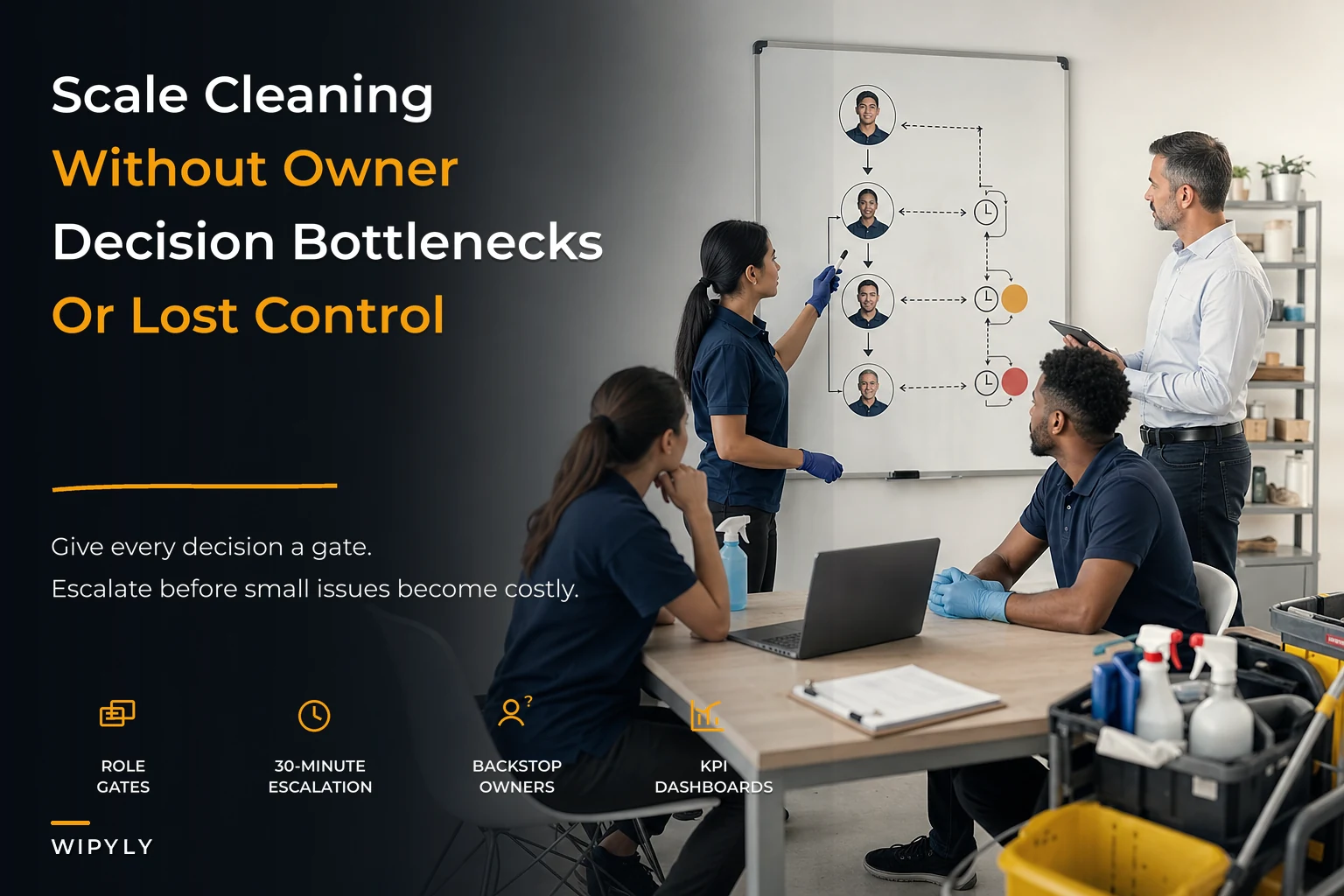
Crew lead attempts resolution on-site immediately. Involves money above their gate, or client stays unhappy → escalate within 30 minutes.
-
Area supervisor responds, resolves if within their gate. Unresolved or above gate → escalate within 2 hours (same business day).
-
Ops manager handles account-level risk, authorizes larger concessions. Contract-threatening issues → escalate within 4 hours.
-
Founder only touches things that risk the relationship or set precedent.
The timing tightens as urgency rises and loosens as it moves up. A safety incident ladder would be brutal — minutes, not hours. A supply shortage ladder can run on days. Match the clock to the cost of delay.
One pattern worth flagging: escalation ladders fail most often not because people don't know the steps, but because the backstop is missing. Your ops manager is on a plane, the decision hits their inbox, nobody's named as alternate. Every rung needs an "if unreachable, goes to ___." Write it down.
Here's a simple escalation workflow that maps the ladder and timing in a glance.
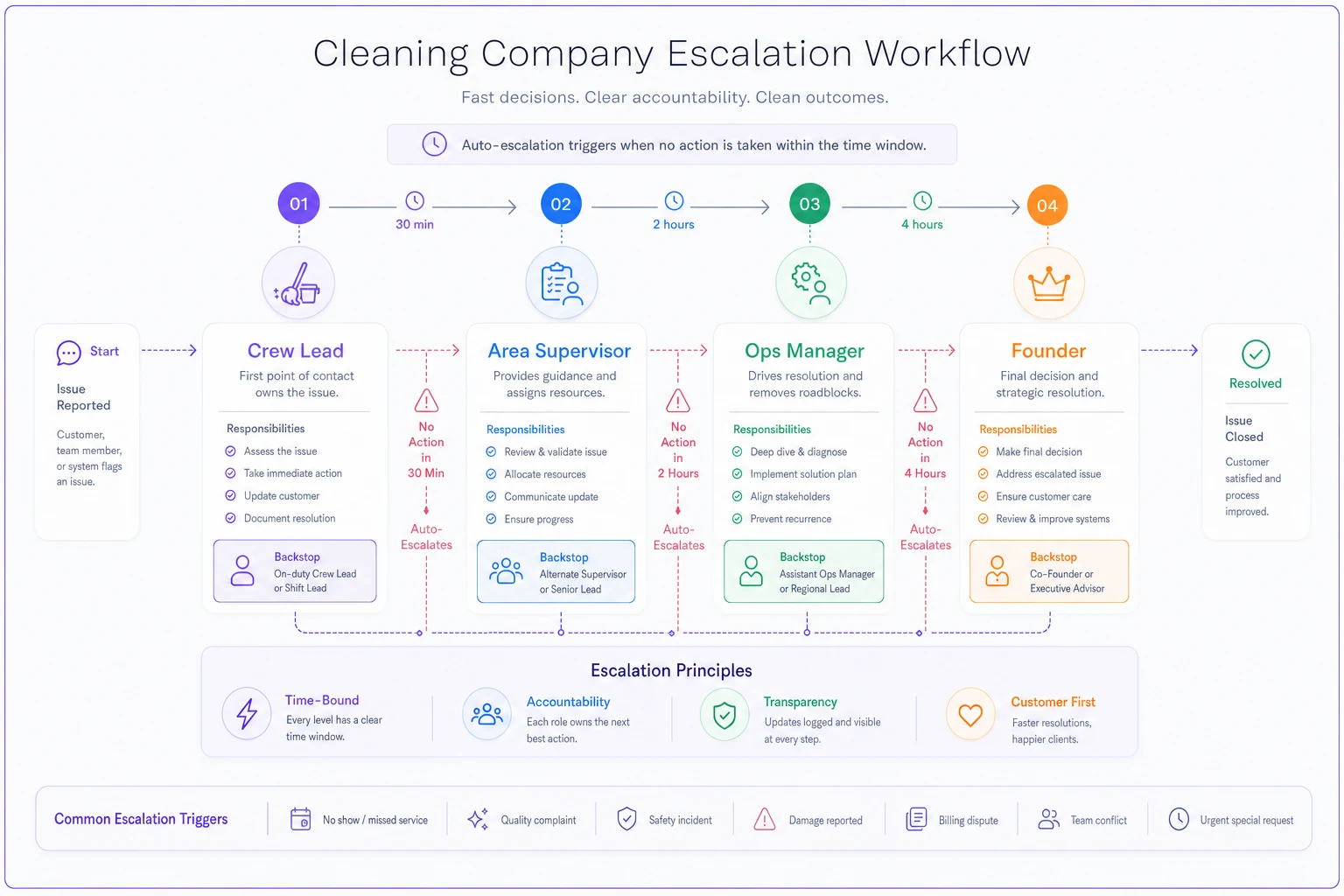
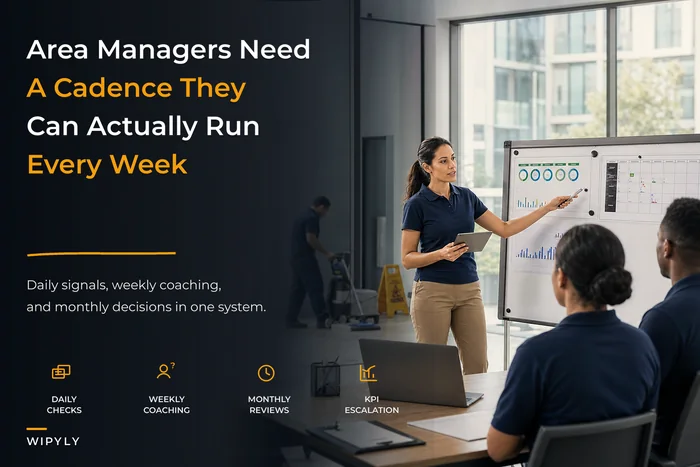
For the day-to-day cadence side of this — who checks what, when — the area manager playbook covering daily, weekly and monthly cadences and escalation rules pairs directly with the ladders here. The gates say what people can decide; the cadences say when they look.
Every dashboard needs one owner (this is where most systems die)
You can have perfect decision maps and perfect ladders and still lose visibility, because governance without accountability is just hope. If you can't see whether the gates are being used well, you're delegating blind.
The mistake almost everyone makes with dashboards: they build a board nobody owns. Everyone can see it, so nobody feels responsible for it. Numbers drift, red cells sit red for weeks, and the dashboard becomes wallpaper.
-
First-time quality rate → owned by the ops manager. Falls below target → triggers root-cause review.
-
Scope-add volume & value → owned by ops manager. Spikes → someone's under-quoting or a client's abusing goodwill.
-
Comp/discount spend by supervisor → owned by founder or finance. This is your delegation-drift alarm.
-
Escalation response time → owned by the ops manager. Decisions routinely blowing past the auto-escalate window means your ladder is broken or someone's overloaded.
-
Overtime hours vs. approved → owned by area supervisors, rolled up to ops.
The escalation-response-time metric is the sneaky important one. It's the only number that tells you whether your governance system is actually running or just written in a doc nobody follows. Decisions consistently escalating late usually means the gate is set too low — people are being asked to escalate things they should've been trusted to handle themselves.
Where this connects to the rest of the operation
Governance isn't a standalone thing. It sits on top of everything else and only works if the layers underneath are solid.
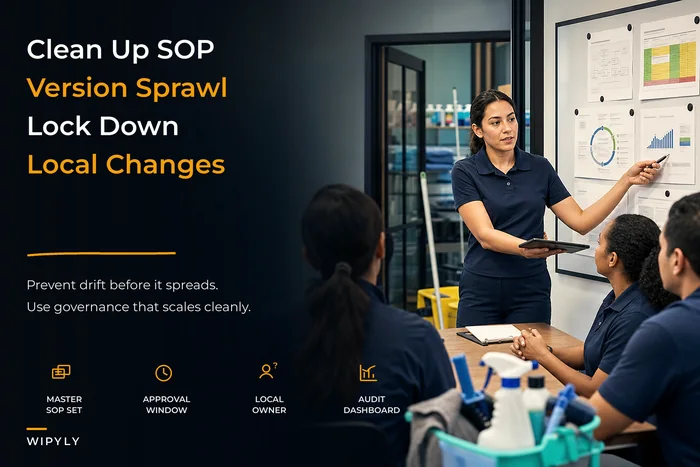
Your decision gates are only as good as your SOPs, because a gate says "you can decide this" and the SOP says "here's how." If the underlying procedure keeps changing and nobody knows which version is current, delegated decisions will be inconsistent no matter how clean the matrix is. That's why version control and role-based permissions matter — the thinking in preventing quality drift through SOP versioning and delegated governance is essentially the foundation this whole blueprint stands on.
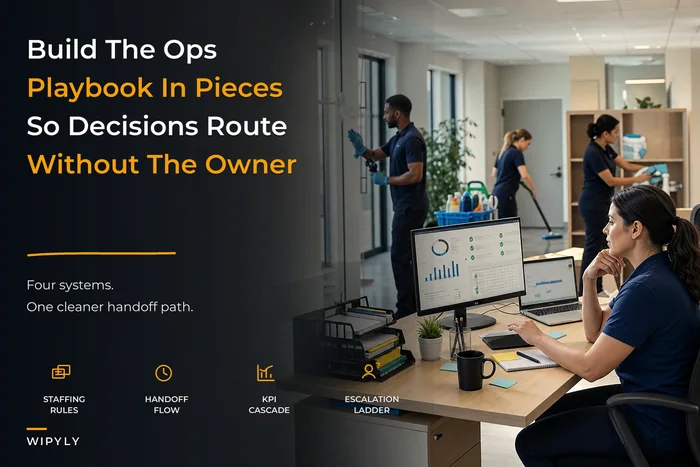
And none of it holds without a documented operational backbone to attach it to. If you're still running the business out of your head, gates and ladders will feel like extra bureaucracy. They only become natural once you've got a real modular operations playbook that scales with the business — the governance layer is what makes that playbook enforceable instead of aspirational.
Roughly how the three fit together: the playbook defines how work happens, SOP governance keeps the how consistent as it changes, and this decision-and-escalation system defines who's allowed to bend the rules and how fast when reality doesn't match the plan. Reality never matches the plan. That's the whole reason governance exists.
A real scenario: the 14-van operator who couldn't take a vacation
A commercial cleaning company running about 14 vans, somewhere in the low-to-mid six figures monthly, had a classic version of this problem. Two area supervisors, one ops person who was really just a senior scheduler, and a founder who approved everything — scope adds, comps, overtime, supply orders over a hundred bucks.
The symptoms: crews idling on-site waiting for scope approval, roughly 15–20 minutes of paid standby a few times a week across the fleet. Client complaints sitting half a day because supervisors didn't want to promise anything. One quarter where comps quietly ran to something like $2k because nobody had a limit and every supervisor just said yes to keep the peace.
They didn't buy anything fancy. They built the matrix above, set gates — crew leads got a $75 on-site scope gate, supervisors got real comp authority up to one clean, the ops role got actual budget — and put a 30-minute/2-hour clock on the complaint ladder. Then they gave the comp-spend number one owner, reviewed weekly.
Inside about two months: standby time on scope calls basically disappeared because crew leads handled the small stuff themselves. Complaint resolution moved to same-day in most cases. Comp spend dropped significantly, not because they got stingy but because someone was finally watching the number and supervisors knew it. The founder took a week off — first one in a couple of years — and the business didn't call once.
Nothing about that was magic. Decisions moving to the right level, with limits, with a clock, and with someone accountable for the results.
When this makes sense — and when it doesn't
This makes sense when:
-
You've got at least one management layer between you and the crews.
-
You're routinely the bottleneck on routine decisions.
-
You're seeing inconsistency across teams — different supervisors making very different calls on the same situations.
-
You want to take real time off, or you're planning to grow further.
This is premature when:
-
You're under roughly 5 vans and you genuinely still have context on every account. Write down two or three gates, not the whole table. Heavy matrix now is bureaucracy for a company that doesn't need it yet.
Who should not do this: owners who aren't actually willing to let go. Build the matrix and then override your own gates every time someone uses them, and you've made things worse — you've told your team the rules are fake and they should just call you anyway. That trains exactly the behavior you were trying to stop. Either the gates are real or don't bother building them.
Implementation checklist
Work through these in order. Don't try to do all of it in one week.
-
List your six decision domains (pricing, client, labor, spend, quality, schedule).
-
For each domain, set a dollar or scope gate per role — start rough, you'll adjust.
-
Convert "ask then act" into "act then log" for every below-the-line decision.
-
Build escalation ladders for your top 3 time-sensitive situations (complaints, safety, coverage gaps).
-
Add auto-escalation timing to each rung, tightening with urgency.
-
Name a backstop for every rung — the "if unreachable" person.
-
Assign each key KPI a single named owner. No shared ownership.
-
Set thresholds that trigger action, not just numbers that get looked at.
-
Train supervisors on the matrix — walk through 5–10 real past decisions and locate them on it.
-
Review comp/discount spend and escalation-response-time weekly for the first two months.
-
Adjust gates that are getting escalated constantly — that's the signal they're set too low.
That last point matters more than it looks. Governance isn't set-and-forget. The first version will have gates in the wrong place. What tells you they're wrong is your own data — decisions that keep bouncing up the ladder that clearly should've been handled below. Every time that happens, you either move the gate or coach the person. Do that for a couple months and the system calibrates itself to how your business actually runs.
The real payoff
Good governance isn't about control in the micromanaging sense — it's the opposite. The whole point of mapping decisions to roles, putting clocks on escalations, and giving dashboards real owners is so you can stop being the answer to everything and still trust what's happening when you look away.
The owners who scale past the bottleneck aren't the ones who work more hours. They're the ones who did the unglamorous work of writing down who decides what, drew the lines clearly, and then actually respected the lines they drew. Do that and the business keeps running at field speed instead of founder speed. That's what scaling without losing control actually looks like.
Ready to simplify your cleaning operations?
Join 1,000+ cleaning businesses using Wipyly to save time, reduce scheduling conflicts, and enhance client satisfaction.