

Most cleaning operators don't fail because they lack a contingency plan. They fail because they have five disconnected ones. There's a weather plan in someone's head, a supply-shortage spreadsheet nobody updates, a "call the backup guy" text chain, and an unwritten rule that the ops manager handles the rest. Those pieces don't fit together, and when a bad week hits — a supplier ghosts you, two crews call out, and a highway closes the same morning — the gaps show up all at once.
Resilience isn't about having a binder. It's about having a graded response where everyone knows what counts as a minor hiccup versus a real emergency, who owns the decision, and what has to happen in the first 30 minutes. That's what a severity-banded matrix gives you: it connects surge supplies, route disruptions, float pools, and incident runbooks into one system instead of four separate fire drills.
This piece walks through how that system actually fits together, where it breaks as you add vans and accounts, and how to build decision tables that hold up under pressure.
Why resilience plans fall apart (and it's almost never the plan itself)
The core problem with operational resilience in cleaning is that disruptions are correlated, not isolated. A snowstorm doesn't just slow your routes — it also spikes salt and entryway-mat demand, puts half your part-timers out with "my car won't start," and triggers client calls asking if you're even showing up. One event, four simultaneous failures.
Single-threaded plans assume disruptions arrive politely, one at a time. In real operations, the same shock tends to hit supply, labor, and routing all at once. And because each piece lives in a different place — a supply sheet here, a staffing group chat there — nobody sees the whole picture fast enough to triage.
The second reason plans collapse is ownership ambiguity. Ask most owners "who decides to pull a crew off Account A to cover Account B?" and the honest answer is "whoever's awake and picks up the phone." That works at three vans. It does not work at fifteen, where the person making that call might not know Account A has a penalty clause and Account B doesn't.
Resilience also quietly degrades as a business scales. The informal network that made a five-van shop nimble becomes the exact thing that makes a twenty-van shop fragile — because tribal knowledge doesn't replicate, but risk does.
Severity bands: the backbone of the whole system
Everything starts with classifying the event. Not by type (weather, supply, staffing) but by impact. A supplier being two days late and a supplier going bankrupt are technically the same category but wildly different severities. If your response keys off the category rather than the impact level, you'll overreact to small things and underreact to big ones.
Stop losing bookings in operational chaos.
Wipyly helps you manage, confirm, and optimize every cleaning appointment efficiently.
- Centralized booking management
- Automated client notifications
- Staff scheduling & route optimization
No credit card required
Here's a four-band structure that tends to work for cleaning operators:
| Band | Trigger (examples) | Response window | Who owns it | Communication |
|---|---|---|---|---|
| S1 – Minor | One crew short, single supply item low, one route delayed | Same shift, informal | Supervisor / lead | None external unless SLA-impacting |
| S2 – Moderate | 2–3 crews down, key supply out for 48h, one zone disrupted | Within 2–4 hrs | Ops manager | Notify affected site contacts |
| S3 – Major | Multi-zone disruption, supplier failure, >25% labor gap | Within 60 min | Ops manager + owner | Proactive client outreach, documented |
| S4 – Critical | Regional event, multiple account SLAs at risk, safety issue | Immediate | Owner / incident lead | Full client + internal notification |
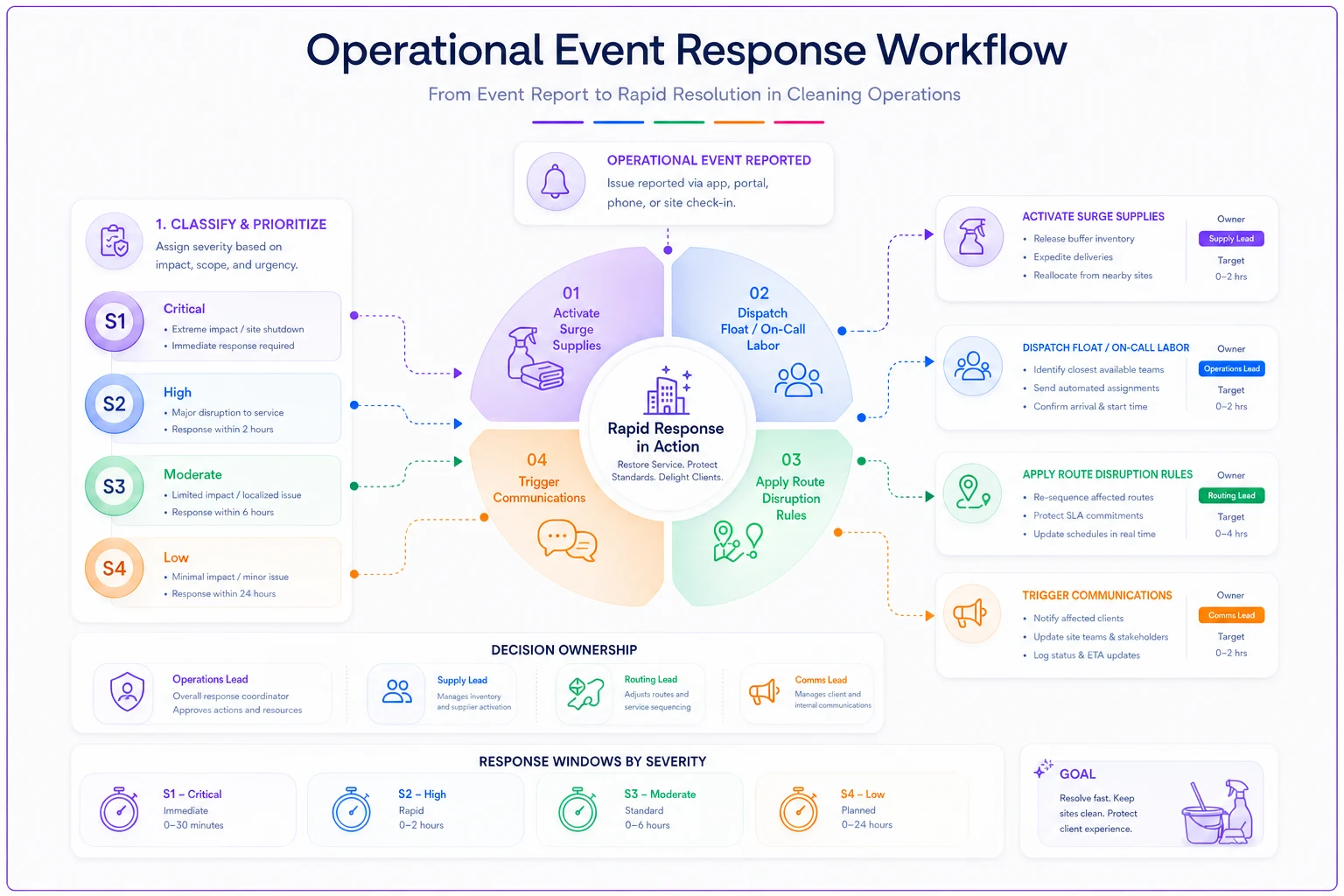
The point of banding isn't the table itself — it's that the band determines everything downstream. The float pool you tap, the supply contract you activate, the redeployment template you pull, and the KPIs you track afterward all key off the severity. One classification cascades into a coordinated response instead of four people improvising.
A common mistake: defining bands by how stressed the ops team feels rather than by measurable triggers. "It feels like a bad day" isn't a band. "Three or more scheduled crews unavailable before 6am" is. Objective triggers let a supervisor classify correctly at 5am without calling the owner to ask.
Surge supplies: contracts, not closets
Stockpiling isn't resilience — it's tied-up cash and expired product. The operators who handle surges well don't hoard; they contract for priority access ahead of time.
A surge-supply arrangement has three things worth negotiating before you ever need them:
-
Priority allocation clause — during regional shortages, you're served before walk-in accounts. This matters more than price. In a real squeeze, availability beats a 4% discount every time.
-
Standing emergency order — a pre-approved SKU list and quantities your supplier can ship on a single phone call or one-tap approval, no re-quoting.
-
Secondary supplier on retainer — not your main vendor, but one you order from quarterly just to keep the relationship warm, so they'll actually answer when your primary fails.
Tie surge-supply triggers directly to severity bands.
A typical example: an operator running around 18 commercial accounts kept a single disinfectant supplier because the pricing was best. When that supplier had a manufacturing issue, the operator was locked out for about nine days. Accounts with healthcare-adjacent requirements couldn't legally be serviced with substitutes, and two renewals got shaky. The fix wasn't a bigger stockroom — it was a second qualified supplier they now order from every quarter. Costs maybe a few hundred dollars more annually and removes the single point of failure entirely.
Tie surge-supply triggers directly to severity bands. S2 might authorize the standing emergency order. S3 activates the secondary supplier. That way nobody debates "is this bad enough to call the backup vendor?" in the moment — the band already answered it.
Float and on-call pools: the labor buffer that actually holds
Supply you can contract for. Labor is harder, because people are unpredictable and float capacity is expensive if it sits idle. The trick is designing a pool that pays for itself before the emergency.
Good float structures aren't a bench of people waiting around. They're a blend:
-
Cross-trained regulars who can jump zones — your most valuable float, because they already know your standards
-
Guaranteed-hours part-timers who take flexible fill-in shifts in exchange for a baseline
-
A warm on-call list of former crew and trusted subs you keep paid and current with occasional shifts
-
A documented "degrade gracefully" protocol — which tasks get skipped when you simply can't fully staff a site, agreed with the client in advance
That last one is underrated. Clients forgive a reduced-scope visit during a storm far more readily than a no-show. The difference is whether you told them what they'd get. Bake a reduced-scope tier into your SLA conversations early and you turn a crisis into a managed event.
The coordination challenge is matching float to the gap fast. Knowing in minutes which float person is closest to the uncovered site, trained on that account, and actually available — that's where resilience lives or dies at scale. The routing logic behind that overlaps heavily with normal day-of dispatch, and the clustering discipline in day-of routing rules for 1–10 vans is the same muscle you flex when redeploying under pressure — just faster and with fewer options.
Route disruption rules: pre-decided, not improvised
Road closures, weather, and vehicle breakdowns all produce the same operational question: which accounts get served, in what order, with what's left? You don't want crews answering that individually in the field, because they'll optimize for their own convenience, not your SLA exposure.
Route-disruption rules should be a short, ranked logic everyone already knows:
-
Protect penalty-bearing and healthcare/critical sites first — these are where a miss costs real money or compliance exposure
-
Preserve first-visit-of-day contractual windows before flexible-window accounts
-
Cluster the survivable losses — if something has to slip, slip the accounts with the most schedule tolerance, and notify them proactively
-
Reassign, don't abandon — a disrupted route folds into the nearest covered route before anything gets dropped
Equipment failures deserve their own callout because a broken machine mid-route can cascade exactly like a road closure. A vehicle down means a crew stranded means a route orphaned. The preventive side of this — keeping that from happening in the first place — sits in your equipment uptime plan, and the two systems should reference each other. Your route-disruption runbook assumes some equipment will fail; your uptime plan reduces how often.
Incident runbooks: the first 30 minutes
A runbook isn't a policy document. It's a sequenced checklist for a specific scenario that someone groggy and stressed can follow correctly. The test of a good runbook: a supervisor who's never handled this exact event can execute it without calling the owner.
A solid S3 incident runbook contains:
-
Classification confirmation — verify the band against objective triggers
-
Owner notification — who gets the call/alert, and the escalation path if they don't respond within X minutes
-
Containment actions — the immediate moves to stop the bleeding (reroute, activate float, trigger surge order)
-
Client communication templates — pre-written, so nobody's drafting a nervous email at 6am
-
Status cadence — how often you update internally until resolved
-
Resolution criteria — what "back to normal" actually means, so the incident formally closes
The named-owner piece is where most runbooks fail. "The team will handle notifications" means nobody does. "Ops manager texts the three affected site contacts using Template C within 30 minutes" is a runbook. Specificity is the whole point.
What breaks at scale — and the KPIs that catch it early
At five vans, resilience is one person's attention. At fifteen or twenty, the failure modes change entirely. Decisions that used to be instant now require someone to know things they can't possibly all know — which account has a penalty clause, which crew is trained on the healthcare site, which supplier contract covers surge pricing.
This is where resilience stops being a plan and becomes a data problem. You can't redeploy intelligently if account priorities, crew certifications, and supply status live in three different heads and two spreadsheets. Centralizing that information — so the person triaging at 5am can see severity, ownership, and options in one place — is what lets a severity-banded system actually function past a certain size. The broader governance structure for this kind of risk coordination is covered in enterprise risk and compliance governance for cleaning operators.
Track resilience with recovery and remediation KPIs, not just "did we survive":
-
Time-to-classify — minutes from event to assigned severity band
-
Time-to-containment — how long until the bleeding stopped
-
Coverage rate during incident — % of scheduled visits delivered (full or reduced-scope)
-
SLA breaches avoided vs. incurred — the dollar-weighted outcome
-
Recurrence rate — how often the same failure hits twice
-
Post-incident remediation close-rate — % of identified fixes actually implemented within 30 days
That last one separates operators who learn from operators who just survive. Every incident should produce one or two concrete changes, with an owner and a date. A float pool that was too thin, a supplier with no backup, a route rule nobody knew — these show up in the post-mortem, and if they don't get closed out, you'll meet them again.
A real scenario
A mid-sized janitorial company running around 22 accounts across two metros kept hitting the same pattern every winter. A storm week would knock out roughly a third of their scheduled visits, and recovery took four to five days because every decision went through the owner's phone. Two accounts churned over consecutive winters, and they were eating a few thousand dollars a year in SLA penalties they never formally tracked.
They didn't buy anything exotic. They built a severity-banded matrix, defined objective triggers, named owners per band, pre-signed a secondary supplier, and wrote three runbooks for their most common events. They added reduced-scope language to the next round of SLA renewals.
The following winter, their time-to-containment dropped from most of a day to under two hours, because the supervisor could classify and act without waiting on the owner. Coverage during the incident landed around 85% including reduced-scope visits, versus the roughly 60% they used to manage. No penalties that quarter, and the two previously shaky accounts renewed. The owner's comment was basically that the storm was no less severe — they'd just stopped improvising.
When this is worth building — and when it isn't
A full severity-banded matrix is overkill for a two or three van owner-operator who's on every job anyway. At that size, your resilience is your attention, and formalizing it adds overhead without much return. Keep a simple backup-supplier contact and a short list of who you call when someone's out.
This becomes necessary when:
-
You're past the point where one person can hold every account's priorities and every crew's skills in their head
-
You have accounts with real penalty clauses or compliance requirements
-
Disruptions are already costing you renewals or penalties you can measure
-
Your ops manager is making triage calls without full context
Worth avoiding if you build the binder and never test it. An untested runbook is worse than none, because it creates false confidence. Run a tabletop drill — walk through a fake S3 out loud with your team — at least a couple times a year. The gaps surface fast when you make someone actually execute it.
Bringing it together
Operational resilience in cleaning isn't a stack of separate contingency plans — it's one graded system where the severity classification pulls the right supplies, labor, routes, and communication into motion together. The band decides; everything else follows. That's what keeps a bad week from becoming a lost account.
The operators who weather disruptions calmly aren't the ones with the biggest stockrooms or the most backup staff. They're the ones who decided in advance what counts as a real emergency, who owns the call, and what the first 30 minutes look like. When the storm hits, they're executing a plan while everyone else is still figuring out whose job it is to panic.
Start with the severity bands. Get the triggers objective and the owners named. The surge contracts, float pools, and runbooks all hang off that spine — and once it's in place, you'll find most disruptions quietly drop a category, because you caught them early instead of discovering them all at once.
Here's a quick visual of the workflow.
Start with the severity bands. Get the triggers objective and the owners named. The surge contracts, float pools, and runbooks all hang off that spine — and once it's in place, you'll find most disruptions quietly drop a category, because you caught them early instead of discovering them all at once.
Start with the severity bands. Get the triggers objective and the owners named. The surge contracts, float pools, and runbooks all hang off that spine — and once it's in place, you'll find most disruptions quietly drop a category, because you caught them early instead of discovering them all at once.
Ready to simplify your cleaning operations?
Join 1,000+ cleaning businesses using Wipyly to save time, reduce scheduling conflicts, and enhance client satisfaction.