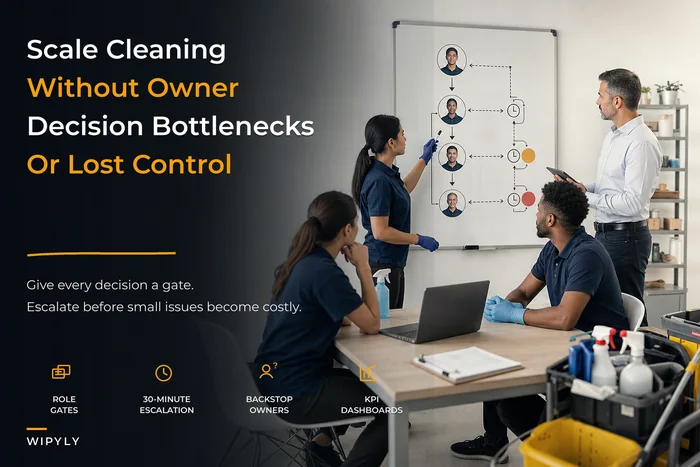



Most cleaning companies don't hit a wall because of demand. They hit it because the founder is still the only real decision-maker at 40 vans that they were at 4. Every escalation, every angry site manager, every "can we clean the third floor tonight instead" routes back to one phone. The revenue grows, but the org chart never actually changes — it just gets taller while the same person keeps making the same calls.
That's the core problem with organizational design for cleaning operators: the structure stays flat and founder-centric long after the headcount stops being flat. You end up with a business that technically has managers but functionally has one brain running everything. This piece is about fixing that deliberately — with role ladders, span-of-control targets, a hiring sequence that doesn't blow up your margins, and delegated decision gates that let people act without dropping quality.
This is an operational breakdown, because that's how it actually fails — layer by layer, function by function.
Where the structure quietly breaks
Before touching org charts, it helps to name the failure points, because they don't all show up at once. They stack.
Failure point 1: The "supervisor" who isn't allowed to supervise. A very common pattern: a company promotes a strong cleaner to "team lead" or "site supervisor," gives them a title and a small raise, and changes almost nothing about what decisions they can actually make. They can't approve a $60 supply run. They can't tell a client "no." They can't move a person off a route. So they escalate everything, and the founder now has more interruptions than before — just with an extra layer added.
Failure point 2: Span of control that makes no sense. One area manager is responsible for 22 sites and 60 cleaners; another "manager" covers 3 accounts. Nobody sat down and decided this — it grew organically as accounts landed. The overloaded manager becomes a bottleneck and a quality risk. The underloaded one is expensive dead weight.
Failure point 3: Decision rights live in someone's head. There's no written line between "you can decide this yourself" and "check with me first." So people either over-ask (slow) or over-assume (mistakes). Both erode trust, which makes the founder pull decisions back in — which is exactly the wrong direction.
Failure point 4: Hiring by panic. Roles get created reactively — right after a bad month, right after losing a key person, right after landing a big contract. The result is a lopsided org: three coordinators and no quality function, or a big sales push with no operations capacity behind it.
What all four have in common: the work grew, but nobody redesigned who owns what. Organizational design isn't the org chart. It's the map of decisions, ownership, and capacity — and that map is what actually breaks under scale.
Think in three layers, not one org chart
The mistake most owners make is trying to design "the org chart" as a single picture. It's more useful to think in three overlapping layers, because they change at different rates as you grow.
Stop losing bookings in operational chaos.
Wipyly helps you manage, confirm, and optimize every cleaning appointment efficiently.
- Centralized booking management
- Automated client notifications
- Staff scheduling & route optimization
No credit card required
-
The delivery layer — cleaners, team leads, site supervisors. This scales fastest and has the highest turnover.
-
The coordination layer — area/ops managers, schedulers, QA. This scales in steps, not smoothly.
-
The direction layer — you, plus eventually an ops director/GM and finance. This should scale last and smallest.
When founders feel overwhelmed, they almost always over-invest in the direction layer — hiring an expensive "operations manager" who's really a glorified assistant — when the actual gap is a missing or under-empowered coordination layer. Fix the middle before you fluff up the top.
Span-of-control targets that actually hold
Span of control is one of the quieter levers in a cleaning operation, but it's what determines whether your managers can actually breathe. Here are working ranges that hold up across most operations. Treat them as starting targets, not laws — complexity matters more than raw headcount.
| Role | Reasonable span | Gets dangerous above | Notes |
|---|---|---|---|
| Team lead / crew lead | 3–6 cleaners | ~8 | On-site, hands-on; span shrinks for complex sites (healthcare, labs) |
| Site supervisor (single large account) | 8–15 cleaners across shifts | ~20 | One site, multiple shifts — coordination-heavy |
| Area / ops manager | 8–14 sites or 40–60 cleaners | ~18 sites | Whichever cap hits first; night routes count as more load |
| Scheduler / dispatcher | 60–120 cleaners' shifts | ~150 | Depends heavily on churn and last-minute change volume |
| QA / field auditor | 15–25 site audits per week | ~30 | Quality drops fast when auditors are rushed |
The number that surprises most people is the area manager row. Once a single manager is past roughly 15 sites, the coaching is the first thing to disappear. They still handle admin, still field escalations, but the walk-alongs, the retraining, the "hey, your corners are getting sloppy" conversations — gone. And that's exactly the work that protects quality over time. If your area managers are stretched thin, the area manager playbook covering daily, weekly, and monthly cadences and coaching checklists is worth working through — the cadence only holds if the span leaves room for it.
A practical rule: when a manager's span crosses the danger column, you don't hand them more help — you split the territory. Adding an assistant to an overloaded manager usually just creates two confused people.
Role ladders: giving people somewhere to go
Turnover in cleaning is brutal partly because there's no visible path forward. A cleaner sees no ladder, so they leave for a dollar more an hour somewhere else. A clear ladder — even a simple one — changes retention math and gives you an internal pipeline for the coordination layer.
Delivery track
-
Cleaner → Senior Cleaner (trusted on complex sites, can train new hires) → Team Lead (owns a crew + quality on their sites) → Site Supervisor (owns a large single account end-to-end)
Operations track
-
Team Lead → Area Manager (multi-site) → Ops Manager / Regional (multiple area managers) → Ops Director
Specialist track (often forgotten)
-
Senior Cleaner → QA/Field Auditor, or Trainer, or Scheduler/Dispatcher
The specialist track matters more than people realize. Not everyone wants to manage people, but plenty of strong cleaners would happily move into a quality or training role. If your only ladder is "become a manager," you lose your best technicians to jobs they don't actually want — and are often bad at.
Each rung needs three things written down: what they own, what decisions they can make alone, and what the pay range looks like. Vague ladders are worse than no ladders because they breed resentment — people who got the title but not the authority or the money notice that gap fast.
A sample RACI for the parts that cause the most fights
RACI (Responsible, Accountable, Consulted, Informed) sounds like consultant overhead until you apply it to the specific decisions that actually generate chaos. Don't RACI your whole business — RACI the contested zones. Here's a starter for the decisions that create the most founder interruptions.
| Decision / task | Cleaner / Lead | Area Manager | Scheduler | Ops Director | Owner |
|---|---|---|---|---|---|
| Same-day callout cover | R | A | C | I | — |
| Supply reorder (under $150) | R | A | I | — | — |
| Supply reorder (over $150) | C | R | — | A | I |
| Client scope change (small, no price change) | C | R/A | I | — | — |
| Client scope change (pricing impact) | — | C | — | R | A |
| Hiring a cleaner | I | R/A | — | C | — |
| Firing / final warning | — | R | — | A | I |
| Approving overtime | I | R | C | A | — |
| Losing/renewing an account | — | C | — | R | A |
Two things worth noticing. First, the owner is deliberately absent from most rows — that's the point. Second, "Accountable" and "Responsible" are usually different people on the rows that matter. The area manager may be responsible for handling a small scope change, but the ops director is accountable that those changes don't quietly bleed margin.
The single most valuable row here is "supply reorder under $150." It looks trivial. But that exact decision — "can I spend a bit without asking" — generates a shocking volume of founder texts. Cutting the owner out of small-dollar spending frees up more mental bandwidth than almost anything else on this list.
Delegated decision gates: how to hand off without losing control
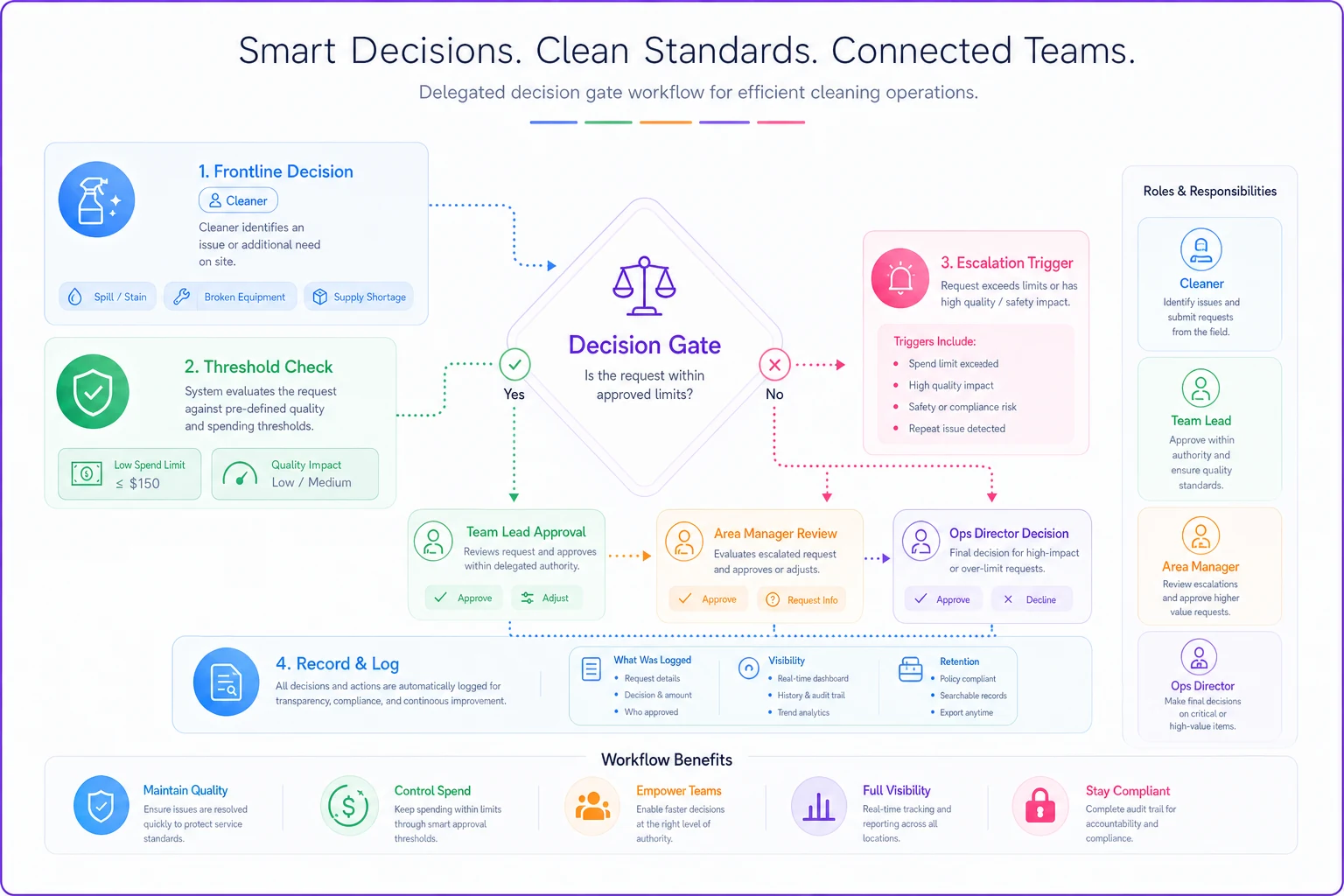
The fear underneath every delegation is: if I let them decide, quality drops or money leaks. Fair concern. But the answer isn't to keep deciding — it's to build decision gates: pre-defined thresholds where a decision is safe to make without escalating, with a clear trigger when it isn't.
-
The decision (e.g., approve a same-day route change)
-
The threshold where it can be made alone (e.g., affects two or fewer sites, no SLA impact)
-
The escalation trigger (e.g., a Priority-1 client, or overtime cost above a set amount)
-
The record — where the decision gets logged so it's reviewable
That fourth part is what makes delegation survivable. You're not giving up visibility; you're giving up real-time approval while keeping after-the-fact review. Founders who won't delegate are usually really saying "I need to see what happened," and they've conflated that with "I need to approve it first." You can have full visibility with zero approvals — those are different things.
A simple visual of the decision gate workflow follows.
This is where the operational governance layer matters. Decision gates handle the moment-to-moment; governance handles the "are we still on track" review. The framework in operational governance for scaling cleaning companies without losing control pairs directly with delegated gates.
And when the decisions being delegated touch how the actual work gets done — SOPs, quality standards, method changes — you need versioning and role-based controls so a well-meaning manager doesn't quietly rewrite a standard that costs you an account. That's covered in preventing quality drift with SOP versioning and role-based controls.
The hiring sequence: what to add, and in what order
Reactive hiring is what produces lopsided orgs. A sequence fixes that. This is a rough order that holds for operators moving from roughly 5–8 vans up toward 30+. The exact trigger points shift with your margins, but the order is what matters.
-
First
a scheduler/dispatcher.
Before you hire another manager, take the scheduling load off yourself. This is usually the highest-leverage first hire — it's the function that eats the most owner hours and the one people cling to longest. -
Second
your first real area manager — with actual authority.
Not just a title. Written decision gates. If you promote from within, this is where your role ladder pays off. -
Third
a QA/field auditor.
Once you're not personally walking every site, quality drift starts. Add the eyes before the problem shows up in a lost contract. -
Fourth
split the area manager territory.
When span crosses the danger line, split rather than assist. -
Fifth
an ops manager over the area managers.
Only once you have two or more area managers who need coordination. -
Sixth — and often done too early
an ops director/GM.
This is the "buy back the founder's time entirely" hire. It fails when done before layers 1–4 exist, because there's nothing structured for them to run.
The most common expensive mistake is jumping straight to step 6 — bringing in a senior operations manager at $70k–$90k to fix chaos, when the chaos is really a missing scheduler and missing decision gates. That person ends up doing dispatch and putting out fires, and everyone concludes "delegation doesn't work here." Delegation didn't fail. Sequence did.
A quick before/after on sequencing
A regional janitorial company running about 26 recurring commercial accounts and roughly 45 cleaners was funneling nearly everything through the two owners. They'd tried hiring an "operations manager" who lasted five months and mostly answered scheduling calls. When they reset the sequence — scheduler first, then two area managers with written decision gates (supply spend under $150, same-day cover, small scope changes), then a part-time auditor — the owners' after-hours interruptions dropped from somewhere around 15–20 a week down to a handful. Overtime came down too, because the area managers could actually manage coverage instead of waiting on approvals. Nothing about the demand changed. Only who was allowed to decide changed.
Founder-to-operator checklist
Run through this honestly.
-
[ ] Have I written down every recurring decision I currently make, and identified which ones only I think I need to make?
-
[ ] Does every management role have a defined span of control — and is anyone currently over the danger line?
-
[ ] Does each role ladder rung have
owned outcomes, allowed decisions, and a pay range?
-
[ ] Are there written decision gates (threshold + escalation trigger + where it gets logged) for spend, scheduling changes, scope changes, and coverage?
-
[ ] Is there a QA function that doesn't depend on me personally inspecting sites?
-
[ ] Can the business handle a same-day callout and a small client scope change without my phone ringing?
-
[ ] Is there a review rhythm so I keep visibility even though I gave up approvals?
-
[ ] Have I hired in sequence — coordination layer before direction layer?
-
[ ] Is there a clear "escalate to me" line, so people know when I actually want to be involved?
-
[ ] If I disappeared for two weeks, what would break first — and is that a role gap or a decision-rights gap?
That last question is the most diagnostic one on the list. If your answer is "everything," you don't have a people problem. You have a design problem.
When this redesign makes sense — and when it doesn't
When it makes sense: You're past roughly 15–20 cleaners, you're personally the escalation point for daily operations, and growth has stalled not for lack of leads but because you can't take on more without breaking. That's the signal the structure is the constraint, not the market.
When it's premature: You're at 4–6 cleaners and building a 4-layer org chart. At that size, formal RACIs and role ladders are overhead. You need a good scheduler and clear standards, not a decision-gate matrix. Design ahead by one stage, not three.
Who should hold off entirely: Owners whose real problem is thin margins or bad account selection. Reorganizing won't fix unprofitable contracts — it'll just give you a nicer chart around a leaky boat. Get account-level profitability sorted first, then redesign the org to scale what actually makes money.
The real shift
Scaling a cleaning company isn't about adding people — it's about moving decisions outward. Every layer of the org exists to absorb a category of decisions so they stop routing back to you. Span-of-control targets keep those layers from collapsing. Role ladders keep good people around long enough to fill them. RACIs and decision gates make it safe to let go without losing sight of quality or spend.
The tools you use to run this — scheduling, QA logging, decision records — matter mostly because they give you visibility without requiring approval. You can watch everything and touch almost none of it. When the design is right, the business keeps making decent decisions on days you're not even looking at your phone. At real scale, that's not a nice-to-have. It's the whole point.
Ready to simplify your cleaning operations?
Join 1,000+ cleaning businesses using Wipyly to save time, reduce scheduling conflicts, and enhance client satisfaction.