


Most cleaning operators treat people problems and contract problems as two separate worlds. HR lives in one spreadsheet, renewals in another, and the two only collide when a national account complains that "the crew keeps changing" — and nobody realizes the complaint started six weeks earlier when a good supervisor quit over pay.
They're the same system. Turnover feeds renewal risk. Renewal risk feeds revenue instability. Revenue instability feeds underinvestment in pay and training, which feeds more turnover. Once you see cleaning people-ops as one connected loop instead of a pile of disconnected HR tasks, it becomes fixable with actual structure instead of gut feel.
This is the blueprint: role families, pay-band math you can defend, promotion gates that aren't just favoritism, coaching cadences that stick, and retention mechanics tied directly to the operational numbers that decide whether a contract renews.
Why people-ops breaks in cleaning companies specifically
The industry has structural pressures that most people-ops advice ignores. Pay sits close to minimum wage in a lot of markets, margins are thin, work happens offsite at odd hours, and supervisors are usually promoted cleaners who've never managed anyone before. That combination produces a very specific failure pattern.
Here's the loop that actually plays out across small and mid-size operators:
A crew lead quits. You scramble to fill the slot — usually by promoting whoever's been around longest, or hiring fast and cheap. The new person doesn't know the site's quirks. The loading dock code, the client who's particular about the lobby glass, the fact that the third-floor break room gets inspected every Friday. Quality dips for a few weeks. The client notices. QA scores slide. Now you're heading into a renewal conversation in a worse position than you needed to be, all because one person left that you could've kept for an extra dollar an hour and a clearer path forward.
What tends to happen across operators of every size: turnover doesn't just cost you the replacement hire. It costs you institutional knowledge of specific sites, and that knowledge is exactly what protects renewals. Site-specific competence is the invisible asset. When it walks out the door, your SLA scores feel it before your HR reports do.
The second thing that breaks: pay decisions get made emotionally and inconsistently. One cleaner negotiates a raise, another doesn't, and six months later you've got two people doing identical work at different rates. Word gets out — it always gets out. Then the underpaid one leaves, and you're back in the loop.
Start with role families, not job titles
Before you touch pay or promotions, you need a clean map of the roles that actually exist in your operation. Not titles — families. A role family is a cluster of jobs with similar responsibility, skill, and autonomy levels. It's what makes pay bands and promotion gates coherent instead of random.
Stop losing bookings in operational chaos.
Wipyly helps you manage, confirm, and optimize every cleaning appointment efficiently.
- Centralized booking management
- Automated client notifications
- Staff scheduling & route optimization
No credit card required
-
Field Cleaner — entry through experienced. Does the work, follows SOPs, may specialize (floors, restrooms, high-detail).
-
Crew Lead / Working Supervisor — still cleans, but runs a small crew, handles site-level problems, does basic QA.
-
Site Supervisor / Account Lead — owns one large account or a cluster of smaller ones. Client-facing. Owns quality and scheduling for their patch.
-
Area Manager — owns a portfolio of accounts and multiple supervisors. P&L awareness, coaching, escalations.
-
Operations / Specialist roles — trainers, QA auditors, equipment techs. Off the main ladder but mapped to it for pay purposes.
The thing most owners miss: these families let people grow without forcing everyone onto a single straight line toward management. Your best floor-care tech might never want to manage people. If your only growth path is "become a supervisor," you lose that person the moment they max out their pay band. A good role-family map gives them a specialist track that pays well and keeps them around.
If you're still working out how these roles fit together as you scale, the thinking in staffing and schedule patterns that let cleaning teams scale with less turnover pairs directly with this — role structure and schedule structure have to move together, otherwise you end up with people stuck in roles the schedule can't actually support.
Building pay bands you can actually defend
A pay band is just a floor and a ceiling for each role family, usually with a midpoint. The point isn't rigidity — it's to make every pay decision explainable. When a cleaner asks "why does she make more than me," you want an answer better than "she asked."
| Role family | Band floor | Midpoint | Band ceiling | Typical time-to-ceiling |
|---|---|---|---|---|
| Field Cleaner (entry) | $15.00 | $16.50 | $18.00 | 12–18 months |
| Field Cleaner (experienced/specialist) | $17.00 | $19.00 | $21.50 | 2–3 years |
| Crew Lead | $19.00 | $21.00 | $23.50 | 2–3 years |
| Site Supervisor | $22.00 | $25.00 | $28.00 | 3+ years |
| Area Manager | $52k | $62k | $72k (salary) | ongoing |
A few rules that keep bands from falling apart:
-
Nobody gets hired above the midpoint unless they bring rare skill — floor machine certification, bilingual site coverage, healthcare-cleaning experience. This leaves room to give raises later.
-
Overlap between adjacent bands is fine and healthy. An experienced top-of-band cleaner can out-earn a brand-new crew lead. That's correct — experience has value even without the title.
-
Movement within a band is for performance and tenure. Movement between bands requires a promotion gate. More on that next.
-
Review bands against your market at least once a year. Minimum wage changes and local labor tightness can make your "generous" band floor illegal or uncompetitive overnight.
The mistake that keeps showing up: operators set bands and then blow through the ceiling to keep someone they're afraid of losing. One off-the-books raise and the whole structure loses credibility. If someone's genuinely worth more than their band ceiling, that's a signal they've outgrown the role — promote them or redesign the band. Don't quietly overpay and pretend it didn't happen.
A quick pay-band calculator you can run
-
Pull the actual market rate for entry cleaners in your zip code — a few local job postings will give you a decent picture.
-
Set your entry floor at or slightly above that number.
-
Set each band's ceiling about 15–20% above its floor.
-
Set the next family's floor at roughly the midpoint-to-ceiling of the one below it, so there's deliberate overlap.
-
Pressure-test
can a cleaner who starts at the floor realistically reach the ceiling in 2–3 years through normal raises? If not, your band is too wide and people will feel stuck.
If someone's genuinely worth more than their band ceiling, that's a signal they've outgrown the role — promote them or redesign the band. Don't quietly overpay and pretend it didn't happen.
Promotion gates: the thing that kills favoritism
Most cleaning promotions happen because someone was reliable and available, not because they actually demonstrated the skills the next role demands. That's how you end up with crew leads who can clean beautifully but fall apart running a 7am crew or handling a client annoyed about the carpets.
A promotion gate is a checklist of demonstrated competencies someone has to clear before they move up a band — not after. It protects the person being promoted (they're set up to succeed) and protects your clients (quality doesn't crater during the transition).
Sample gate for Field Cleaner → Crew Lead:
-
[ ] 12+ months in role with no active performance flags
-
[ ] Consistently meets QA scores on their own assigned areas
-
[ ] Has trained at least one new hire start-to-finish
-
[ ] Can open and close a site independently, including equipment and security
-
[ ] Reliable attendance record over the last 6 months
-
[ ] Demonstrated judgment on at least two real site issues (documented)
-
[ ] Wants the role — actually asked, not just got voluntold
And a tougher gate for Crew Lead → Site Supervisor:
-
[ ] Ran a crew for 12+ months with stable QA scores
-
[ ] Handled at least one client-facing complaint to resolution
-
[ ] Understands the account's SLA terms and what triggers a penalty
-
[ ] Can build and adjust a weekly schedule for their crew
-
[ ] Kept turnover on their crew below the company average
-
[ ] Shadowed a supervisor through a full renewal or audit cycle
Notice that last crew-lead metric — kept turnover below average. That's the connective tissue between people-ops and renewals. You're literally gating promotions on the behavior that protects contracts. People who develop the humans around them get rewarded. People who burn out their crews don't advance, regardless of how good their own cleaning is.
For the supervisor layer specifically, the supervisor hiring scorecard and 30/60/90 onboarding gives you a structured evaluation and ramp that pairs with these gates — the gate decides who moves up, the scorecard and onboarding decide whether they survive the first 90 days.
Coaching cadences that don't fall apart by week three
Everybody agrees coaching matters. Almost nobody sustains it, because coaching gets treated as something you do when there's a problem instead of a fixed rhythm. Reactive coaching feels like punishment. Scheduled coaching feels like investment. The difference matters more than most owners expect.
A workable cadence across the levels:
Field Cleaners — a short monthly check-in with their crew lead. Five to ten minutes. Three questions: What's going well? What's frustrating? What do you want to learn next? That last question is the retention lever almost nobody pulls. People stay where they feel they're growing.
Crew Leads — a biweekly 1:1 with their supervisor covering QA trends, any attendance concerns, and one development goal. Not a status meeting — a coaching conversation. There's a difference.
Supervisors — a weekly touchpoint with their area manager tied to account health, plus a monthly deeper session on accounts showing renewal risk.
The pattern that makes this stick: tie the cadence to the role above, and make holding those conversations part of that person's own promotion gate. If a crew lead can't demonstrate they've been coaching their people, they don't advance to supervisor. The cadence becomes self-enforcing because skipping it costs the manager their own progression.
Put the coaching check-ins on both calendars and make a missed session count toward the coach's development review — it turns coaching into a trackable behavior.
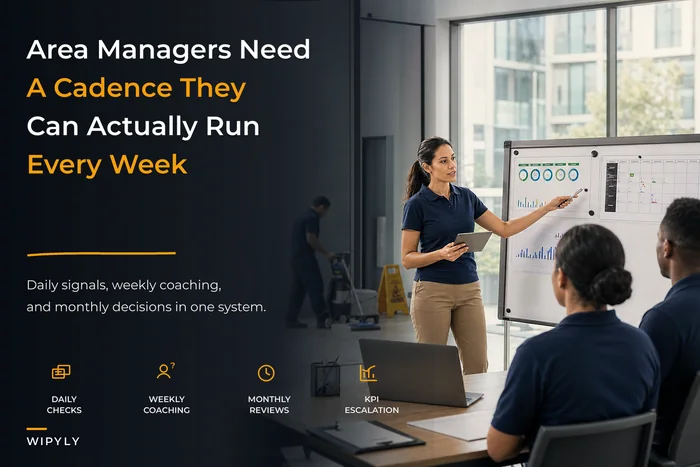
This connects to the management rhythm in the area manager playbook on daily, weekly and monthly cadences — the coaching cadence for people and the operational cadence for accounts should sit inside the same calendar, not compete for the same hour.
Mapping retention mechanics to operational KPIs
This is where the whole thing earns its keep. You want retention actions triggered by the same signals that predict a contract going sideways. When those two systems share data, you stop reacting late.
| Operational signal | What it often means for people | Retention action to trigger |
|---|---|---|
| QA scores sliding at one account | Crew lead stretched thin or a key person close to leaving | Supervisor 1:1, check workload and morale on that crew |
| Rising overtime on a specific crew | Understaffed; burnout building | Backfill the role before someone quits, not after |
| Renewal risk flag on an account | Site knowledge at risk if staff turns over | Stay conversation with the site supervisor |
| Attendance slipping for an individual | Early disengagement signal | Check-in before it becomes a resignation |
| A supervisor's crew turnover above average | Management problem, not a staffing one | Coach the supervisor; don't just keep rehiring |
Turnover is a lagging indicator. By the time someone resigns, you've already lost. The leading indicators — overtime creep, attendance wobble, a dip in someone's QA on sites they used to nail — show up weeks earlier. Operators who connect those dots keep people the others lose.
The "stay conversation" most owners skip
Exit interviews are mostly useless. The person's already gone and being polite. The higher-leverage move is the stay conversation — a deliberate chat with a valued employee before anything's wrong. "You're important to how this account runs. What would make you want to be here in two years? What's annoying you right now that I could actually fix?" Doing this with your key site supervisors two or three times a year surfaces problems while you can still act on them, and it protects exactly the people whose departure would trigger renewal risk.
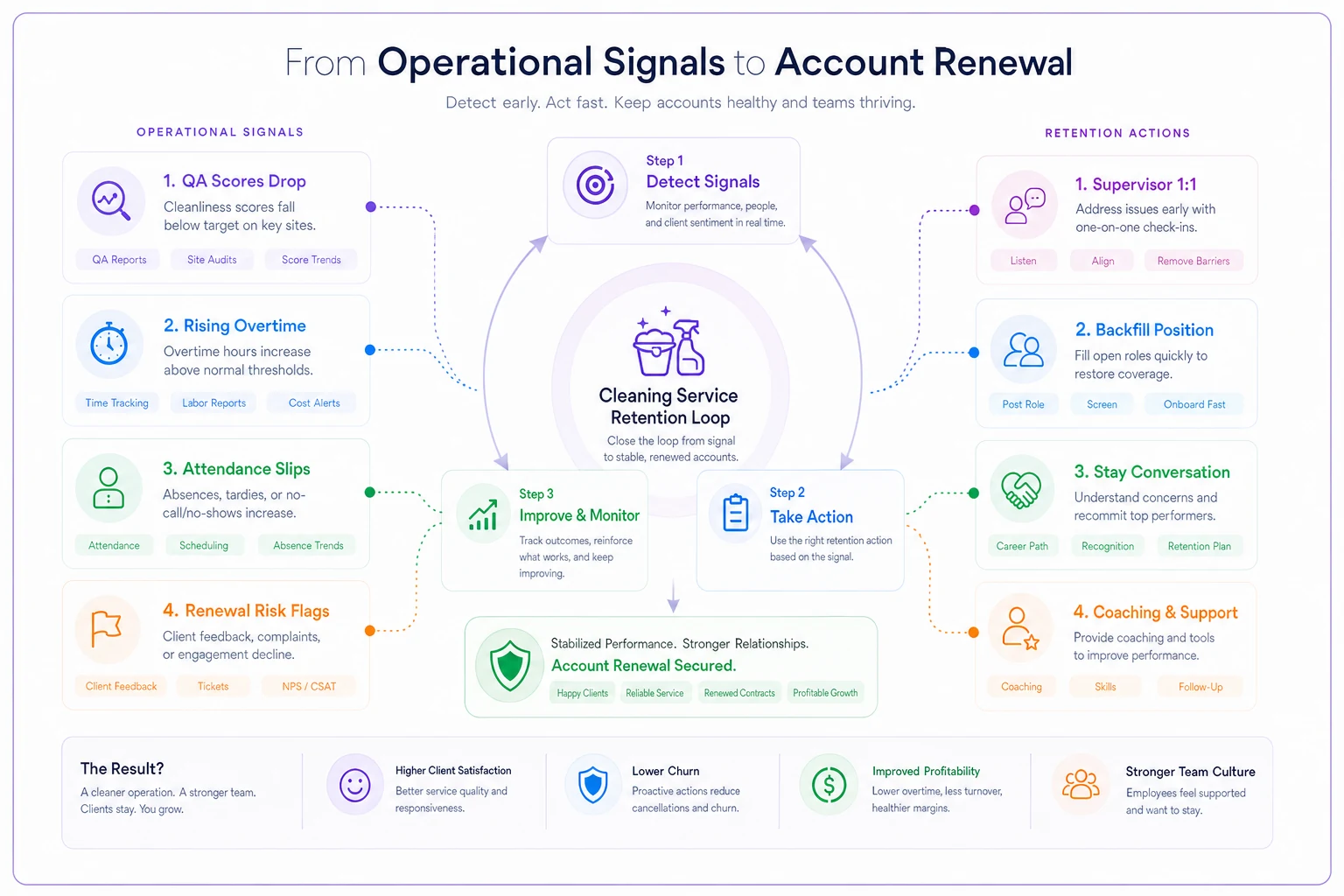
The diagram shows how signals flow to the right manager and trigger targeted retention steps before turnover becomes a renewal problem.
Where software fits — honestly, lightly
You can run this whole blueprint on spreadsheets at first, and plenty of operators do. The friction shows up at scale. Once you're past a few dozen people and a handful of accounts, keeping pay bands current, tracking who's cleared which promotion gate, remembering coaching cadences, and connecting all of that to live QA and renewal data by hand becomes its own full-time job. And the first thing that gets dropped is the coaching cadence — which is the part that actually retains people.
An operational platform that keeps QA scores, scheduling, overtime, and account health in one place is what makes the KPI-to-retention mapping above actually run instead of living in someone's head. The value isn't the dashboard — it's that the signal (overtime creeping on crew 4) reaches the right manager in time to act, rather than surfacing in a resignation letter. Use tooling where the manual version breaks down, not before.
A real scenario
A regional janitorial company running around 40 cleaners across roughly 25 commercial accounts was losing people at a rate that felt normal until they actually counted it — turnover sitting somewhere north of 70% annually. Two national accounts had flagged them "under review" after noticing constant crew churn and slipping lobby and restroom scores.
Over about two quarters, they did three things. Built five role families with real pay bands and bumped their entry floor by just over a dollar. Put promotion gates in place so crew leads earned the title instead of inheriting it. And set a coaching cadence tied to each manager's own advancement.
The pay bump cost real money up front. But turnover came down to somewhere around 45% over the following year — not perfect, but a meaningfully different business. More importantly, both at-risk accounts renewed. The site supervisors on those accounts stayed put, clients stopped seeing new faces every month, and QA scores stabilized. The owner's rough math put the retained revenue well above what the raises cost. The raises weren't an expense. They were renewal insurance.
When this blueprint makes sense — and when it doesn't
It makes sense when you've got more than 15–20 people, multiple accounts, and you're feeling the pain of inconsistent pay or supervisors who aren't ready for the job. If turnover is actively costing you renewals, this is the highest-leverage fix available.
It's overkill when you're still under ten people and the owner personally knows and manages everyone. You don't need formal pay bands for a crew of six. You need them the moment you can no longer hold every pay decision and every person's growth path in your own head — that's usually somewhere around 15–25 employees.
Solo operators and small husband-and-wife shops with a couple of helpers don't need the full version. Borrow the stay-conversation habit and skip the rest until you grow into it.
Bringing it together
The companies that keep their people and their contracts aren't paying wildly more than everyone else. They've just connected the pieces most operators leave disconnected. Clear role families so people can see a future. Pay bands that make raises fair and explainable. Promotion gates that put ready people into hard jobs. Coaching rhythms that signal investment. And a habit of watching operational KPIs for the early signs that a good person — and the renewal riding on them — is about to walk.
Turnover and renewal risk are the same problem wearing two different hats. Build the people-ops system that treats them that way, and both numbers start moving in the direction you want.
Ready to simplify your cleaning operations?
Join 1,000+ cleaning businesses using Wipyly to save time, reduce scheduling conflicts, and enhance client satisfaction.