

Most cleaning operators staff by geography and contract size. Bigger account gets the stronger crew, smaller account gets whoever's available. That logic feels reasonable on paper, but it quietly wastes your best people on accounts already halfway out the door — and starves the ones actually in play.
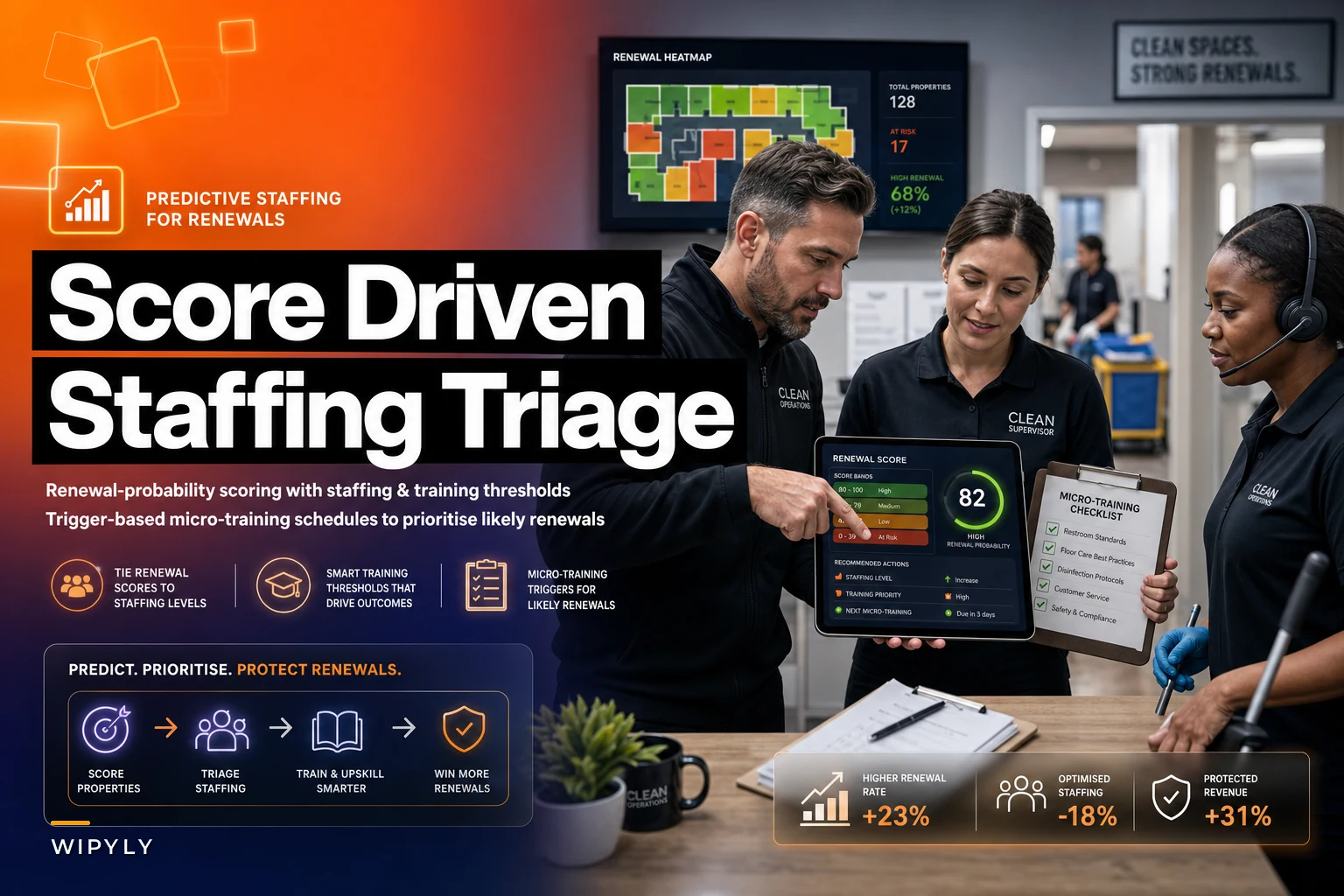
The idea here is narrow: build a renewal-probability score for each account, then use that score to decide where your workforce investment actually goes. Not just staffing — training hours, micro-training triggers, which supervisor gets pulled in before things deteriorate. When a contract is sitting at 78% likelihood to renew and basically runs itself, it doesn't need your A-team. When one sits at 44% with three months left on the agreement, that's where an extra training push can actually change the outcome.
Below is how to build the score, what the thresholds look like, and how to tie training to it without creating a spreadsheet nobody touches.
Why staffing by contract size gets renewals wrong
Contract size tells you what you'd lose. It tells you nothing about how likely you are to lose it. Those are different questions, and operators constantly collapse them into one.
A typical situation looks like this. You've got a 40,000 sq ft medical office paying around $9k a month. It's your biggest single account, so it gets your most senior crew lead and first pick on scheduling. But it's been renewing for four years straight, the client barely emails, and audit scores sit steady in the low 90s. That account has maybe a 5% chance of leaving next cycle. You're putting your strongest resource into an outcome that was basically already decided.
Then there's a cluster of three retail sites — maybe $2,400/month combined — where you've had two supervisor turnovers this year, a billing dispute in the spring, and a few missed audit thresholds. The client's district manager has gone quiet. That's the account genuinely at risk. And it's getting leftover staffing because the numbers are small.
The mistake isn't caring about big accounts. It's assuming size and risk move together. In real operations, they often move in opposite directions — accounts you've had longest tend to be the most stable, and newer mid-size ones are where relationships are still fragile.
Building the renewal-probability score
You don't need a data science team. You need five or six signals you already track, weighted by how much they actually predict churn in your book. The goal is a repeatable number, not a perfect one.
Stop losing bookings in operational chaos.
Wipyly helps you manage, confirm, and optimize every cleaning appointment efficiently.
- Centralized booking management
- Automated client notifications
- Staff scheduling & route optimization
No credit card required
Here's a signal set that holds up well for commercial cleaning:
-
Audit score trend (not just the latest score — the direction over the last 3–4 audits)
-
Complaint/rework frequency in the trailing 90 days
-
Client responsiveness (are they replying, requesting scope changes, going quiet?)
-
Payment behavior (on-time, chronically late, disputed)
-
Contract tenure (longer usually means stickier, up to a point)
-
Supervisor/crew stability on that account (turnover on a site correlates hard with churn)
Weight them based on what's actually burned you before. If most of your lost accounts started with a rework spike, weight that heavier. A simple version: each signal scores 0–100, you apply weights that sum to 100%, and you land on a single renewal-probability number.
A rough example for one account:
| Signal | Score (0–100) | Weight | Contribution |
|---|---|---|---|
| Audit trend | 60 | 25% | 15 |
| Rework frequency | 45 | 20% | 9 |
| Responsiveness | 70 | 20% | 14 |
| Payment behavior | 85 | 15% | 12.75 |
| Tenure | 80 | 10% | 8 |
| Crew stability | 40 | 10% | 4 |
| Renewal score | ~63 |
That 63 isn't something you'd bet the company on. It's a band — mid-range, watch it. The value isn't the decimal. It's that you can now compare this account against your whole portfolio on the same scale and make decisions about where the hours go.
One thing worth flagging: renewal scoring only works if your underlying data is honest. If audits are inconsistent or complaints don't get logged, the score just launders bad inputs into a confident-looking number. The signals above overlap heavily with the at-risk indicators in a proper operational client lifecycle — if you've already got that running, most of your inputs already exist.
Score bands and what each one actually triggers
A score by itself does nothing. Each band needs to map to a different staffing and training response.
| Band | Score | What it means | Staffing action | Training action |
|---|---|---|---|---|
| Green | 80–100 | Stable, low churn risk | Standard crew, don't over-invest | Maintenance micro-training only |
| Yellow | 60–79 | Fine now, drift possible | Keep continuity — no crew swaps | Targeted micro-training on weak signals |
| Orange | 40–59 | Genuinely in play | Assign a strong lead, add supervisor touchpoints | Focused re-training on the failing area |
| Red | Below 40 | Likely churn without intervention | Best available crew + manager involvement | Intensive, triggered micro-training + on-site coaching |
The counterintuitive part is the Green band. The instinct is to reward stable accounts with your best people. Resist it. A green account renewing for years is exactly where you can afford a solid-but-not-star crew and light-touch training. That frees your strongest people for orange and red accounts where their presence actually moves a renewal decision.
Keep Green accounts on solid-but-not-star crews to free your strongest leads for Orange and Red accounts.
Yellow is where most operators get tripped up. Yellow doesn't feel urgent, so it gets ignored — then it slides to orange three weeks before the renewal conversation, when it's too late to fix the impression. Yellow is where cheap, early micro-training pays off most, because you're correcting drift before the client has emotionally checked out.
Trigger-based micro-training instead of calendar training
Most cleaning companies train on a calendar — quarterly refreshers, annual certifications, onboarding week. Fine for baseline competence. Basically useless for renewal defense, because renewals are lost account-by-account for specific reasons, not on a quarterly schedule.
Trigger-based micro-training flips it. Instead of pushing everyone through restroom SOP training in March, you send a short, specific module to a specific crew the moment a signal on their account moves the wrong direction. If the orange retail cluster fails two consecutive audits on floor edges, that crew gets a five-minute edge-detailing module this week — not next quarter.
It works because the training is small, targeted, and tied to something real. The crew understands why they're getting it. And it's cheap enough to repeat without wrecking the schedule. The logic behind short, high-frequency modules is covered in detail in 5-minute micro-training modules to cut rework and boost first-time quality — the renewal score just tells you which crew needs which module right now.
A simple trigger sequence that keeps this from becoming chaos:
-
Score crosses from Yellow into Orange → assign one targeted micro-module addressing the lowest-scoring signal within 5 business days.
-
Two consecutive audit failures on the same task → push the matching task module to that crew immediately, and log completion.
-
Complaint logged on a Red-band account → same-week on-site coaching, not a remote module.
-
Crew change on any Orange/Red account → run the account's site-specific module before the new lead's first solo shift.
-
Score recovers to Green and holds 60 days → drop back to maintenance-only cadence.
That last rule matters as much as the first. If you never dial training back down when an account stabilizes, you'll drown your best crews in redundant modules and they'll start ignoring all of them. The whole system only works if the triggers go both directions.
Visual workflow for the triggers:
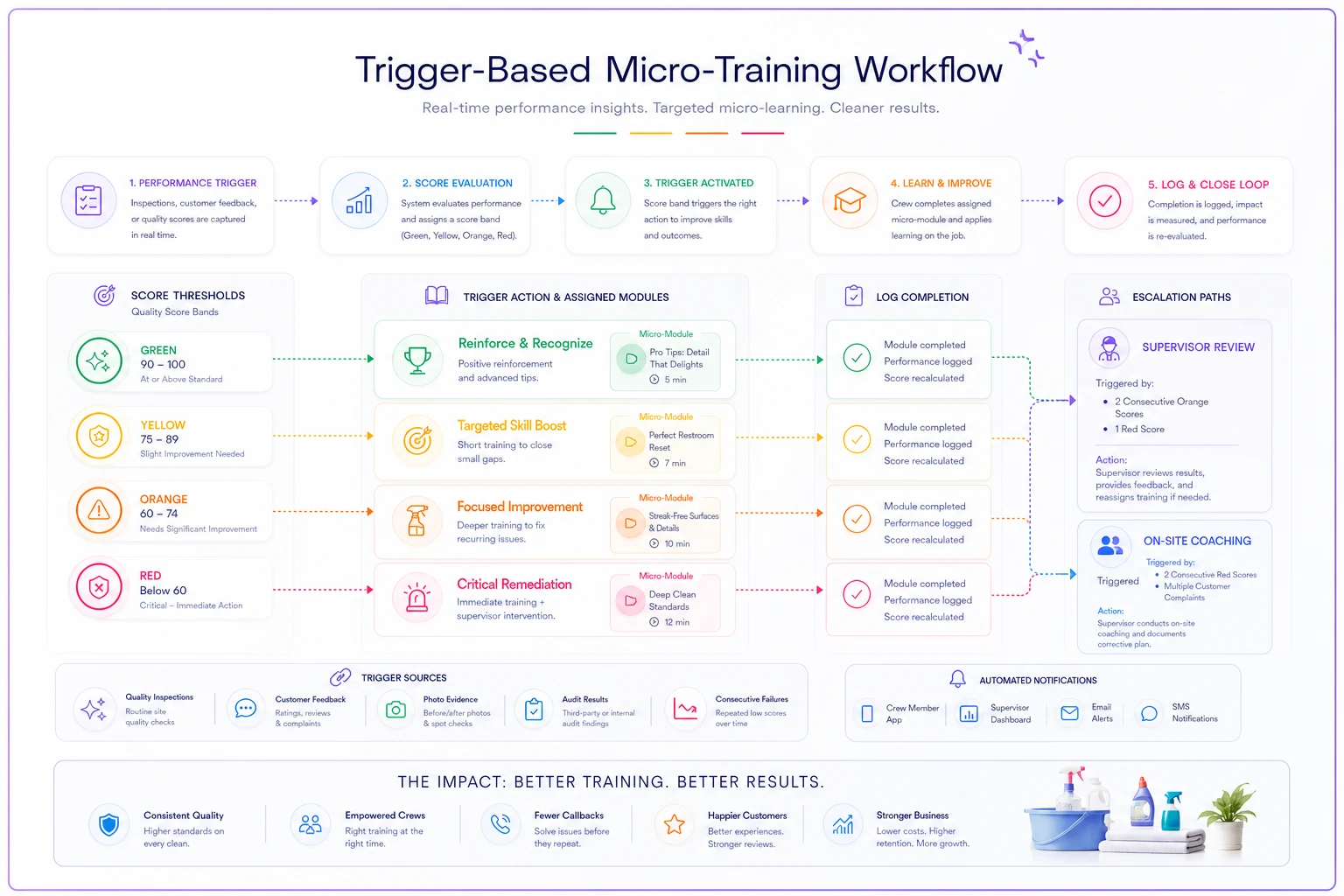
The diagram shows how score changes route to micro-modules, supervisor touchpoints, and escalations so teams know which action to take at each threshold.
A real scenario
A mid-size janitorial company running around 30 commercial accounts and 6 vans kept losing two or three accounts a renewal cycle — always mid-size ones, always described as a surprise. Their staffing model was pure size-based: top three crews locked onto the three biggest contracts, everyone else spread by route efficiency.
They built a rough renewal score across all 30 accounts using audit trend, rework frequency, responsiveness, and crew stability. Two things showed up fast. Their three biggest accounts were all sitting Green at 82–90 — stable, over-resourced. And four mid-size accounts (roughly $2k–$3k/month each) were sitting Orange or below, all showing the same pattern: one crew turnover plus a slipping audit trend.
They reassigned. One strong crew lead came off a rock-solid Green medical account and rotated onto the two worst Orange accounts. Micro-training got retargeted — instead of quarterly blanket refreshers, modules went only to the four at-risk crews based on their specific failing signals. Around a dozen targeted modules over the quarter, most under ten minutes each.
Over the next two renewal cycles, they held all four at-risk accounts. The Green medical account they pulled the lead off didn't notice; audit scores held. Net effect: somewhere in the $6k–$8k monthly recurring revenue range that would normally have leaked stayed on the books, without adding anyone to payroll. Same labor, pointed at the accounts where it actually changed the outcome.
When this makes sense — and when it doesn't
This makes sense when:
-
You have 15+ accounts and can't personally track every one's health in your head
-
Your renewals feel like surprises rather than predictable outcomes
-
You have at least a few months of audit and complaint data to feed the score
-
You've got crews of varying strength you can actually reallocate
This is a bad idea when:
-
You have 5–6 accounts and already know each client personally — the score adds overhead without much insight
-
Your audit and complaint logging is inconsistent, so the inputs are garbage
-
Your crews are basically interchangeable in skill, so "reassign your best lead" isn't a real lever
-
You're in a period of heavy turnover where crew stability is chaos across the board — fix that first
That last point matters. Renewal scoring assumes you can keep a crew on an account long enough for training and continuity to actually build client trust. If turnover is so high that every account cycles crews monthly, the score will flag everything Red and tell you nothing useful. The staffing-stability foundation has to come first — the patterns in staffing and schedule patterns that let cleaning teams scale with less turnover are basically the prerequisite for any of this to work.
Point your best people and your training hours at the accounts where the decision is still open. Leave the sure things stable, and stop burning your strongest resources on renewals that were never actually at risk.
Keeping the score honest over time
The failure mode isn't building the score — it's letting it go stale. A renewal score reflecting last spring's data is worse than no score, because it creates false confidence. Rescore on a real cadence: monthly for Orange and Red accounts, quarterly for Green.
Two habits keep it useful. First, when an account renews or churns, go back and check what its score was three months prior. If your Red accounts kept renewing and your Green ones kept leaving, your weights are off — adjust them. Over a year or two of that feedback loop, the weights start reflecting how churn actually works in your specific market, not a generic template someone else built.
Second, don't let the score override obvious human signals. If a client mentions in passing they're consolidating vendors, that outranks any number on your dashboard. The score is there to catch the quiet risks — accounts drifting without complaining — because those are the ones that blindside you.
Point your best people and your training hours at the accounts where the decision is still open. Leave the sure things stable, and stop burning your strongest resources on renewals that were never actually at risk.
Ready to simplify your cleaning operations?
Join 1,000+ cleaning businesses using Wipyly to save time, reduce scheduling conflicts, and enhance client satisfaction.