

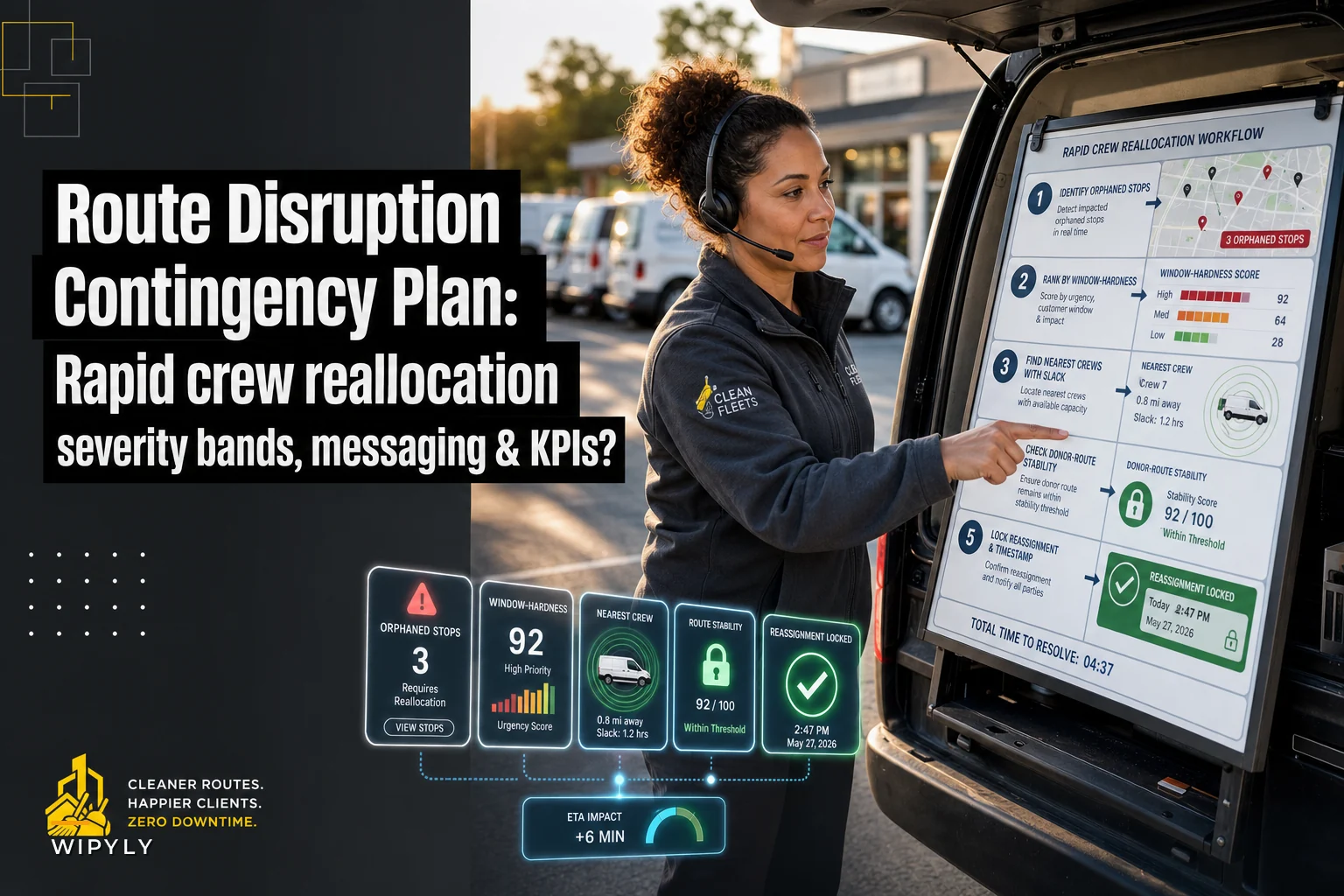

Most cleaning operators already have a vague plan for a bad day. "Call the client, shuffle a van, figure it out." That works right up until two vans go down the same morning, a downtown parking garage closes for maintenance, and your supervisor is spending 40 minutes on the phone deciding who moves where. By the time the decisions are made, you've already missed two window times and nobody told the clients.
The difference between a fleet that absorbs disruption and one that spirals isn't better luck. It's having the decisions pre-made. When a van breaks down, nobody should be inventing a response from scratch. They should be reading one.
This is about building that response into a tiered system — severity bands that tell you how hard to react, reallocation templates that move crews fast, scripts your dispatcher can send without thinking, and billing rules that keep disruption from quietly eating your margin. Plus the part most people skip: measuring what actually went wrong afterward so the same disruption doesn't cost you twice.
Why disruption handling collapses under pressure
The core problem isn't that disruptions happen. It's that every disruption gets treated as a unique emergency requiring a custom decision.
In real operations, this usually plays out the same way. A route that's running fine until 9:15 hits a snag — a crew member no-shows, a client's building has a fire drill, a van won't start. The supervisor now has to answer five questions at once: How bad is this? Who can cover? What do we tell the client? Do we still bill full rate? Who do I pull from, and does that create a second problem downstream?
Answering all of that live, under time pressure, with incomplete information, is where mistakes get made. People overreact to small problems — pulling a crew off a stable route to cover a 15-minute delay — and underreact to big ones, treating a two-van outage like a normal hiccup until it's too late to recover.
The other thing that happens constantly: client communication becomes an afterthought. The ops team is heads-down solving the logistics, and nobody messages the account until the client calls in angry. At that point you're not managing a disruption anymore, you're managing a relationship problem on top of it.
Severity bands: deciding how hard to react before you need to
The foundation of the whole system is a severity classification that happens in the first two minutes. You're not solving the problem yet — you're sizing it.
Stop losing bookings in operational chaos.
Wipyly helps you manage, confirm, and optimize every cleaning appointment efficiently.
- Centralized booking management
- Automated client notifications
- Staff scheduling & route optimization
No credit card required
Three bands. Keep it to three. Five bands sound thorough but they slow down the exact moment when speed matters, and your dispatcher will never reliably remember the difference between a "Level 2" and a "Level 3."
| Band | Trigger examples | Expected client impact | Response posture |
|---|---|---|---|
| Green (minor) | Single crew running 20–45 min late, one no-show on a 3-person crew, minor equipment issue | Window slips, work still completed same day | Absorb internally, notify only if window is contractual |
| Amber (moderate) | Van down with same-day repair possible, two no-shows, site access delayed 1+ hour | One or more sites likely miss window or get partial service | Reallocate crews, proactive client message, possible billing note |
| Red (severe) | Two+ vans down, severe weather closure, crew unable to reach a zone entirely | Multiple sites missed or rescheduled | Full reallocation protocol, account manager involved, billing adjustment triggered |
The band dictates the posture. A Green event means "fix it quietly and move on." A Red event means "stop treating this as routine and escalate." The band decides who gets pulled in, whether the client hears from you, and whether billing changes — all without a debate.
One pattern worth flagging: the most expensive mistakes come from Amber events that get handled like Green. The van's "probably going to be fixed by noon," so nobody reallocates or messages anyone — and then it's 1 PM, three sites are missed, and a manageable moderate event has become a Red-level client problem. When in doubt, band up.
Rapid crew reallocation templates
Once you've got a severity band, the next bottleneck is deciding who moves. This is where having clustering and sequencing already documented pays off — if you know which routes are geographically adjacent and which stops have flexible windows, reallocation is a lookup, not a calculation. If your base routing is still ad hoc, this is a good moment to tighten it. The day-of routing rules for small fleets make reallocation dramatically faster because you're moving crews between known clusters instead of improvising.
Here's the reallocation logic for a one-page template:
-
Identify the orphaned stops. List the sites the down crew or van was supposed to cover, with their window times and whether each window is hard (contractual) or soft (preference).
-
Rank orphaned stops by hardness. Hard windows get covered first. A soft-window office that doesn't care if you show at 2 PM instead of 11 AM goes to the bottom.
-
Find nearest crews with slack. Pull from routes that are geographically close and have soft windows remaining or are running ahead of schedule. Never pull from a route that itself has a hard window at risk.
-
Confirm the donor route won't tip. Before committing the move, check that borrowing the crew doesn't create a second disruption. This is the step people skip, and it's how one problem becomes two.
-
Lock the reassignment and timestamp it. Everyone involved — donor crew, receiving sites, dispatcher — gets the updated plan. Timestamp matters for the post-incident review later.
A quick visual guide to the reallocation workflow:
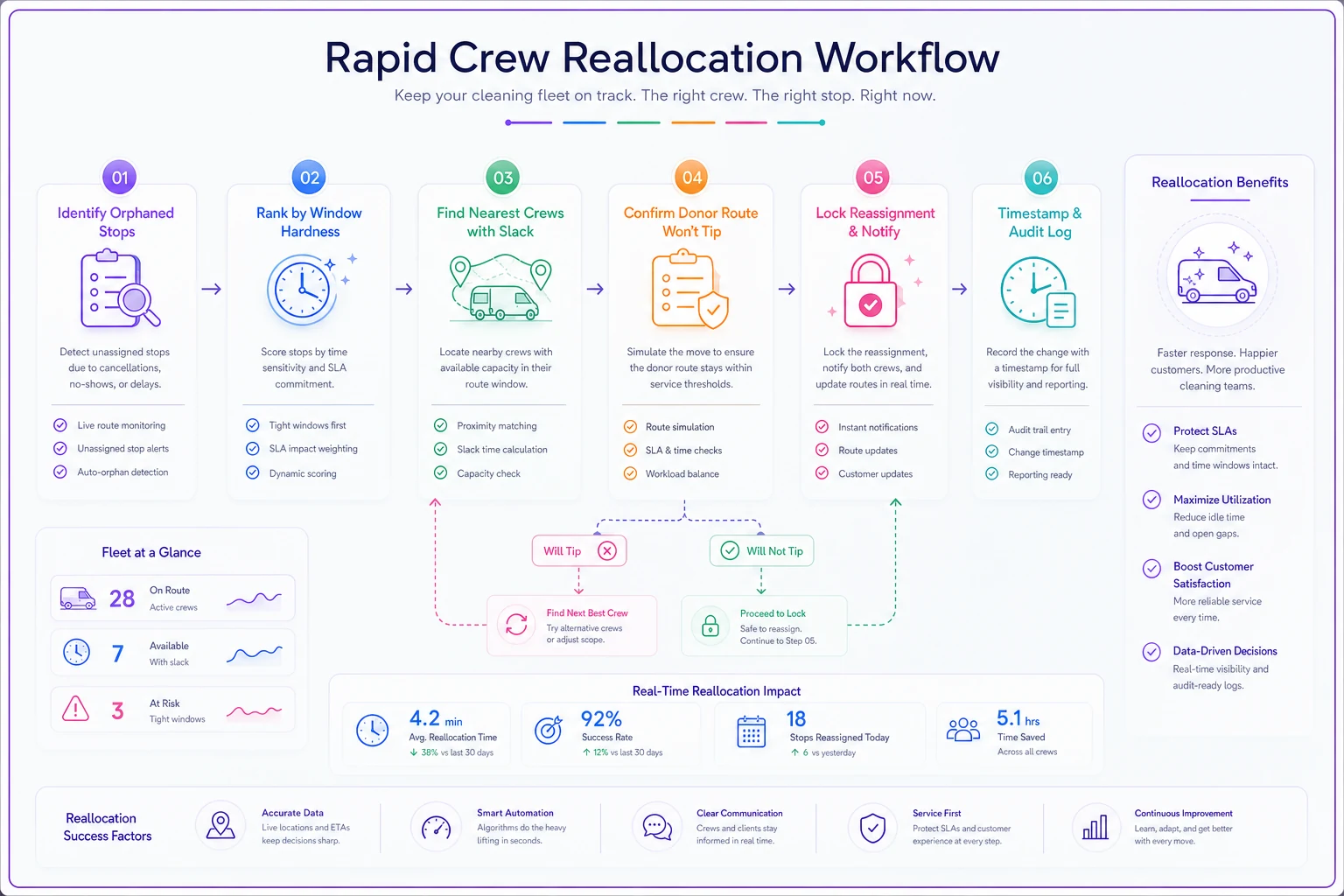
The reallocation template should live somewhere everyone can see the current state. The failure mode that comes up most often: the dispatcher holds the entire revised plan in their head. They know who moved where, but the crew lead doesn't, and the account manager definitely doesn't. When the plan lives in one person's head, the recovery is one distraction away from collapse.
The reallocation template should live somewhere everyone can see the current state.
For larger fleets running zones or hub-and-spoke, reallocation gets easier in some ways and harder in others — more crews to borrow from, but zone boundaries slow cross-coverage. If you're at that scale, the zone and hub-and-spoke transition playbook covers how to set up spill-over rules so adjacent zones can backstop each other without permission-chasing.
Client messaging scripts tied to severity
The message you send should match the band. Over-apologizing for a Green event trains clients to expect perfection and makes every small slip feel like a failure. Under-communicating a Red event destroys trust. Pre-written scripts solve both.
Three templates, one per band, with blanks the dispatcher fills in:
Green (only if window is contractual):
> "Quick heads up — your [site] cleaning today will run about [X] minutes behind our usual window due to a scheduling adjustment on our end. All scope will be completed as normal. No action needed on your side."
Amber:
> "Wanted to reach you directly — we've had an operational issue this morning affecting your [day's/afternoon's] service. Here's our plan: [covered as scheduled / rescheduled to X / partial service today with the remainder tomorrow]. I'll confirm completion by [time]. Apologies for the disruption and happy to talk through it."
Red:
> "I'm reaching out personally because today's service at [site] is significantly affected by [cause]. Here's exactly what's happening and what we're doing: [plan]. We will [reschedule / credit / prioritize next visit] and I'll follow up by [time] with confirmation. I know this is disruptive and I want to make it right."
Speed beats polish. A plain, slightly imperfect message sent at 9:25 — before the client notices anything is wrong — lands far better than a polished apology sent at noon after they've already called in. The whole point of tying scripts to bands is that the dispatcher doesn't have to write anything. They pick the right script, fill three blanks, and send.
Who sends it also matters. Green and Amber can go from the dispatcher. Red should come from the account owner — the client needs to hear from someone who can actually make commitments, not a scheduler relaying a message.
Billing adjustments that match disruption severity
This is where disruption quietly erodes margin, and where most operators have no rule at all. They either eat every disruption as a goodwill credit — margin death by a thousand cuts — or they bill full rate on a missed visit and spark a dispute.
-
Green No adjustment. Full scope delivered, just late. Billing unchanged.
-
Amber Depends on delivery. Full scope eventually completed = full bill. Partial service = prorated for what was actually delivered, documented with photos.
-
Red Automatic adjustment trigger. Missed visit = credit or reschedule per contract terms. The account owner decides between credit and priority reschedule based on the relationship and the SLA language.
The discipline that makes this work is documentation. Every Amber and Red billing decision needs the severity band, the cause, what was and wasn't delivered, and photo evidence attached. When a client later disputes a prorated invoice, you're not arguing from memory — you've got a timestamped record of exactly what happened.
One thing worth being firm on internally: a disruption that was your fault (deferred van maintenance, a chronic no-show employee) and one that was outside your control (city road closure, client building emergency) can carry the same client-facing message, but should be tracked differently for the post-incident review. The client doesn't need to know whose fault it was. You do.
Post-incident KPIs and root-cause remediation
The part almost everyone skips. The disruption gets handled, everyone exhales, and nobody writes down what happened. So the same van dies next month and you re-solve the identical problem from scratch.
-
Time-to-classify How long from the event to someone assigning a severity band? If this is creeping up, your front-line team isn't confident in the bands.
-
Time-to-reallocation From band assignment to a locked recovery plan. This is the number that most directly affects whether clients notice.
-
Client-notified-before-noticed rate What percentage of Amber/Red events did you message the client before they contacted you? This is the single best predictor of whether disruptions hurt retention.
-
Recurrence by root cause Group events by cause — equipment, staffing, access, weather. The cause that keeps showing up is the one to actually fix.
-
Billing leakage Total credits and proration from disruption, trended monthly. If this number is climbing, your disruptions are getting more expensive, not just more frequent.
The real payoff is in recurrence tracking. A common pattern: an operator discovers that 60–70% of their Amber events over a quarter trace back to the same two or three vans with deferred maintenance. The disruption plan handled the symptoms every time — but the actual fix was a maintenance schedule, not a better reallocation template. Without the KPI tracking, they'd have kept getting better and better at recovering from a problem they could have eliminated.
Root-cause remediation is also where disruption handling connects to your broader quality system. A recurring disruption cause is a performance signal, and feeding it into your field performance system is how you stop re-solving the same breakdown every month.
A real scenario
A mid-size commercial operator running around 14 vans and roughly 90 recurring accounts. Their disruption handling was entirely ad hoc — every bad morning was a fire drill, and the owner estimated they were losing a day or two of productive dispatcher time a month just to chaos, plus occasional client churn they couldn't quite explain.
They built the three-band system, the one-page reallocation template, and the three message scripts. Nothing fancy — most of it lived in a shared doc and a printed card in each dispatcher's area at first.
Over the next two quarters, a few things changed. Time-to-reallocation on Amber events dropped from "whenever we figured it out" to under 15 minutes most of the time. Their client-notified-before-noticed rate went from near zero to roughly 80%, which the account managers said changed the tone of client conversations entirely — complaints turned into "thanks for the heads up." And the post-incident tracking surfaced that a cluster of recurring Amber events came from two accounts with impossible back-to-back hard windows across town — a routing problem they fixed by resequencing, which removed the disruptions at the source.
The billing side was quieter but real: they stopped reflexively crediting Green and Amber events that didn't warrant it, recovering a few thousand dollars over the period they'd previously been giving away as unnecessary goodwill.
When this level of structure makes sense — and when it doesn't
If you're running one or two vans, you don't need three documented bands and scripts. You are the severity classifier, the reallocator, and the client messenger all at once, and the overhead of formalizing it won't pay off.
This starts to matter somewhere around five or six vans — the point where the person classifying the disruption often isn't the person reallocating crews, and information has to travel between people. That's when undocumented handling starts costing you, because the coordination gaps show up exactly when you're under pressure.
It becomes essential past ten vans with multiple hard-window commercial accounts, where a single unhandled Amber event can cascade across a zone and clients have SLA terms that make missed windows a contractual problem, not just an annoyance.
The one group that should hold off: operators whose base routing is still chaotic. If you don't have stable, documented routes to reallocate from, the contingency plan has nothing solid to stand on. Fix the day-to-day routing first, then layer disruption handling on top.
The operators who handle disruption well aren't the ones who've eliminated bad days — nobody has. They're the ones who've made the decisions in advance, so a van breaking down at 8:40 triggers a sequence of known moves instead of a scramble. Bands tell you how hard to react. Templates tell you who moves. Scripts tell you what to say. Billing rules protect the margin. And the post-incident review makes sure you fix causes, not just symptoms.
Build it once, keep it on one page, and the next time the morning goes sideways, your team reads the plan instead of inventing one.
Ready to simplify your cleaning operations?
Join 1,000+ cleaning businesses using Wipyly to save time, reduce scheduling conflicts, and enhance client satisfaction.