


Most cleaning operators don't fail at picking software. They fail at governing the rollout. The demo looks great, the contract gets signed, a few enthusiastic supervisors log in for two weeks, and then the whole thing quietly dies while everyone drifts back to the WhatsApp groups and spreadsheets that "just work." Six months later the owner is paying $600–$1,200 a month for a platform maybe 30% of the crew actually touches.
The problem isn't the tool. It's that tech gets treated like a purchase instead of an initiative. Nobody owns it. There's no gate that says "this pilot passed" or "this pilot failed, pull the plug." There's no definition of what winning even looks like. So the money leaks out slowly, adoption plateaus, and the next vendor gets blamed.
A real technology adoption roadmap for cleaning operations treats every tool the way you'd treat opening a new territory: assessment, sponsor, phased pilot, KPI gates, and hard ROI milestones with someone's name attached. This piece walks through how that governance actually works across a growing cleaning company — where it breaks, and what changes as you scale from a handful of vans to a real portfolio.
The real reason adoption dies (it's structural, not attitude)
The convenient story is "my crews resist change." Sometimes true. But when you look at why adoption stalls across dozens of cleaning companies, the pattern is almost always structural, not emotional.
What usually happens: the owner or ops manager evaluates the software alone, based on features from a demo. They roll it out to everyone at once because "we paid for it, let's use it." There's no clear before-state measured, so nobody can tell if it's working. The person who championed it also runs day-to-day operations, so when a big account has a bad week, the software gets deprioritized instantly. And there's no checkpoint where leadership formally decides to expand, fix, or kill it.
That's five failure points, and none of them are about crew attitude. When adoption is governed properly — with a sponsor, a scoped pilot, and defined gates — crews adopt at roughly double the rate compared to a big-bang "everyone starts Monday" rollout. Same tech. The governance is the difference.
There's a related trap worth naming: buying tools to fix a process you haven't defined. If your quality-check process is inconsistent on paper, a QA app just digitizes the inconsistency. Software amplifies whatever system you already have. Vague in, vague out.
Start with an honest assessment, not a feature comparison
Before you shortlist vendors, you need to know what you're actually solving and whether your operation can absorb the change. Feature spreadsheets are seductive and mostly useless — every platform checks the same boxes on a sales call.
Stop losing bookings in operational chaos.
Wipyly helps you manage, confirm, and optimize every cleaning appointment efficiently.
- Centralized booking management
- Automated client notifications
- Staff scheduling & route optimization
No credit card required
The assessment that matters looks more like this:
Pre-adoption assessment checklist
-
What breaks today, in numbers? Rework rate, missed clocks, late invoices, disputed hours — pick the two or three that actually cost you money. If you can't quantify the pain, you can't measure the fix.
-
Is the underlying process defined? Do you have an SOP the tool will enforce, or are you hoping the tool becomes the SOP? (Hint: tools rarely create discipline that didn't exist.)
-
Who touches this daily? Cleaners, site leads, area managers, back office — map every role that has to change behavior, not just the buyer.
-
What's the data situation? If your client list, site addresses, and pay rates live in four different places, no rollout survives contact with reality until that's cleaned up.
-
What's the switching cost? Training hours, parallel-running weeks, temporary productivity dip. Budget for it honestly — it's real.
-
Can one person own this without dropping operational balls? If the answer is no, you have a sponsorship problem before you've spent a dollar.
That data question is the sleeper issue. A tool is only as good as the records feeding it, and cleaning companies are notorious for messy, duplicated site data. Getting a clean canonical view of clients, sites, and rates sorted out before rollout is worth doing properly — the data integration and hygiene playbook covers why reconciliation before rollout saves you from garbage dashboards later. Skip it and your shiny new reporting will just surface confident-looking nonsense.
Reconcile client and site records before contacting vendors to avoid migration headaches.
Before moving on: this checklist isn't a formality. It's the part most operators skip because it feels slow, and it's exactly why their rollouts fail.
The executive-sponsor playbook
Every tech initiative that sticks has one thing in common: a named sponsor with authority who isn't buried in daily firefighting. In a 5-van company that's usually the owner. In a 30-van company it should not be the owner — it should be an ops director or a senior area manager who's been given explicit air cover.
The sponsor's job isn't to configure the software. It's to:
-
Own the KPI targets and defend them when things get busy
-
Remove blockers (approve training time, override the "we're too slammed" excuse)
-
Chair the gate reviews and make the expand/fix/kill call
-
Protect the pilot from getting deprioritized the first time a big account has a rough week
That last one is where most rollouts quietly die. Operations will always have a reason to skip the new process this week. Without a sponsor who holds the line, "just this once" becomes permanent.
Worth watching: the wrong sponsor is someone who loves the tool but has no authority, or someone with authority who delegates it entirely and stops showing up to reviews. Both kill momentum. The sponsor needs to be senior enough that people take it seriously and involved enough that they actually see the numbers.
Phased pilots with KPI gates
Big-bang rollouts feel efficient and are almost always a mistake in cleaning ops. You can't afford every site struggling at once, and you learn nothing you can act on. Phased pilots with gates let you prove value on a small, controlled slice before you bet the whole operation.
Here's the phase structure that works:
| Phase | Scope | Duration | Gate to advance |
|---|---|---|---|
| 0 — Setup | Clean data, configure, train sponsor + 1 lead | 1–2 weeks | Data validated, sponsor signed off |
| 1 — Pilot | 1–2 sites, 1 crew, 1 area manager | 3–4 weeks | Adoption ≥70%, target KPI moving in right direction |
| 2 — Expand | One region or roughly 25% of accounts | 4–6 weeks | KPI improvement holds, no billing/QA regressions |
| 3 — Standardize | Full portfolio | Ongoing | ROI milestone hit, process documented as new default |
The gates are the whole point. A gate is a stop-or-go decision, not a milestone you cheer and walk past. If Phase 1 doesn't hit its adoption threshold, you don't advance — you diagnose. Maybe the training was thin. Maybe the workflow doesn't fit how that crew actually works. Maybe the tool's genuinely wrong. Either way, you find out on two sites, not thirty.
What KPIs actually gate a cleaning tech pilot? Not "logins." Logins are vanity. Gate on things tied to money and quality:
-
Adoption depth — percent of expected daily actions completed in-tool (clock-ins, completed checklists, photo evidence), not just accounts created.
-
The target metric — whatever pain you scoped
rework rate, on-time clock accuracy, invoice-to-actual variance, dispute frequency.
-
A guardrail metric — something that must not get worse. If your QA app speeds up sign-off but complaint rates climb, that's a failed pilot even if adoption looks great.
The training side deserves its own attention. Crews don't fail because they're incapable — they fail because they got a 40-minute overwhelming demo once and were expected to remember it. Short, repeated, role-specific micro-training beats a marathon session every time. The full mechanics of phasing and crew-level training are worth studying in the software migration and crew-adoption playbook, which goes deep on exactly this rollout sequence.
A simple rollout workflow follows these phases and decision points.
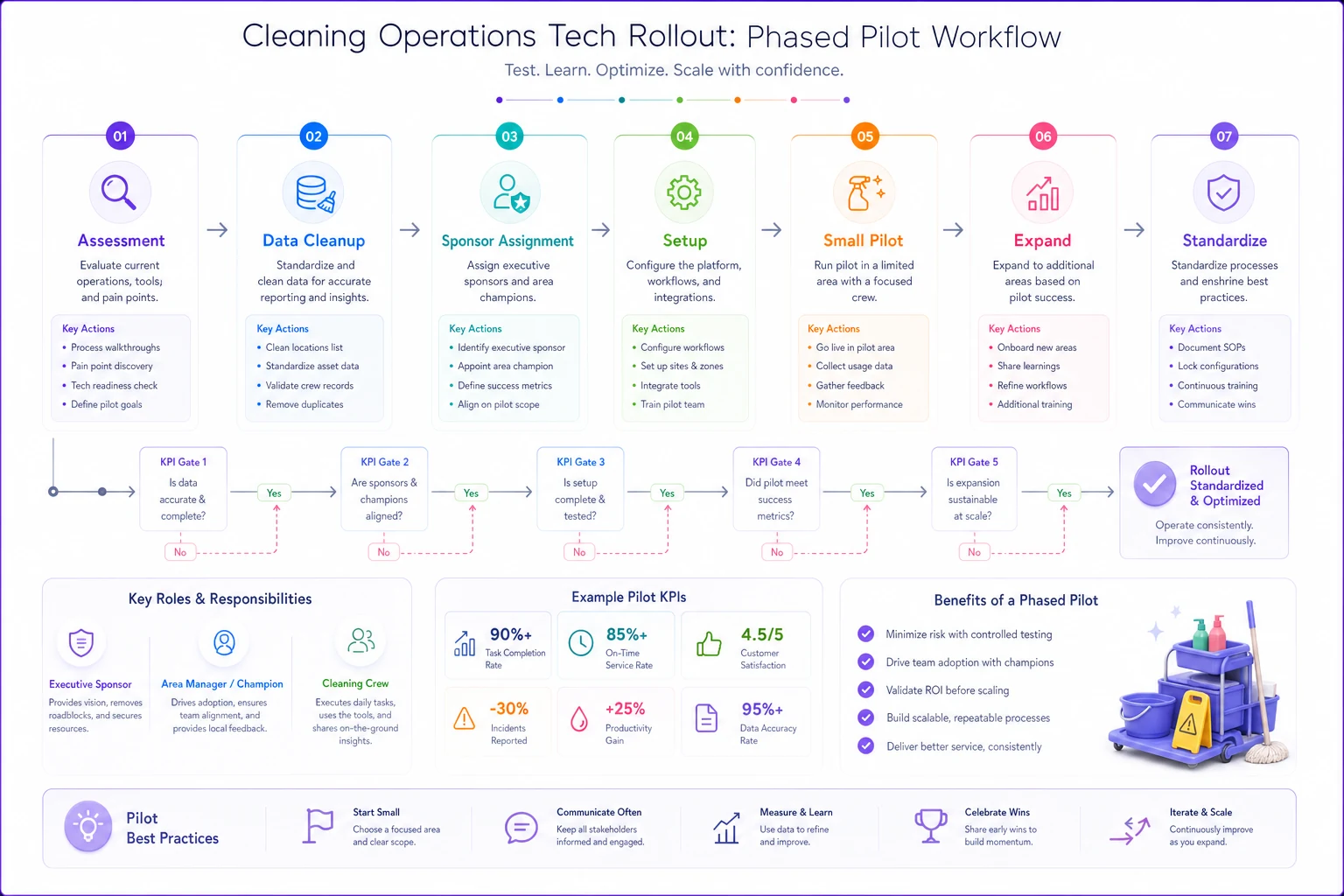
Getting the gate structure right is the difference between a pilot that teaches you something useful and one that just delays the inevitable.
Adoption metrics vs. ROI metrics — don't confuse them
This trips up a lot of owners. Adoption metrics tell you if people are using the thing. ROI metrics tell you if it's worth using. You need both, and they answer different questions at different times.
Early in a pilot, watch adoption. If nobody's using it, ROI is meaningless — there's nothing to measure. Once adoption crosses a real threshold (say 70%+ of expected daily actions), shift your attention to the money question.
A rough sequence of what to watch, and when:
-
Weeks 1–2 adoption depth, drop-off, where people get stuck. Pure usage focus.
-
Weeks 3–4 early KPI signal — is the target metric starting to move? Is any guardrail slipping?
-
Weeks 5–8 ROI signal — hours saved, disputes avoided, rework reduced, translated into dollars.
-
Beyond does the gain hold when the novelty wears off and you stop babysitting it?
That last question separates real wins from temporary ones. Plenty of tools show a nice bump for six weeks while everyone's paying attention, then quietly regress. A gain that survives being ignored is a gain you can bank.
A real scenario: mid-size commercial cleaner, QA + evidence tool
A commercial cleaning company running around 22 sites — offices and a couple of medical facilities — was bleeding margin on disputes. Clients would claim work wasn't done, the company couldn't prove otherwise, and they were eating credits worth roughly $2,500–$3,500 a month plus the reputation damage. They bought a QA-and-photo-evidence platform to fix it.
First attempt: big-bang, all 22 sites, one 90-minute training call. Six weeks in, maybe a third of crews were logging photos, the data was patchy, and disputes hadn't budged. Classic failure — no sponsor, no gates, no phasing.
They restarted with governance. An area manager was named sponsor. Phase 1 was three sites, including one medical facility where evidence mattered most. Gate: 75% of scheduled tasks with timestamped photo proof, and dispute response time under 24 hours. That took about four weeks and two rounds of short refresher training to hit. Once it held, they expanded to a full region, then the rest.
By the time it was standardized — roughly three months in — disputed credits had dropped by well over half, landing somewhere around $1,000–$1,300 a month instead of $3,000+. The tool was identical to what they used in attempt one. The governance is what captured the ROI. Same software, completely different outcome, because this time someone owned it and there were real checkpoints that forced honest decisions.
When this level of governance actually makes sense
Not every tool needs a formal roadmap. If you're buying something with near-zero behavior change — a new accounting integration the office uses, say — the heavy governance is overkill. Just buy it and move on.
Run the full roadmap when:
-
The tool changes how field crews or managers work daily
-
Adoption failure would waste real money (subscription + lost productivity)
-
You're rolling across multiple sites or teams
-
The tool touches billing, QA, or anything client-facing
Skip the ceremony when:
-
It's a back-office tool a couple of people use
-
Behavior change is minimal
-
The cost of it failing is trivial
Who should not attempt a big platform rollout right now: operators whose underlying processes are still undefined, whose site and client data is a mess, or who genuinely don't have one person with the authority and bandwidth to sponsor it. Fix those first. A rollout on top of chaos just makes the chaos more expensive and better-documented.
What changes as you scale
At 5 vans, the owner does everything — sponsor, trainer, gatekeeper — and that's fine because they can see every job. The roadmap is mostly informal, living in the owner's head.
Around 15–25 vans, that stops working. The owner can't personally see every site, so "I'll just check if it's being used" is no longer possible. This is where informal adoption collapses and you need actual gates, a delegated sponsor, and adoption metrics you can read without visiting sites. Tech that worked when you could eyeball everything now needs governance to stay honest.
Past 30–50 vans and multi-region, you're running several initiatives at once — routing, QA, billing, scheduling — and they interact. A staffing change affects the routing tool; a QA change affects billing accuracy. Governance isn't just per-tool anymore, it's a portfolio question: which initiatives get sponsor attention, which are competing for the same crews' limited capacity to absorb change, and how do you sequence them so you're not asking teams to learn three systems in one quarter.
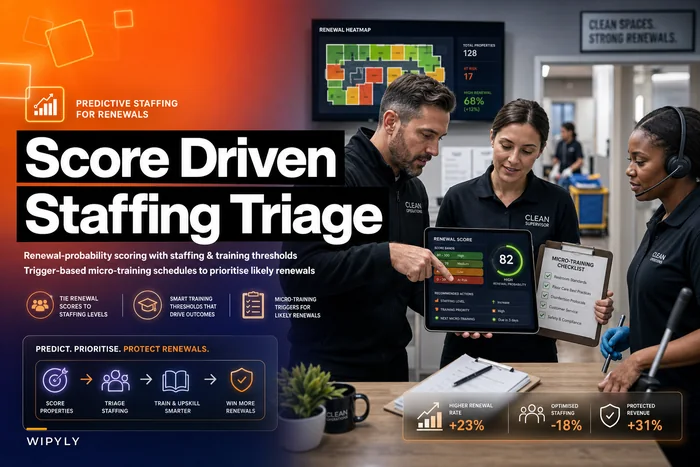
That sequencing matters more than people realize. Crews can only absorb so much change at once. Stacking rollouts guarantees all of them get done badly. Better to run them in deliberate order, each with its own gates, than to launch everything and wonder why nothing stuck. This connects directly to how you plan capacity around renewals and training load — tying rollout timing to staffing and renewal cycles, as covered in predictive staffing for renewals, keeps you from launching a demanding new tool the same month three big accounts come up for renewal.
The ROI milestone gate — where the money decision lives
The final gate isn't "did people adopt it." It's "did it pay for itself, and does it keep paying." This is where owners get soft and where discipline matters most.
Set the ROI milestone before the pilot starts, in dollars, with a deadline. Something like: within 90 days of full rollout, this tool must reduce [disputes/rework/admin hours] by enough to cover its cost plus deliver a return of at least X. Write it down. Attach the sponsor's name.
Then hold the review honestly. Three outcomes:
-
Passed the gate — ROI is real and holding. Standardize it, document the new default process, move the sponsor's attention to the next initiative.
-
Ambiguous — some gain, not enough yet. Extend once, with a specific fix and a firm new deadline. Do not extend indefinitely.
-
Failed — no meaningful return after a fair shot. Kill it. Eat the sunk cost and stop the bleed. This is the decision almost nobody makes, and it's why dead tools sit on invoices for years.
The willingness to kill a failed tool is the single most valuable habit in tech governance. It's not admitting defeat — it's protecting your budget from the slow drip of subscriptions nobody uses. Every month you delay that call, the sunk-cost feeling gets stronger and the decision gets harder.
Bringing it together
Technology in a cleaning business isn't a shopping problem — it's an operations problem wearing a software costume. The companies that capture real ROI aren't buying better tools than everyone else. They're running each rollout as a governed initiative: honest assessment first, clean data underneath, a named sponsor with authority, phased pilots that prove value on a small slice, KPI gates that force real decisions, and an ROI milestone that someone is accountable for hitting.
Do that, and the same software that dies on someone else's invoice becomes a genuine margin lever on yours. The difference was never the platform. It was whether anyone actually owned the outcome — and whether there was a gate honest enough to tell the truth about it.
Technology in a cleaning business isn't a shopping problem — it's an operations problem wearing a software costume. The companies that capture real ROI aren't buying better tools than everyone else. They're running each rollout as a governed initiative: honest assessment first, clean data underneath, a named sponsor with authority, phased pilots that prove value on a small slice, KPI gates that force real decisions, and an ROI milestone that someone is accountable for hitting.
Do that, and the same software that dies on someone else's invoice becomes a genuine margin lever on yours. The difference was never the platform. It was whether anyone actually owned the outcome — and whether there was a gate honest enough to tell the truth about it.
Ready to simplify your cleaning operations?
Join 1,000+ cleaning businesses using Wipyly to save time, reduce scheduling conflicts, and enhance client satisfaction.